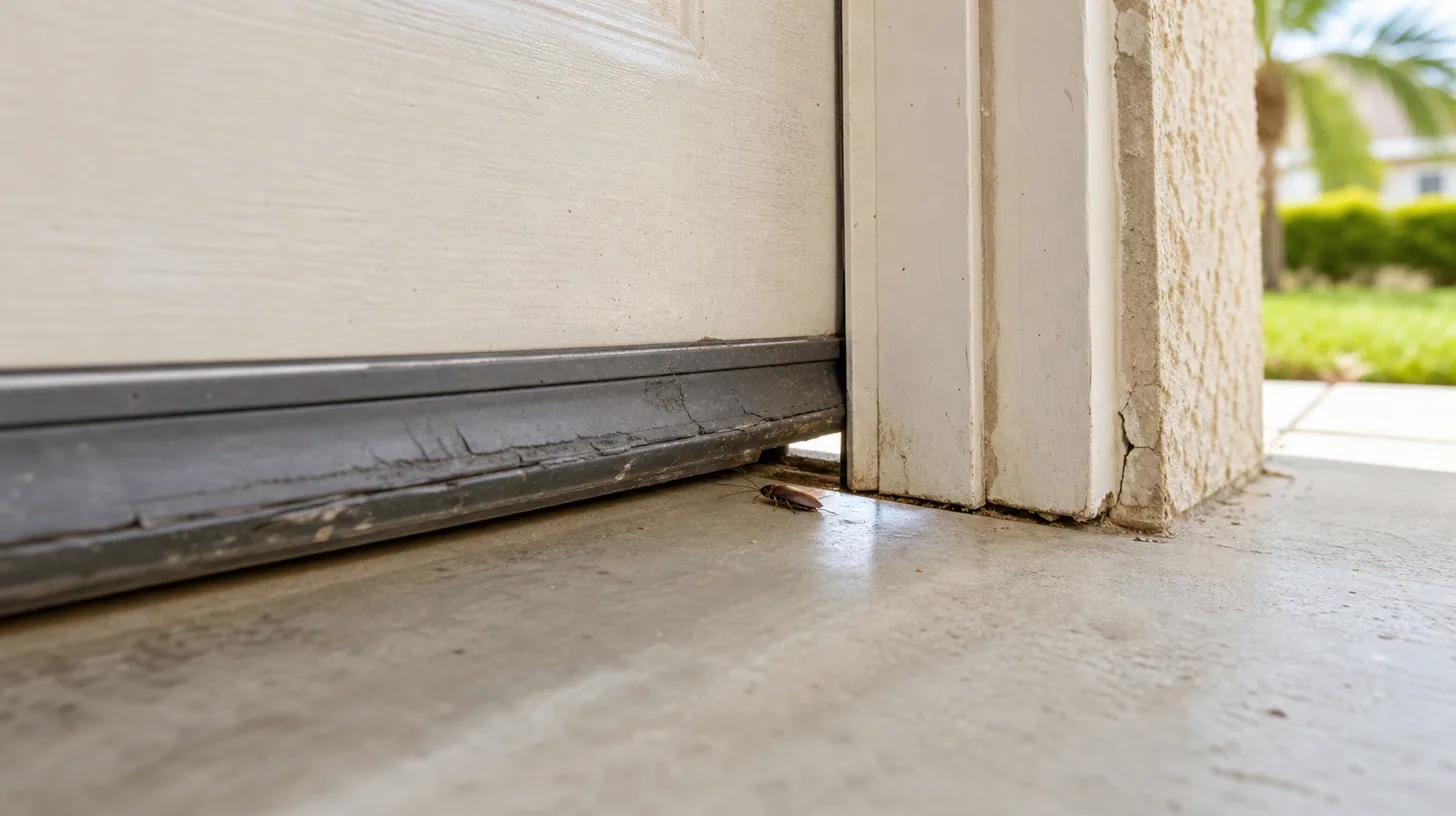
Your Garage Door Seal Is Basically a Roach Welcome Mat
Look, I’m going to level with you. If you live in Parrish and you’ve been seeing roaches scuttle across your garage floor when you flip the light on, there’s about a 90% chance the culprit is sitting right there at the bottom of your garage door. That rubber strip — the one that’s supposed to keep the outside out — has probably given up the ghost.
And honestly? I don’t blame it. The poor thing has been baking in Florida sun, getting blasted by afternoon thunderstorms, and dealing with garage door panels that expand and contract every single day. After a few years of that abuse, you’ve got gaps. And gaps mean bugs.
If you’ve Googled “garage door seal roaches Parrish” at 11pm after seeing something skitter near your kayak, you’re not alone. This is genuinely one of the most common calls we get out here, especially in the newer developments off Fort Hamer and Erie Road where the slab construction makes the garage a prime entry point.
Why the Garage Door Seal Fails in SWFL (Faster Than Anywhere Else)
That cheap rubber sweep at the bottom of your garage door has a tough job anywhere. In Florida? It’s got a tougher job than a roofer in August.
Three things are working against it:
Heat warping. Your garage door itself heats up to 140°F+ in direct sun. The seal underneath gets cooked. Over time, the rubber loses its flexibility and starts to pull away from the door or develop hairline cracks.
UV degradation. Even the small strip exposed to sunlight slowly turns chalky and brittle. You can see it — rub your finger along it and if you get gray-black residue, that rubber is dying.
Slab settling and sandy soil. Parrish is built on sandy soil that shifts. Subtly, sure, but enough that your concrete slab and the garage door track don’t line up the way they did the day the builder handed you keys. You end up with a quarter-inch gap on one side that’s basically a four-lane highway for a palmetto bug.
Add in the fact that most builders use the cheapest seal money can buy, and you’ve got a five-year part doing a two-year job.
Palmetto Bugs vs. German Roaches: Know Your Enemy
Before you panic, you need to figure out what you’re actually seeing. Because the treatment plan for one is “fix the seal and move on with your life,” and the treatment plan for the other is “we need to have a longer conversation.”
Palmetto bugs (American/Smokybrown roaches) are the big ones. Like, “did that thing just fly at my face” big. Inch and a half or longer, reddish-brown, and they live outside — in palm trees, mulch beds, sewer drains, and your neighbor’s woodpile. They wander in by accident, usually one or two at a time, and they’re typically looking for water or escaping a downpour. These are occasional invaders. Annoying, gross, but not a sign your house is infested.
German roaches are the small ones. About half an inch, light brown with two dark stripes behind the head. These are the ones that live inside. They breed indoors, hide in your dishwasher motor and behind your fridge, and one female can produce 300+ offspring in her lifetime. If you’re seeing these, the garage door seal isn’t your problem — it’s just how the first one got in. Or worse, they hitchhiked in on a cardboard box.
The 10-second test: Is it big and showed up solo? Palmetto. Is it small, and you’ve seen more than one in a week? German. Time to call.
The 10-Minute DIY Fix That Stops Most Invaders
For palmetto bug situations — which is most of what we see in Parrish neighborhoods like North River Ranch, Crosscreek, and Silverleaf — replacing the garage door seal genuinely solves the problem most of the time.
Here’s the play:
- Measure your garage door width. Standard is 16 feet for a two-car, 8 or 9 feet for a single.
- Buy a replacement bottom seal. Home Depot or Lowe’s, around $25-40. Get the T-shaped or bulb-style — they’re more forgiving with uneven slabs.
- Slide the old one out. Open the garage door about halfway. The old seal slides out the end of the retainer track on the bottom of the door. Some WD-40 helps.
- Slide the new one in. Lubricate it with a little dish soap and water, feed it through the track, and trim to length.
- While you’re down there, check the side weatherstripping too. Those vinyl strips along the door jambs crack and pull away, and that’s the other favorite entry point.
Total time: about 10 minutes. Total cost: less than dinner for two at Detwiler’s. And it cuts garage door seal roaches in Parrish homes down by something like 80% in my experience.
When DIY Isn’t Going to Cut It
Here’s where I have to be straight with you. If you’re seeing German roaches — the little striped ones — replacing your garage door seal is like putting a Band-Aid on a broken leg. Sure, do it. But you’ve got a population breeding inside your home, and they need to be dealt with.
Same goes if you’re seeing palmetto bugs constantly — like, multiple a week, every week. That suggests a harborage problem on your property (mulch piled against the foundation, irrigation issues creating moisture, palm tree litter, etc.) and you need a proper exterior treatment program.
And if you’re seeing roach droppings (look like coffee grounds or black pepper) in your pantry, under the sink, or around appliances? That’s an infestation indicator, not a wandering guest. Call somebody. Preferably us, but call somebody.
The Summer Rain Pattern Every Parrish Homeowner Should Know
Here’s something most folks don’t realize until they live through a couple of SWFL summers: roach pressure isn’t constant. It spikes.
In Parrish, we typically see two big invasion waves. The first hits in late May through June when the afternoon thunderstorms start cranking up. Heavy rain floods the sandy soil and the storm drains, and palmetto bugs that were happily living outside suddenly need higher ground. Your garage, sitting at slab level with a gappy seal, looks like a Hilton.
The second wave hits in September and October during the tail end of hurricane season. Same deal — saturated ground, displaced bugs, and your house is the closest dry real estate.
If you’re going to do the DIY seal replacement, do it in April or early May. Get ahead of it. Don’t wait until you’re already swatting them with a flip-flop in your kitchen.
FAQ
Q: I replaced the seal and I’m still seeing roaches. What gives?
A: Couple of possibilities. The side weatherstripping or the top seal might also be compromised. There could be a gap where the garage meets the house (check around the door from garage to interior). Or — and this is the one nobody wants to hear — they’re not coming from the garage at all. Could be coming through the AC line penetration, plumbing gaps under sinks, or soffit vents. Time for a proper inspection.
Q: Do German roaches come through the garage door seal too?
A: Rarely. German roaches don’t live outside in Florida — it’s actually too hot and dry for them in the open. They almost always come in via cardboard boxes, used appliances, grocery bags, or from a neighbor (especially in attached or close-built homes). If you’re seeing German roaches, the seal is not your origin point.
Q: How often should I replace the garage door bottom seal in Parrish?
A: Every 3-4 years, honestly. I know the package says 7-10, but that’s not accounting for Florida UV and humidity. Check it annually — if it’s chalky, cracked, or you can see daylight under your closed garage door, replace it.
Look, the garage door seal fix is one of those rare home maintenance items where 30 bucks and ten minutes actually solves a real problem. Do that first. But if you’ve already done it, or you’re seeing the small striped roaches, or you just want somebody to look at the whole picture and tell you what’s actually going on — we’re right here in the neighborhood. Whatever is getting in, pest control in Parrish starts with a free look at the whole house.
Get a quick, no-pressure estimate using our pest control calculator and we’ll come take a look. Beats finding another one in your shoe.