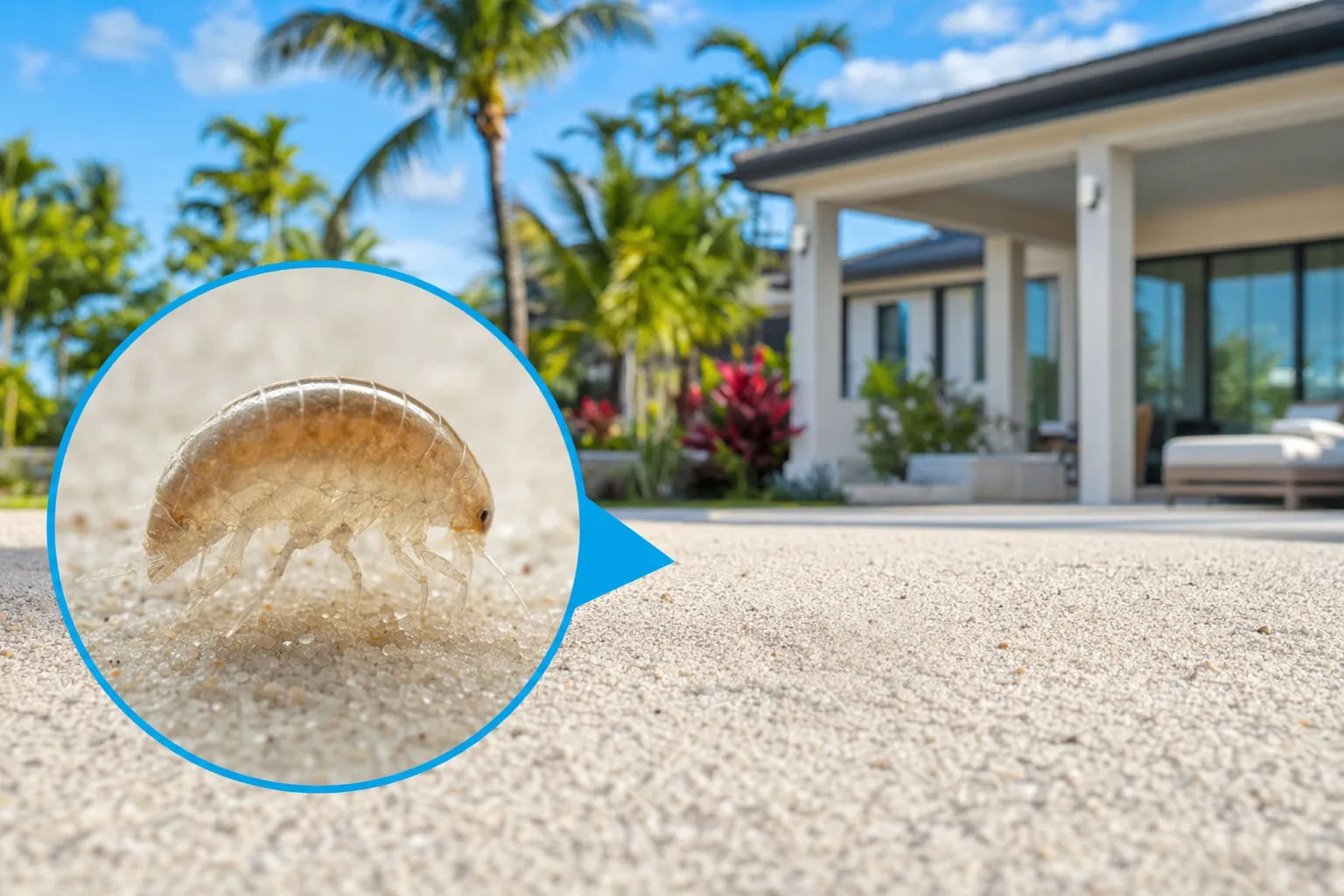
If you’ve ever walked off the beach in Bradenton with a constellation of itchy red welts on your ankles, you’ve probably blamed sand fleas. You’re not wrong, exactly — but you’re probably not totally right either. The bug most Southwest Florida beachgoers call a sand flea isn’t a flea at all, and the actual critter making your dog scratch a week later is usually something completely different.
Here’s the deal on sand fleas in SWFL: what they actually are, why they bite, how to keep them off your skin, and when to escalate to an exterminator. If you’d rather skip the reading and just get a tech out, our pest control services page is the fastest path, or grab a free Bradenton pest quote and we’ll take it from there.
What “sand fleas” actually are on SWFL beaches
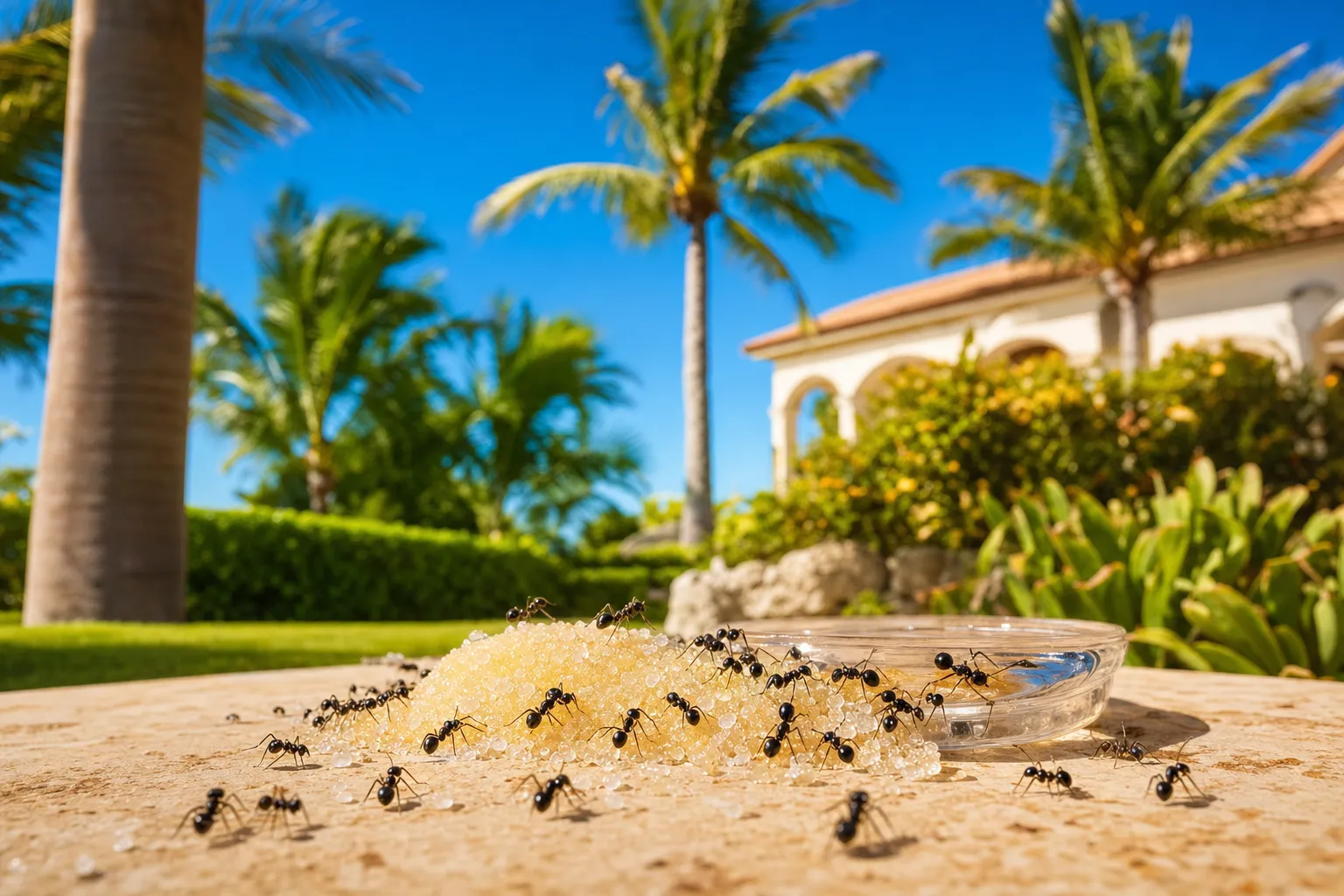
In Florida, “sand flea” is a catch-all term for at least four different critters, and almost none of them are true fleas:
- Mole crabs (Emerita talpoida) — the harmless thumbnail-sized crustacean that burrows into wet sand on the swash zone. Pompano fishermen rake them up by the bucket as bait. They don’t bite people.
- Beach hoppers / amphipods (Talitridae) — the tiny gray “fleas” you see bouncing around piles of seaweed at the high tide line. These can pinch or nip if you sit on them, especially around dawn and dusk.
- No-see-ums (Culicoides biting midges) — not crustaceans at all, but the real reason most folks walk off Anna Maria Island scratching. They’re so small you genuinely can’t see them, they bite hard, and they’re worst at dusk after a SWFL afternoon storm.
- Cat fleas (Ctenocephalides felis) — the actual flea species that infests yards and homes in Southwest Florida. They don’t live at the beach, but our sandy soil and shaded St. Augustine turf make them very happy in your backyard.
So when you say “I got eaten by sand fleas,” there’s about a 70% chance you mean no-see-ums and a 25% chance you mean amphipods. The remaining 5% — true flea infestation in the house — almost always turns out to be cat fleas you picked up somewhere else entirely.
| What you're seeing | Beach amphipod | No-see-um | Cat flea |
|---|---|---|---|
| Where you got bit | On the sand, near seaweed | Lanai or backyard at dusk | Inside the house or on the dog |
| Can you see it? | Yes — small gray jumper | No — almost invisible | Yes — dark, fast-jumping speck |
| Lives in your house? | No, dies fast indoors | No, but drifts in through screens | Yes — carpet, bedding, yard |
| What actually fixes it | Move off the sand, rinse off | Picaridin plus finer screen mesh | Treat pet, yard, and indoors |
The 'sand flea' you're talking about is almost certainly one of these three.
Why Southwest Florida gets bit more than the rest of the state
Three things make SWFL especially friendly to beach-zone biters:
- Sandy soil that drains fast. Mole crabs, amphipods, and burrowing beach insects love loose, well-drained beach sand. It is, essentially, their entire universe.
- Afternoon storms. That 3 p.m. thunderstorm cools the sand, jacks up humidity, and triggers no-see-ums and biting midges to emerge in clouds at dusk.
- Year-round warmth. Cat fleas and biting insects in St. Augustine lawns never get a hard freeze to reset them, so populations stack all year.
Combine those and you get the classic SWFL beach-day souvenir: a row of welts across your ankles that itches for a week.
Seasonal pressure
Southwest Florida pest pressure through the year
- Spring Mar–MayBuilding
Warming weather wakes colonies up — activity climbs week over week.
- Summer / rainy season Jun–AugPeak
Heat + humidity + standing water = the year’s heaviest pressure.
- Hurricane season Sep–OctSurge
Storms and flooding push pests indoors looking for dry shelter.
- Fall NovActive
Cooler nights slow things down, but activity stays well above zero.
- Winter Dec–FebLower (not zero)
Our mild winters keep many pests going year-round indoors.
Summer / rainy season & Hurricane season run hottest. Sand-flea-adjacent biting pressure stays elevated almost year-round in Southwest Florida — there's no off-season to coast through.
How to keep sand fleas (and no-see-ums) off your skin
You don’t need a hazmat suit. A few small habits do most of the work:
- Time it right. Hit the beach mid-morning to early afternoon. Skip the dawn and dusk windows when biting midges and amphipods are most active.
- Use a real repellent. Picaridin 20% or DEET 25–30% both knock down no-see-ums and discourage amphipods. Citronella candles are decorative, not pest control.
- Don’t sit directly on wet sand or seaweed wrack. That seaweed line is amphipod headquarters. Use a chair or a thick towel.
- Rinse off before you get in the car. A quick freshwater rinse keeps stragglers from hitching back to your house.
- Wear light, breathable long sleeves at sunset. No-see-ums have a hard time biting through woven fabric.
Pro tip from the Waves crew: If you’re still getting nailed with picaridin on, the issue isn’t sand fleas — it’s almost certainly no-see-ums sneaking up under the brim of your hat and behind your ears. Spray those zones too, plus a thin coat on the back of your neck. We see this complaint every June in Sarasota and Bradenton.
”Can sand fleas come home with me?” — what to actually worry about
Short answer: real beach sand fleas (mole crabs and amphipods) cannot live in your house. They need wet, salty sand and they die fast indoors. So if you’re seeing bugs on your floor a week after a beach trip, you’re not dealing with sand fleas.
Here’s what it usually is instead:
- Cat fleas picked up by the dog at a friend’s house, a groomer, or a shaded corner of your own yard. These do breed in carpet, pet bedding, and under furniture.
- Carpet beetles — small, oval, brown — often mistaken for fleas because they show up after vacation.
- No-see-ums drifting through screen mesh that’s too coarse (most pool cages are 18×14, which biting midges sail right through; 20×20 is the minimum that actually slows them down).
Safe homeowner checks before you panic:
- Vacuum daily for a week — carpet edges, baseboards, under furniture, pet bedding. Empty the canister outside immediately and tie off the bag.
- Wash all pet bedding in hot water.
- Treat the pet with a vet-recommended oral or topical product. Grocery-store collars and drops are mostly useless against a real Florida flea load.
- Mow and trim shaded yard areas. Cat fleas love damp, shaded St. Augustine in afternoon-storm season.
- Flick the sock test. Drag a white tube sock through your grass; if dark specks jump on, you have a yard flea population.
What NOT to do: don’t bug-bomb the whole house. Foggers push fleas deeper into baseboards, rarely touch eggs and pupae, and coat your dishes in pyrethroid residue. Don’t dump bleach in the yard either — it kills nothing useful and trashes the lawn. And don’t dust your dog with anything you wouldn’t put on yourself.
When to call a pro
It’s time to bring in a tech when:
- You’ve vacuumed and treated the pet for two solid weeks and you’re still finding fleas.
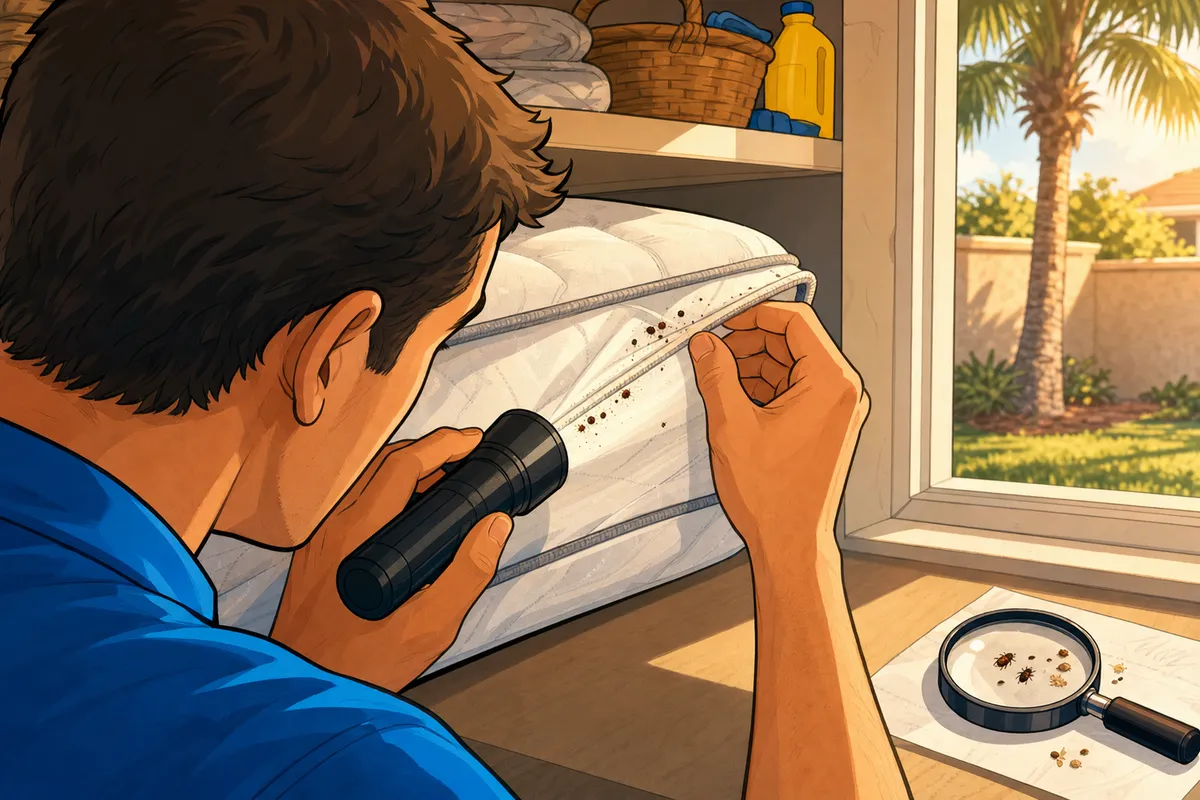
- You’re getting bit indoors but the pets are flea-free (often no-see-ums, sometimes bird mites, occasionally bed bugs).
- The sock test in the yard comes back positive.
- You just want a quarterly perimeter program so you stop thinking about it.
Our Bradenton and Sarasota techs treat fleas with a labeled liquid in the targeted zones — pet rest areas, shaded turf, baseboards, garage thresholds — plus an insect growth regulator to break the egg-to-adult cycle. We don’t blast the whole yard; that’s wasteful and it doesn’t work anyway. Adult fleas in full sun die in about half an hour on their own.
For a transparent estimate without sitting through a sales call, our pest control calculator gives you a real number in about 60 seconds. If you’d rather just let us handle it on autopilot, our WaveGuard membership bundles flea, ant, roach, and spider control year-round at one predictable cost.
How Waves approaches flea-like pests in Southwest Florida
A few principles we don’t bend on:
- Diagnose before we spray. If you’ve actually got no-see-ums, fogging the lawn is a waste of your money. We’d rather walk the property, confirm what’s biting, and treat the real source.
- Treat where the bugs live. Shaded turf, mulch beds, pet rest zones, garage corners — not the middle of a sunny lawn where adult fleas die in 30 minutes anyway.
- Break the cycle, not just the adults. A pyrethroid kills what’s biting today; the insect growth regulator is what stops eggs and pupae from hatching next week.
- Respect the local rules. During the Sarasota and Manatee County summer fertilizer restriction — no nitrogen and no phosphorus from June 1 through September 30 — we don’t sneak fert into a pest visit. Different program, different rules.
Want a second set of eyes on what’s actually biting you? Browse the pest library for the critter you suspect, dig through more homeowner guides on the Waves blog, or jump straight to a free SWFL pest quote and we’ll get a tech to the door.
Frequently Asked Questions
Do sand fleas bite humans in Florida?
The amphipods most people call sand fleas can pinch or nip, but the welts and itchy bumps most beachgoers blame on sand fleas are usually from no-see-ums — biting midges that hatch at dusk after a Southwest Florida afternoon storm. Mole crabs, the bait-shop sand flea, don’t bite people at all.
Can sand fleas infest your house?
Real beach sand fleas (mole crabs and amphipods) can’t survive indoors. They need wet, salty sand. If you’re finding bugs jumping around your floor or carpet a few days after the beach, you’re almost certainly dealing with cat fleas brought in by a pet, not sand fleas from Anna Maria Island.
How do I know if it’s sand fleas or no-see-ums biting me?
If the bites happened on the sand near seaweed during the day, amphipods are the likely culprit. If they showed up at dusk on a screened lanai, in the backyard, or while you were grilling well away from the water, that’s a no-see-um. Both itch like crazy — the source is different, and so is the fix.