You are on the lanai, coffee in hand, when a spider the color of a traffic cone drops down two inches from your face. It has red spikes. It looks angry. It is, statistically, probably nothing you need to worry about — but “probably” is not what your nervous system wants to hear at 7 a.m.
Southwest Florida is genuinely one of the best places in the country to look at spiders. Warm nights, sandy soil that never really freezes, afternoon storms that hatch clouds of gnats and mosquitoes — it is a buffet, and the local arachnids dress accordingly. This is a plain-English guide to the “color spiders” you actually see around Sarasota, Bradenton, Venice, and every screened porch in between: which ones are harmless (most of them), which ones deserve respect (a small handful), and what to do when the wrong one shows up in the wrong place. For the broader lineup of local pests, our Pest Library covers the rest of the cast.
Not in the mood to play spider taxonomist this morning? Waves handles spider knockdown and web clearing on every recurring visit — no charge for the awkward corners you cannot reach.
The colorful cast: Florida’s harmless standouts
Most of the truly eye-popping spiders you meet in SWFL are orb weavers or hunting spiders that would rather sprint away than deal with you. A quick tour of the ones you are most likely to photograph and text to your group chat:
- Spiny-backed orb weaver (Gasteracantha cancriformis). The crab-shaped one with six pointy spines. It is one of the most colorful and easily recognized spiders in Florida, with a dorsum usually white with black spots and large red spines on the margin. Yellow-and-black color forms also occur, and specimens can range from white to yellow with red or black spines. Harmless. Builds small orb webs across the exact path you were about to walk.
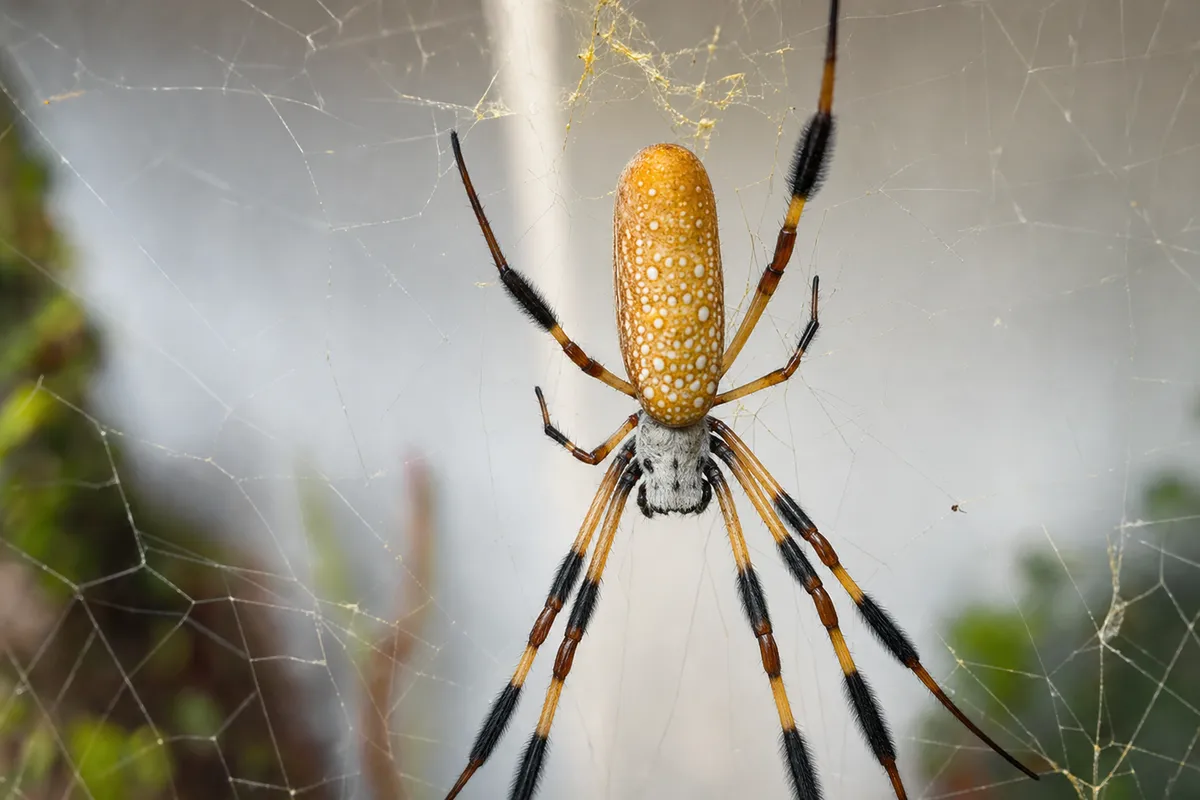
- Golden silk orb weaver / “banana spider” (Trichonephila clavipes). The big one with the golden-tinted web strung between two trees at face height on the trail. Females can reach up to two inches in body length with a leg span of five inches or more, with elongated abdomens that are olive or greenish-yellow with white spots, and legs banded in yellow and brown with tufts of dark hair near the joints. Impressive. Not dangerous.
- Green lynx spider (Peucetia viridans). The bright green one on your hibiscus. It is a conspicuous, large, bright green spider found on many kinds of shrub-like plants throughout the southern United States and the largest North American lynx spider. It does not use a web to capture prey — it pounces cat-like, which is where the “lynx” name comes from. A voracious eater of caterpillars and moths in your garden, which is why gardeners love them.
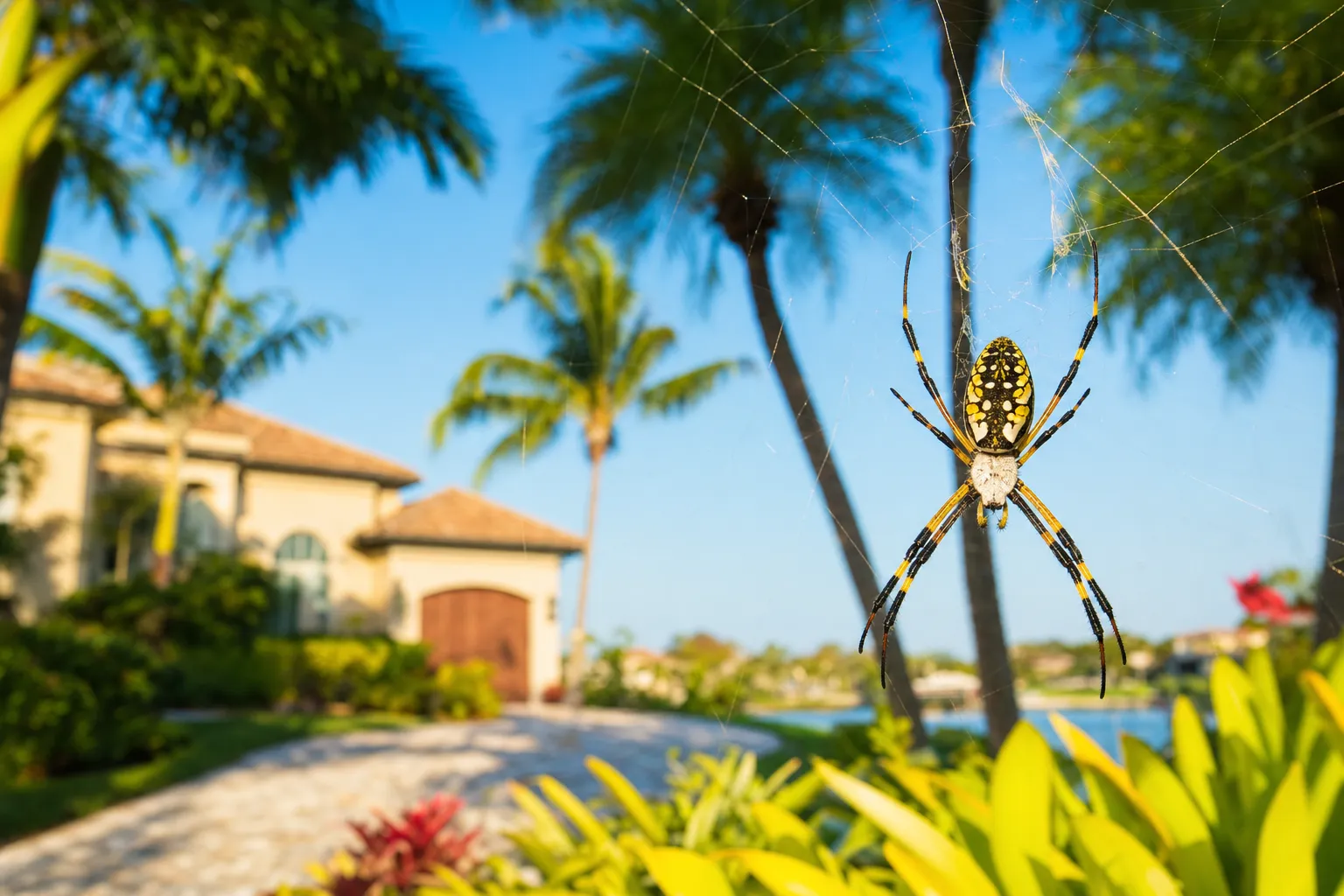
- Argiope garden spiders. The bold black-and-yellow ones that build zigzag “zipper” decorations into the middle of the web. Four different Argiope species live in Florida — yellow garden, banded, silver, and Florida garden — and the females are among the largest and most conspicuous web-builders while posing no threat to humans and providing essential biological control for insect pests.
- Jumping spiders (Phidippus regius and cousins). Tiny, fuzzy, iridescent, and often the color of a candy shell. Jumping spiders are usually less than 15 mm long, easily identified by their three-row eye arrangement, and many are brightly colored, sometimes with iridescent chelicerae as in the genus Phidippus. They will absolutely make eye contact with you. They are also basically the golden retrievers of the spider world — curious, non-aggressive, and functionally harmless.
If you want a deeper species-by-species breakdown, we keep photos and behavior notes in the pest library entries for spiders, or see the full rundown in our Florida spider identification guide.
What is an “October spider”?
This one shows up in Google every fall. People start seeing a pumpkin-orange spider hanging in a web near their porch light around Halloween and quite reasonably assume it is a themed hallucination.
It is real, and it is called the marbled orb weaver (Araneus marmoreus). It is sometimes called the pumpkin spider because the female’s inflated abdomen resembles an orange pumpkin, and while two main color forms exist, the species can have a wide range of colorations and folium patterns. The overall color can be yellow, orange, tan, grayish, or even white, with mottling and spotting of black, brown, or purple. Adults are seen from midsummer until the first hard freeze of fall, and egg cocoons containing several hundred eggs are generally deposited in October — which is why sightings spike right before Halloween.
Bites are extraordinarily rare and medically insignificant. If you see one, take the photo.
Colorful and actually worth respecting: the widows
Here is where the “most colorful spiders are harmless” rule bends. Florida has widow spiders, and they wear their warning colors on purpose.
The two you are most likely to run into around a SWFL home are the southern black widow (jet black, red hourglass on the underside) and the brown widow (mottled tan and brown, orange or yellow hourglass, spiky-looking egg sacs). Brown widows have become the more common of the two in a lot of Gulf Coast neighborhoods — they love the undersides of patio furniture, meter boxes, grill covers, kids’ toys left in the yard, and the lip of a pool skimmer.
You will not confuse a widow with an orb weaver if you know one thing: widows build messy cobwebs down low in dark cavities. Orb weavers build tidy circular wheel webs out in the open. Orchard orb weavers sometimes get confused with widow spiders because of the bright orange dots on the abdomen, but their orb web shape, color patterns, and thinner elongate abdomen distinguish them from widows with their messy cobwebs and bulbous round abdomens.
Florida also has a red widow — a genuinely orange-red spider — but it is a scrubland specialist you will not encounter around a suburban home. Do not spend time worrying about it.
If you find a widow in a spot where kids or pets play, that is a legitimate reason to call a pro rather than DIY it. Widow venom is medically significant, and squishing an egg sac with a broom just launches a hundred new spiders into your garage.
Why Southwest Florida grows such colorful spiders
Short version: everything a spider eats also loves it here.
Between the sandy soil that drains fast after every afternoon storm, the St. Augustine lawns that hold moisture at the root zone, and the year-round warmth, SWFL never really shuts down insect production. Mosquitoes, midges, moths, small beetles, gnats — the flying-prey menu runs 12 months a year. Orb weaver sightings increase in late summer and early fall, but Florida’s warm climate means some species remain active year-round, especially in South Florida.
That is also why porch lights are spider magnets. Spotted orb weavers construct webs near artificial lights because those lights attract moths, beetles, and other prey, so you will frequently see them on porches, eaves, and near garage doors. Nothing personal — you built a bug lighthouse and they moved in.
Seasonal pressure
Spider Activity in Southwest Florida
- Spring Mar–MayBuilding
Egg sacs hatch and spiderlings disperse as insect prey ramps up with the warm-up.
- Summer Jun–AugHigh
Storms hatch clouds of mosquitoes, midges, and moths — orb weavers grow fast and webs multiply.
- Fall Sep–NovPeak
Mature orb weavers are largest and most visible; marbled "October" spiders and egg-laying peak around Halloween.
- Winter Dec–FebModerate
Cooler nights slow activity inland, but warm coastal microclimates keep some species active and webs present.
Fall runs hottest. Spider activity tracks the insect population, which is why late summer through fall is peak orb-weaver season across Southwest Florida — but warm coastal microclimates keep pressure elevated year-round.
What to do when you find one
For 90% of the colorful spiders you meet in SWFL, the answer is honestly: leave it alone. They are eating the mosquitoes you would otherwise be swatting. That said, here is the sane homeowner’s checklist:
Safe checks you can do yourself:
- Look at the web shape first. Circular, wheel-like, out in the open? Orb weaver. Messy, tangled, tucked into a dark cavity? Treat it as a possible widow and do not stick your hand in.
- Check the underside for an hourglass. A clear red hourglass is a strong clue for a black or brown widow — but treat it as a “yes” signal, not a rule-out test. Florida’s red widow can show only one or two spots instead of a complete hourglass, so a missing or incomplete hourglass does not guarantee a spider is harmless. When in doubt, keep your hands off and get a photo instead.
- Check the legs. Long, banded, tufted legs = golden silk orb weaver. Short crab-like legs held to the side = crab spider or spiny-backed orb weaver. Chunky, jumpy, big-eyed = jumping spider (harmless).
- Take a phone photo from a foot away. Zoom is free. Identification is easier when the spider is not actively deciding what to do about you.
What not to do:
- Do not spray a widow you find in a wall void or meter box with hardware-store aerosol. It scatters the spider and any egg sacs into places you can no longer see.
- Do not knock down every orb web on the property. You are removing free mosquito control and the webs will be rebuilt overnight anyway.
- Do not try to catch a green lynx by hand while gardening. One of its defense mechanisms is to squirt venom from its chelicerae, sometimes for a distance of about a foot. Yes, really.
Pro tip from the field: If you want fewer spiders on the lanai without killing off the good ones, change your porch bulbs to yellow “bug” LEDs and knock the webs down with a long-handled broom once a week during evening cleanup. Fewer bugs at the light = fewer webs to walk through in the morning. It works better than any perimeter spray you can buy at a big-box store.
When it is worth calling a professional: recurring widow sightings around the house, spider populations dense enough that webs re-form daily in doorways, or any situation where someone in the household has been bitten and reacted. On our recurring routes we handle web sweeping, corner dusting, and eave treatment as part of the standard visit — most homeowners on the WaveGuard membership keep spider pressure managed around the home, and if activity comes back between visits, the free re-treat guarantee has you covered.
Frequently Asked Questions
Are there colored spiders?
Yes — a lot of them, and Florida has more than most states. Between the spiny-backed orb weavers (red, white, and yellow), green lynx spiders, golden silk orb weavers, marbled orb weavers, and the iridescent jumping spiders in the genus Phidippus, “color spiders” are the norm here, not the exception. UF/IFAS overviews of common Florida spiders cover jumping spiders, crab spiders, golden silk spiders, spiny orb-weavers, black and yellow argiope spiders, green lynx spiders, wolf spiders, and long-jawed orb-weavers — and almost all of them are harmless to people.
Can a spider hear you?
Not with ears — spiders do not have them. What they can do is feel vibrations through the fine hairs and slit sensors on their legs, which is functionally close to hearing at very short range. Recent research on jumping spiders and orb weavers suggests they can pick up airborne vibrations from a few feet away, especially low-frequency sounds. So when you walk toward the web and the spider bolts to its retreat, it is not “hearing” your footsteps — it is feeling the air and the ground shake. Practically speaking: yes, it knows you are there.
Will the spider in my room come closer to me while I sleep?
No, and this one gets asked a lot. Spiders indoors are almost always there by accident — they wandered in through a screen or an open door, and they are looking for a way back out or a dark corner to hide in. Humans are not prey, not warm-blooded targets like mosquitoes, and not on the menu. If you see a spider on the ceiling at bedtime, it will likely still be roughly there in the morning, or hiding somewhere else in the same room. It is not stalking you. (The “we eat X spiders a year in our sleep” claim you have seen on Facebook is also not true.)
The bottom line
Southwest Florida is a rainbow of spiders because it is a rainbow of insects. Most of the color spiders you meet — spiny-backed orb weavers, green lynxes, banana spiders, jumping spiders, garden argiopes, the pumpkin-orange October spider — are doing free pest control for you. The two you should actually respect are the black widow and the brown widow, and both are easiest to ID once you know to look under the abdomen for the hourglass — just remember that a missing hourglass alone is not proof a spider is harmless, so keep your hands off anything you cannot confidently identify.
If you would rather not spend your Saturdays classifying arachnids, that is what we are for. Get on a recurring Waves pest control plan and we will keep the widow habitat knocked down, the eaves swept, and the webs off your entryways — while leaving the beneficial garden spiders where they belong.