Jump to a section (6)
If you’ve spotted clusters of tiny, fuzzy “moths” hovering near a bathroom sink or kitchen drain in your Sarasota home — the kind that barely fly, just sort of flop from the wall to the faucet and back — those aren’t gnats and they aren’t fruit flies. You’re looking at drain flies (family Psychodidae), and the reason they keep coming back after you spray, bleach, or pour boiling water down the drain is simple: you’re killing adults while the next generation is busy hatching inside a film of gunk you can’t see from above the strainer.
This guide walks through how to confirm them, why they thrive year-round here, where they actually breed, and how to break the cycle without making the problem worse. If you’d rather just have someone diagnose and treat it, request a quote and we’ll come out.
How to Tell a Drain Fly From a Fruit Fly (the Tape Test)
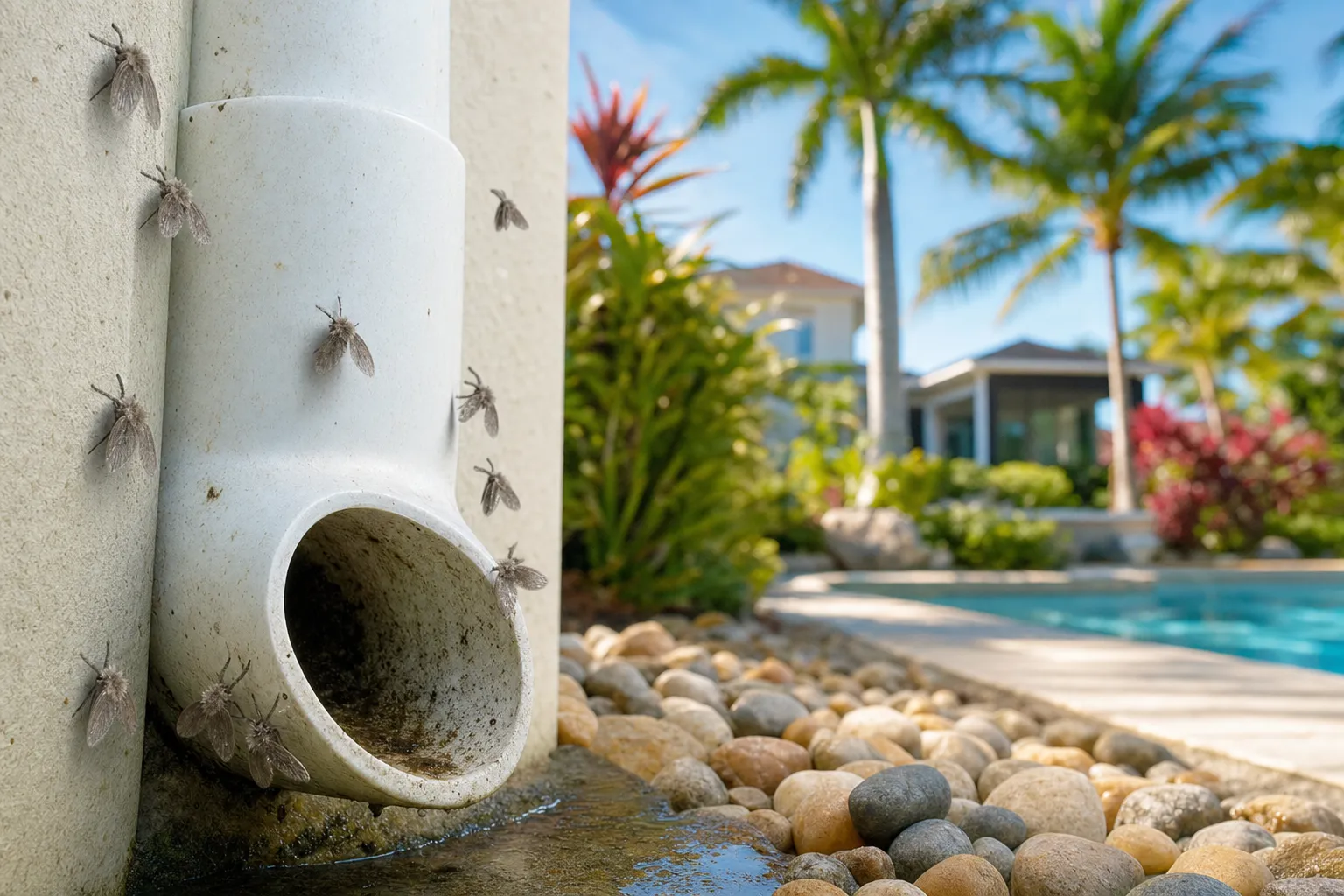
Drain flies are tiny — about 2 millimeters — with dark, fuzzy bodies and broad, leaf-shaped wings they hold tented over their back like a miniature moth. They’re weak fliers. If you swat at one and it just hops six inches and lands again on the tile, that’s a drain fly. Fruit flies are tan, hover in tight circles, and beeline for a ripe banana. Phorid (sewer) flies humpback-run across the counter before they fly. Different bugs, different problems.
The fastest way to confirm where they’re breeding is the tape test:
- After dinner, dry the rim of the drain with a paper towel.
- Stretch a piece of clear packing tape — sticky side down — across every suspect drain. Cover the opening, but leave a small gap so you’re not sealing it airtight (you don’t want a vapor lock).
- Leave it overnight.
- In the morning, peek. Whichever drain has fuzzy little bodies stuck to the tape is your breeding site.
Run tape on every drain in the house — master bath, guest bath, kitchen, laundry standpipe, utility sink in the garage, even an accessible AC condensate line. People assume it’s the drain right next to where they see the flies, and it’s often a different fixture entirely.
Why Sarasota Homes Get Drain Flies Year-Round
Up north, drain flies are mostly a summer problem. In Sarasota, they’re a Tuesday problem. A few things working against you:
- Humidity that never quits. Our afternoon storms and Gulf air keep indoor relative humidity stubbornly high, so the wet film inside a drain never gets a chance to dry out — even on a cool January morning.
- Older housing stock. A lot of Sarasota’s mid-century neighborhoods — Gulf Gate, Arlington Park, Southgate, the older slices of Bee Ridge — were plumbed with cast-iron stacks or first-generation PVC. The interior walls of those pipes pit and roughen over the decades, which gives biofilm an even better grip than smooth modern pipe.
- Guest baths and snowbird homes. If you’ve got a second bath that nobody uses for weeks, or the house sits closed up while you head back north for the summer, the P-trap water stagnates. Stagnant traps plus warm humid air equal a perfect drain fly nursery.
- AC condensate lines and washer standpipes. Both run wet around the clock in Florida and both are commonly overlooked. Your lawn might be lush St. Augustine outside, but inside, your condensate line is a drain fly buffet.
They Don’t Live in the Bathroom — They Live in the Biofilm
This is the part most homeowners miss, and it’s why the can of bug spray under the sink is a waste of money.
Drain fly larvae don’t hatch in the room, on the counter, or in the standing water in the bowl. They hatch inside the gelatinous biofilm coating the inside walls of the drain — that slimy mix of soap scum, hair, skin cells, grease, toothpaste, and bacteria that quietly accumulates an inch or two below the strainer and down the inside of the P-trap. The female lays eggs directly into that film. The larvae feed on it, pupate in it, and emerge as adults that crawl up the pipe wall.
So when you:
- Pour bleach down the drain → it slides right past the biofilm without dissolving it (and it stresses your P-trap gasket and any septic system on the property).
- Pour boiling water → it cools fast, mostly hits the trap water, and doesn’t scour the film off the pipe wall.
- Spray the bathroom → you kill the adults you can see, while the next generation hatches on schedule below the strainer.
You’re playing whack-a-mole with grown-ups while the daycare runs uninterrupted. The full egg-to-adult cycle runs roughly 8 to 24 days depending on temperature, so as long as the biofilm is intact, a new wave shows up every couple of weeks.
How to Actually Break the Cycle
Two things have to happen, in this order, or you’re wasting your time:
- Mechanically scrub the drain wall. Get a stiff, long-bristled drain brush from the hardware store. Push it 10 to 12 inches down past the strainer and twist hard against the pipe walls. In bathroom sinks, also brush the overflow port (the little hole near the rim) — it’s a hidden drain fly favorite. You’re not trying to unclog anything; you’re trying to physically rip the slime off.
- Follow with an enzyme or microbial drain gel. Pour it in at night when the drain won’t be used for 6 to 8 hours. Beneficial bacteria in the gel digest whatever biofilm your brush missed. Repeat nightly for 5 to 7 days, then weekly to maintain.
Then keep the drain in service. Run hot water through the guest bath and laundry sink once a week so the trap doesn’t stagnate. If a sink truly never gets used, cap the drain or float a tablespoon of mineral oil on top of the trap water to slow evaporation.
Pro tip from our techs: If your “drain fly drain” is in a bathroom with a pedestal sink or wall-hung vanity, check underneath for a slow drip at the tailpiece or trap nut. A pinhole leak keeps the cabinet floor or baseboard wet, the wood absorbs it, and you end up with a secondary breeding site that isn’t technically in any drain at all. Dry it, fix the drip, then treat.
When Recurring Drain Flies Mean a Bigger Plumbing Problem
If you’ve scrubbed, enzyme-treated for a full week, and they’re still coming back — or you’re seeing them in three or four unrelated drains across the house — you’re probably not dealing with a kitchen sink problem anymore. Things we look for at that point:
- A cracked cast-iron stack behind a wall or under the slab. Sarasota’s sandy soil shifts more than people think; older joints leak, sewer gas and moisture seep into the wall cavity, and drain flies breed in the saturated drywall and insulation.
- A dry or missing P-trap on a fixture you forgot existed (an old utility room floor drain, an abandoned laundry standpipe, a tub spillover).
- A broken sewer lateral out in the yard — roots find the crack, the line backs up intermittently, and you get sewer flies plus drain flies plus the occasional bad smell after a heavy storm.
- A vent stack issue that’s slowing every drain in the house, which lets biofilm rebuild faster than you can scrub it.
At that point you need a camera scope on the line and, often, a plumber working alongside the pest tech. We run recurring drain-fly callbacks all over town — from Lakewood Ranch down through Venice — and the ones that don’t resolve with surface treatment almost always trace back to one of these structural issues. If you’re at that stage, it’s worth having a licensed tech and a plumber both look. You can get our team out for the pest side through Sarasota pest control and we’ll tell you straight up if it’s a plumbing call.
For ongoing prevention — especially in second homes and rentals where nobody’s running water for weeks — a recurring pest control service with scheduled drain treatments is the cheap version of insurance. You can also browse our pest library for more on small-fly identification, and a WaveGuard membership covers drain-fly callbacks between regular visits if you’re already on a plan. Want the ballpark before you call? Run your address through the pest control calculator.
When you’re ready, request a quote and we’ll get the inspection on the schedule.
Frequently Asked Questions
Why do drain flies come back after I bleach the drain?
Because bleach doesn’t remove biofilm — it just sanitizes the surface it touches and then washes through. The gelatinous film that drain fly larvae feed on stays glued to the pipe wall, the eggs survive, and a new wave of adults emerges in a week or two. You need mechanical scrubbing plus an enzyme treatment to actually strip and digest the biofilm.
Do drain flies bite or carry disease?
No, they don’t bite, and they’re classified as a nuisance pest rather than a public-health pest. That said, they’re breeding in sewage-adjacent biofilm, so they can mechanically carry bacteria from the drain to surfaces they land on — which is reason enough to keep them off your kitchen counter.
How long does it take to get rid of drain flies?
If the source is a single drain and the breeding site is shallow, you can usually see the adult population drop within 7 to 10 days of scrubbing plus nightly enzyme treatment. If it’s still happening after two weeks, the breeding site is either deeper in the line, in a second drain you haven’t found, or outside the drain entirely (wet cabinet, condensate pan, slab leak).
Could drain flies be coming from my AC condensate line or washing machine?
Yes — both are common breeding sites in Sarasota homes. AC condensate lines run wet year-round and accumulate algae and biofilm; washer standpipes hold residual water and lint. Pour an enzyme treatment down the condensate line at the cleanout and through the laundry standpipe as part of any drain-fly cleanup.
When should I call a pest control company about drain flies?
Call once you’ve done a full tape-test pass and a week of brushing plus enzymes and they’re still showing up, or if you’re seeing them in multiple drains at once. Recurring drain flies often point to a structural plumbing issue, and a licensed tech can help you narrow down which fixture (or which wall) is the real problem before you spend money on a plumber chasing the wrong line.