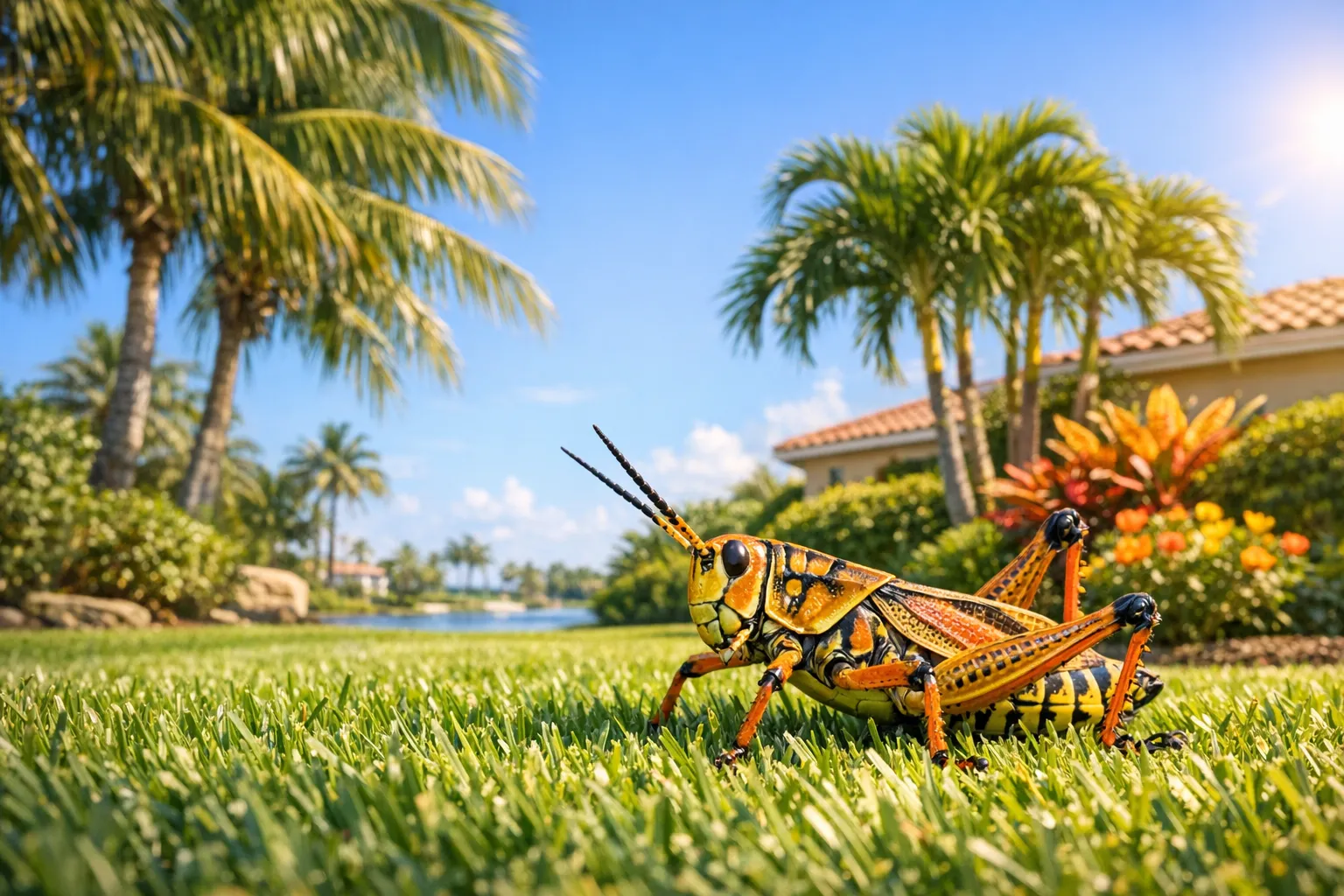
If you’ve been in Southwest Florida for more than one summer, you’ve probably met one — a grasshopper the size of your palm, yellow with black accents, refusing to move even when you nudge it, and somehow stripping the leaves off your prized amaryllis overnight.
That, friend, is an eastern lubber grasshopper (Romalea microptera), and per UF/IFAS it’s the largest grasshopper species in the United States. It’s also flightless, toxic to most predators, and — once it hits adult size — almost impossible to spray your way out of. From Bradenton down through Nokomis and out past Punta Gorda, we get calls every May and June from homeowners wondering what the yellow monsters chewing their crinum lilies are, and whether there’s anything to be done. Short answer: yes, but only if you catch them at the right life stage.
This post is an identification guide, not a treatment manual — it covers what the species is, how to tell nymphs from adults, why predators leave them alone, and what the calendar means for your yard. For the how-to-manage-them side (control windows, what works, what doesn’t), our lubber grasshopper management guide is the companion piece, and our pest library has ID guides for the rest of the SWFL cast. If you already know what you’re looking at and just want a technician on-property, you can request a quote any time.
How to identify an eastern lubber: nymph vs. adult
The eastern lubber is one of the easiest insects in Florida to ID once you know what you’re looking for — but its two life stages look so different that UF/IFAS notes homeowners routinely mistake them for two separate species entirely.
Adults. According to the UF/IFAS Featured Creatures profile (EENY-006), adult males measure at least 1.7–2.2 inches long, with females typically 2–2.8 inches and sometimes reaching 3.5 inches. The typical color pattern is mostly yellow or tawny, with black on the distal antennae, the pronotum (the “shield” behind the head), and the abdominal segments. Forewings extend two-thirds to three-fourths the length of the abdomen and are pink or rose-colored centrally; the short hind wings are entirely rose colored. Those hind wings are the giveaway on the name — microptera literally means “small wing,” and per UF/IFAS Gardening Solutions, they’re incapable of providing lift, so the adult can’t fly.
Nymphs. The immature form is where people get confused. UF/IFAS describes the nymphs as mostly black with a narrow median yellow stripe running along the pronotum and abdomen, along the edges of the pronotum, and along the lower side of the abdomen — with legs well-marked in red. Sizes progress through five instars, measuring roughly 10–12, 16–20, 22–25, 30–40, and 35–45 mm across those stages. Young nymphs are highly gregarious — you’ll often see a dozen or more piled on a single crinum leaf in the morning.
| Field mark | Nymph | Adult |
|---|---|---|
| Body color | Mostly black with a narrow yellow stripe on pronotum/abdomen | Mostly yellow or tawny with black on antennae, pronotum, abdomen |
| Legs | Well-marked with red | Yellow/tawny to match body |
| Size range | ~10 to ~45 mm across five instars | 1.7 to 3.5 inches |
| Wings | Wing buds only, not functional | Short forewings, rose hind wings — flightless |
| Behavior | Highly gregarious, clustered on host plants | More spread out, walks and climbs slowly |
| When to expect | Late winter through spring | Peak numbers in July and August |
Field ID: eastern lubber nymph vs. adult. Measurements and marks per UF/IFAS Featured Creatures (EENY-006).
Why birds won’t solve this problem for you
The most-asked question from homeowners: “Why doesn’t something eat these things?” Turns out, most predators do try — once.
Eastern lubbers advertise their toxicity with what biologists call aposematic coloration — the yellow-and-black warning pattern is a “do not eat” sign, and it’s backed up with real chemistry. Per the UF/IFAS Featured Creatures profile, when threatened lubbers spread their wings, hiss by expelling air through their spiracles, and secrete a foul-smelling froth from those same spiracles. They can also spray toxic chemicals a short distance, and regurgitate a dark brown “tobacco spit” that will stain skin and clothing.
The one native workaround, per UF/IFAS, is the loggerhead shrike — a bird that impales lubbers on thorns or barbed wire and comes back after a day or two, once the toxins have degraded. Cool trick. Not something you can outsource to your local mockingbirds.
What lubbers eat in SWFL landscapes
Per UF/IFAS Gardening Solutions, eastern lubbers have a broad host range — at least 100 species of plants across 38 plant families — but they have very clear favorites. In Florida flower beds, they routinely defoliate:
- Amaryllis
- Amazon lily
- Crinum lily
- Narcissus
- Oleander
- Butterfly weed
- Canna
- Mexican petunia
- Lantana
They’ll also climb into young citrus and chew tender new foliage at branch tips. If you have a young lime or Meyer lemon in Venice or Cape Coral and see chewed-up new growth in late spring, lubbers are a strong suspect. In our sandy, afternoon-storm-soaked yards, the damp low spots at the property line — the exact places where eggs got laid the previous fall — tend to be ground zero every spring.
Pro tip: Walk your amaryllis and crinum beds in the early morning starting in March. Nymphs are lethargic when it’s cool, they cluster together on the same leaves, and hand-picking a dozen off one plant takes about ten seconds. Waiting until the afternoon means chasing warm, mobile grasshoppers around the yard.
The control window: it’s the nymphs or nothing
This is the single most important thing on the page: timing is everything with lubbers. UF/IFAS is blunt about it — insecticide treatments are more effective on young grasshoppers, and adults become progressively harder to kill because of their size and their ability to detoxify plant compounds.
Here’s what the SWFL calendar looks like, based on UF/IFAS reporting for the Florida Gulf Coast:
Seasonal pressure
Eastern lubber pressure across the year in Southwest Florida
- Winter Dec–FebLower
Eggs overwintering 1.2–2 inches deep in soil. In southern Florida a few late nymphs or adults may linger.
- Early spring Mar–AprActive
Nymphs hatch — small, black, yellow-striped, clustered together. The best window to intervene.
- Late spring May–JunBuilding
Nymphs molt through five instars over roughly 40–60 days; groups start spreading out.
- Summer Jul–AugPeak
Adult lubbers at peak numbers. Damage is loudest but they're hardest to control now.
- Fall Sep–NovBuilding
Numbers taper as females lay next year's egg pods in soil. Population reset happens here.
Summer runs hottest. Timing per UF/IFAS EENY-006 and Featured Creatures reporting for the Florida Gulf Coast.
In southern Florida (that’s us), nymphs or adults are actually present through most of the year, but the meaningful control window opens in March and April when the nymphs emerge — and it closes fast. You have roughly 40–60 days of nymphal development before you’re dealing with hardened adults. That’s why every UF/IFAS county blog on lubbers hammers the same point: catch them as nymphs in spring, don’t wait for the adults.
Damage triage on ornamentals
Once damage is done, it’s done — lubbers chew large, irregular holes and can completely defoliate a mature amaryllis in a couple of afternoons. Triage priorities:
- Save the bulbs first. Amaryllis, crinum, and Amazon lily are the plants lubbers hit hardest. If the leaves are gone but the bulb is intact, the plant typically rebounds the following year.
- Check young citrus. Chewed new growth on young trees is a bigger deal than defoliated ornamentals — young canopies can’t afford the setback. Our pest control services overview covers how we roll landscape pest pressure into routine service.
- Skip the “just spray it” reflex on adults. Broadcast sprays on adult lubbers are exactly the low-return, high-collateral approach the UF/IFAS IPM literature warns against — you’ll burn product and beneficial insects without touching the lubbers.
What a pest professional can (and cannot) do about lubbers
Real talk from someone who does this in Sarasota and Manatee counties every year: no pest control company can guarantee lubbers off your property. They’re natives, they walk in from adjacent lots and greenbelts, and the adults shrug off treatments that would flatten most other insects. The Waves Pest Control approach is honest about that: we inspect for hotspots on your property early in spring, roll lubber monitoring into a broader landscape pest program, and target other pressures — chinch bugs, scale, whitefly, the usual SWFL crew — that respond well to routine service.
If you want a technician to walk the property and give you an honest read on what you’re seeing, request a quote or check our pest control services overview for what’s actually included in routine service. Pricing questions can go to our contact page.
For homeowners who prefer to DIY the lubber piece: gloves on, bucket of soapy water, morning walkthroughs of your amaryllis and crinum beds from mid-March through May. Don’t crush nymphs against your skin (that foul foam is a real thing), and don’t let the “tobacco spit” hit light-colored clothing. Skip broadcast spraying of adult populations — you’ll waste product and hit beneficial insects.
Frequently Asked Questions
Are eastern lubber grasshoppers dangerous to humans?
Not really. Per UF/IFAS, lubbers are harmless to humans and aren’t aggressive — the toxicity is a dietary defense against predators that try to eat them. That said, wear gloves when handling: a lubber is not aggressive, but it may defensively nip when picked up, the defensive foam is foul-smelling, and the regurgitated “tobacco spit” will stain skin and clothing.
When should I start looking for lubber nymphs in Southwest Florida?
March and April, though in southern Florida you may see nymphs earlier than that. UF/IFAS reports eggs hatching in early spring, with nymphs highly gregarious and clustered on host plants — often on grasses and strap-leaved ornamentals like crinum and amaryllis. Morning walkthroughs of your beds starting in late winter will catch them at their sluggish, easiest-to-remove stage.
Do lubber grasshoppers come back every year?
Yes — but only one generation per year, with the egg stage overwintering in the soil 1.2–2 inches deep. Females lay egg pods in late summer and fall, the eggs sit through winter, and hatch the following spring. Which means the effort you put in this year does compound: UF/IFAS extension agents report that gardeners who diligently remove nymphs for several years in a row can meaningfully reduce next year’s population, since there’s no second generation to bail the survivors out.
Get ahead of next spring’s nymphs
Ready to get ahead of next spring’s nymph flush? Request a quote and we’ll take a look at your amaryllis, crinum, and young citrus setups — the usual lubber magnets around Sarasota and Bradenton yards. Not sure whether you’re dealing with lubbers or something else entirely? Our pest library has ID guides for the rest of the SWFL cast.
Sources: UF/IFAS Featured Creatures — Eastern Lubber Grasshopper, EENY-006/IN132, entnemdept.ufl.edu/creatures/misc/grasshopper/eastern_lubber.html; UF/IFAS Gardening Solutions — Eastern Lubber Grasshoppers, gardeningsolutions.ifas.ufl.edu/plants/ornamentals/eastern-lubber-grasshoppers.html.