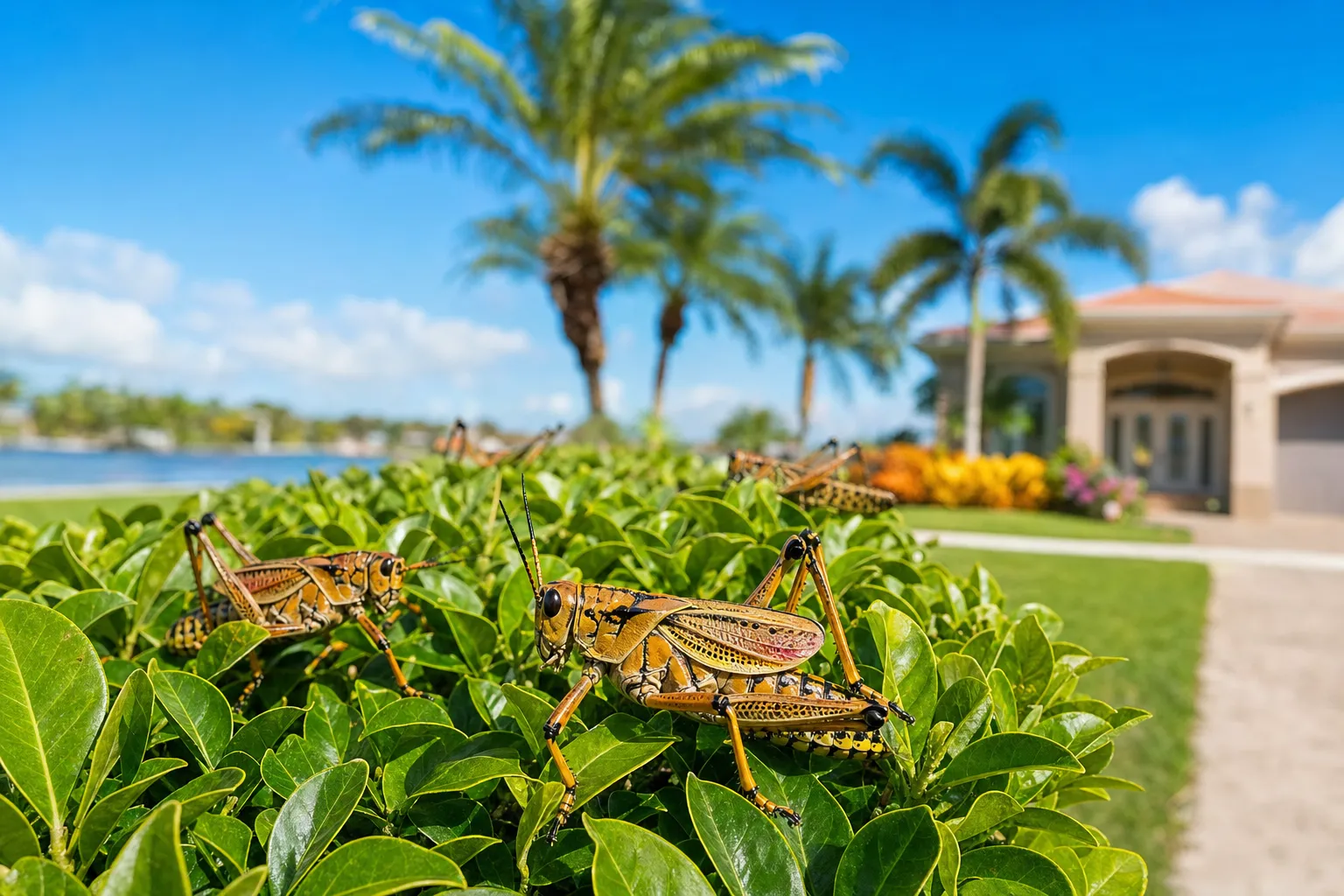
You spot a small black grasshopper with a stripe like traffic-cone paint. Then you spot forty more of them, all camped out on your amaryllis. Congratulations — you’ve met the eastern lubber grasshopper, the loudest, slowest, most photogenic garden pest Southwest Florida has to offer. This is a homeowner’s guide to what they are, why they show up on cue every spring, and what actually works to keep them from turning your landscape into a salad bar. For a broader look at the bugs that share this ZIP code with you, our pest library has the full rogues’ gallery.
Yes, they’re weird looking. Yes, they can absolutely wreck a bed of ornamentals in a weekend. And yes — the same warning colors that make them so fun to photograph are basically a giant “I am toxic, don’t eat me” billboard for birds, which is why so few things prey on them once they hit adulthood.
If your yard already looks like a lubber convention and you’d rather not spend the weekend triaging plants, we can help — book a pest inspection with Waves and we’ll walk your landscape with you.
What a lubber grasshopper actually looks like
There are two versions depending on when in the year you’re seeing them, and they look almost nothing alike:
- Nymphs (spring): Almost completely black with a distinctive yellow, orange, or occasionally red stripe running down the back. Nymphs are wingless and cluster in groups — if you see one, there are usually a bunch of siblings within arm’s reach.
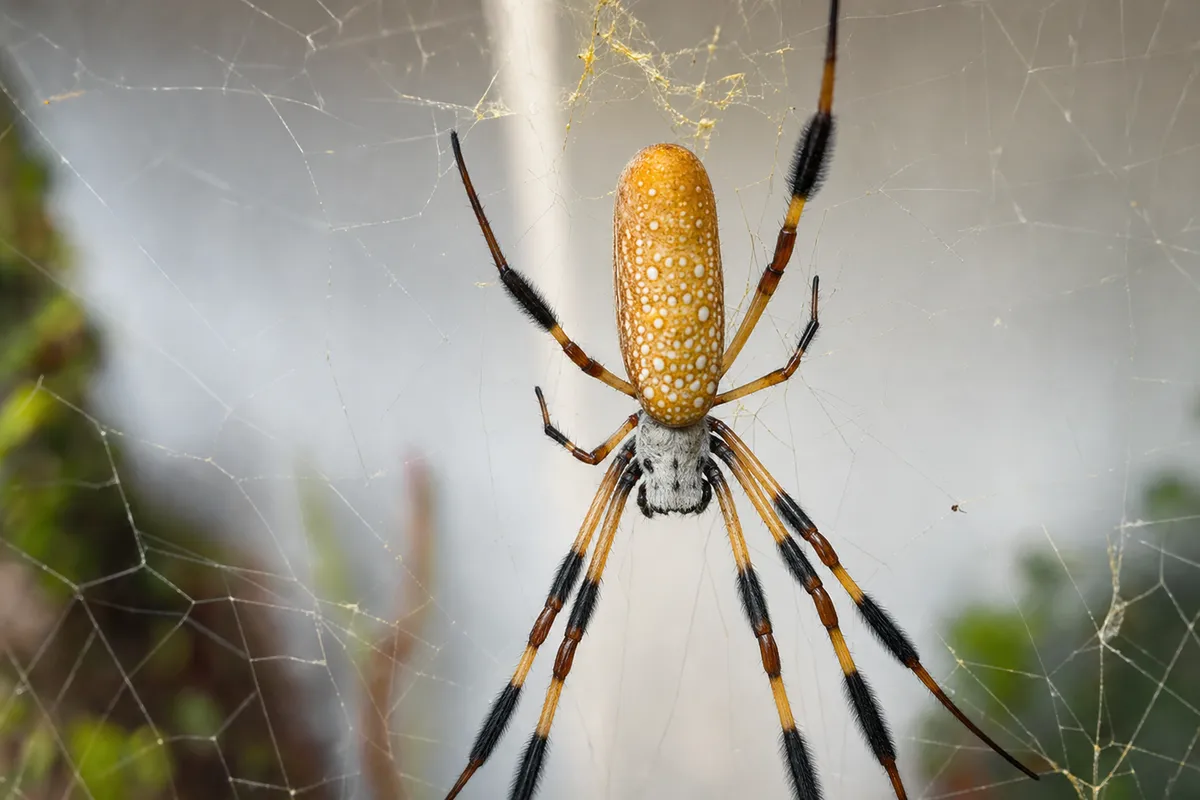
- Adults (mid-summer): Big, slow, and dressed like a school-bus warning label. Yellow or tawny with black accents, short forewings, and rose-colored hind wings that can’t lift them off the ground. Males run about 1.7–2.2 inches long. Females push 2–2.8 inches and occasionally hit 3.5.
They can’t fly. They don’t really hop, either. The name “lubber” comes from an old English word for lazy or clumsy — accurate. If you want the full species profile — exact measurements, color variants, and the biology behind the warning colors — our eastern lubber grasshopper identification guide goes deeper; this page stays focused on managing them.
On every inspection
What lubber damage looks like in your landscape
- Ragged leaf holes Chewed-out irregular holes on ornamentals and vegetables — not the neat scallops of caterpillar feeding.
- Stripped foliage Amaryllis, crinum, oleander, canna, and lantana can be defoliated down to stems in a heavy hatch.
- Nymph clusters Dense groups of small black nymphs with a bright dorsal stripe, low on stems or on the ground nearby.
- Egg pods in open soil Females return to the same open, sunny spots with a little soil moisture — bed edges, ditch banks, pond margins — to lay pods of 25–50 eggs, often the same spot every year.
Lubbers rarely arrive alone — the nymph cluster is the tell.
Why lubbers love Southwest Florida yards
SWFL is basically catered for lubbers. Warm winters, plenty of open sunny ground that holds just enough moisture for egg pods, weedy edges around canals and retention ponds, and a reported host range of at least 100 plant species from 38 plant families to munch through. Lubbers have one generation a year: eggs overwinter in the soil, hatch in March or April, and the highest number of adults shows up in July and August — right when your afternoon storms are keeping every bed lush and eating-ready.
They aren’t picky. Preferred ornamentals include amaryllis, Amazon lily, crinum, narcissus, oleander, butterfly weed, canna, Mexican petunia, and lantana. In the veggie garden, they’ll go after peas, lettuce, kale, beans, and cabbage first, and are less interested in eggplant, tomato, pepper, and okra. St. Augustine lawns aren’t a lubber’s preferred menu — their mouthparts are built for broadleaves, not grass blades — but a nymph cluster hatched near turf will happily march across your St. Augustine to reach a landscape bed.
Lubber pressure runs on a hard calendar in SWFL — nymphs in spring, big colorful adults driving damage in mid-summer, eggs back in the ground until next year:
| Season | What lubbers are doing | What that means for you |
|---|---|---|
| March–April | Eggs hatch; black-and-yellow nymphs cluster low on plants | Prime scouting and hand-picking window |
| May–June | Nymphs grow and fan out into landscape beds | Keep picking; mow and clear weedy edges |
| July–August | Adult numbers peak; egg-laying begins about a month after adults emerge | Hand removal — foliar sprays on adults mostly fail; start marking the egg-laying sites you find |
| September–October | Females keep laying egg pods in open, sunny soil | Mark and disturb the egg-laying spots you find |
| November–February | Eggs overwinter in the soil | Disturb known egg zones; plan for the spring hatch |
What actually works (and what doesn’t)
Here’s where the lubber earns its reputation. Nymphs are relatively easy to kill. Adults, not so much — they’re big enough and biochemically weird enough that they can literally detoxify insecticides they eat off treated foliage. Foliar sprays on grown adults are famously disappointing. Timing matters more than product choice.
Do this:
- Scout in March and April. As soon as you see the black-and-yellow nymph clusters, that’s your window.
- Hand-pick when numbers are small. Gloves, a bucket of soapy water, done. UF/IFAS literally lists mechanical control as the most effective home approach for homeowners with a few plants to protect.
- Mow and clear weedy edges. Short vegetation doesn’t feed lubbers well and exposes nymphs to predators. Ditches, canal banks, and back fences are the usual hatch zones.
- Encourage natural predators. Tachinid flies parasitize a meaningful percentage of young lubbers — you want them around. Diverse native plantings help.
Don’t do this:
- Don’t rely on a broad foliar spray after July. Adults shrug it off and you’ll just knock out beneficials.
- Don’t squish nymph clusters bare-handed on plants you care about. Lubbers release a foul, dark thoracic secretion when disturbed — it stains, and it stinks. Gloves.
- Don’t assume your dog or cat can play with them. Lubbers concentrate plant toxins as a defense, and pets that swallow one can get sick.
- Don’t hardcode “just spray something.” If you want an estimate for a targeted program, our pest control calculator will give you a ballpark without a sales call.
Pro tip from the field: If you can locate the egg-laying spots — usually the same open, sunny patches with intermediate soil moisture every year, not the bone-dry sandy spots — you can shrink next year’s problem with a targeted soil disturbance in fall or winter. Female eastern lubbers return to the same real estate to lay their pods, so those spots are gold.
Safe DIY checks any homeowner can do
You don’t need a license to walk your own yard. Between March and June, do a slow lap once a week:
- Check the base of ornamental beds and open, sunny ground that holds some moisture — bed edges, pond margins, ditch banks — first. That’s where egg pods hatch; skip the bone-dry upland sand.
- Flip the lower leaves of amaryllis, crinum, and canna. Nymphs will be low on the plant.
- Walk the edges — canal banks, drainage ditches, and the messy zone between mulch and lawn. That transition strip is prime real estate.
- Note the spots you find them. Those are the same spots you’ll find them next April.
Two things NOT to do while you’re scouting: don’t blast the beds with a garden hose thinking it’ll “wash them away” (they climb right back), and don’t spray a broad-label insecticide preventively. You’ll only kill the beneficials that would have parasitized the next hatch.
When to call a pro
You want a professional in the loop when:
- You’re seeing hundreds of nymphs, not dozens. A big hatch on an amaryllis bed or a young citrus tree can strip plants in days.
- The infestation is already at the adult stage and hand-picking isn’t realistic. Effective control here means the right product on the right life stage — actives like carbaryl, bifenthrin, cyhalothrin, permethrin, esfenvalerate, and spinosad appear on UF/IFAS lists for nymph control, and they all have label restrictions worth respecting.
- You’ve got pets, edibles, pollinator plantings, or a shoreline nearby and need someone who’s going to think about drift, runoff, and beneficials before pulling a trigger.
- You’re in a heavier-pressure part of Southwest Florida — Sarasota’s east side, Punta Gorda ranchland edges, or any yard backing up to a canal or preserve — where the seasonal wave is bigger than a homeowner bucket can handle.
| Approach | DIY | Waves pro program |
|---|---|---|
| Best life stage handled | Nymphs, small numbers | Nymphs at scale, plus adult removal at aggregation points |
| Product access | OTC neem, soap, general-labeled pyrethroids | Full label set with SWFL-specific timing |
| Beneficial-insect risk | Higher if you spray broadly | Lower — targeted to aggregation points |
| Egg-zone follow-up | Homeowner memory | Documented and revisited next spring |
Both approaches work — the question is scale and whether you want to be the one out there in July.
How Waves approaches lubber grasshoppers
We treat lubbers like the seasonal, targeted problem they are, not a monthly spray excuse. A Waves tech will:
- Walk the property and ID nymph clusters, hatch zones, and preferred host plants.
- Time interventions to the nymph window whenever possible — that’s when products actually work.
- Combine mechanical removal at aggregation points with spot-treatment of nymph clusters, instead of blanket foliar spraying on grown adults.
- Note egg-laying spots for follow-up so next year’s population is smaller before it starts.
If you’d rather have lubbers (and everything else that comes with a SWFL landscape) on someone else’s calendar, our WaveGuard membership folds seasonal lubber checks into the same visits that handle ants, roaches, and the usual suspects.
Frequently Asked Questions
Are lubber grasshoppers dangerous to humans or pets?
Not to humans in any meaningful way — they don’t sting, and a nip from a nymph is more surprising than painful. Pets are a different story: lubbers concentrate plant toxins in a thoracic secretion, and dogs and cats that swallow one can vomit, drool, or worse. If your dog is a bug-eater, don’t let it snack on the bright yellow ones.
What’s the fastest way to get rid of lubber grasshoppers?
Catch them as nymphs. Black-and-yellow clusters, March through May — pick them off, drop them in soapy water, and don’t wait. Once they’re big colorful adults in July or August, foliar spraying is largely a waste — insecticides aren’t reliable on grown adults, so hand removal is the dependable option at that stage. A pro’s real value here is timing any treatment to the next nymph flush, not spraying adults. The fastest long-term fix is catching next year’s hatch at the right stage.
Will they come back next year?
Almost certainly, yes. Eastern lubbers have one generation a year, and females return to the same open, sunny spots — the ones with a little soil moisture, not bone-dry sand — to lay eggs. Marking those spots and disturbing them off-season is how you shrink the following spring’s hatch. For gardens near Fort Myers canals or Sarasota drainage ditches, that hatch pressure basically resets every April.
Ready to stop feeding your amaryllis to grasshoppers?
If the nymphs are already out or you just want next spring handled before it starts, call Waves at (941) 297-5749 or book an inspection online. We’ll walk the property, ID the hatch zones, and put together a plan that hits the lubber life stage where it actually matters — not the one where it doesn’t.