

Jump to a section (7)
- 01Are “bagworms” in Florida the same thing as plaster bagworms?
- 02What plaster bagworms actually are (it’s not a worm)
- 03Why Southwest Florida homes suit them so well
- 04How to get rid of plaster bagworms (the homeowner playbook)
- 05How Waves handles plaster bagworms
- 06Frequently Asked Questions
- 07Ready to stop scraping seeds off your ceiling?
If something seed-shaped just moved on your wall, you’re not losing it. You’re probably looking at a plaster bagworm, the caterpillar of a small moth called the household casebearer. It’s harmless, and getting rid of it is mostly a cleaning job: vacuum the cases, clear the cobwebs they eat, and bring the humidity down. Once you’ve spotted one, though, you’ll start spotting them in every quiet corner of the house.
From Sarasota down through Port Charlotte, “what is THAT stuck to my ceiling?” is a familiar call: small grayish-brown cases on a bathroom ceiling, a garage wall, or the corner above the bedroom door nobody dusts. Here’s what they are, why your house suits them, and how to make them stop.
Don’t feel like dealing with it yourself? Skip the trial-and-error and book a Waves visit — we’ll knock down the active population and treat the cracks and crevices the vacuum can’t reach.
Are “bagworms” in Florida the same thing as plaster bagworms?
Usually not, and this trips people up constantly. Two different kinds of moth caterpillars share the nickname here:
- Plaster bagworms (household casebearers) live indoors on walls and ceilings, drag a flat, seed-shaped silk case around, and eat old spider webs. They’re harmless to your house and your plants. That’s what this article is about, and it’s what you have if the case is on drywall or stucco.
- True bagworms belong to a different moth family and live outdoors on trees and shrubs. Their bag hangs from a branch and is covered in bits of twig and leaf, and a heavy population can strip a shrub. Several species live in Florida. The evergreen bagworm that chews up junipers farther north is only an occasional pest here, because most of its favorite host plants don’t grow well this far south (UF/IFAS).
Quick sort: indoors, flat, seed-shaped, on a wall = plaster bagworm. Outdoors, cone-shaped, hanging off a branch and dressed in leaf bits = true bagworm (that’s a tree-and-shrub problem, not a household pest problem).
| What to check | Plaster bagworm (household casebearer) | True bagworm |
|---|---|---|
| Where | Indoors — walls, ceilings, garages, lanais | Outdoors — trees and shrubs such as live oak, ligustrum, and Indian hawthorn |
| Case shape | Flat, spindle/seed-shaped, about 1/3–1/2 inch | Hanging cone or spindle, 1–2 inches |
| Case material | Silk plus lint, sand, hair, dust | Silk plus bits of the host plant's leaves or needles |
| What it eats | Old spider webs, hair, lint, occasionally wool | Living foliage — can defoliate a shrub |
| Damage risk | Cosmetic nuisance | Real plant damage if the population builds |
| Who fixes it | Interior pest service plus cleaning | Tree and shrub care |
Same nickname, different insect, different fix. Check whether the case is indoors on a wall or outdoors on a branch.
What plaster bagworms actually are (it’s not a worm)
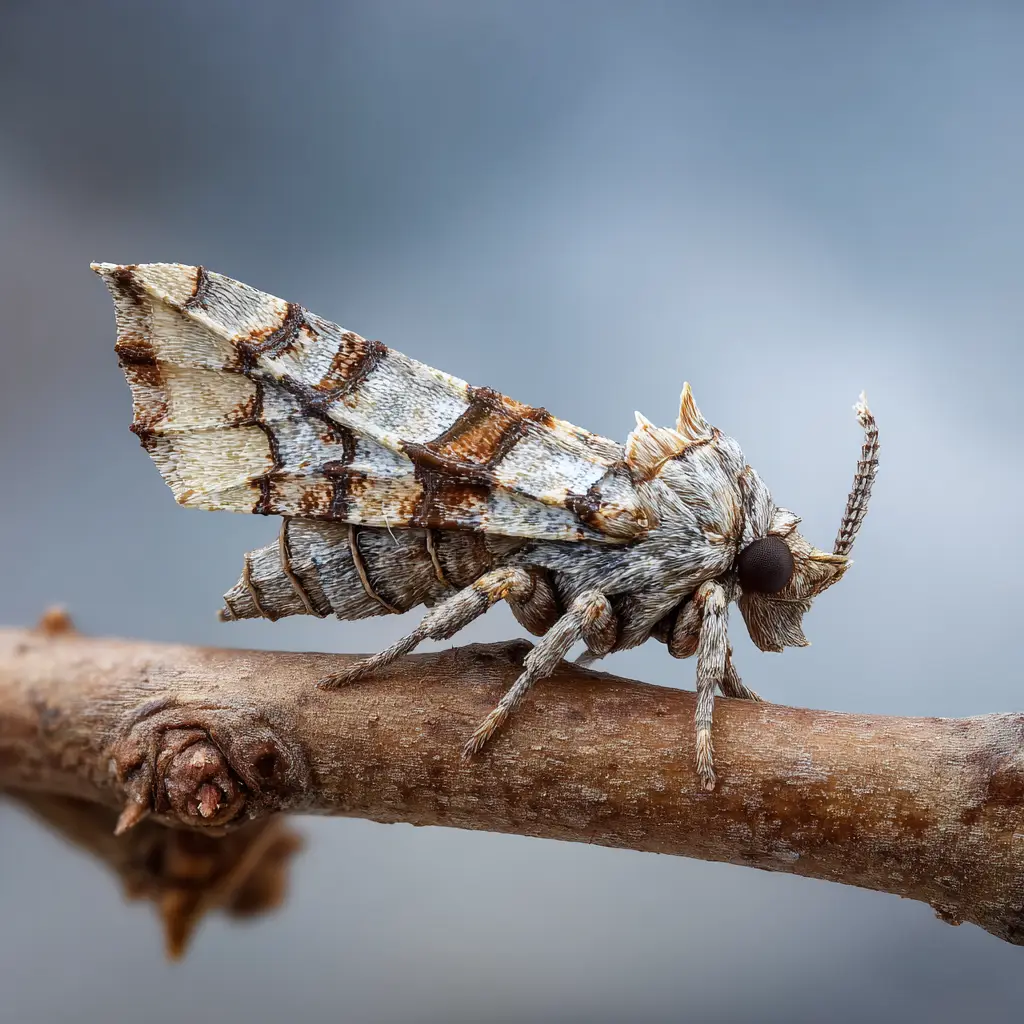
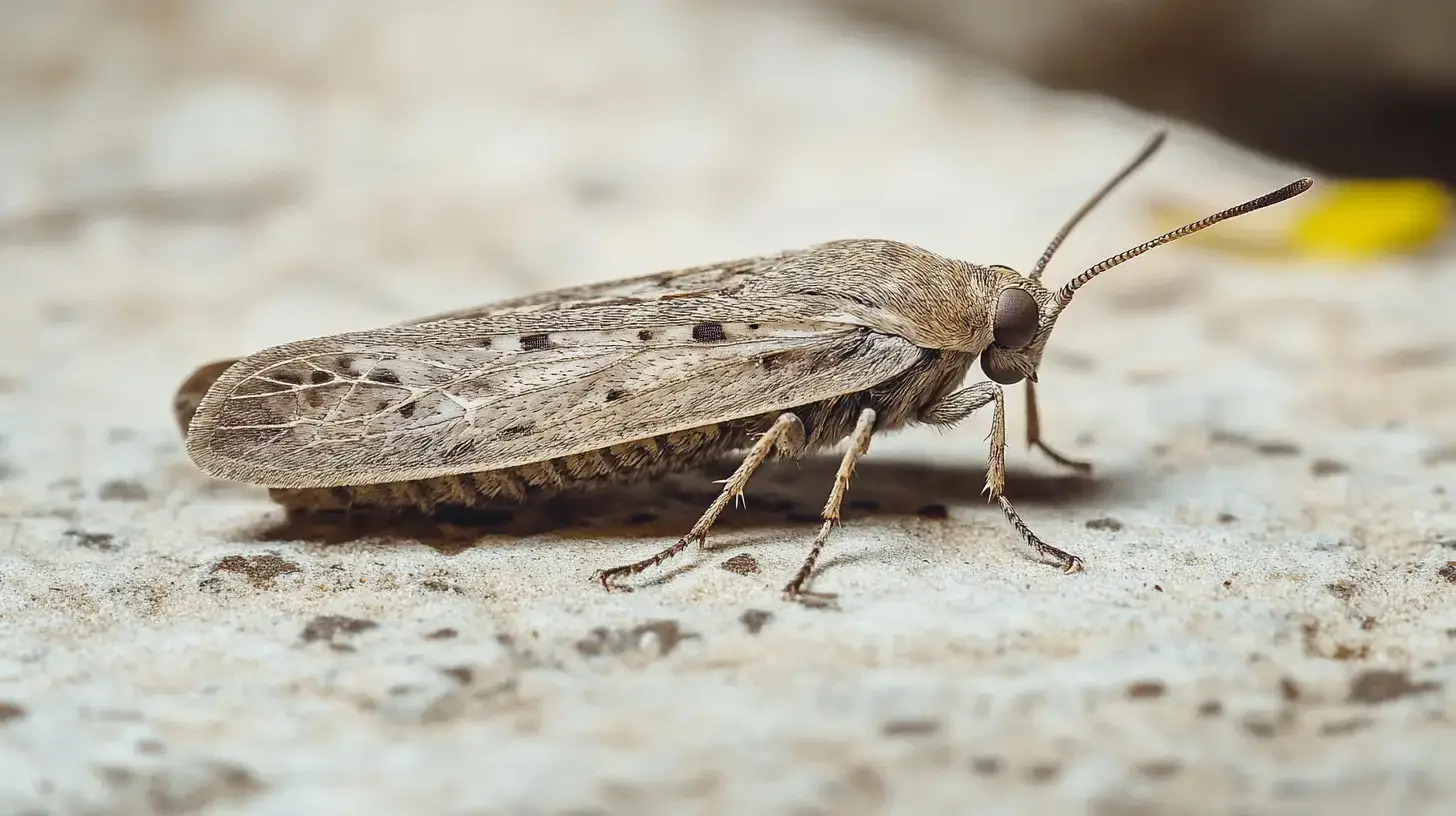
Despite the name, plaster bagworms aren’t worms, and they aren’t true bagworms either. They’re the larvae of a small moth, the household casebearer (Phereoeca uterella), from the same family as clothes moths. The “bag” on your wall is a portable silk case the caterpillar drags around like a tiny sleeping bag. The accepted common name was changed from “plaster bagworm” to “household casebearer” to avoid confusion with real bagworms (UF/IFAS), but the old name stuck because people keep finding them on plaster, drywall, and stucco.
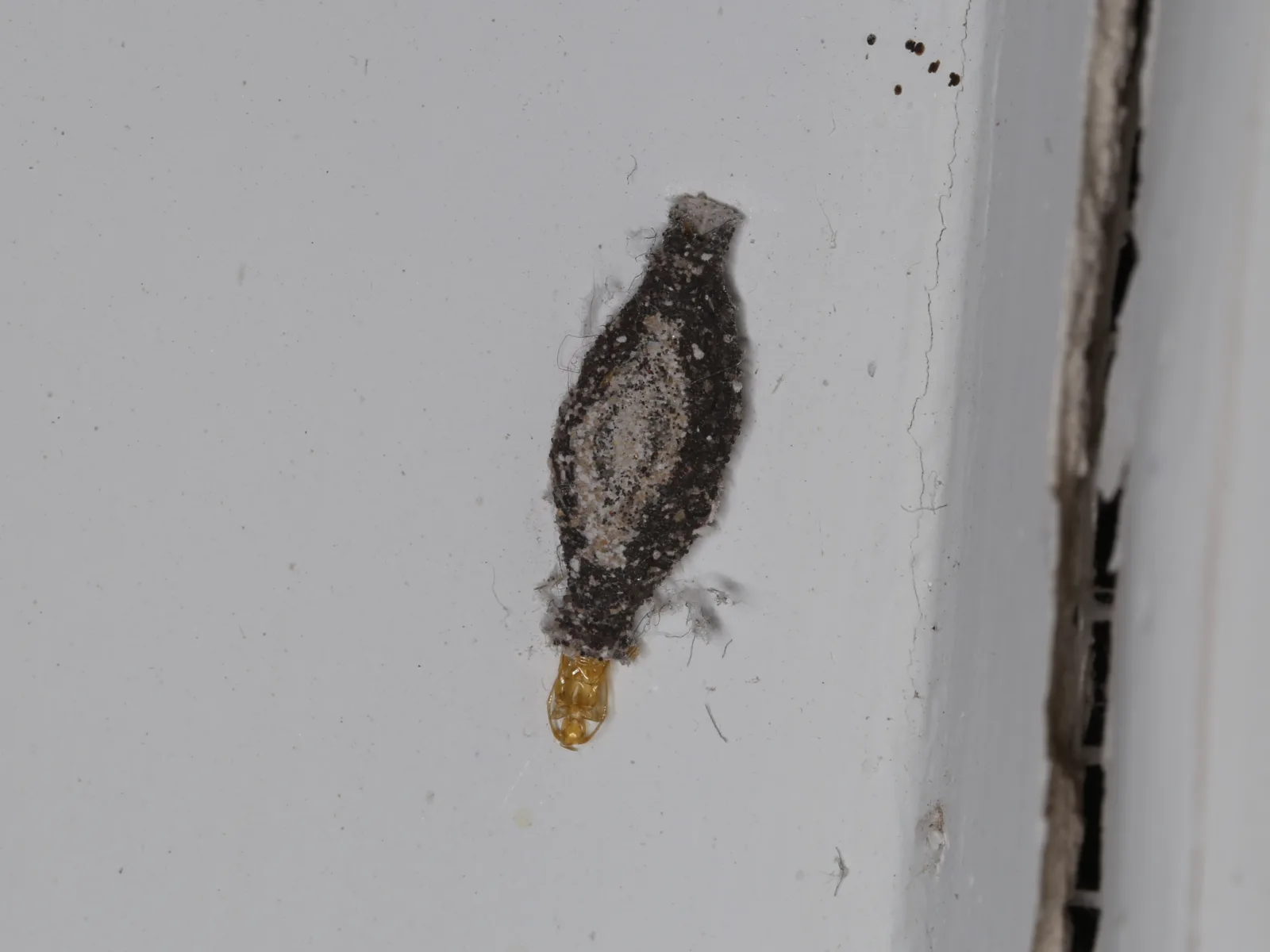
A plaster bagworm case stuck to a wall, with the empty golden pupal skin (exuviae) poking out of one end after the moth emerged. Photo: Donald Hobern via Wikimedia Commons, CC BY 2.0, resized.
The case itself is the giveaway:
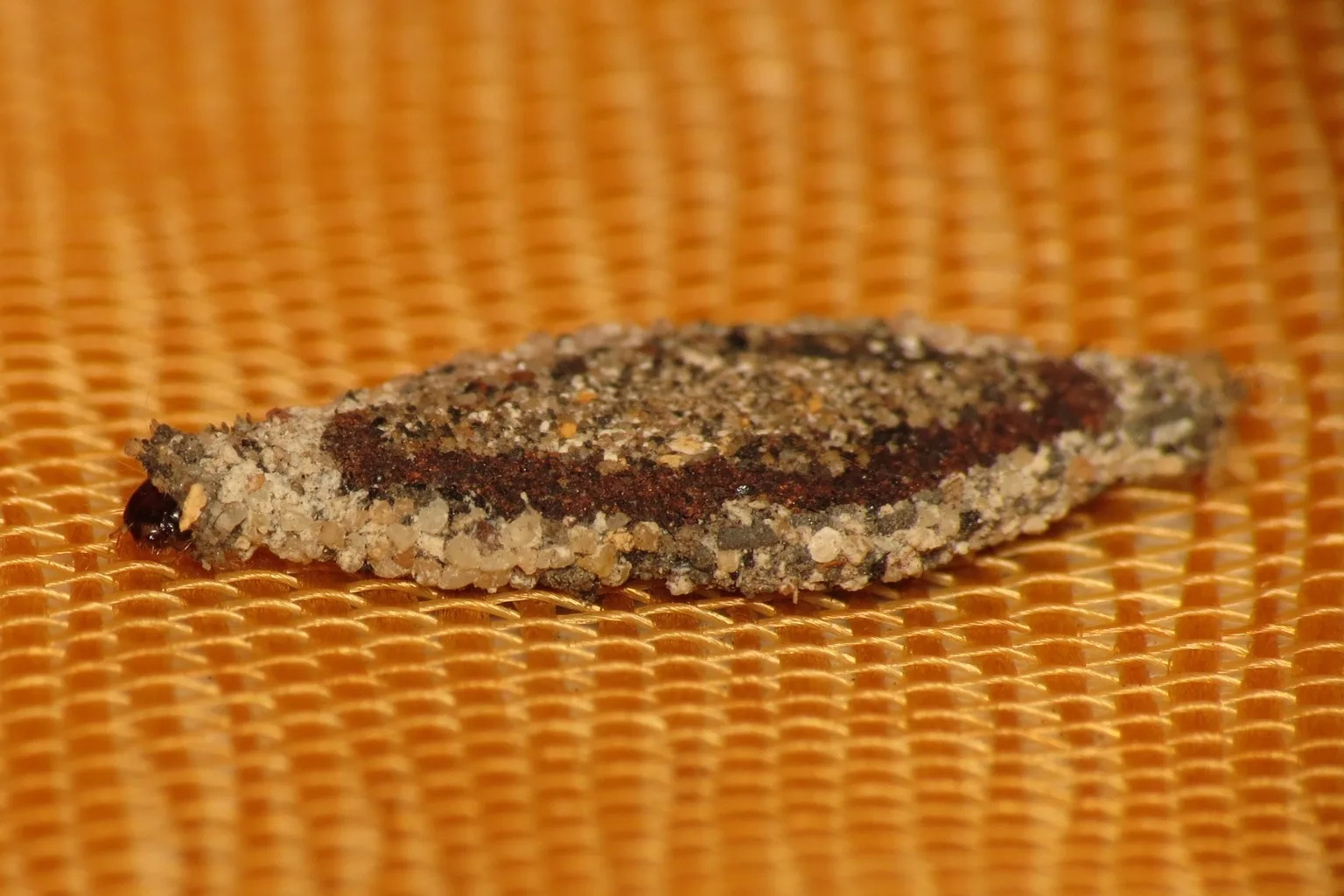
- Flat and spindle-shaped, like a pumpkin or cantaloupe seed
- About 1/3 to 1/2 inch long
- Gray, tan, or brown, depending on what the larva mixed into the silk: sand, lint, dust, hair, bits of insects
- Open at both ends, so the larva can poke its head out of either end to crawl, and pull back in when disturbed
If you see one inching across the wall, that’s a live larva. If one has sat in the same spot with both ends sealed, it’s pupating. Empty, abandoned cases stay stuck where they were.
Why Southwest Florida homes suit them so well
Household casebearers need high humidity to complete their development. That’s the main reason they’re common in Florida and rare in drier parts of the country (UF/IFAS). Indoors, they settle anywhere warm and damp: lanais, garages, bathrooms, laundry rooms, closet ceilings, and the corner above the shower nobody looks at.
Two things keep them going in your house:
- Humidity. They struggle in dry air. An undersized AC, a bathroom fan that doesn’t actually vent outside, or a thermostat set high while you’re away all let indoor humidity climb.
- Food. Their main meal isn’t your clothes. It’s old spider webs, plus the hair, dander, and lint caught in them. They will also eat wool if they find it. Garages, lanai ceilings, attic corners, and the dusty zone behind the couch suit them perfectly.
One generation, egg to adult, takes about 74 days on average, or roughly two and a half months (UF/IFAS). That’s slow enough to miss at first and fast enough to notice a lot more cases by next season if nothing changes.
On every inspection
What our techs look for during a plaster bagworm inspection
- Seed-shaped cases on walls Gray or tan, flat, about 1/3–1/2 inch — usually on stucco, drywall, or ceilings.
- Cobwebs in quiet corners Their main food source. Heavy webbing = heavy bagworm potential.
- Lint and dust buildup Tops of closets, behind furniture, under bathroom vanities.
- Empty cases stuck in place A moth may have already emerged, so adults could be laying eggs nearby.
- Humidity hotspots Bathrooms without working fans, garages, laundry rooms, shaded lanais.
- Damaged wool or felt Rare, but they'll nibble natural fibers stored in still, dusty spots.
Most homeowners only notice the cases. Our techs are reading the room around them.
How to get rid of plaster bagworms (the homeowner playbook)
Here’s the part a lot of pest companies skip: plaster bagworms are mostly a housekeeping problem. UF/IFAS entomologists say picking off or vacuuming the cases and clearing spider webs should be enough to keep them under control (UF/IFAS). Spraying without changing the conditions won’t hold, because the larva spends its life inside that silk case. Take away the webs they eat and the moisture they need, and they fade out.
Step 1: Confirm it’s actually a plaster bagworm
Before you go full hazmat, make sure you’re looking at the right pest. Plaster bagworms get confused with:
- Smooth, papery cocoons (which are made of just silk, no debris)
- Mud-dauber wasp cells (much bigger, way harder)
- Termite pellets (these don’t move, and they look like sawdust on the floor — not seeds on the wall)
- Clothes moth larvae (the webbing clothes moth makes no portable case; the casemaking clothes moth carries a smaller, tube-shaped case and stays on fabric, not walls)
If the thing on your wall is a flat, gray, seed-shaped case about 1/3 to 1/2 inch long, and especially if you nudged it and a tiny head poked out, congratulations: you’ve got plaster bagworms.
Step 2: Vacuum, don’t squish
Use a vacuum with a hose attachment to lift cases off walls and ceilings. Empty the canister or seal the bag immediately and take it outside. Sweeping or wiping just smears the silk and spreads the exact organic debris the next generation feeds on.
Step 3: Kill the buffet
- Knock down every spider web you can find — interior, lanai, garage, under the eaves
- Dust ceiling corners, tops of closets, baseboards behind furniture, and ceiling fan blades
- Vacuum floors and carpets thoroughly, paying attention to edges and under furniture
- Store wool, felt, and other natural-fiber clothing in sealed bins (rare meals for them, but possible)
Step 4: Cut the humidity
- Run bathroom exhaust fans during and 20–30 minutes after every shower
- Aim to keep indoor humidity under about 60%. If you’re away for the season, don’t set the thermostat so high that the AC stops running; a dehumidifier or a thermostat with humidity control helps
- Use a dehumidifier in garages, laundry rooms, and closets if humidity stays above 60%
- Fix slow leaks under sinks, around toilets, and behind the fridge
Step 5: Reduce the moth invitation outside
The adults are small, drab moths. Keep them out the same way you’d keep out any small flying insect: weatherstrip the door between the house and garage, screen open attic or soffit vents, and swap bright white porch bulbs for yellow “bug” bulbs, which draw fewer insects to your doors.
Pro tip from our techs: Don’t waste money on bug bombs or off-the-shelf foggers. The larva lives inside its case, and fog doesn’t reach the cracks where eggs are laid. Removing the cases and webs does most of the work. Targeted crack-and-crevice treatment helps on stubborn infestations.
What NOT to do
- Don’t blast the wall with bleach or ammonia. It won’t get into the case, and it can damage paint.
- Don’t ignore the garage and lanai. If you only clean the interior, the next generation walks right back in.
- Don’t expect overnight results. Eggs laid before your cleanup keep hatching, and one generation takes about two and a half months. Expect stragglers for a couple of months, getting fewer as you go.
How Waves handles plaster bagworms
Our pest control services treat plaster bagworms as part of a regular interior + exterior plan, not a one-and-done spray. Here’s the short version of what a tech actually does on site:
- Inspect. Identify active cases vs. empty pupal cases, find harborage (garages, lanai ceilings, bath ceilings), and flag moisture problems we can see.
- Mechanical removal. Knock down webs and cases — the single most impactful step. We bring the right tools to reach high ceilings safely.
- Targeted residual. Treat cracks, crevices, baseboards, and wall/ceiling junctions — the surfaces adult moths land on. We’re not fogging the room; we’re putting product where the pest actually is.
- Exterior perimeter. Spider control on the outside knocks out the food source and the moth landing zones around eaves, soffits, and lights.
- Recheck. Follow-up visits on a normal service interval catch the next emergence before it gets out of hand again.
| What you get | DIY only | Waves Quarterly Service |
|---|---|---|
| Removes existing cases | Yes — if you can reach them | Yes — including high ceilings and garage rafters |
| Treats cracks and crevices where eggs hide | Limited — store-bought products are short-residual | Yes — professional residuals where adults land |
| Controls outside spider/web food source | Possible with hose-end products | Built into the exterior perimeter every visit |
| Catches the next emergence | Only if you keep cleaning | Quarterly visits knock down webs and new cases |
| Time to control | Variable — many homeowners give up | Usually a couple of months, about one generation |
DIY can absolutely work for a small problem. Persistent or recurring? Bring in a pro.
If you’re tired of running the cleanup yourself every other month, a recurring pest plan keeps the webs knocked down outside, which cuts off their food. WaveGuard members also get free re-treats if they show back up between visits. Want a transparent estimate before you book? Run the numbers in our pest control calculator — no sales call required.
Frequently Asked Questions
Are plaster bagworms harmful to people or pets?
No. They don’t bite, sting, or carry disease. The downsides are that they look gross stuck to a ceiling, they can damage stored wool or felt, and the dusty debris they leave behind can bother people with allergies. Nuisance pest — not a health emergency.
Why do I have plaster bagworms if my house is clean?
Because they’re not after kitchen crumbs — they’re after spider webs and the dead bugs, hair, and lint trapped inside them. Even a tidy home accumulates cobwebs in garages, lanais, attic corners, and behind furniture. SWFL humidity does the rest. If you’re seeing cases, focus on dust, webs, and moisture, not your dishes.
How long does it take to fully get rid of plaster bagworms?
Plan on a couple of months of steady effort. One generation takes about two and a half months, so eggs laid before your cleanup keep hatching for a while. With the webs gone, those late hatchlings have little to eat, and the numbers drop. One vacuum session won’t cut it; a steady routine will, with targeted treatment for stubborn cases.
Ready to stop scraping seeds off your ceiling?
If the cases keep coming back no matter how often you clean, the problem isn’t your effort. There’s still a food source or a damp spot somewhere you can’t see. A Waves tech can find it, treat it, and keep the webs knocked down on a regular schedule. Book your pest control service or call (941) 297-5749 and we’ll take it from here.
Want to nerd out on more SWFL bugs before they show up uninvited? Browse the Waves pest library for identification guides, biology, and homeowner-tested tips on the pests we deal with every day.
Header photo: a plaster bagworm larva in its case (Phereoeca sp.), by Donald Hobern via Wikimedia Commons, licensed CC BY 2.0, cropped.

.jpg)
.jpg)