Jump to a section (9)
- 01The real answer: why fleas can’t set up shop on your head
- 02What’s actually biting you, then?
- 03Why Southwest Florida is a flea buffet
- 04Safe steps you can do today
- 05Where fleas actually hide (and where we treat)
- 06When to call a pro
- 07How Waves handles a flea call
- 08Frequently Asked Questions
- 09Bottom line
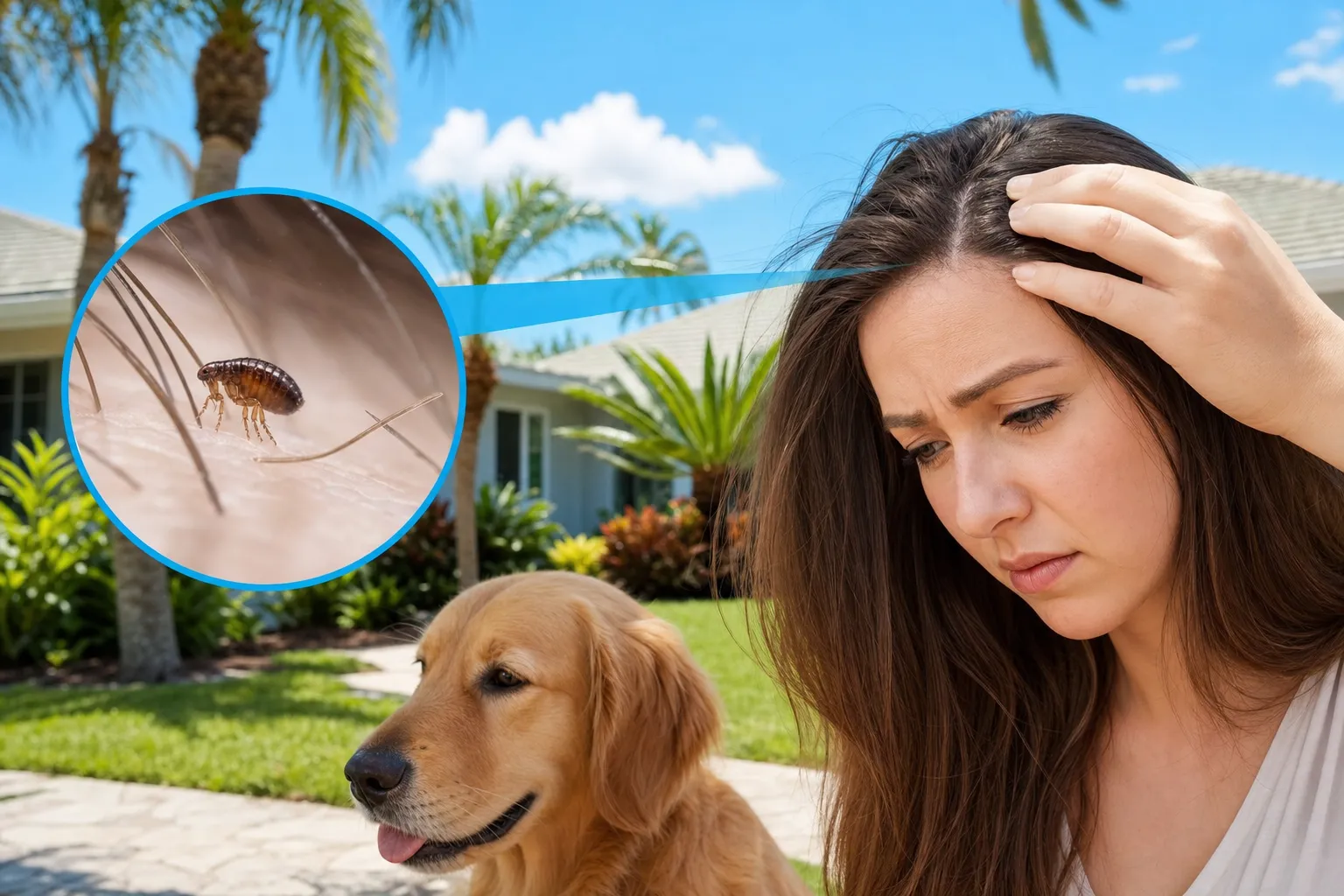
Short version: no. Dog fleas — really cat fleas (Ctenocephalides felis), which is the species biting almost every pet and person in Southwest Florida, despite the “dog flea” nickname — can’t actually live in human hair. Our scalps aren’t dense enough, our body temperature is a little off, and most of us shower more often than a flea can tolerate. They’ll still hop on, bite your ankles, and jump right back off. If you’re finding welts in Sarasota, Bradenton, or anywhere along our stretch of the Gulf, the problem isn’t your hair — it’s your carpet, your yard, or your pet. Let’s fix that.
Want the full field guide on Florida biters? Our pest library breaks down every common SWFL pest species by species. If you’re already past the “identify” stage and want boots on the ground, our dedicated flea treatment clears an active infestation — and a WaveGuard membership keeps year-round pressure on the rest of the SWFL pest list.
The real answer: why fleas can’t set up shop on your head
Fleas evolved on dense-fur mammals — coyotes, opossums, feral cats, raccoons — where they can grip a fur shaft with a laterally flattened body and hooked claws. That grip is the whole point of a flea. When one lands on your arm, its claws have nothing to hook. Human hair grows too spread out on our limbs, and even our scalps don’t offer the shaft density or the greasy insulation a flea needs to stay put. Add a shampoo bottle to the equation and any adult that made it up there is drowned or gone within a day.
There is an actual “human flea” species — Pulex irritans — but you basically never see it in a modern U.S. home. It’s a museum-piece pest. What you’re dealing with in SWFL is almost always the cat flea, which prefers cats, dogs, opossums, and raccoons, in that order. You’re a snack, not a habitat.
What’s actually biting you, then?
If fleas are in the house, the bites follow a pattern:
- Ankles and lower legs. Adult fleas jump about seven inches vertically. That’s why bites cluster below the knee when you sit on the couch and above the sock line when you walk barefoot.
- Groups of two or three. Fleas often “test bite” and move a few millimeters before biting again, leaving little constellations.
- Small red bump with a lighter halo. They itch for days, not hours.
That’s different from bed bug bites (upper body, often in a line, from a bug hiding in the mattress seam) and mosquito bites (single, spread out, welts fade in a day). Nail down the pattern before you nuke the wrong thing.
Pro tip: Walk through the suspect room in tall white socks for five minutes. Adult fleas contrast on white cotton and will hop on almost immediately if the room is infested. Sounds silly. Works better than any gadget you can buy.
Why Southwest Florida is a flea buffet
Fleas love SWFL for the same reasons we do — the weather never really stops. A few local realities that make our flea seasons rough:
- No hard freeze. The larval and pupal stages die during sustained sub-freezing weather. We don’t get sustained sub-freezing weather. Ever.
- Afternoon storms and humidity. Flea larvae need more than 50% relative humidity to survive. Our summer dew points laugh at that threshold.
- Sandy, shaded pet zones. The strip of sandy soil under your deck, behind the AC pad, or along the fence where the dog naps holds moisture longer than you’d think. That’s where eggs drop off the pet and hatch.
- St. Augustine grass canopy. Thick St. Augustine holds shade at soil level, which is exactly the microclimate flea larvae want.
- Wildlife carriers. Opossums and feral cats crossing the yard drop eggs even when your pet is on prevention.
Translation: your indoor problem often starts outside.
The calendar version: flea pressure builds through spring, peaks across the summer rainy season, and stays elevated deep into fall. A mild winter — which is most of our winters — can keep the life cycle turning all twelve months. Prevention is a year-round conversation here, not a summer-only one.
Safe steps you can do today
Before you call anyone, here’s the homeowner triage that actually helps:
- Shower with normal soap. A regular shower drowns any adult flea on you. You don’t need medicated shampoo, dish soap, or a vinegar rinse.
- Wash clothes and pet bedding in hot water. 120°F or hotter kills all life stages. Cold wash doesn’t cut it.
- Vacuum every day for two weeks. Focus on carpet edges, under couch cushions, and any spot the pet lays. Empty the canister outside — pupae can hatch inside a bagless vacuum.
- Talk to your vet. Modern oral flea meds for pets are the single biggest lever. If the pet’s not protected, nothing else works long term.
- Thin out shaded yard spots. Sunlight and dryness kill larvae. Open up the dog’s favorite nap zone. Rake leaf litter along the fence line.
What not to do: flea bombs and total-release foggers. They push fleas deeper into carpet fibers and rarely touch the pupal stage, which is the resistant one. Also skip the essential-oil sprays on pets — tea tree, pennyroyal, and undiluted eucalyptus can be toxic to cats and small dogs.
Where fleas actually hide (and where we treat)
- Pet resting zones. Under decks, behind AC pads, shaded fence lines — sandy, humid, protected.
- Interior carpet edges. Where wall meets carpet, pupae wedge into fibers and wait for a vibration cue.
- Upholstered furniture. Anywhere the pet naps. Cushion seams, skirts, throws.
- Pet bedding and crates. Ground zero for egg drop. Wash weekly on hot.
- Yard perimeter. Opossum and feral cat travel lanes deposit eggs even when your pet is treated.
Fleas aren’t a hair problem — they’re an environment problem. Every one of these zones has to be handled together.
When to call a pro
It’s time to stop DIYing when:
- Bites keep showing up after two weeks of daily vacuuming and pet treatment.
- More than one person in the house is getting bit.
- You can see adult fleas jumping on light socks or the carpet.
- Your pet is on vet-prescribed prevention and still comes in scratching.
At that point you’ve got a pupal reservoir in the carpet or a wildlife source in the yard, and you need an adulticide plus an insect growth regulator, plus a perimeter treatment, to break the cycle.
How Waves handles a flea call
When we roll on a flea job in Southwest Florida, the visit isn’t just “spray the carpet.” It’s:
- Interior treatment with a labeled adulticide plus an insect growth regulator (IGR) that blocks eggs and larvae from maturing. The IGR is what actually breaks the cycle — adult fleas are only about 5% of the population you’re seeing.
- Exterior perimeter focused on the shaded, sandy pet zones and the wildlife travel lanes along the fence.
- Prep coaching. Vacuum, wash bedding, keep the pet on vet prevention. Our treatment plus your prep is the combo that lasts.
- Follow-up window. Flea pupae are physically resistant to insecticide and hatch on their own timing, so we plan on a re-treat or check-in inside three weeks.
| What you get | Dedicated flea treatment | WaveGuard recurring plan |
|---|---|---|
| Full life-cycle flea protocol (indoor IGR + 14-day follow-up) | Yes — the complete flea knockdown | Added as a discounted flea visit when you're actively infested — not run on every quarterly stop |
| Exterior treatment of shaded flea harborage | Yes, flea-focused | General perimeter each visit; flea-focused harborage work comes with the flea treatment |
| Coverage if fleas come back | Follow-up within the treatment window | Unlimited callbacks on covered pests; a fresh flea flare-up is handled with a discounted flea visit |
| Bundled with ants, roaches, spiders | No | Yes — quarterly, year-round |
| Best for | An active flea outbreak | Ongoing prevention plus a member discount when fleas flare |
For an active infestation, start with the dedicated flea treatment; WaveGuard keeps general pest pressure down year-round and gives members a discount on the flea visit when they need it.
If you’d rather not think about fleas again, this is where our full pest control services live, and a WaveGuard membership keeps year-round pressure down on ants, roaches, and everything else the Florida climate throws at you — with a member discount when a flea treatment is what you need. Pricing isn’t one-size-fits-all — for an active infestation, get a real number from the dedicated flea-treatment estimator without the sales call. For a deeper step-by-step treatment walkthrough, our get-rid-of-fleas guide covers the whole process.
Frequently Asked Questions
How do I know if fleas are in my hair?
Almost certainly they aren’t. If you were bitten on the scalp and now feel “crawling,” check for head lice (you’ll see nits glued to hair shafts near the scalp) or ask a dermatologist about a dry-scalp reaction. Fleas leave your head within minutes because there’s nothing to grip and no way to feed. Real flea bites cluster on ankles, calves, and along the waistband — not the scalp.
Will showering get rid of fleas on humans?
Yes. A normal shower with normal soap drowns any adult flea that hitched a ride. You don’t need medicated shampoo or a dish-soap-in-hair trick. The bigger question is whether they’ll be back tomorrow, which means treating the house and the pet — not just you.
What smell do fleas absolutely hate?
Cedar, eucalyptus, and citrus scents get recommended constantly, but be careful: concentrated essential oils — eucalyptus and citrus included — can be toxic to pets, and cats are especially vulnerable, even from oils used around their resting areas. Talk to your vet before using any essential oil in a home with animals. And even setting safety aside, “repel” is not “kill” — none of these touch eggs or pupae. In an active infestation, an IGR is doing 90% of the real work.
Bottom line
Fleas can’t live in your hair, but they can absolutely make your house miserable — especially in a Bradenton or North Port summer where the humidity, sandy soil, and warm nights keep the life cycle spinning nonstop. Handle the pet, handle the environment, and if the bites keep coming, book a flea treatment with Waves or call us at (941) 297-5749 and we’ll shut it down.