If you just spotted a squiggle of tiny gray worms on the shower wall, in the dog food bin, on a houseplant, or crawling across the lanai after an afternoon storm — welcome to Southwest Florida. Our sandy soil, humidity, and near-constant warmth mean that “worms” (most of them aren’t actually worms, but we’ll get to that) show up year-round in places you weren’t expecting. The good news: the large majority are a nuisance, not a crisis. The better news: figuring out which one you have is mostly a matter of where you’re seeing them.
This is a plain-English ID guide for the gray worm-looking things SWFL homeowners in Sarasota, Bradenton, Venice, North Port, and everywhere in between actually run into. If you’d rather skip straight to a tech taking care of it, our general pest control service covers most of what’s on this list.
Not sure what you’re looking at? Snap a phone photo next to a coin or a fingernail for scale, then get a quick quote — our team can usually ID it from the pic before we even roll a truck.
What “Gray Worms” Usually Are (Spoiler: Not Earthworms)
When someone types “gray worms” into Google in Florida, they’re almost never dealing with actual worms. Real worms — earthworms, nematodes — are underground and helpful. The gray, wiggly things you’re staring at are almost always fly larvae, moth larvae, or beetle larvae. A few are millipedes (which have legs, technically not worms). And a small handful are actual caterpillars chewing your St. Augustine grass down to the stolons.
Here’s the shortlist, sorted by where you found them.
In the bathroom, kitchen sink, or floor drain → drain fly larvae
Small, gray-to-brown, about ¼-inch long, kind of segmented, and they don’t move much? Those are drain fly larvae (Psychodidae). Adults look like tiny fuzzy gray moths hovering near drains. The larvae live in the gunky biofilm inside your P-trap or overflow. They love slow-drain guest bathrooms and the utility-sink drain in the garage — anywhere water sits and organic slime builds up.
They don’t bite, don’t carry disease in any meaningful way, and don’t survive if you break their food source (the biofilm). But in SWFL, where every home has at least one rarely-used drain, they come back if you don’t clean the actual pipe wall — not just pour bleach down and hope.
In the pantry, dog food, birdseed, or flour → Indian meal moth larvae
Cream-to-grayish caterpillars, roughly ½-inch, with a slightly darker head, sometimes trailing silky webbing across the top of a cereal bag. That’s Indian meal moth larvae (Plodia interpunctella). They come home from the store already in the bag or the bulk bin. In our climate they can run three or four generations a year inside a pantry.
If you’re seeing them crawling up walls or on the ceiling near the pantry, they’re pupating — which means adults are about to fly. Time to empty the pantry, not spray it.
On houseplants or in potting soil → fungus gnat larvae
Tiny, translucent-gray, thread-thin larvae with a black head, living in the top inch of soil of a houseplant. Adults look like small gray-black gnats bouncing around your face when you water. Fungus gnat larvae thrive when potting mix stays wet. Let the top inch dry between waterings and you’ll starve them out in a couple of weeks.
In the lawn, especially St. Augustine → sod webworms, armyworms, or cutworms
Now we’re into actual caterpillars, and this is where SWFL homeowners lose real money if they ignore it. Grayish-tan caterpillars about an inch long, curled into a C when disturbed, hiding at the soil line during the day — those are cutworms or sod webworms. Slightly larger, greener-gray with stripes and a distinctive inverted “Y” on the head? Fall armyworms.
All three chew St. Augustine down to the runners in a hurry. Signs to look for before you even find the worm: irregular brown patches, chewed grass blade tips that look “ragged” rather than cleanly cut, and a lot of little brown birds hanging around your lawn at dusk (they know). Peak pressure in Southwest Florida runs late summer through early fall, right after our heaviest storm cycles push moth populations inland.
On the patio or garage floor after a rain → millipedes
Dark gray or brown, segmented, curl into a tight coil when you touch them, way too many legs. Not a worm, not dangerous, just a millipede displaced by wet soil. Sandy SWFL yards after an afternoon downpour push hundreds of them onto driveways and into garages. They dry out and die within a day indoors — a broom fixes the immediate problem, but if it’s a recurring thing, your mulch line is too close to the slab.
Where They Come From (Blame the Weather, Mostly)
One timing note up front: sod webworm and armyworm pressure peaks late summer into fall in SWFL — right when afternoon storms are heaviest and lawns stay wet overnight.
A few patterns that hold across the region:
- Humidity + biofilm = drain flies. Any drain used less than once a week is a nursery.
- Warm pantries = pantry moths. Anything over 70°F speeds up their life cycle. That’s every kitchen in Florida.
- Overwatered soil = fungus gnats. Whether it’s a houseplant or a flower bed, if the top layer never dries, larvae live in it.
- Wet, thatchy St. Augustine = webworms and armyworms. Moths lay eggs in the thatch. Excess nitrogen makes it worse — one more reason the Sarasota and Manatee County summer fertilizer rule (which restricts both nitrogen and phosphorus from June 1 through September 30) exists.
- Sandy soil + heavy rain = millipedes on the move. They’re not coming for you. They’re drowning.
What You Can Safely Do Yourself
Before anyone sprays anything, do the boring stuff. It works.
In the house:
- Photograph and measure. Coin for scale. Note the room, the surface, and how many.
- For drains: scrub the inside of the pipe wall with a long bottle brush, then follow with an enzyme drain cleaner and a hot tap-water flush. Skip the boiling water — it mostly passes through the trap without touching the biofilm on the pipe wall, and household PVC drain lines aren’t rated for that kind of heat. Bleach has the same problem: it kills adult flies but leaves the biofilm — that’s why it “keeps coming back.”
- For pantry moths: empty the entire pantry. Anything open goes in the freezer for 4 days or in the trash. Wipe shelves with soap and water, paying attention to the seams where the shelf meets the wall. Check every sealed package for webbing at the top.
- For houseplants: stop watering until the top inch of soil is bone dry. Consider a layer of horticultural sand on top of the pot to block egg-laying.
In the yard:
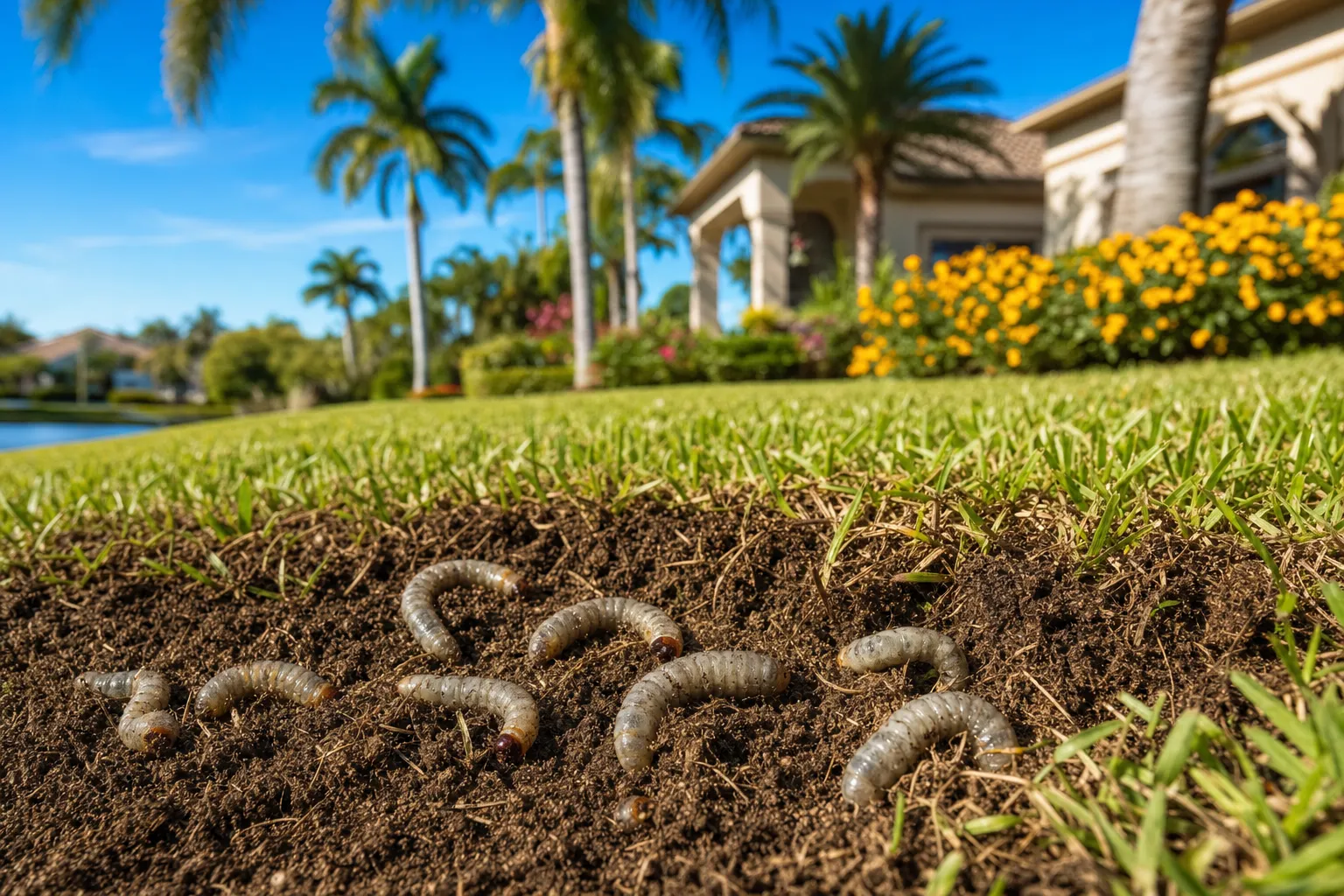
- Pull-test the grass. Grab a patch of yellowing St. Augustine and tug. If the blades are chewed ragged but the sod stays anchored, you’re looking at surface-feeding caterpillars (or, less commonly, chinch bugs — those are pinhead-sized and reddish/black, not gray). If instead the turf peels up like a loose carpet with the roots severed underneath, that’s a root-feeder — usually white grubs — which is a different inspection and treatment path, so don’t chase it as caterpillars.
- Do a soap flush. Mix 2 tablespoons of lemon-scented dish soap in a gallon of water, drench a 2-foot-square area at the edge of the damage, and wait 5 minutes. Caterpillars will crawl up so you can count them. More than 5–10 per square foot is treat-worthy.
- Mow high. St. Augustine cut at 3½–4 inches shades the soil, dries the thatch faster, and stresses moth eggs.
On a full property inspection we walk the same zones every time — drains, pantry, houseplants, the turf edge, and the mulch line — because that’s where “gray worms” actually live.
What NOT to do:
- Don’t dump insecticide down a drain. It won’t reach the biofilm and it will kill the beneficial bacteria in your septic system if you’re on one.
- Don’t nuke the pantry with pyrethrin fog while food is exposed. Toss and clean instead.
- Don’t drench a stressed lawn with the strongest thing at the big-box store. Broad-spectrum pyrethroids kill the beneficial predators (spiders, big-eyed bugs, earwigs) that were actually keeping caterpillar numbers down. You’ll be worse off in 3 weeks.
Pro tip from the truck: If you’ve knocked back drain flies twice this year and they keep coming back, the culprit is almost always a rarely-used shower or a laundry-room floor drain you forgot existed. Run every drain in the house for 30 seconds once a week. Free preventive.
When to Call a Pro
Call somebody (us or otherwise) when:
- You’ve cleaned the drain twice and adult flies are still swarming after a week → there’s a hidden moisture source (broken seal under a toilet, condensate line, slab crack).
- Pantry moths are showing up in rooms far from the kitchen → they’ve pupated in wall voids and re-treatment needs to hit those, not the shelves.
- Your soap-flush counts run well above the 5–10-per-square-foot treat threshold and the brown patches keep spreading daily → that’s past a weekend DIY fix, and you’re days from bare dirt.
- The “worms” are actually maggots (creamy white, no legs, tapered head) coming from a wall cavity, attic, or crawl space → that’s a decomposition source and it needs to be found, not sprayed.
How Waves Handles the Gray-Worm Grab Bag
Because “gray worms” is really 6 different pests, our approach depends on which one you’ve got:
| Situation | One-time visit | Quarterly WaveGuard |
|---|---|---|
| Drain flies in one bathroom | Good fit — biofilm treatment + IGR | Overkill unless recurring |
| Pantry moths, spreading rooms | Works, but returns are common | Better — quarterly interior + monitoring |
| Fungus gnats on plants | Not really a pro job | Not really a pro job |
| Sod webworms / armyworms in turf | Effective if caught early | Best — preventive diamide before peak |
| Millipedes on the patio | Perimeter granular fixes 90% | Included in the perimeter treatment |
Which gray-worm scenarios actually justify a service call vs. a full membership.
For turf caterpillars specifically, we lean on a labeled preventive from the diamide family (Group 28) ahead of peak moth flights, then rotate to a fast-knockdown product only if we find live larvae above threshold. That’s how you avoid burning through the same mode-of-action every visit and creating resistance — which, yes, is a real thing already happening in Florida armyworm populations.
For everything indoors, the fix is almost always mechanical (cleaning, exclusion, moisture correction) plus a targeted labeled product, not a fogger. If you’re the kind of homeowner who’d rather never think about this stuff again, that’s what our WaveGuard membership is built for — quarterly interior + exterior with unlimited callbacks between visits.
Want a deeper dive on any single pest on this list? Our pest library has individual write-ups by species.
Frequently Asked Questions
What are the small grayish worms in my bathroom?
Almost certainly drain fly larvae. They live in the biofilm inside floor drains, sink overflows, and P-traps — anywhere water and organic slime sit together. They don’t bite, they don’t fly (the adults do, but they’re weak fliers), and they’ll disappear if you scrub the actual inside of the pipe wall, not just pour something down it. If they’re back within two weeks, you’ve got a drain you haven’t found yet or a hidden moisture leak.
How do I get rid of tiny grey worms in the house?
Identify where they’re coming from first — drain, pantry, houseplant, or wall cavity — because the treatment is completely different for each. For 90% of indoor “gray worm” cases, the fix is cleaning and moisture control, not spraying. If you can’t find the source after a thorough look, or they keep coming back, that’s when a pro inspection earns its cost.
Are gray worms in my lawn dangerous to pets or kids?
The caterpillars themselves (sod webworms, cutworms, armyworms) aren’t known to be toxic, and a curious dog that eats one usually won’t have a problem — but eating insects can still cause mild stomach upset, drooling, or vomiting in some pets, so keep an eye out and call your vet if symptoms show up or seem severe. What can be an issue is the products people spray to control them. Follow the label re-entry interval on anything you apply, keep pets off treated turf until it’s dry, and never mix multiple products hoping for a “stronger” result. If you’d rather not deal with the label math, that’s a fair reason to hand it off.
Ready to Stop Guessing?
If you’re still not sure what you’re looking at, or you’ve done the DIY round and they came back, that’s what we’re here for. Book an inspection through our pest control services page or call (941) 297-5749 — bring the phone photo you took with the coin next to it and we’ll tell you what you’re dealing with before we quote a thing.
Southwest Florida gives us a lot of weird pests. Gray worms are one of the easier problems on the menu — as long as you figure out which “gray worm” you actually have.