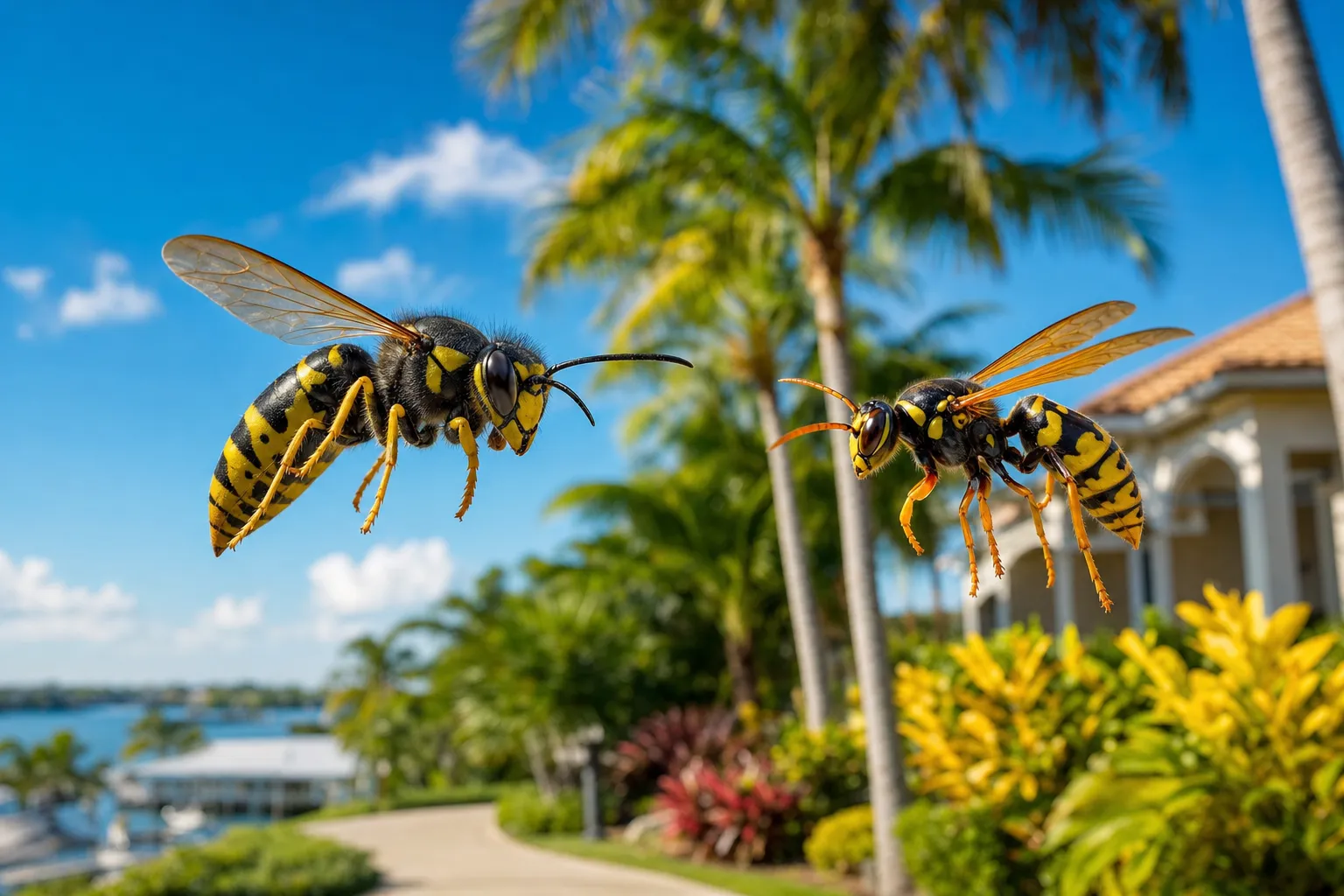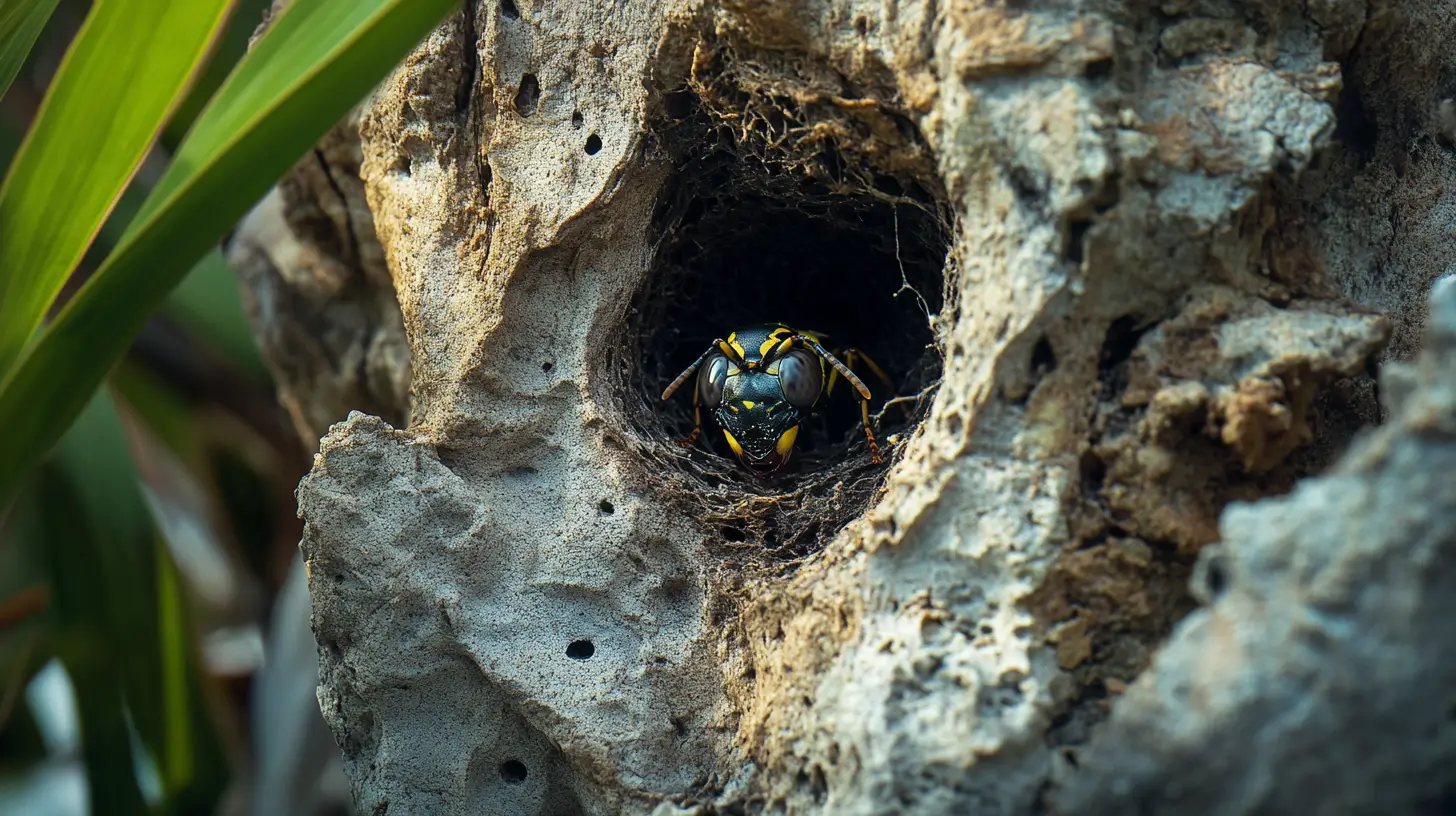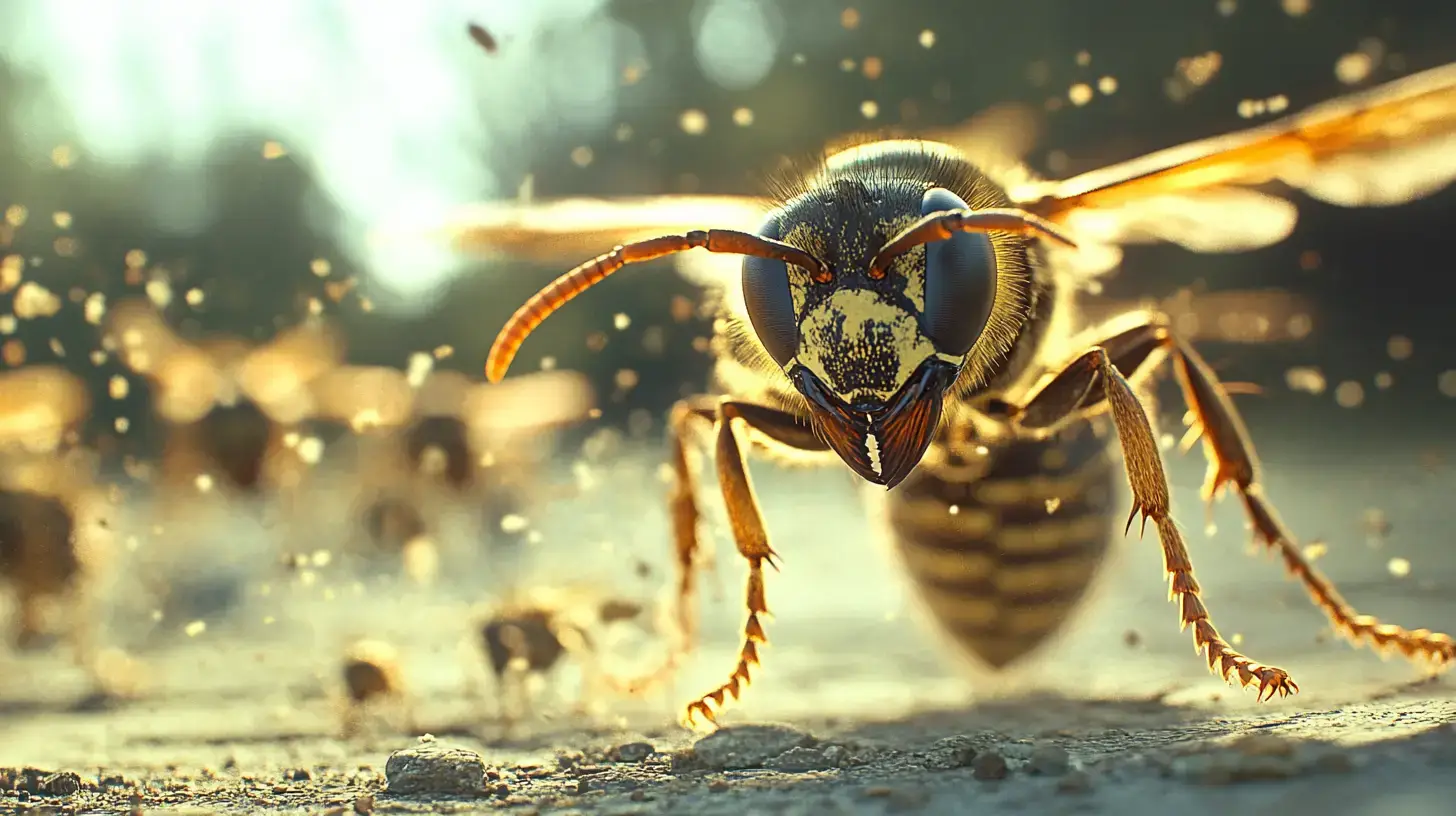
If you’ve spotted a row of little mud tubes stuck to your porch ceiling and immediately Googled “does mud daubers sting” before getting anywhere near it — smart move, but you can exhale. The short answer is yes, technically they can sting, but they almost never do. Mud daubers are the introverts of the wasp world. They’re not the ones you need to worry about.
If you’d rather skip the entomology lecture and just get those nests off your house, our pest control services team handles wasp knockdowns and nest removal across Southwest Florida — get a quick estimate here and we’ll get you on the schedule.
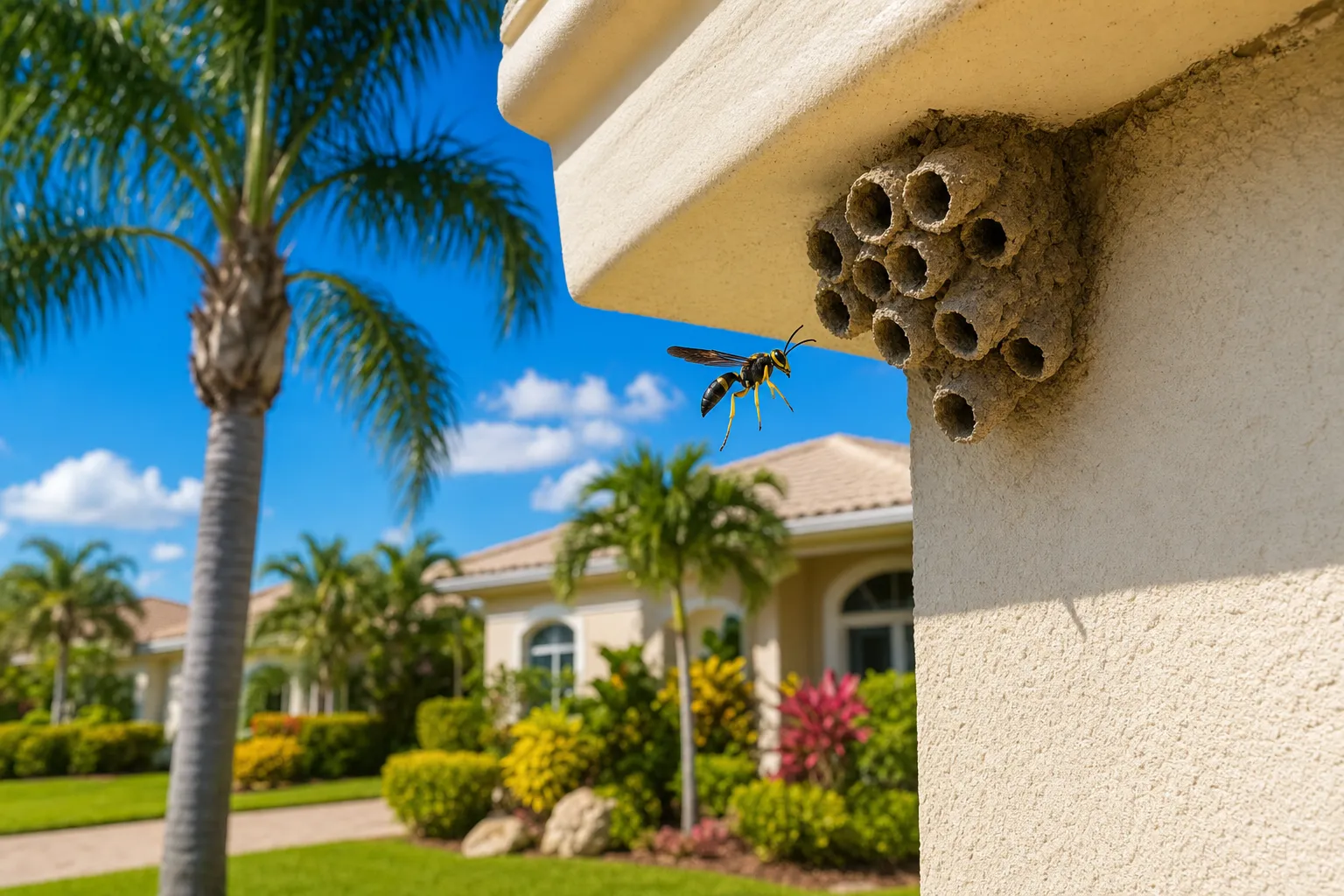
Now, for the curious (or the still-nervous): here’s what’s actually going on with those mud tubes, why SWFL homes get so many of them, and how to tell a chill mud dauber from the wasp you should be running from.
What Is a Mud Dauber, Actually?
“Mud dauber” is a catch-all name for several species of solitary wasps in the families Sphecidae and Crabronidae. In Southwest Florida you’ll mostly run into the black-and-yellow mud dauber and the metallic blue mud dauber. They share a few tell-tale features:
- Long, skinny body with an exaggerated thread-like waist between the thorax and abdomen. They look almost cartoonishly stretched out.
- Black, blue-black, or yellow-and-black coloring depending on species.
- Signature mud nests — either pipe-organ-style tubes stacked side by side, or lumpy blobs about the size of a pack of gum, tucked under eaves, porch ceilings, soffits, sheds, garages, and pretty much any sheltered horizontal surface.
The word “solitary” is doing a lot of work here. Unlike social wasps, mud daubers don’t live in large colonies — each female works alone to build and provision her own mud-cell nest, with no worker caste behind her. No queen, no workers, no hive full of grumpy siblings waiting to swarm you. Just one wasp, one project, and a very focused agenda: build mud tubes, catch spiders, lay eggs, repeat.
On every inspection
How to spot a mud dauber nest
- Pipe-organ tubes Parallel mud cylinders about an inch long stacked under eaves, porch ceilings, or soffits.
- Blob-style nests Irregular mud lumps roughly the size of a gum pack, often tucked in garage corners or sheds.
- Round exit holes A round hole means that cell's wasp has emerged. If every cell in the cluster is open, the nest is likely old; if some are still sealed, treat it as active.
- A single wasp coming and going One wasp, not a swarm. Mud daubers are solitary — no colony behind her.
Mud daubers give you a lot of visual clues before you ever see the wasp itself.
So, Does a Mud Dauber Sting?
Here’s the honest answer, because we know that’s why you’re really here.
Mud dauber wasps are among the least aggressive stinging insects you’ll encounter, and they will not sting unless touched or accidentally caught in clothing. Because mud daubers are solitary, they lack the colony-defense instinct that makes social wasps like yellowjackets and paper wasps so aggressive. There is no hive full of workers ready to swarm when threatened. A female mud dauber’s priority is building her nest and hunting spiders — not defending territory against humans.
The University of Florida’s IFAS Extension puts it plainly: mud daubers and cicada killers usually are not as aggressive and will not sting unless touched or accidentally caught in clothing. That’s the entomologist version of “leave it alone and it’ll leave you alone.”
What about when they do sting? A mud dauber sting causes mild, localized pain similar to a bee sting. The redness and swelling are a normal reaction and usually subside within a day or two. That said, anaphylaxis is possible with any wasp or bee sting, so anyone with a known insect-venom allergy should treat every stinging encounter — mud dauber or not — with the caution they always would. If you carry prescribed epinephrine, keep it in reach; at the first sign of a severe reaction — hives, swelling of the face or throat, trouble breathing, or dizziness — use the epinephrine and call 911 right away. Don’t play hero.
Their stinger is basically a spider-hunting tool. A female paralyzes spiders with her sting and stores them in the mud cells as food for her developing larvae; that sting is rarely turned on humans unless the wasp is grabbed or trapped. Which is kind of metal, honestly — mud daubers are out here providing free black widow control while paper wasps are the ones dive-bombing your grill.
Why Southwest Florida Is Mud Dauber Paradise
SWFL basically checks every box on a mud dauber’s wish list:
- Sandy soil + afternoon storms = infinite mud supply. Every summer downpour turns your driveway edge, flower beds, and any bare patch of yard into premium nest material. That’s why you see so much activity from late spring through the tail end of hurricane season.
- Warm, humid climate. Southwest Florida’s mild winters stretch the wasp season far longer than it runs up north — nest founding ramps up in spring and removal calls peak through late summer and fall. Mud daubers slow down in a cold snap, but they don’t really “go away” the way they do in colder states.
- Endless sheltered horizontal surfaces. Lanais, pool cages, screened porches, garage door tracks, boat lifts, dock pilings — everything we build down here is basically a mud dauber real estate listing.
- A spider buffet. Between the golden silks, wolf spiders, and yes, black widows tucked into your pool equipment shed, our spider population keeps mud daubers extremely well fed. If you want a broader look at what else is buzzing, crawling, and skittering around your property, our pest library breaks down the usual SWFL suspects.
Seasonal pressure
Mud dauber activity through the SWFL year
- Spring Mar–MayBuilding
Overwintered daubers emerge and females start their first mud tubes.
- Summer / rainy season Jun–AugPeak
Daily storms mean unlimited mud — solitary females build at their fastest.
- Hurricane season Sep–OctSurge
Wet ground keeps mud plentiful while the year's last tubes get finished.
- Fall NovActive
Building winds down; the season's final larvae are sealed in to develop.
- Winter Dec–FebLower (not zero)
Mild SWFL winters slow the adults, but sealed tubes hold next spring's wasps.
Summer / rainy season & Hurricane season run hottest. Mud dauber activity tracks with SWFL's warm, wet months — but they're never fully gone.
Should You Just Leave Them Alone?
Honestly? Sometimes, yes. A single mud dauber quietly building a nest in a corner of a rarely-used shed is doing you a favor by eating spiders. Ecologically, they’re the good guys.
But there are real reasons homeowners want them gone, and they’re valid:
- Nests look terrible on a freshly-painted lanai ceiling. Once the mud dries it’s basically concrete — the mix of dirt and wasp saliva sets hard, so scraping a nest off often leaves a stained ghost outline behind.
- Abandoned nests attract other pests. Once the mud dauber is done, other wasps, spiders, and even some bee species will move into the old tubes. Free real estate for the wrong tenants.
- Nests near doors, air vents, and pool cages put a normally chill wasp in your walking path. Startle one by walking through a doorway and you can get stung.
- Attic and soffit intrusions. Nests tucked into an attic cause two headaches: the buzzing of wasps coming and going can be surprisingly loud, and sooner or later one finds her way down into the living space. A mud dauber trapped inside with you is much more likely to sting than one outside minding her own business.
Pro tip from the field: A round exit hole means that particular cell’s wasp has emerged. But a single mud nest holds several sealed cells, and the neighbors can still be occupied — so holes are a clue the nest may be old, not proof it’s empty. Old nests also get repaired, reused, or taken over by other insects. Treat any cluster with a mix of open and sealed cells (or no holes at all) as active: work it in the evening when the wasp is inside and cooler temps slow her down, or call a pro.
Safe Homeowner Steps — And What Not to Do
If you want to handle a mud dauber nest yourself, here’s the SWFL neighbor version of the safety brief:
Do:
- Wait until evening or early morning. Cooler temps + low light = calmer wasp.
- Wear long sleeves, pants, and gloves. Even the least aggressive wasp gets grumpy when her house gets scraped off a wall.
- Check for exit holes first. No holes, or a mix of open and sealed cells, means the nest may still be occupied — more caution needed. Round holes in every cell suggest the wasps have emerged, but check the whole cluster before you assume it’s empty.
- Use a putty knife or paint scraper to pop the nest off cleanly, drop it in a sealed bag, and toss it in an outdoor trash bin.
- Scrub the spot with soapy water to remove pheromone traces that signal “good nesting site” to next year’s generation.
- Fix standing water issues. Less mud = fewer mud daubers. Clean gutters, fix drainage puddles, and don’t leave wet dirt piles sitting next to the house.
Don’t:
- Don’t empty a can of wasp spray into an active nest and walk away. Aerosols can damage paint, kill beneficial pollinators downwind, and often just chase the wasp into your soffit or attic instead of killing her.
- Don’t stand directly under a nest and swing a broom at it. You will absolutely get stung, and you’ll deserve it a little.
- Don’t ignore a nest inside your home. A mud dauber that finds her way through a recessed light fixture or attic vent is one interior encounter away from a defensive sting.
- Don’t confuse a mud dauber nest with a paper wasp nest. Papery honeycomb nest with visible cells and multiple wasps on it = paper wasp, and that’s a different (much more aggressive) animal.
Your home, zone by zone
Where mud daubers actually build on SWFL homes
A typical Southwest Florida home — the numbered zones a local tech walks on every visit.
- Stucco walls & slab corners Sheltered vertical corners near the foundation — like the nest in our hero photo.
- Porch & entry overhangs Right above the doors you walk through daily.
- Eaves & soffits Up under the roofline, out of the rain — their top pick.
- Weep holes & lower walls Block-wall gaps that lead behind the veneer.
- Garage corners & door tracks Especially garages left open during the day.
- Lanai & pool cage framing Screened-in doesn't mean bug-proof. Look up at the framing.
- Bed edges & bare soil Not a nest spot — it's their mud supply after every storm.
- Interior walls & ceilings Where nests end up once a wasp slips inside.
- Pipe & utility penetrations The gaps that let her slip into the living space.
- Attic & gable vents The way indoors when a vent screen fails.
These are the spots a Waves Pest Control tech checks first during a wasp inspection.
When to Call a Pro
Look, a lot of mud dauber situations really are one-and-done DIY jobs. But there are cases where calling in Waves’ pest control team is the smart play:
- Repeat nesting in the same spot year after year. Generations return to the original site. You’re not going to out-scrape a wasp that has a genetic memory for your porch ceiling.
- Nests inside attics, wall voids, or soffits. These need careful treatment and often mechanical exclusion — not a can of spray.
- You’re allergic to bee or wasp stings, or you’re not sure. Don’t roll the dice.
- You can’t tell what species you’re dealing with. Mud daubers are chill; paper wasps and yellow jackets are not. A tech can ID the nest and treat accordingly.
- The nests keep coming back even after removal. That’s a sign of environmental attractants — mud sources, spider populations, sheltered harborage — that a routine treatment plan is built to address.
Our approach is boring in the best way: identify the species, treat active nests with non-repellent products that don’t just chase the wasps into your attic, mechanically remove the mud, and knock down the spider population that’s drawing them in the first place. If you want that handled quarterly so you’re not thinking about it at all, that’s exactly what the WaveGuard membership is built for.
Frequently Asked Questions
What kills mud daubers instantly?
Direct contact with almost any wasp aerosol will kill an individual mud dauber on the spot. But killing a mud dauber and controlling mud daubers aren’t the same thing, and control is harder for two reasons. First, generations tend to return to the original nest site to lay eggs, so a cleared spot gets reclaimed. Second, common residual sprays act as repellents — instead of killing the wasp, they can push her into untreated areas like the attic or a wall void. That’s why pros lean on non-repellent products applied to landing surfaces rather than fogging the whole eave.
What happens if a mud dauber stings you?
Expect a sharp pinch followed by localized swelling and redness — similar to a bee sting. That reaction is normal and usually subsides within a day or two. Wash the area, ice it, and take an antihistamine if you tend to swell. If you know you’re allergic to bee or wasp venom, or you develop hives, dizziness, throat tightness, or trouble breathing, treat it as a medical emergency: use your prescribed epinephrine and call 911 right away.
Are mud daubers the worst wasp to get stung by?
Nope — not even close. Mud dauber stings are among the mildest wasp stings you can get. The wasps most SWFL homeowners actually need to worry about are paper wasps, yellow jackets, and bald-faced hornets, which will sting repeatedly and defend their nests aggressively. If you’re seeing a papery honeycomb-style nest or a football-shaped enclosed nest instead of mud tubes, you’re dealing with a very different (and more dangerous) situation.
Will mud daubers chase you?
Almost never. They don’t have a colony to defend, so there’s no swarm-and-pursue behavior baked into their DNA. If you get too close to an active nest, a female might buzz around you as a “please back up” gesture — but she’s not going to chase you across the yard the way a yellow jacket will.
Bottom Line
Mud daubers can sting. They just really, really don’t want to. If you’ve got a few mud tubes on the eaves and nothing else going on, you can usually knock them down in the evening with a putty knife and call it a Tuesday. If they keep coming back, or you’re finding them inside the house, or you’re seeing a mix of wasp species you can’t ID, that’s when it’s worth having a pro walk the property.
Ready to stop playing wasp roulette every time you open the lanai door? Get your Waves pest control quote or see how WaveGuard’s quarterly service keeps mud daubers, spiders, and their friends off your house year-round. We’ll bring the ladder.