Jump to a section (7)
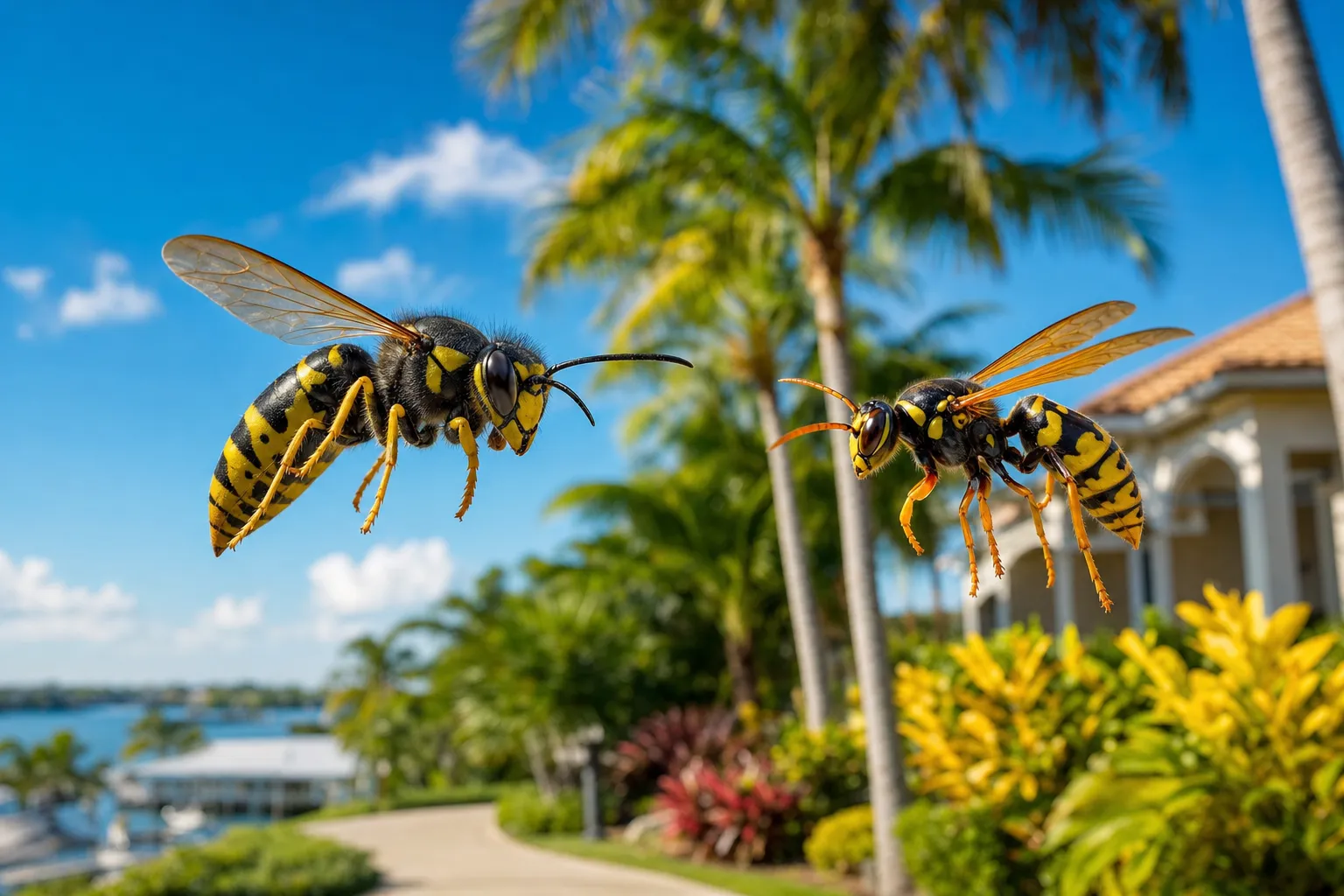
If you just Googled “murderous hornets” after spotting something the size of your thumb dive-bombing your citrus tree in the backyard — first, take a breath. Second, welcome to Southwest Florida in summer, where the wasps and hornets get big and dramatic and people understandably lose it.
Here’s the short answer up front: the actual “murder hornet” — the northern giant hornet, Vespa mandarinia — has never been documented in Florida. It briefly showed up in Washington state and southern British Columbia starting in 2019, USDA and Washington State Department of Agriculture ran a multi-year eradication program, and in December 2024 they officially declared it eradicated from the U.S. It’s not here. It’s not on its way here. What you’re seeing in your yard is one of a handful of native or long-established SWFL stinging insects that just happen to look terrifying.
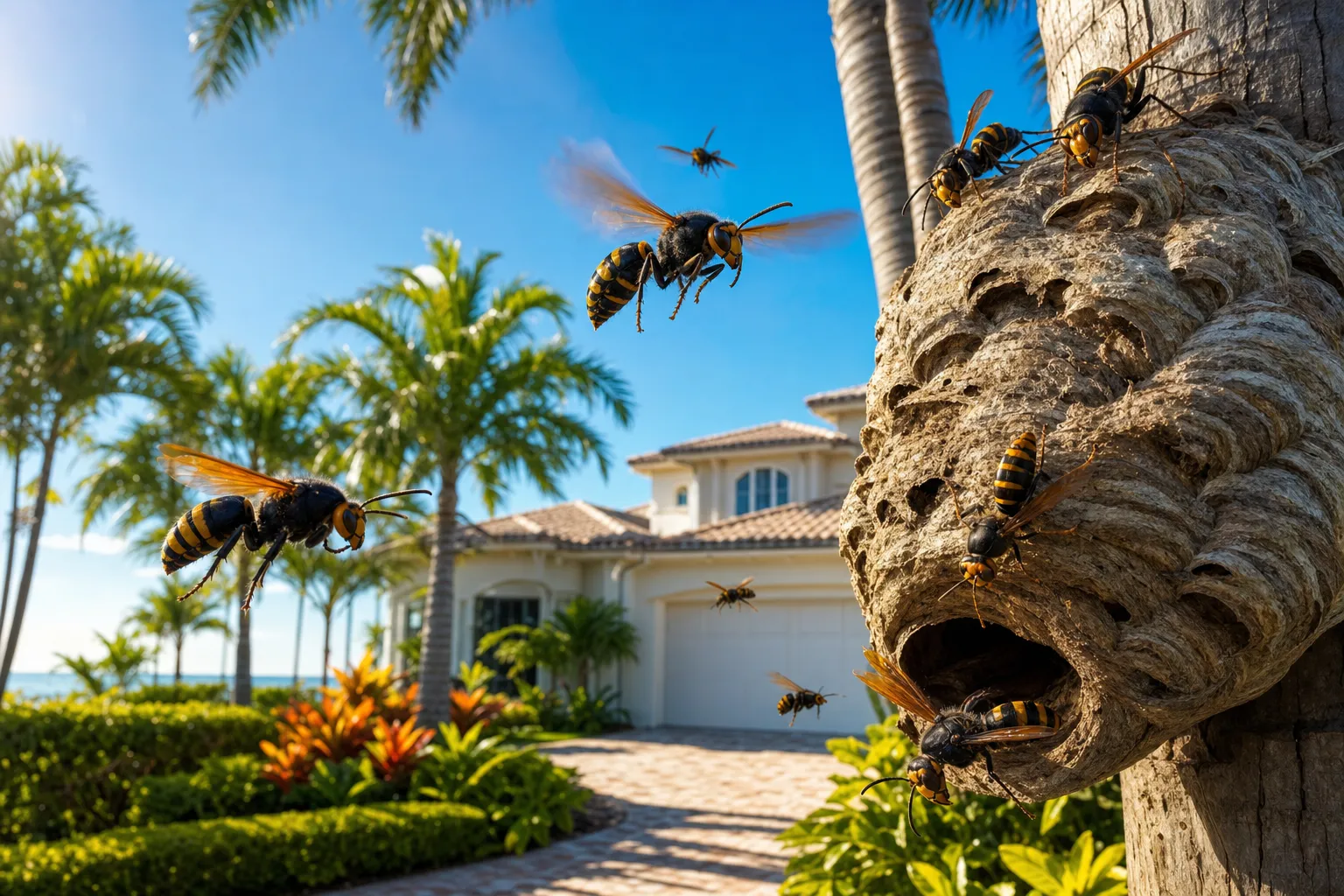
That said, “not a murder hornet” doesn’t mean “harmless.” Some of the wasps you’ll bump into between Bradenton and Naples can absolutely put you in an urgent-care waiting room if you kick their nest. If a stinger has already turned into a nest problem on your property, skip the identification rabbit hole and get a pest inspection scheduled — the tech will ID it and handle removal safely. For everyone else who just wants to know what the giant angry thing is, keep reading. You can also browse our full SWFL pest library if you’d rather match a photo than read.
What “murder hornets” actually are (and why they aren’t here)
Vespa mandarinia, now officially called the northern giant hornet, is a species native to parts of Asia. They’re the largest hornets in the world — queens can push two inches long — and they earned the “murder” nickname mostly because of what they do to honeybee colonies, not because they hunt humans. A handful of stings a year in their native range are fatal, usually to people with allergies or people who stumble into a ground nest of them.
Two things you should know:
- They only ever established a foothold in the Pacific Northwest. Detections were confined to Whatcom County, Washington and adjacent parts of British Columbia. Nothing in Florida. Nothing in the Southeast. Nothing near the Gulf.
- USDA and WSDA declared them eradicated from the U.S. in December 2024, after three straight years with zero confirmed detections. The traps stayed out. Nothing came back.
So if a headline from 2020 is still living rent-free in your head every time you see a big striped wasp on your lanai screen, you can retire that fear. The bug is not the bug.
What SWFL homeowners actually see
Southwest Florida’s sandy soil, warm winters, and daily summer storms make this region a genuinely great place to be a wasp. Here’s the short list of stinging insects that get called “murder hornets” around here — none of them are, but a couple of them are still worth respecting.
Eastern cicada killer (Sphecius speciosus)
The number-one “OH MY GOD IT’S A MURDER HORNET” culprit in SWFL. Cicada killers are huge — up to two inches — with rust-colored heads, dark wings, and yellow-and-black striped abdomens. They cruise low over lawns in July and August, dig finger-sized burrows in bare sandy patches, and generally look like something out of a monster movie.
Here’s the plot twist: they’re nearly harmless. Females can sting but almost never do unless you grab one. Males are territorial and will fly right at your face, but they have no stinger at all. It’s pure theater.
Paper wasps (Polistes spp.)
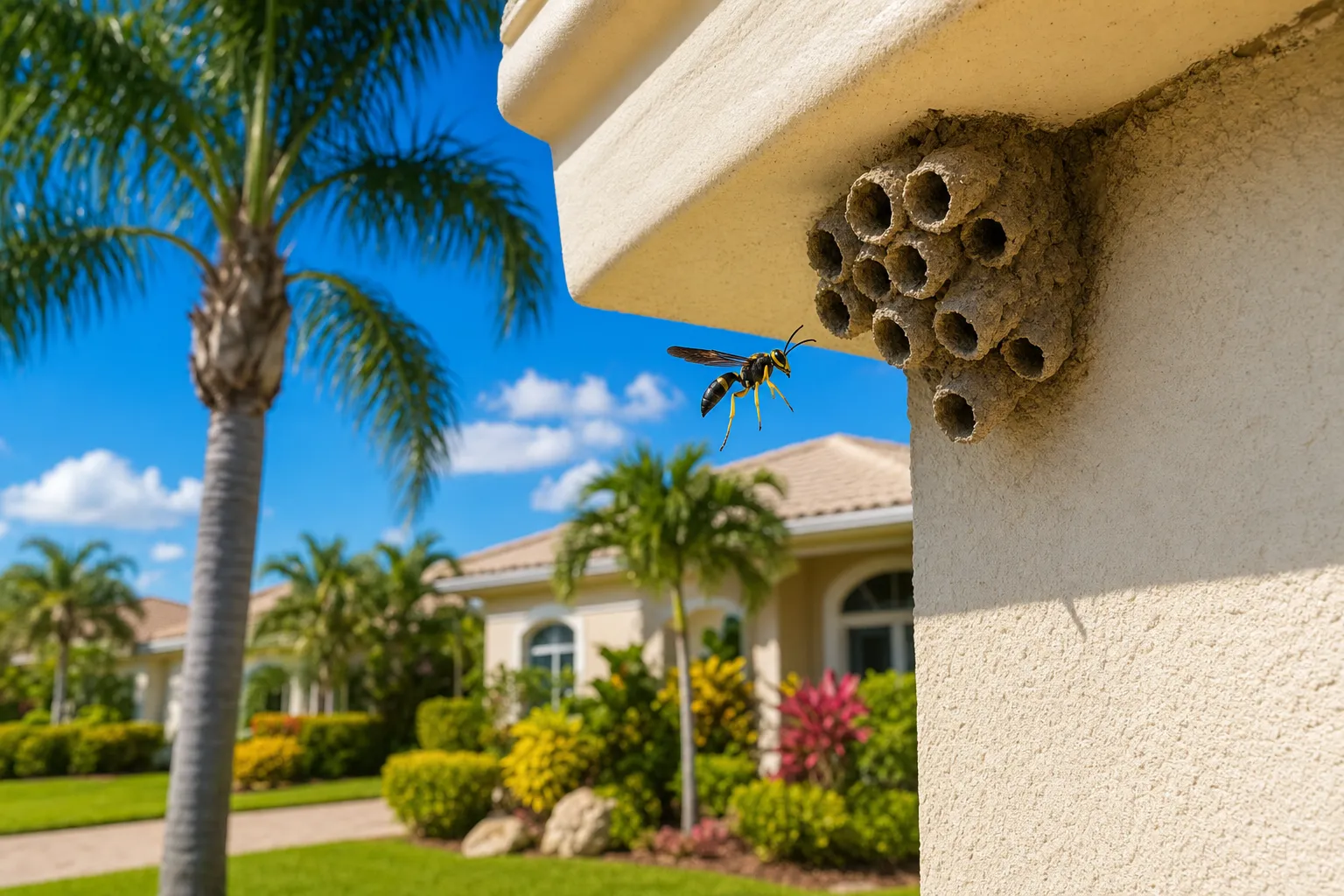
The reddish-brown or dark wasps building open, umbrella-shaped nests under your soffit, grill lid, or patio furniture. Common year-round in Sarasota, Fort Myers, and Naples. Not aggressive unless the nest is disturbed, but the stings genuinely hurt and can trigger allergic reactions.
Bald-faced hornets (Dolichovespula maculata)
Technically a yellowjacket, not a true hornet. Black-and-white, builds those big grey papier-mâché football nests you sometimes see hanging from an oak or a gable. Aggressive around the nest. If one of these shows up over your entryway, do not try the tennis-racket approach — that’s the fastest way to earn 40 stings and an ER copay.
European hornet (Vespa crabro)
The one insect on this list that could actually pass for a “murder hornet” at a glance — brown and yellow, up to an inch and a half long, and it flies at night, which is unusual. Established in the eastern U.S. It shows up occasionally in Florida but is not common in SWFL. Still not Vespa mandarinia.
Yellowjackets (Vespula spp.)
Ground-nesting, short-tempered, and the wasp most likely to actually chase you across a yard. If you mow over a nest, you’ll know within about four seconds. Peak abundance in SWFL is late summer into fall.
Why Southwest Florida is a wasp buffet
A few things about our climate stack the deck:
- Sandy soil. Cicada killers and some yellowjackets need loose, well-drained dirt to dig into. That’s basically the entire coastal strip from Bradenton to Bonita Springs.
- Afternoon storms. Regular rain means constant flowering plants, which means constant nectar, which means adult wasps stay energetic for months.
- St. Augustine lawns. Thick turf hides ground nests until you’re on top of them with a mower. Every summer we get calls that start with “I didn’t see it until…”
- Year-round warmth. Colonies that would collapse in a hard freeze up north just keep humming along here.
None of that summons murder hornets. It does mean you’ll be sharing the yard with something stripe-y for most of the year.
Pro tip: If you see a big wasp digging in the sand instead of building a papery nest, it’s almost certainly a cicada killer — not a hornet at all. Leave the burrows alone and they’re gone in about six weeks. If you see a papery nest under an eave or a grey football hanging in a tree, that’s when you want a professional to knock it down safely.
What to do (and not do) when you find a nest
You can handle some situations yourself. Others really are worth a phone call. Here’s the honest breakdown.
Safe checks you can do:
- Watch from at least 20 feet away for a few minutes. Count how many wasps go in and out per minute. Anything more than one every couple of seconds means an active, mature colony — not a DIY job.
- Note the nest shape. Open umbrella = paper wasp. Enclosed grey football = bald-faced hornet or aerial yellowjacket. Hole in the ground = yellowjacket or cicada killer.
- Check when they’re active. Most stinging insects here work dawn to dusk. If you see something flying around a nest opening at night, that’s a European hornet flag.
Do NOT:
- Spray a can of over-the-counter wasp killer at a big enclosed nest during the day. You’ll agitate hundreds of wasps at once and they know exactly where you’re standing.
- Plug a ground nest with dirt or pour gasoline down the hole. Both are old-timer advice that gets people stung and, in the gasoline case, in trouble with the state.
- Knock a nest down with a broom “real quick.” No such thing as real quick with wasps.
- Assume it’s the same species you had last year. Colonies rotate.
Call a professional when:
- The nest is bigger than a softball, enclosed, or in a spot you can’t retreat from quickly (over a doorway, near a pool cage entrance, in a kid’s play area).
- You or anyone in the household has a stinging-insect allergy.
- You’ve been stung once already going near it. That was your free warning.
- You can hear the nest before you see it.
How Waves handles stinging insects in SWFL
Our stinging-insect calls generally break down into two buckets. Nests we can knock out during a normal service visit — paper wasps under a soffit, small aerial nests on a lanai frame — we handle in-line with a targeted product application and physical removal. Larger, well-established colonies (mature bald-faced hornet nests, wall-void yellowjackets, ground nests near heavy foot traffic) get treated as a dedicated visit with the right PPE and a follow-up check to make sure the colony’s actually done.
If wasps are a recurring problem at your property — which they will be if you’ve got mature oaks, a pool cage, or a lanai anywhere in our service area, from Bradenton, Parrish, and Lakewood Ranch down through Sarasota, Venice, North Port, and Port Charlotte — a WaveGuard membership helps by keeping general pest pressure down and catching small wasp starts on the recurring visits before they grow into established colonies. Large or mature nests that need a dedicated removal visit are quoted separately; the pest control calculator covers both one-time treatments and the quarterly plan if you want to compare.
For more on what we actually treat and how the visits are structured, see our full pest control services rundown, or dig into our guide to getting rid of wasps and our post on Florida pest pressure by season for extra homework.
Frequently Asked Questions
Are murder hornets in Florida in 2026?
No. The northern giant hornet (Vespa mandarinia) has never been confirmed in Florida. Detections were limited to Washington state and British Columbia between 2019 and 2021, and USDA and WSDA declared the species eradicated from the U.S. in December 2024. Anything you’re seeing in a SWFL yard is a different species.
What’s the biggest wasp in Southwest Florida?
The Eastern cicada killer is the largest wasp you’re likely to see in Sarasota, Manatee, Lee, or Collier counties — females routinely hit 1.5 to 2 inches. They look terrifying and act aggressive but very rarely sting people. European hornets can approach a similar size but are much less common here.
Should I try to remove a large wasp nest myself?
Generally, no. Once a nest is bigger than a softball, enclosed, or in a spot where you can’t back away quickly — over a door, near a pool cage entrance, in a wall void — the risk of multiple stings goes up sharply. Grocery-store wasp spray is designed for small, open paper-wasp nests, not mature yellowjacket or bald-faced hornet colonies. That’s when you call a pro.
Ready to stop guessing?
If there’s something big and stripe-y patrolling your lanai and you’d rather have someone else figure out what it is and remove it, book a pest inspection with Waves or call the office at (941) 297-5749. We’ll ID the actual species, handle the nest, and — spoiler — it will not be a murder hornet.