You put the coffee pot down for one afternoon, come back, and there’s a highway of tiny ants running from the baseboard to a sticky ring on the counter. Welcome to sugar ant season in Southwest Florida — which, unfortunately, is basically all twelve months.
The good news: if you’ve been spraying every ant you see with kitchen cleaner and wondering why more keep showing up the next morning, you’re not doing anything wrong on purpose. You’re just working from the wrong playbook. This guide walks you through what “sugar ants” actually are in Florida, why they suddenly parade across your counter, and the bait-first approach that actually clears them out. If you’d rather just have somebody handle it, our pest control services team runs this exact protocol on kitchens across Sarasota, Manatee, and Charlotte counties every week — get a ballpark on the pest control calculator and skip to the end.
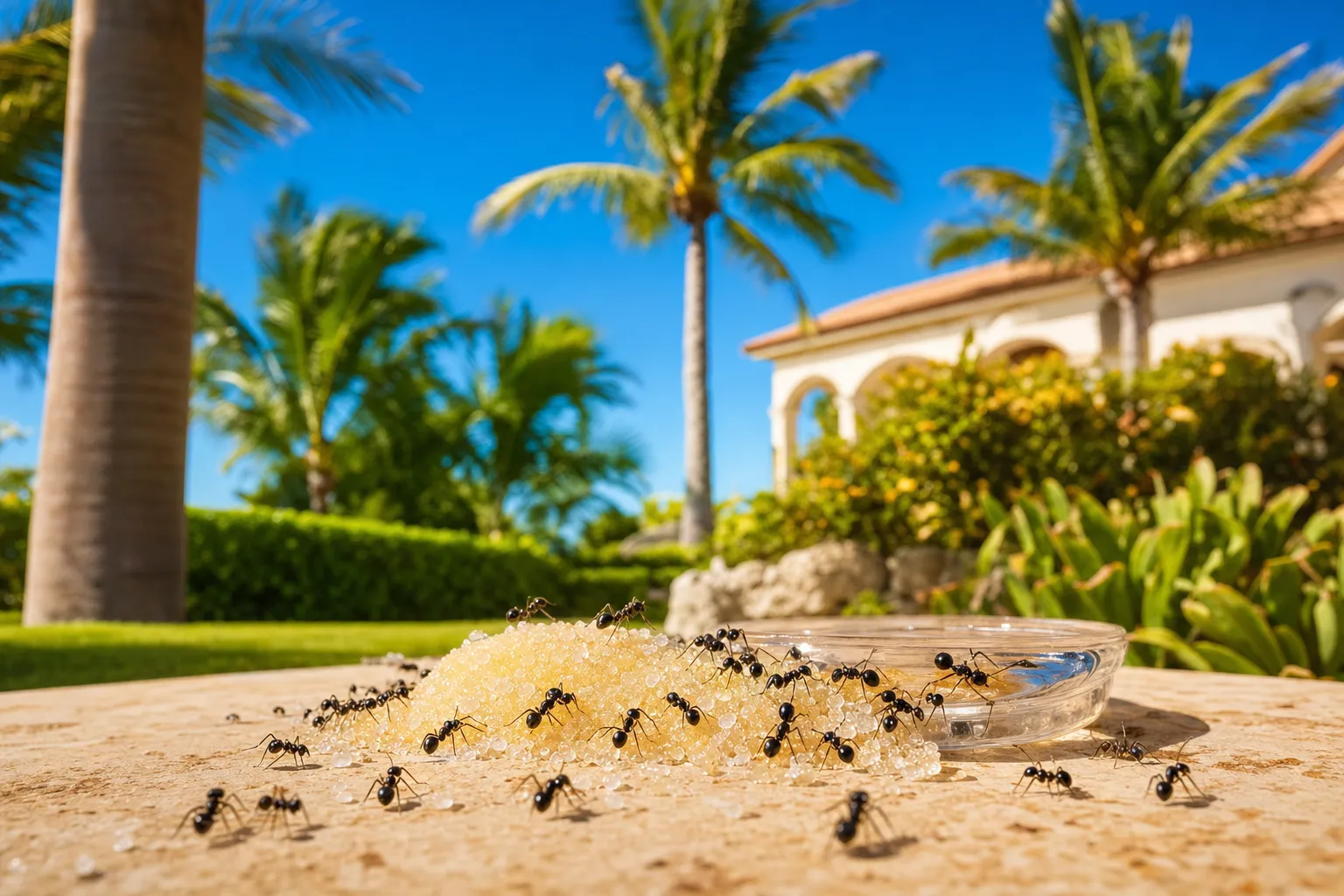
What “Sugar Ants” Actually Are in SWFL
“Sugar ants” isn’t a species — it’s a homeowner nickname for any small, sweet-feeding ant that shows up on a countertop. In Southwest Florida, the usual suspects are:
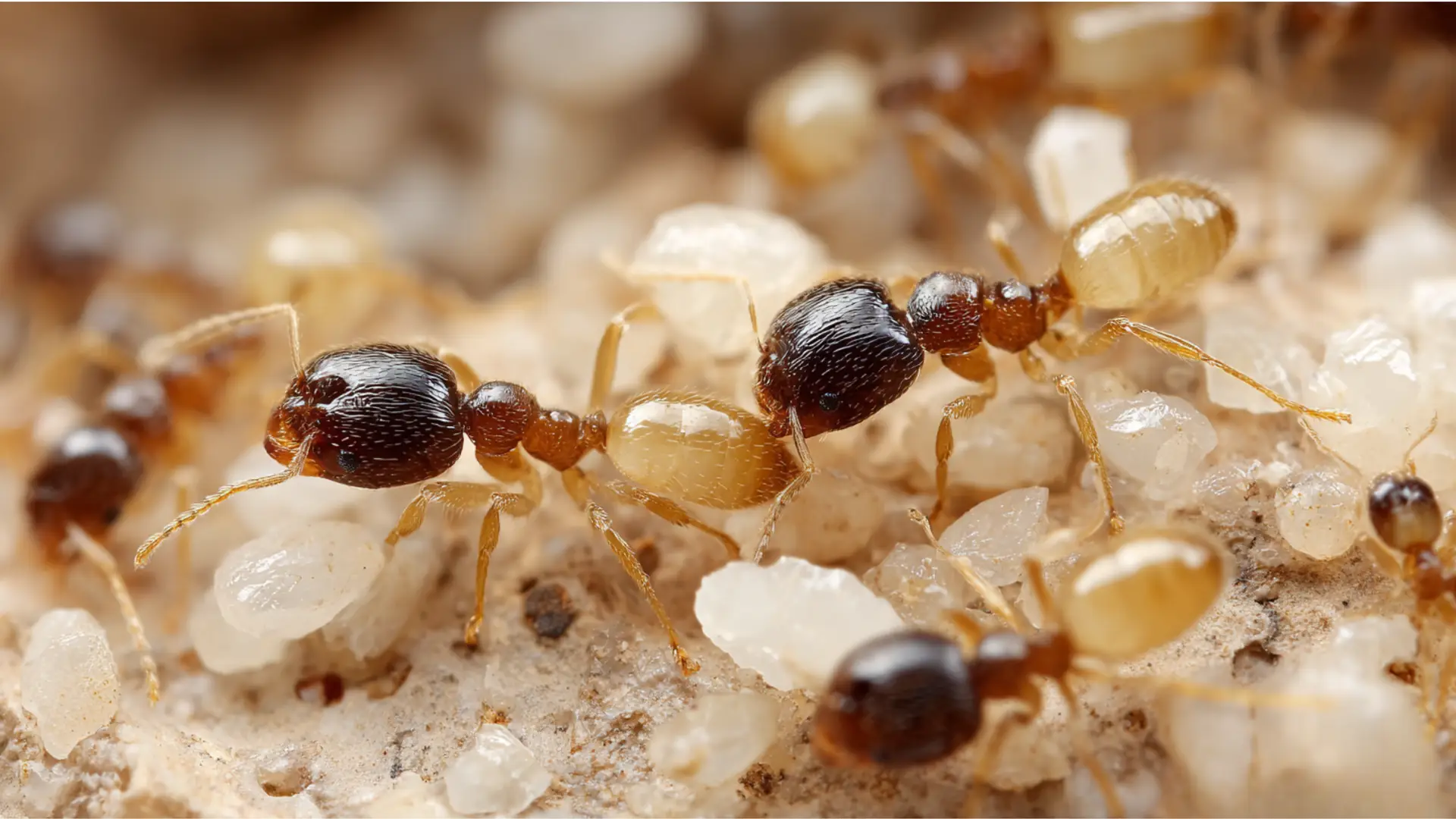
- Ghost ants — pale, almost translucent legs and abdomen, about 1/16 inch. Nest in wall voids, potted plants, and behind switch plates. Love anything sugary and split their colonies when disturbed, which is the reason spray-and-pray backfires.
- Odorous house ants — dark brown, slightly bigger. Squish one and it smells faintly like rotten coconut (yes, really). Also multi-queen and prone to fragmenting.
- White-footed ants — dark body, pale feet, common around trees and shrubs pressing on the house.
- Little black ants — exactly what they sound like.
What most of them share: they’re polygynous (multiple queens) and readily bud into new colonies when you hit them with a repellent spray. That’s why the can of ant killer under your sink can genuinely make the problem worse.
What they don’t share is a treatment plan. Bait chemistry and placement differ by species — ghost ants, big-headed ants, and crazy ants each respond to different bait types and placements, and carpenter ants are a structural problem, not a countertop one — so identification comes first (it’s step 3’s opening move below). Colonies also shift between sugar and protein feeding with the season, so the bait that worked in March may get ignored in August.
Our pest identifier has pictures and behavior notes for several of the big players — ghost, big-headed, fire, carpenter, tawny crazy, and white-footed ants. It doesn’t profile odorous house ants or little black ants yet, so if you think that’s what you’ve got, snap a close-up photo and send it to us for a free ID.
Pro tip: put down the spray
If you take one thing from this article: for kitchen ants, do not spray a repellent pesticide (Raid, Ortho Home Defense, most big-box aerosols) on the trail. It kills the foragers you can see, scatters the colony, and triggers a survival response called “budding” where the colony splits into two or three new nests deeper in your walls. You just made your problem harder.
Why Sugar Ants Suddenly Appear in Your Kitchen
Two possibilities, and both are common here. Either the colony has been outside the whole time and something just gave it a reason to come in — or it’s already living inside: ghost ants in particular nest in wall voids, potted plants, and behind switch plates, and colonies move between rooms through shared plumbing chases. The triggers below explain the outdoor-origin trails; if your trail keeps starting at the same wall outlet or pipe gap with no path to the outside, think indoor nest.
- Afternoon storms. The daily 3 p.m. summer downpour floods shallow nests in our sandy soil, and ants march indoors looking for dry ground. This is why a rainy week almost always means an ant call.
- Sandy, well-drained yards. SWFL soil is basically a giant ant condominium. Nests are shallow, mobile, and everywhere.
- Landscaping touching the house. Palms, St. Augustine grass, and mulch beds bridging up to the slab are ant on-ramps.
- Food and water rewards. A crumb behind the toaster, a dog bowl left overnight, a leaking dishwasher hose — any of it is a trailhead.
- Cracks and utility penetrations. Ants come in around plumbing, dryer vents, weep holes, and the gap under sliders.
Once one scout finds food, she lays a pheromone trail and the rest of the colony follows. That’s the line you’re seeing on the counter — a scent highway, not a random walk.
Seasonal pressure
When sugar ants hit SWFL kitchens
- Spring Mar–MayBuilding
Colonies grow fast as it warms; scouting indoors picks up.
- Summer / rainy season Jun–AugPeak
Daily downpours flood shallow nests — kitchen trails become a weekly event.
- Storm-surge months Sep–OctSurge
The year's heaviest indoor push — major storms displace whole colonies at once.
- Fall NovActive
Drier and cooler, but trails keep showing up around food and water.
- Winter Dec–FebLower (not zero)
Mild winters mean indoor-nesting ghost ants never really stop.
Summer / rainy season & Storm-surge months run hottest. Ant pressure never really drops to zero in SWFL, but wet-season storms are when kitchens light up.
The Actual Plan: How to Get Rid of Sugar Ants
Here’s the sequence that works. Do the steps in order.
1. Follow the trail before you kill it
Resist the urge to wipe. Get down at counter level and watch where the trail comes from and where it disappears — behind the fridge, up the wall, under the trim. Note the entry point. If you can, watch for 30 seconds and follow the returning ants (the ones walking away from the food) toward the nest side.
2. Clean the food source, not the trail
Wipe up the spill, seal the honey jar, take out the trash, wash the pet bowl. Do not wipe the pheromone trail with vinegar or bleach yet — you want the ants to keep using it so they can find the bait.
3. Identify the ant, then match the treatment to the species
This is the whole game — and it starts with actually identifying the ant, because the right treatment depends on the species, not on what the colony happens to be eating this week. Match what you’re seeing against the pest identifier — size, color, where the trail leads. It profiles several of the big players (ghost, big-headed, fire, carpenter, tawny crazy, and white-footed ants); if your ant isn’t one of those, or you can’t make a confident match, snap a close-up photo and send it to us. An ID costs you nothing, and treating an unidentified ant is the classic way DIY fails.
What the ID changes:
- Ghost ants, odorous house ants, little black ants — the classic sweet-feeders. These are the ones a slow-acting, sugar-based gel bait actually works on, so the bait plan below is written for them.
- White-footed ants — the exception that proves why ID matters: they famously ignore most baits (workers share little food with the colony), so a gel that clears a ghost-ant trail barely dents them. Do not use the gel-bait plan below for these — it will waste your time. Focus on trimming the vegetation bridges they travel and call for a professional treatment, because DIY baiting alone reliably fails on this species.
- Large ants active at night — possibly carpenter ants, a structural issue that deserves an inspection, not a countertop gel.
If — and only if — you’ve confirmed a sweet-feeder (ghost, odorous house, or little black ant), a quick preference test tells you which formulation the colony wants right now: put a dab of honey next to a dab of peanut butter and watch which one the trail hits. (Feeding preference shifts with the season — it tells you what the colony wants today, not what species it is, which is why it comes after identification.)
- If they swarm the honey, the colony is on a sweet kick — use the slow-acting, sugar-based gel described below.
- If they swarm the peanut butter instead, the colony is currently protein/fat-feeding, so a sugar gel will likely get ignored — switch to a slow-acting, protein-based ant bait labeled for indoor use (same placement rules below), or, if you can’t source the right formulation or the ants ignore what you put down, call us rather than dosing the trail with a bait it won’t touch.
Then — for a confirmed sweet-feeder, never for white-footed ants, and using whichever formulation the preference test just pointed you to — place a few pea-sized dabs of a slow-acting ant bait gel labeled for indoor use along the trail and at the entry point — not a puddle. Read and follow the product label exactly. That means keeping gel off countertops, cutting boards, and any food-preparation or food-contact surface — use the cracks, crevices, and enclosed bait placements the label directs instead — and putting every drop where children and pets cannot see or reach it. Slow-acting matters: foragers need time to carry the bait home and feed the queen and brood before it takes effect, which is exactly what you want with multi-queen species like ghost ants.
Give it 3–7 days. Trails will get worse for the first 24–48 hours as more workers recruit to the bait. That’s a good sign, not a bad one.
4. Do not spray over the bait
Repellent sprays and bait cancel each other out when they share a zone — which is why the indoor plan is bait-only. The exterior perimeter is a different story, and it’s a licensed applicator’s job precisely because it’s not one product: a routine professional visit deliberately combines repellent and non-repellent materials, placed so the exterior barrier and your indoor bait never work against each other. What you can’t do is approximate that with a hardware-store can sprayed inside next to the gel.
5. Close the on-ramps
Once the interior calms down, seal exterior cracks, trim landscaping back off the walls, fix the dripping AC line, and get mulch a few inches away from the slab. This won’t make the house ant-proof — nothing in Florida will — but it closes the easiest routes back inside and makes the next scout’s job a lot harder.
Your home, zone by zone
Where an ant call focuses
A typical Southwest Florida home — the numbered zones a local tech walks on every visit.
- Foundation perimeter The exterior barrier band where the treatment intercepts foragers crossing in from the yard.
- Entry points (doors/sliders) Thresholds and the gap under sliders where trails cross inside.
- Eaves & soffits Where vegetation touches the roofline — an elevated ant highway onto the structure.
- Weep holes Block-wall gaps ants use to get behind the veneer.
- Garage corners The garage-door seam and clutter edges — a favorite quiet entry.
- Lanai & screen cage Trails run the cage base and slab seam, especially after storms.
- Mulch beds & turf edges Damp landscaping against the slab where shallow nests sit.
- Interior baseboards Followed when there's active indoor pressure — the trail line to the entry point.
- Kitchen & bath plumbing gaps Pipe penetrations colonies use to move room to room; checked on indoor calls.
- Attic Checked when trails climb walls — large-ant territory that changes the plan.
An ant treatment is exterior-focused — knocking pressure down at the property line — with interior work when there's active indoor pressure or you ask for it.
What Not to Do (Common Mistakes We Fix Every Week)
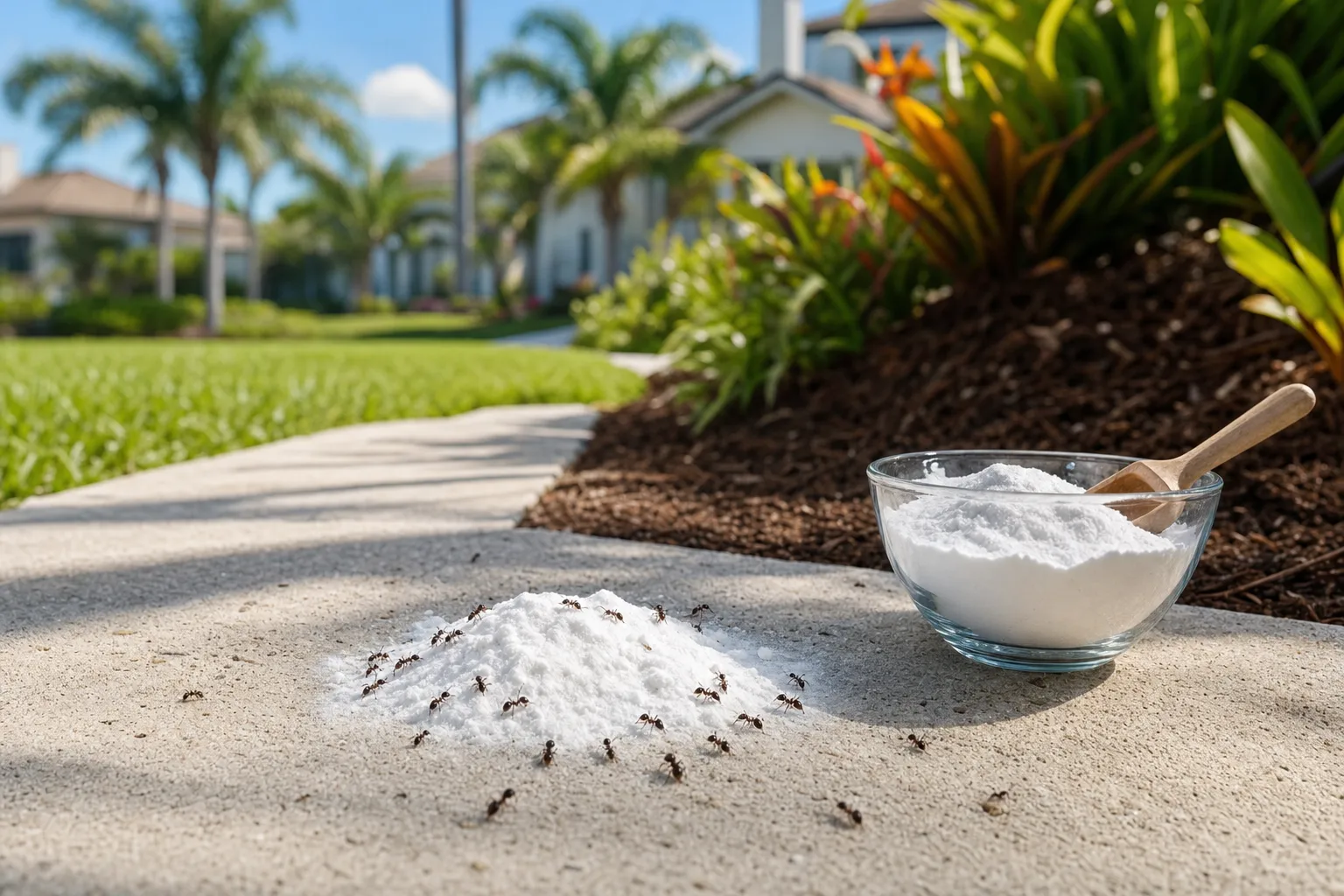
- Vinegar and essential oils on the counter. These wipe the pheromone trail temporarily. Cool. The colony is still in the wall. They’ll blaze a new trail by dinner.
- Buying the strongest-sounding aerosol at the hardware store. See “budding,” above. On ghost ants especially, this is how a one-counter problem becomes a three-room problem.
- Boric acid puddles. Homemade sugar-and-borax bait can work, but the concentration matters. Too strong and it kills foragers before they get home — same failure mode as spray.
- Ignoring the outside. If your yard is a nest and your foundation is a doorway, kitchen treatment alone is a rerun waiting to happen.
- Giving up after two days. Bait needs a week. Don’t switch strategies on day 3 and reset the clock.
When to Call a Pro
Call somebody (us, ideally) if:
- You’ve been baiting correctly for 10+ days and trails are not shrinking.
- You’re seeing ants in more than one room, or in bathrooms and bedrooms — that usually means multiple satellite colonies.
- You spot winged ants indoors (could be an ant swarm, could be termites — worth an ID either way).
- The trails are coming from an exterior wall you can’t access, an attic, or a slab crack.
- You just don’t want to deal with it. Fair.
Most SWFL homes do best on quarterly exterior pest control that keeps ant pressure knocked down at the property line so the kitchen rarely becomes the battleground. No honest company will promise you’ll never see another ant — Florida doesn’t work that way — but that quarterly cadence is exactly what we run across Sarasota, Bradenton, and everywhere in between. And any recurring plan on autopay automatically activates WaveGuard benefits — it’s not a membership you buy, it’s the perks tier that kicks in on its own once you’re enrolled in autopay — including free re-treatment if ants flare up between visits.
| Approach | DIY spray-and-wipe | Bait-first DIY | Quarterly pro program |
|---|---|---|---|
| Kills the ants you see | Yes | Slow (2–5 days) | Yes |
| Reaches the queen | No | Yes | Yes |
| Risk of colony budding | High | Low | Low |
| If they come back | They usually do | You re-bait and wait | Free re-treatment |
| Handles exterior nest pressure | No | No | Yes |
Why 'just spray it' keeps failing on SWFL sweet ants.
Frequently Asked Questions
How do you permanently get rid of sugar ants?
There’s no truly “permanent” fix in Florida — new colonies are always forming in the yard next door. What works long-term is a two-part plan: bait interior trails until the visible colony is gone, then keep a non-repellent perimeter treatment on the exterior every 60–90 days so foragers get intercepted before they ever reach your slider.
Does Dawn dish soap actually kill sugar ants?
A soapy water spray drowns individual ants on contact and wipes the pheromone trail. That’s it. It does nothing to the nest, and the trail will be re-laid within hours. One important caveat: once bait is down, keep soap away from the baited trail entirely — killing the foragers and erasing the trail interrupts the bait’s ride back to the colony, which is the whole point of steps 2 and 4. Soap is only a stopgap before you bait, or on stray ants far from any bait placement.
Why do I suddenly have sugar ants when I didn’t last month?
Almost always one of three things: a new food source they finally scouted (a spill behind an appliance, pet food, a leaky pipe), a weather shift like a big rain event pushing outdoor nests inside, or landscaping/mulch that grew into the wall and gave them a new bridge. Walk the outside of the house and look for the change.
Ready to Stop Playing Whack-A-Trail?
Bait-first works, but it works faster and lasts longer when the outside of your house isn’t a highway. If you’re tired of the kitchen ant cycle, get a ballpark on our pest control calculator or reach out and we’ll build a plan for your specific home. Call or text us any time at (941) 297-5749 — we treat homes across Sarasota, Bradenton, Venice, and the surrounding Manatee and Charlotte county communities, and we’ll happily talk you off a can of hardware-store spray before you make it worse.