Jump to a section (9)
- 01What a Wolf Spider Actually Looks Like
- 02Are Wolf Spiders Dangerous? (No. Not Really.)
- 03Why Southwest Florida Homes See So Many of Them
- 04Safe Checks You Can Do Yourself
- 05What Not to Do
- 06When to Call a Professional
- 07How Waves Approaches Wolf Spiders in SWFL Homes
- 08Frequently Asked Questions
- 09The bottom line
You walk into the garage at 10 p.m., flip the light on, and something the size of a silver dollar bolts across the concrete on eight hairy legs. Your brain screams “brown recluse.” Your feet do the involuntary Florida shuffle-dance. Take a breath — it’s almost certainly a wolf spider, and it’s about as dangerous to you as the gecko on your lanai screen.
Wolf spiders are one of the most misidentified critters in Southwest Florida, and most of the panic phone calls we get about “giant scary spiders” turn out to be Lycosidae doing exactly what they’re built to do: hunting the roaches, ants, and crickets that were already in your garage. If you want the short version — leave it alone, or scoot it outside with a broom. If you want the useful version, keep reading. And if you’re already past the “curious homeowner” stage and just want them gone, get a quote and we’ll handle the perimeter and the pests that draw spiders in.
What a Wolf Spider Actually Looks Like
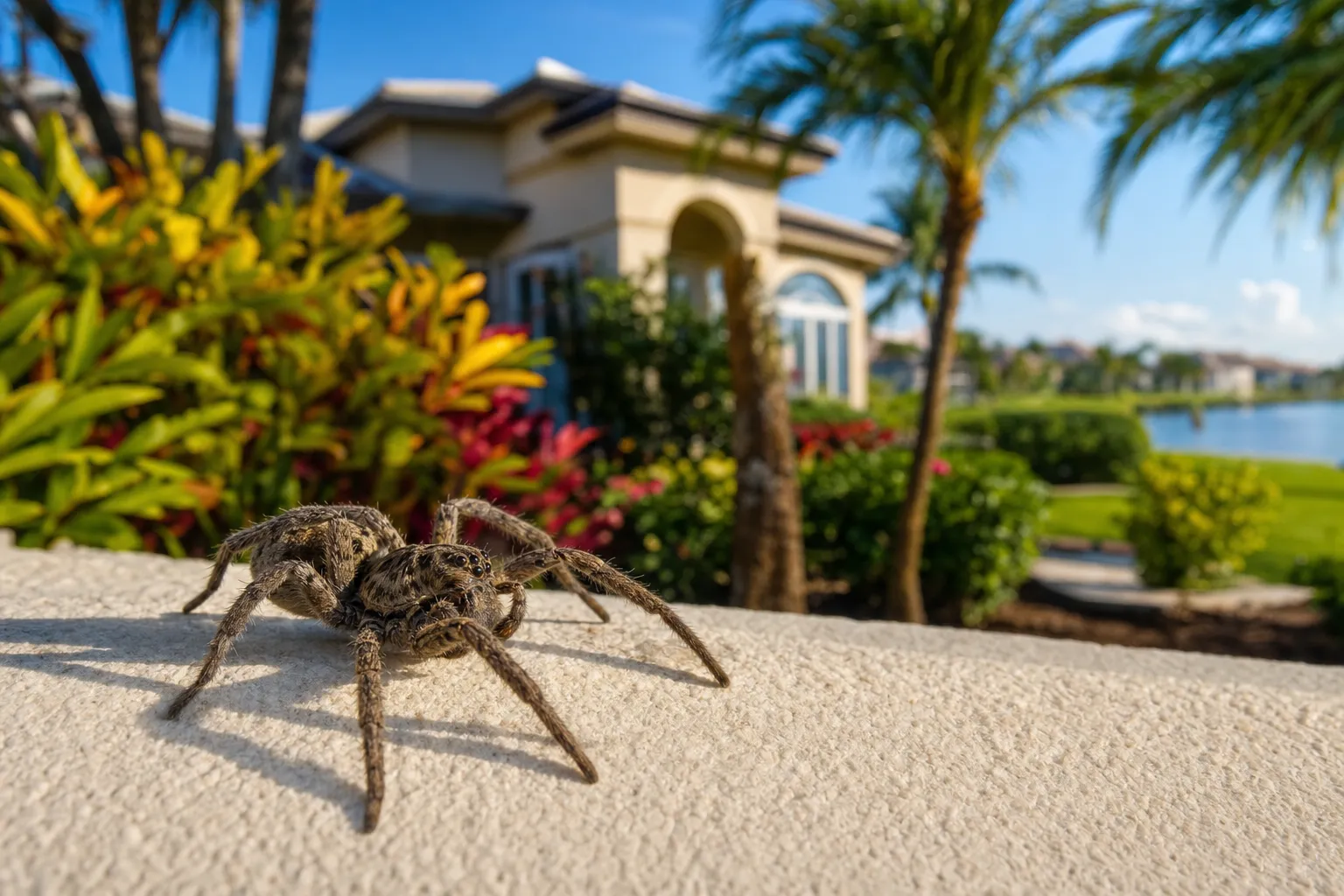
Wolf spiders are ground hunters, not web-builders. That’s the single most useful ID clue in the whole guide — if you found it in a web, it’s not a wolf spider. They belong to the family Lycosidae, and in Florida you’ll mostly run into species from the Hogna and Rabidosa genera.
Here’s what to look for:
- Size: Body length runs about 15–35 mm (roughly a half-inch to over an inch), with a leg span that makes them look much bigger. The chunky “giant wolf spider” reports are almost always females — they’re bulkier than the males.
- Color: Brown, gray, tan, or nearly black, usually with darker stripes down the back. Great camouflage against sandy soil, mulch, and pine straw.
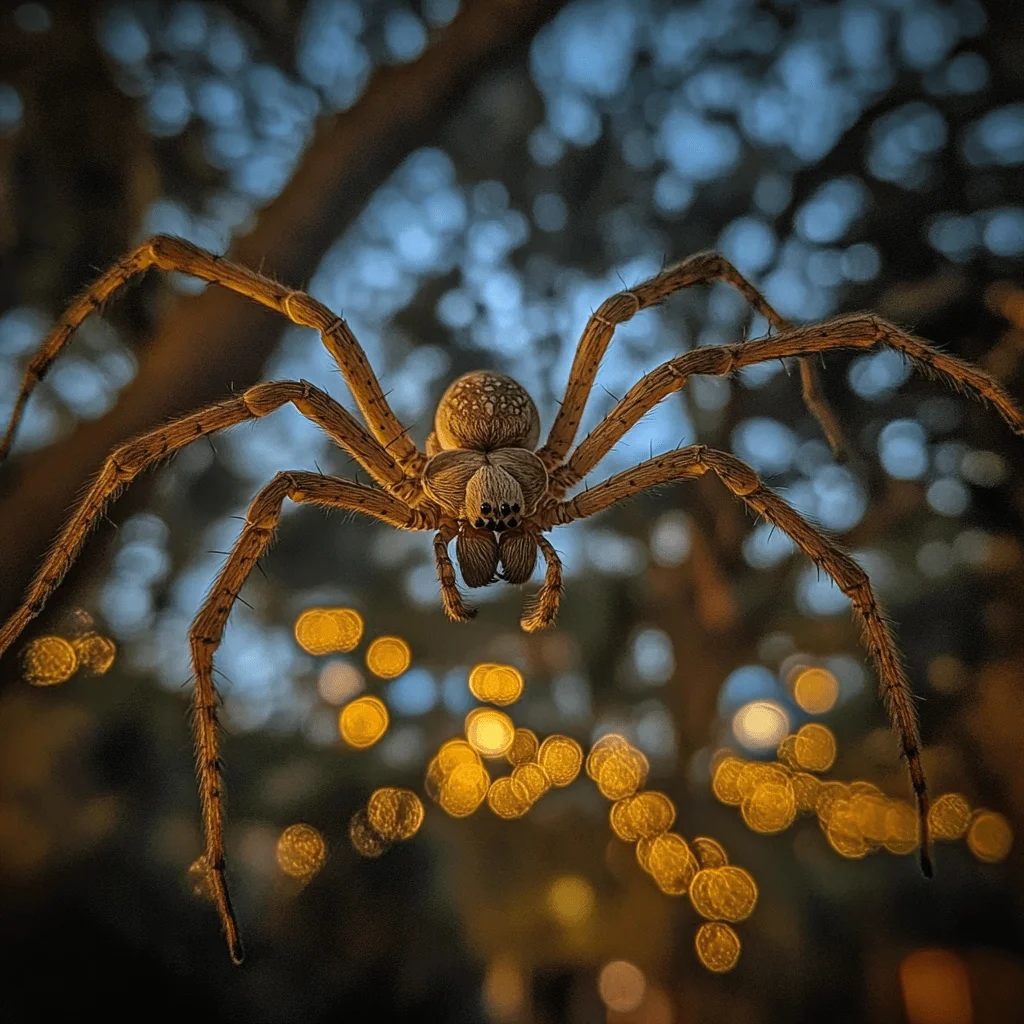
- Eyes: Eight eyes in three rows, with two large central eyes that reflect light at night — shine a flashlight across the lawn and you’ll see little green-blue glows staring back.
- Legs: Thick, hairy, built for sprinting, not climbing smooth vertical surfaces. If it’s scaling a painted wall like Spider-Man, it’s probably a huntsman, not a wolf.
- Behavior: Fast, ground-level, doesn’t spin webs. They’re nocturnal and rely on strong vision to locate insects at night.
The dead giveaway that seals the ID: females carry their egg sac attached to the rear of their body, and once the spiderlings hatch, they climb onto her back and ride around until they’re big enough to hunt on their own. No other spider you’ll meet in your yard does that. If you see a hairy brown spider that looks like it’s wearing a lumpy tan sweater, that’s not a sweater — those are the babies. (Sorry.)
Pro tip from the field: The single fastest way to confirm a wolf spider is the flashlight test. Step onto your lawn after dark, sweep a headlamp or phone light across the St. Augustine, and count the little reflective dots. Most of them are wolf spiders (or wolf spiderlings) hunting the insects your grass is already producing — a few other nocturnal hunters like huntsman spiders reflect light the same way, so pair the eyeshine with the body-shape and behavior checks above before you call the ID. First time you do it is genuinely unsettling. Second time you realize they’ve been out there the whole time, quietly working the night shift for free.
Are Wolf Spiders Dangerous? (No. Not Really.)
Let’s kill the myth: wolf spider venom is not considered dangerous to people, and the spiders themselves would rather flee than bite, saving an aggressive response for the insects they actually hunt.
Bites are uncommon and typically only happen when a spider gets trapped against skin — say, in a work glove, a shoe left on the lanai, or a wadded-up beach towel. The usual result is localized pain, redness, and swelling comparable to a bee sting, and symptoms generally clear up on their own without treatment.
Two important caveats:
- Sensitive individuals — children, the elderly, and people with compromised immune systems — may have some form of negative reaction. If that’s you or someone in your household, take the bite more seriously.
- If you develop spreading redness, worsening pain, or any allergic-reaction symptoms like difficulty breathing, that’s a doctor visit, not a “wait it out” situation.
Basic first aid if you do get bit: wash with soap and water, apply a cold compress, take an OTC anti-inflammatory if you need it, and keep an eye on the site for 48 hours. That’s it. That’s the protocol.
Compared to the spiders you actually should respect in Southwest Florida — the black widow and the brown widow, both medically significant here (and brown widows are now the more common of the two), plus the rarely-seen-in-Florida brown recluse — a wolf spider bite is a nuisance, not a medical event. Because wolf spiders can superficially resemble black widows or brown recluses, accurate identification is crucial. When in doubt: photograph it (from a safe distance), don’t handle it, and text the photo to your pest tech.
Why Southwest Florida Homes See So Many of Them
Wolf spiders don’t want to be inside your house. They just follow the food. Wolf spiders enter homes in search of food, moisture, or shelter — insect activity, cluttered storage areas, foundation cracks, and heavy outdoor lighting all increase the likelihood of sightings indoors. They’re most active from spring through early fall, with peak activity during Florida’s warm and humid summer months.
Our climate is basically a wolf spider spa:
- Sandy soil across most of Sarasota, Manatee, and Charlotte counties gives them easy burrowing and drainage.
- St. Augustine lawns irrigate on schedule, which produces the moisture-loving insects wolf spiders eat.
- Afternoon storms from June through September push everything — spiders, roaches, ants, palmetto bugs — toward higher, drier ground. That “higher, drier ground” is often your slab.
- Outdoor lighting on lanais and garage doors pulls in moths and flying insects all night, which pulls in the spiders that eat them.
Seasonal pressure
When wolf spider sightings peak in Southwest Florida
- Spring Mar–MayBuilding
Warming weather gets these solitary hunters moving as insect prey climbs.
- Summer / rainy season Jun–AugPeak
Warm, humid months are peak activity — and peak prey production in irrigated lawns.
- Hurricane season Sep–OctSurge
Storms push ground-level hunters (and everything they eat) toward dry slabs and garages.
- Fall NovActive
Cooler nights slow the hunting, but sightings continue near lit entryways.
- Winter Dec–FebLower (not zero)
Mild SWFL winters mean the flashlight test still finds eyeshine in the lawn.
Summer / rainy season & Hurricane season run hottest. Wolf spider activity tracks the same curve as the roach and cricket populations they hunt — quiet in winter, ramping in spring, peaking through the wet summer months across Southwest Florida.
The tell here: if you’re seeing repeated wolf spider activity in a specific zone of the house — always the garage, always the pool bath, always the guest bedroom baseboard — you don’t have a spider problem. You have a food-source problem for spiders. Fix that, and the spiders lose interest.
Safe Checks You Can Do Yourself
You don’t need a technician to figure out whether you’ve got occasional visitors or a real conducive-conditions issue. A 20-minute walkaround with a flashlight will tell you almost everything:
- Exterior perimeter after dark. Sweep a flashlight along the foundation. Count the eyeshine. Note where the concentrations are — near AC condensers, hose bibs, and downspouts is normal; a swarm right at a specific door threshold is a message.
- Weep holes and slab gaps. Wolf spiders squeeze in through the same gaps roaches use. If you can slide a business card into a crack, an inch-long spider can walk through it.
- Garage door seal. The bottom rubber sweep and the side vinyl seals are the #1 entry point in a SWFL home. Bend down and look for daylight while it’s closed.
- Window screens and door sweeps. Any tear bigger than a pencil eraser is a spider highway.
- Landscape mulch depth. Mulch piled up against the stucco is basically a wolf spider condominium with room service.
- Storage clutter. Pool floats, holiday bins, and stacked cardboard in the garage — pull it out, shake it out in the driveway before it goes back in.
Your home, zone by zone
Where wolf spiders (and their prey) get in
A typical Southwest Florida home — the numbered zones a local tech walks on every visit.
- Foundation perimeter The slab-line band ground hunters cross on their way in — first stop of the flashlight walk.
- Door thresholds & sweeps A gap you can slide a business card into is a wolf spider doorway.
- Eaves & exterior lighting Lights pull in the flying insects that pull in the predators below.
- Weep holes The same block-wall gaps roaches use — screened, not sealed.
- Garage door seal The #1 entry point in a SWFL home; check the bottom sweep for daylight.
- Lanai & screen cage Pool lighting plus insect prey makes this the classic hunting ground.
- Mulch beds & turf edges Deep mulch against stucco is burrow-and-buffet habitat.
- Interior baseboards Repeated sightings along the same wall line mean indoor prey nearby.
- Kitchen & bath plumbing gaps Roach highways — close them and the hunters lose their reason to follow.
- Attic Not wolf spider territory, but we verify what else is active while we're up there.
Wolf spiders concentrate around ground-level entry points and any spot where insect prey and moisture collide — that's what a Waves inspection walks first.
What Not to Do
A few homeowner mistakes we see constantly:
- Don’t squish it barefoot. Not because it’ll bite (it probably won’t), but because if it’s a female carrying an egg sac or spiderlings, you will spread dozens of tiny wolf spiderlings across your tile. That is a bad afternoon.
- Don’t fog the house with a store-bought aerosol bomb. These do almost nothing to ground-hunting spiders (they’re not resting on ceilings absorbing the fog) and they push the actual pest population — the roaches and crickets the spiders were eating — deeper into your wall voids.
- Don’t spray perimeter concentrate over a wet slab after a storm. The active ingredient washes off before it binds. Wait for a dry window, then treat.
- Don’t assume one spider = infestation. A single wolf spider is harmless and often on its way to hunting the insects already in the house, so relocating it outside works just as well. Repeated sightings are the actual signal worth acting on, since they point to an insect population nearby rather than the spider itself being the problem.
- Don’t ignore the pantry moth / roach / cricket problem you’ve been putting off. That’s the buffet. Close the buffet and the diners leave.
When to Call a Professional
Call somebody (us or otherwise) when:
- You’re seeing wolf spiders indoors more than once a week, especially in the same room.
- You’re finding egg-sac females or spiderling clusters inside the living envelope of the house.
- You have a child, elderly parent, or immunocompromised person in the household and want the anxiety off the table.
- You’ve done the perimeter/exclusion basics and it hasn’t changed anything after 2–3 weeks.
- You’re also seeing the prey species — palmetto bugs, crickets, ants — in numbers. Treat the food source and the predator problem largely takes care of itself.
Ready to have somebody actually walk your property? Get a quote from Waves and we’ll build you an exclusion + perimeter plan that targets the food source, not just the spider you happened to see.
How Waves Approaches Wolf Spiders in SWFL Homes
Our spider control service is deliberately built on top of the general pest plan, because treating the spider without treating its food supply doesn’t hold. What we do:
- Inspect the perimeter and interior with a flashlight — same walkaround described above, just with more experience about what matters.
- Identify the driver pest. In most wolf-spider calls we run in Sarasota, Bradenton, Venice, and North Port, it’s roaches or crickets. Sometimes it’s ants. Occasionally it’s an outdoor lighting problem drawing in flying insects. The driver dictates the plan.
- Exterior perimeter treatment with a residual product applied at the label rate to the band where spiders travel — foundation, weep holes, garage door track, door thresholds. Ground-hunting spiders pick this up as they walk across it.
- Interior spot treatment only where it’s warranted — not a house-wide fog, not a baseboard drench. Targeted application in the specific zones with activity.
- Exclusion recommendations — the door sweep, the weep hole screens, the mulch pullback. Not glamorous. Extremely effective.
- Follow-up. Our WaveGuard membership covers the recurring perimeter work that actually keeps this from becoming a summer-long saga. Quarterly service through peak season is when wolf spider populations swing hardest.
For homeowners who want to browse other common SWFL critters before calling anyone, our pest library has ID guides for the usual suspects — palmetto bugs, ghost ants, no-see-ums, and the black widows and brown widows that actually deserve some respect.
Frequently Asked Questions
Are wolf spiders in Florida poisonous?
Technically all spiders are venomous, but wolf spider venom isn’t medically dangerous to humans. Bites are rare and typically cause only mild pain, redness, and swelling that resolves within a few days. Sensitive individuals — kids, seniors, immunocompromised folks — should treat any bite more cautiously and see a doctor if symptoms escalate.
Why shouldn’t I squish a wolf spider?
Two reasons. First, if it’s a female with an egg sac or spiderlings on her back, squishing releases a cloud of babies across your floor — and yes, that’s exactly as awful as it sounds. Second, they’re providing free pest control. Wolf spiders eat crickets, beetles, roaches, ants, and even bed bugs. A single wolf spider in the garage is probably doing more for your pest problem than most DIY sprays.
Is it bad to find a wolf spider in your house?
One occasional wolf spider inside isn’t a red flag — they wander in through gaps and often wander back out. Repeated sightings in the same room are the actual warning sign, because it means there’s an insect population indoors that’s worth hunting. That’s when it’s time to get somebody to look at what’s drawing them in, not just kill the messenger.
The bottom line
The giant hairy spider that made you levitate off the lanai is almost certainly harmless, is almost certainly hunting something worse than itself, and is almost certainly telling you something useful about the conditions around your house. Handle the conditions, and the spiders sort themselves out. If you want somebody local to handle both, that’s what we’re here for.