Jump to a section (7)
If you flipped on the porch light after an afternoon storm and something the size of a AA battery buzzed past your ear, congratulations — you’ve probably met the smokybrown cockroach. It’s the big, glossy, mahogany‑dark roach that most Southwest Florida homeowners assume is an “American cockroach” or, less charitably, a “palmetto bug from hell.” It’s actually its own species (Periplaneta fuliginosa), and the way it lives is what makes it such a headache in Bradenton, Sarasota, Venice, and every neighborhood in between where the tree canopy is thick and the mulch beds are deep.
This one is a supporting piece in our pest library — a plain‑English walkthrough of what the smokybrown actually is, why your specific yard is basically a smokybrown Airbnb, and what you can (and shouldn’t) do about it. If you’ve already decided you’d rather not deal with them yourself, request a quote and we’ll walk your property — or you can see what a program looks like on your home in about a minute.
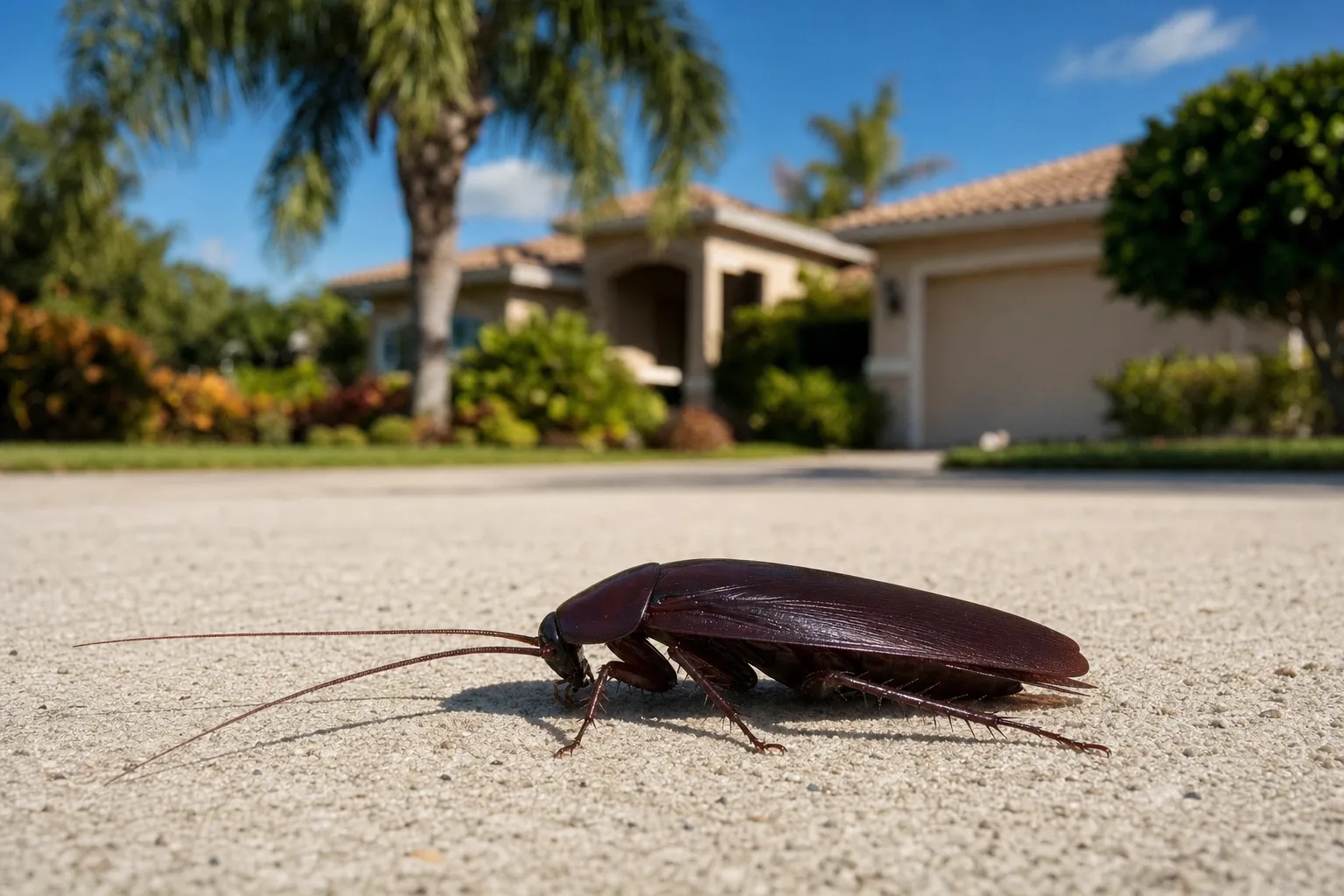
Meet the smokybrown (and stop confusing it with the American)
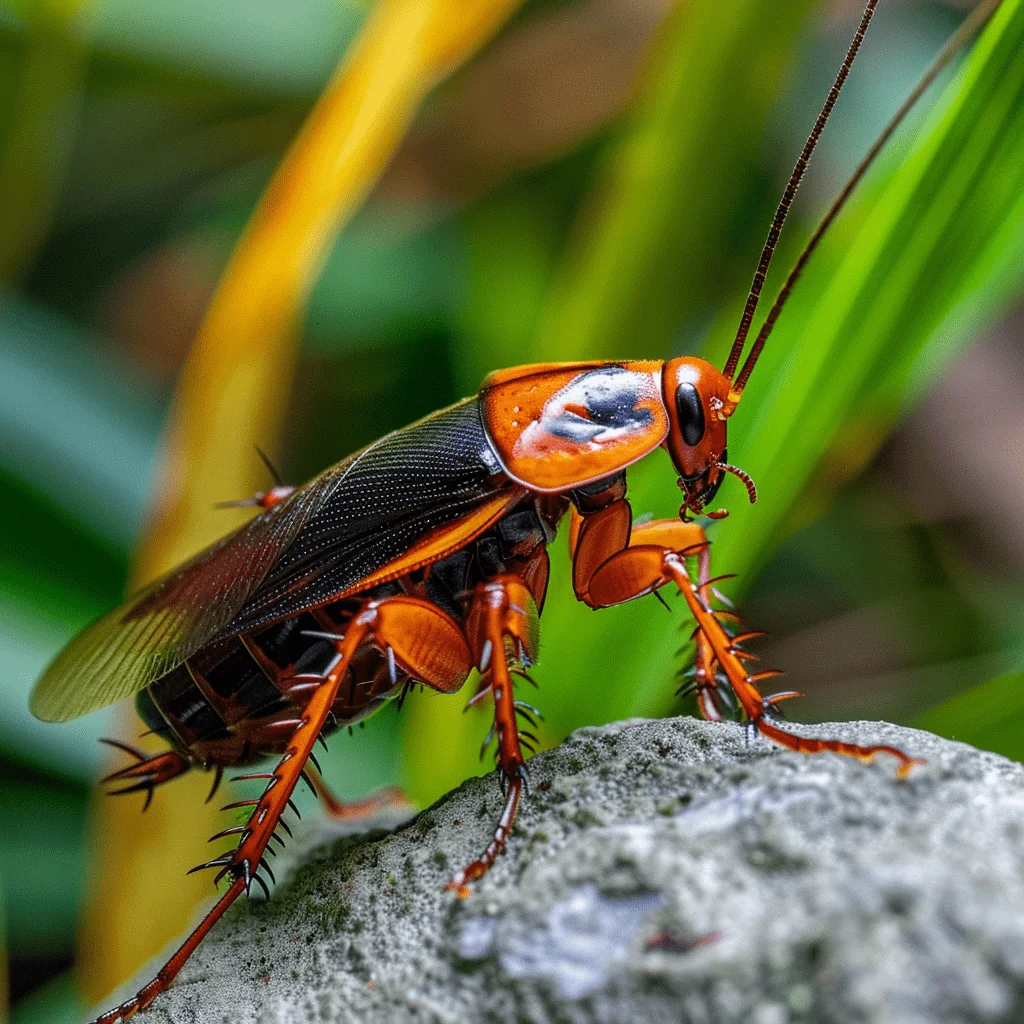
Smokybrowns are large — 1 to 1½ inches long — with a uniform, glossy, dark mahogany color from head to wingtip. No pale markings on the shield behind their head, no yellowish figure‑8, no two‑tone body. Just dark, all the way through. Their wings extend past the tip of the abdomen, and adults absolutely will fly, especially on warm humid nights.
The confusion with the American cockroach is fair, because they’re cousins and both show up in the same yards. But the differences matter for control:
| Trait | Smokybrown cockroach | American cockroach |
|---|---|---|
| Color | Uniform dark mahogany, glossy | Reddish‑brown with pale yellow figure‑8 on the shield |
| Adult size | 1 to 1½ inches | 1½ to 2 inches — noticeably bigger |
| Where it lives | Outdoors: tree canopies, palm boots, mulch, gutters | Outdoors + sewers, storm drains, damp crawlspaces |
| Moisture needs | High — dries out fast without humidity | High, but tolerates drier voids better |
| Flies to lights? | Yes, routinely | Occasionally, mostly glides |
| Egg case (ootheca) | Glued to sheltered surfaces — soffits, siding, sheds | Dropped or lightly attached in hidden spots |
Smokybrown vs. American cockroach — the practical differences that change how you treat them.
Nymphs (the immature stage) are the other giveaway. Baby smokybrowns are dark with distinct white bands on the antennae and a pale stripe on the thorax, which fade as they mature. If you see one of those on your lanai screen, you’re not looking at a random beetle — you’re looking at a smokybrown that grew up on your property.
If you want to sanity‑check against the other big Florida roach species, we keep short pages on the American cockroach and the German cockroach in the pest library. German roaches are the small, indoor, kitchen‑cabinet ones — a totally different problem with a totally different fix.
Side by side, with the one-line tell:
Look-alike check
Is this a smokybrown cockroach?
Periplaneta fuliginosa
Keep an eye on it
- Can spread disease
Keep an eye on it
- Can spread disease
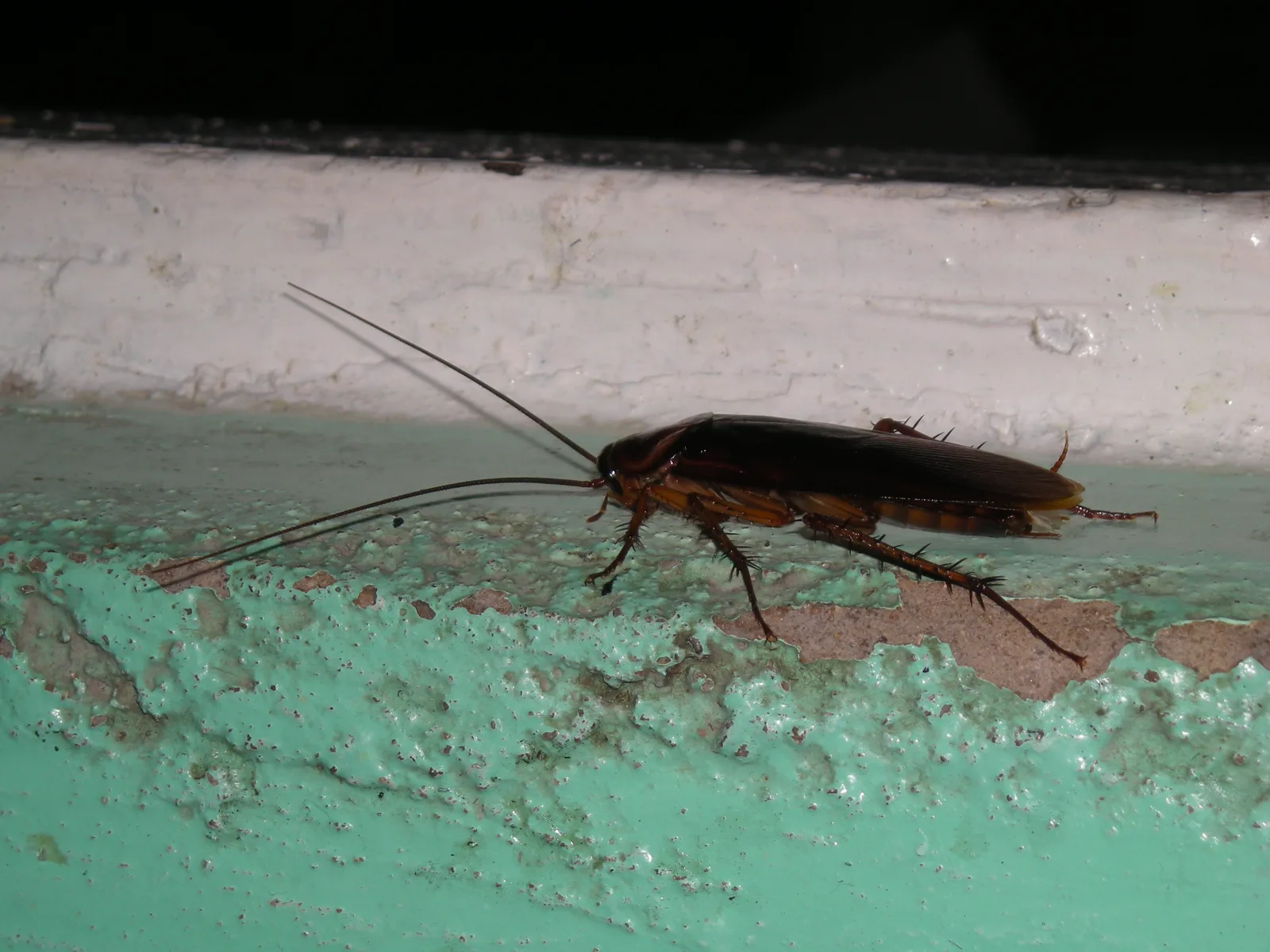
Photo: Muhammad Mahdi Karim via Wikimedia Commons , CC BY-SA 2.5, resized.
The tell: Smokybrown cockroaches are uniformly dark with no band behind the head; American cockroaches have a pale yellow band there.
Want the rest of Southwest Florida’s cockroaches lined up the same way? See the Which Florida Cockroach Is This? hub.
Why smokybrowns thrive in Southwest Florida
Smokybrowns are what entomologists politely call a “peridomestic” species — they want to live outside, and they only wander in when the conditions push them in. SWFL basically hands them a five‑star resort:
- Humidity all year. Smokybrowns dehydrate faster than most roaches. Our afternoon storms plus overnight dew keep them hydrated even in “dry” season.
- Tree canopies and palm boots. Live oaks, cabbage palms, queen palms, and any palm with a skirt of old fronds are prime harborage. The dead frond bases hold moisture and hide egg cases beautifully.
- Mulch and leaf litter. Deep hardwood or cypress mulch right up against the foundation is essentially a smokybrown condo complex.
- Clogged gutters. Wet leaf debris in a gutter above a soffit vent is where a lot of “how did they get in the attic?” stories actually start.
- Sandy soil that drains, but stays warm. Our soils don’t hold a hard freeze, so populations don’t get knocked back the way they do north of I‑4.
Seasonal pressure
Southwest Florida pest pressure through the year
- Spring Mar–MayBuilding
Warming weather wakes colonies up — activity climbs week over week.
- Summer / rainy season Jun–AugPeak
Heat + humidity + standing water = the year’s heaviest pressure.
- Hurricane season Sep–OctSurge
Storms and flooding push pests indoors looking for dry shelter.
- Fall NovActive
Cooler nights slow things down, but activity stays well above zero.
- Winter Dec–FebLower (not zero)
Our mild winters keep many pests going year-round indoors.
Summer / rainy season & Hurricane season run hottest. Smokybrown pressure tracks the SWFL pest calendar — it never truly stops, but the summer wet season is when you'll see the most nighttime flying activity.
Translation: you don’t have smokybrowns because your house is dirty. You have smokybrowns because you live in Southwest Florida and there are trees in your yard. Anyone in Sarasota or North Port telling you otherwise is selling something.
Where they actually get in
Smokybrowns don’t tunnel — they walk, fly, or hitchhike through gaps you already have. When we inspect a home for smokybrown pressure, these are the zones we’re checking:
Your home, zone by zone
Where we inspect & treat
A typical Southwest Florida home — the numbered zones a local tech walks on every visit.
- Foundation perimeter Exterior barrier band — the first line where pests cross in from the yard.
- Entry points (doors/windows) Thresholds and frames where ants and roaches slip indoors.
- Eaves & soffits Up under the roofline where wasps and spiders like to nest.
- Weep holes Block-wall gaps that let pests behind the brick veneer.
- Garage corners Dark, cluttered edges spiders and roaches favor.
- Lanai & screen cage The classic SWFL hot spot for spiders, midges and palmetto bugs.
- Mulch beds & turf edges Damp landscaping that harbors ants, fleas and chinch bugs.
- Interior baseboards Where indoor crawlers travel along the wall line.
- Kitchen & bath plumbing gaps Pipe penetrations roaches and ants use to move room to room.
- Attic Top of the home — checked for rodent runs and nesting.
The zones a Waves tech walks when scoping smokybrown pressure — most 'indoor roach' problems start at zones 1, 3, and 6.
The usual suspects:
- Soffit and gable vents with torn screening or gaps where the vent meets the fascia.
- Gutter downspouts that dump against the foundation and keep mulch beds swampy.
- Weep holes in stucco or brick with no weep covers.
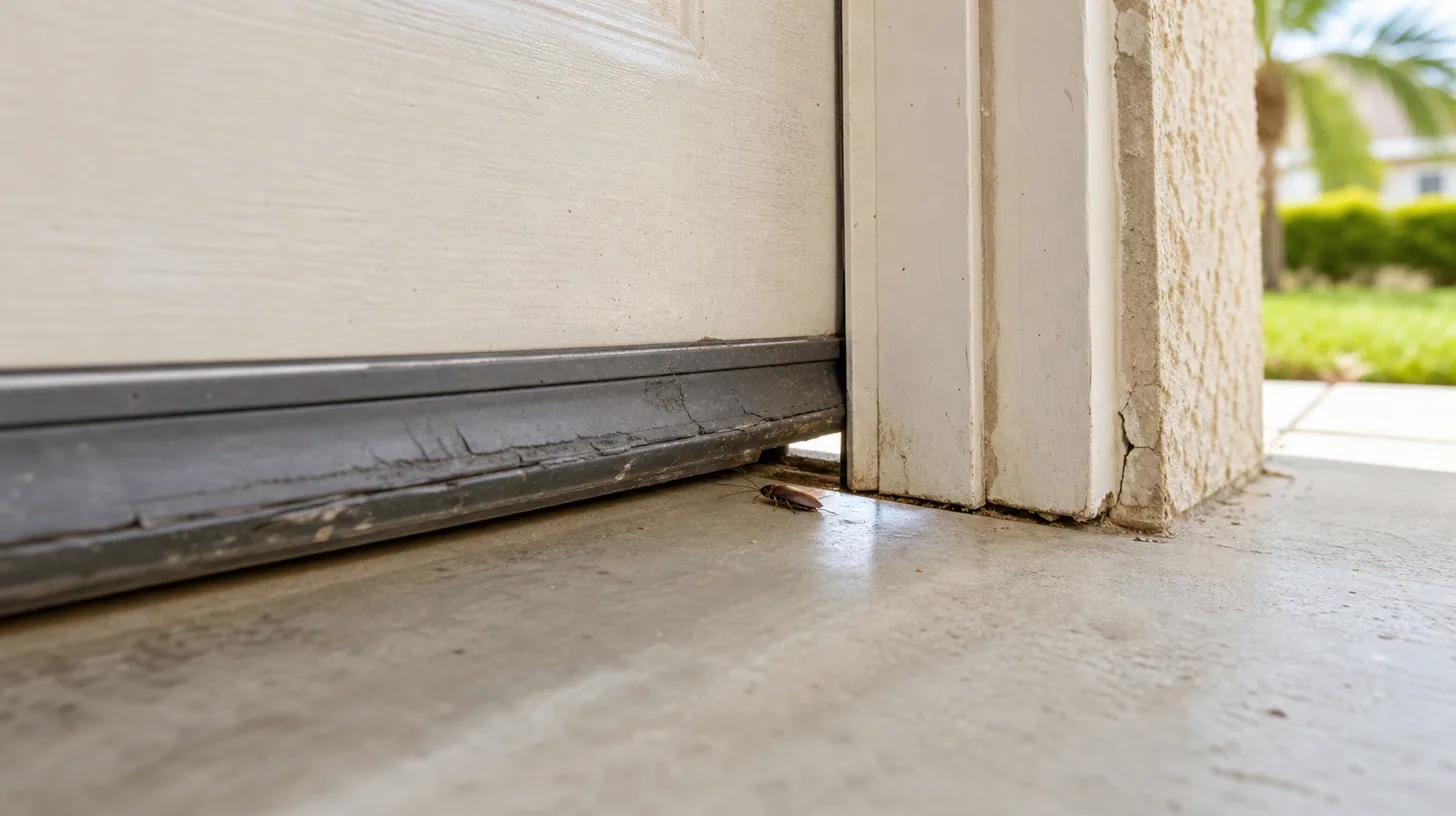
- Weatherstripping on garage doors and side doors — smokybrown nymphs can squeeze through a gap thinner than a pencil.
- Plumbing and A/C line penetrations on exterior walls, especially where the foam has cracked from UV exposure.
- Attached lanais and pool cages with torn screen at the kickplate.
Pro tip: Before you spray anything, look at your exterior lighting. Smokybrowns are strongly attracted to bright white and cool‑white light at night, so swap the bulbs closest to your front door and garage for warm/amber LEDs — or put them on motion sensors — and turn off any purely decorative bright lights where it’s safe to do so. Keep whatever lighting you rely on for steps, visibility, and security; the bulb color swap does most of the work on the “how did that thing get on my porch?” sightings.
What you can do this weekend (and what to skip)
Smokybrown control is 70% habitat, 30% product. Here’s the homeowner‑safe checklist that actually moves the needle:
Do:
- Pull mulch back 12–18 inches from the foundation and thin it to 2 inches deep max. Rock or shell in that band is even better.
- Clean gutters and make sure downspouts extend at least a few feet away from the house.
- Trim palm skirts and prune tree limbs off the roofline — smokybrowns walk in over touching branches.
- Screen soffit vents and gable vents. The dryer exhaust is different: never mesh-screen or cap it (that traps lint and chokes airflow) — use a louvered dryer vent cover that closes at rest and swings freely when the dryer runs.
- Store firewood, pavers, and empty planters off the ground and away from the house.
- Fix any dripping hose bibs or A/C condensate lines that keep a wet spot on the slab.
Don’t:
- Don’t fog the yard with a hose‑end bug killer and call it done. It’s a 24‑hour reset at best, and it wipes out the beneficial predators (spiders, geckos, anoles) that were actually helping you.
- Don’t dump gel bait meant for German roaches around the perimeter. Wrong bait matrix, wrong placement, and it degrades in the sun.
- Don’t seal up entry points before you’ve knocked back the population — you can trap active roaches inside and turn an outdoor problem into an indoor one.
- Don’t bother with ultrasonic plug‑in “repellers.” UF/IFAS research on those has been unkind, to put it politely.
On every inspection
What your tech is looking for
- Egg cases (ootheca) Glued to sheltered surfaces — soffits, siding, sheds, and fence lines.
- Pepper-like droppings Small, dark specks concentrated near harborage spots.
- Harborage sites Palm boots, deep mulch beds, and leaf litter against the foundation.
- Moisture sources Clogged gutters, dripping hose bibs, and wet A/C condensate lines.
- Entry gaps Soffit vents, weep holes, and worn door weatherstripping.
What a tech looks for during a smokybrown inspection — evidence beats guesswork every time.
How Waves handles smokybrown pressure
Our approach on smokybrowns is boring in the good way: we treat the outside like it’s the problem, because it is. That usually means a targeted exterior perimeter application with a residual labeled for cockroaches, granular bait worked into mulch beds and along fence lines, an IGR to break the egg‑case cycle, and spot treatment of harborage zones like soffit gaps, meter boxes, and irrigation valve covers. Inside the home, we lean on discreet gel bait placements in the specific voids smokybrowns actually use — not a fogger, not a baseboard spray‑and‑pray.
Because their life cycle runs long (egg case to adult can take the better part of a year in Florida), a one‑and‑done visit rarely holds. Ongoing quarterly service through a program like WaveGuard is how most SWFL homes stay ahead of them without the roller‑coaster of “they’re back” every rainy season. No guarantees on any single treatment eliminating a species that literally lives in the trees around you — but consistent pressure on the outside is what keeps the inside boring.
Frequently Asked Questions
Why do I have smokybrown roaches in my house?
Almost always because something outside changed — a heavy rain flooded their harborage, tree limbs grew into your roofline, an outside light drew them to a door, or a gap opened up around a soffit or A/C penetration. Smokybrowns don’t want to be inside; they wander in looking for moisture or after being disturbed. Fixing the outside conditions is what keeps them from coming back, not just spraying the baseboards.
How hard is it to get rid of smokybrown cockroaches?
Harder than German roaches to eliminate, easier to manage. Because they breed outside — in trees, mulch, and neighbors’ yards you don’t control — you’re never going to zero them out permanently. What you can realistically do is drive sightings way down — for many homes, close to zero — with consistent exterior treatment, habitat cleanup, and sealing the specific entry points on your home.
What’s the difference between American and smokybrown cockroaches?
American cockroaches are bigger (up to 2 inches), reddish‑brown, and have a distinctive pale yellow figure‑8 on the shield behind their head. Smokybrowns are slightly smaller, uniform dark mahogany with no markings, and are much more likely to fly to lights at night. Americans are also more comfortable in sewers, storm drains, and damp crawlspaces; smokybrowns stick to trees, palms, and mulch.
Ready to stop meeting them on the porch?
If you’re tired of the nightly smokybrown parade, we can help. We cover SWFL from Bradenton and Lakewood Ranch down through Sarasota, Venice, North Port, and Port Charlotte — see our service areas — and a quick look at the pest control calculator will show you what a program on your home looks like without a sales call. Get in touch through our contact page, or call or text us at (941) 297-5749 and we’ll get you on the schedule — no fogging, no theatrics, just the boring‑in‑a‑good‑way roach control your yard actually needs.