

Jump to a section (8)
- 01What Lizard Faeces Actually Look Like
- 02Which SWFL Lizard Left the Present?
- 03Are Lizard Droppings Actually Toxic?
- 04Cleaning Up Lizard Faeces the Right Way
- 05Preventing Lizard Faeces Around Your Home
- 06When to Actually Call a Pro
- 07Frequently Asked Questions
- 08Ready to Deal With What’s Actually Bringing the Lizards?
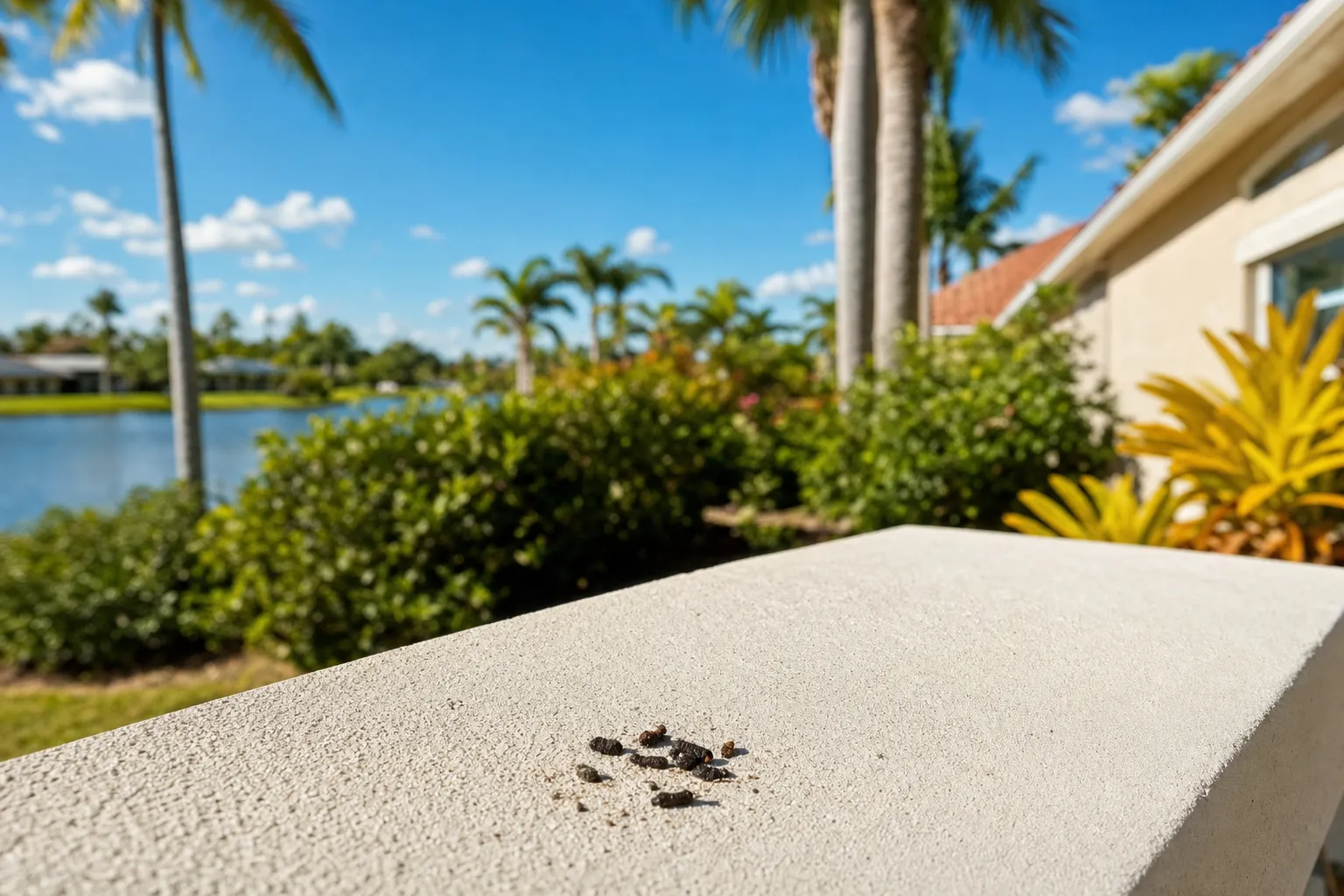
If you live in Southwest Florida long enough, you will eventually walk out onto your lanai, coffee in hand, and find a tiny brown pellet with a chalky white tip sitting on the railing like a very rude business card. Congratulations — you have been visited by a lizard, and the thing you’re looking at is lizard faeces. (Yes, we know most Americans spell it “feces.” Same pellet, same lizard, same slightly annoying cleanup.)
The good news: it’s usually not a serious problem. The better news: you can tell a lot about which little reptile is living rent-free in your soffit just from what it left behind. This is a quick field guide to identifying lizard droppings around SWFL homes, deciding whether you actually need to worry, and knowing when it’s time to stop Googling and call in a pro. For more household critter ID guides, our full pest library has you covered.
Not up for the DIY sleuthing? Book a home pest evaluation and one of our techs will tell you exactly what’s leaving evidence around your place.
What Lizard Faeces Actually Look Like
Lizard droppings have a very distinctive look once you know what you’re staring at. Unlike mammals, lizards excrete solid waste and uric acid at the same time, from the same opening — which is why the poop comes with a built-in white cap.
Here’s the quick ID:
- Shape: Elongated cylindrical pellet, usually with slightly tapered or rounded ends.
- Color: Dark brown to nearly black.
- The tell: A distinct chalky white or off-white tip on one end. That’s the uric acid (urate) — birds do the same thing, which is why bird poop and lizard poop get confused all the time.
- Size: Anywhere from a few millimetres (baby anole) to more than an inch long (grown iguana).
- Texture: Firm and dry when you find it. It doesn’t smear like fresh dog droppings — it flakes.
On every inspection
How to tell it's lizard faeces (not rodent, not bird)
- White urate tip Chalky cap on one end is the giveaway — mammals don't do this.
- Firm, dry pellet Holds its shape. Rodent droppings smear when fresh; lizard droppings crumble.
- Deposited singly Usually one or two pellets in a spot, not a scattered pile like mice leave.
- Elevated surfaces Window sills, lanai railings, screen tracks, pool cage crossbars — anywhere a lizard was sunning or hunting.
If it has the white cap and it's up high, it's almost always a lizard.
The location matters a lot. Lizard faeces show up on vertical or elevated surfaces — lanai screens and tracks, pool cage bars, the top of your outdoor kitchen, window ledges, the top of your grill cover, the edge of a planter. Rodent droppings, by contrast, tend to show up along baseboards, behind pantry items, under sinks, and inside drawers. If your evidence is up where a gecko or anole would sit and hunt bugs, you’re almost certainly looking at reptile leftovers.
| What to check | Lizard droppings | Rodent droppings |
|---|---|---|
| White or cream tip | Usually present as a urate cap | Absent; dark from end to end |
| Typical shape | Rounded cylindrical pellet | Pointed ends on mice and roof rats; blunt capsule on Norway rats |
| Where you find it | Favorite perches near lights, windows, and screens | Travel routes along walls, drawers, pantries, and food storage |
| Other clues | A gecko or anole on a wall or screen | Gnaw marks, grease trails, or chewed packaging |
Size ranges overlap, so use the white urate cap, location, shape, and surrounding evidence together.
Waves pro tip: Before cleanup, photograph the droppings beside a coin for scale. Size alone cannot identify the animal—a mouse pellet and a gecko pellet can overlap, and an old lizard pellet can lose its white cap—but the photo preserves the shape, color, location, and nearby evidence for a more reliable identification.
Which SWFL Lizard Left the Present?
Southwest Florida is lizard country. Warm nights keep geckos active, and porch lights and screens give them easy hunting. A few of the usual suspects (see every species side by side in our Which Florida lizard is this? hub):
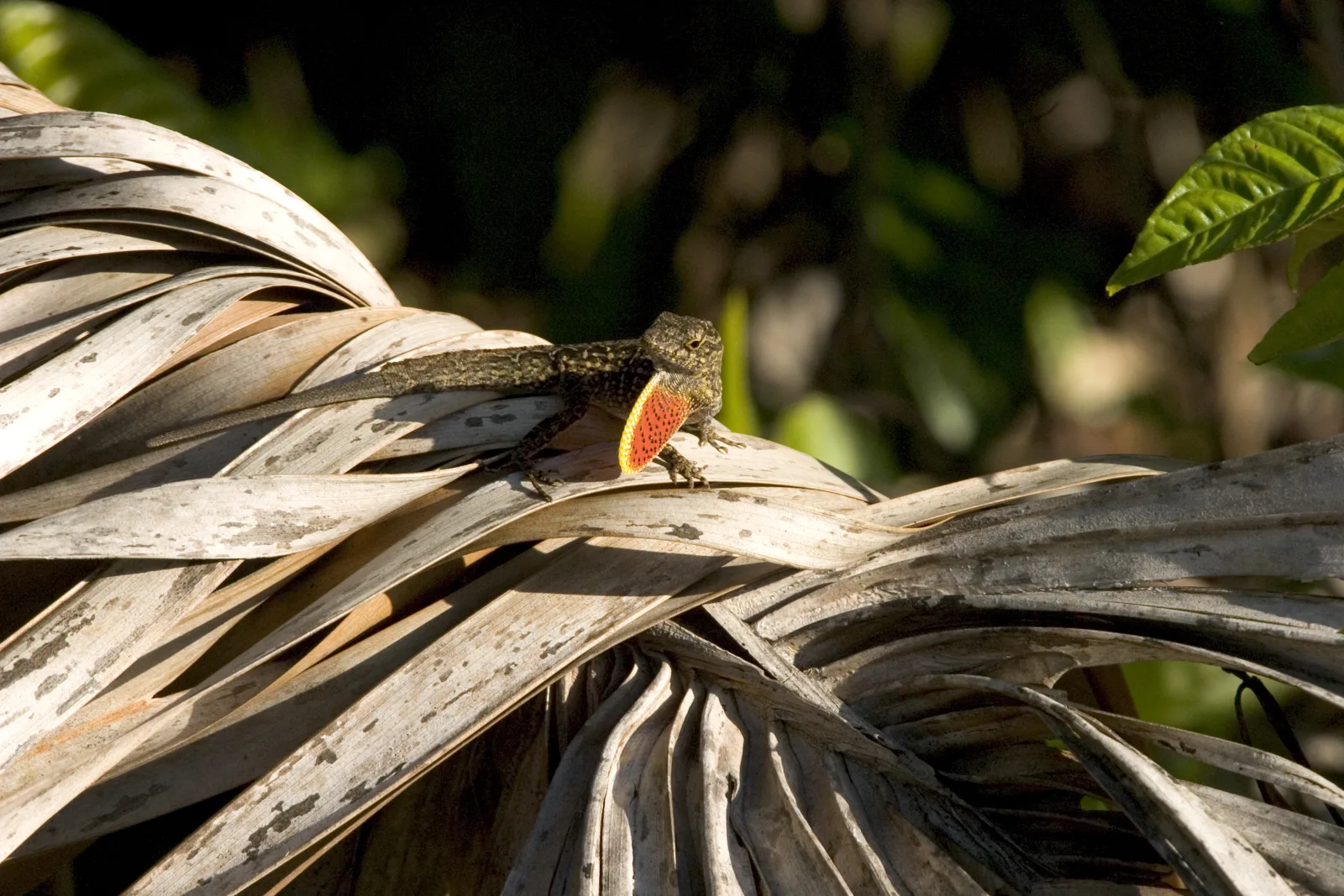
A brown anole displaying its orange throat fan on a palm frond. Photo: Everglades NPS / R. Cammauf, public domain via Wikimedia Commons.
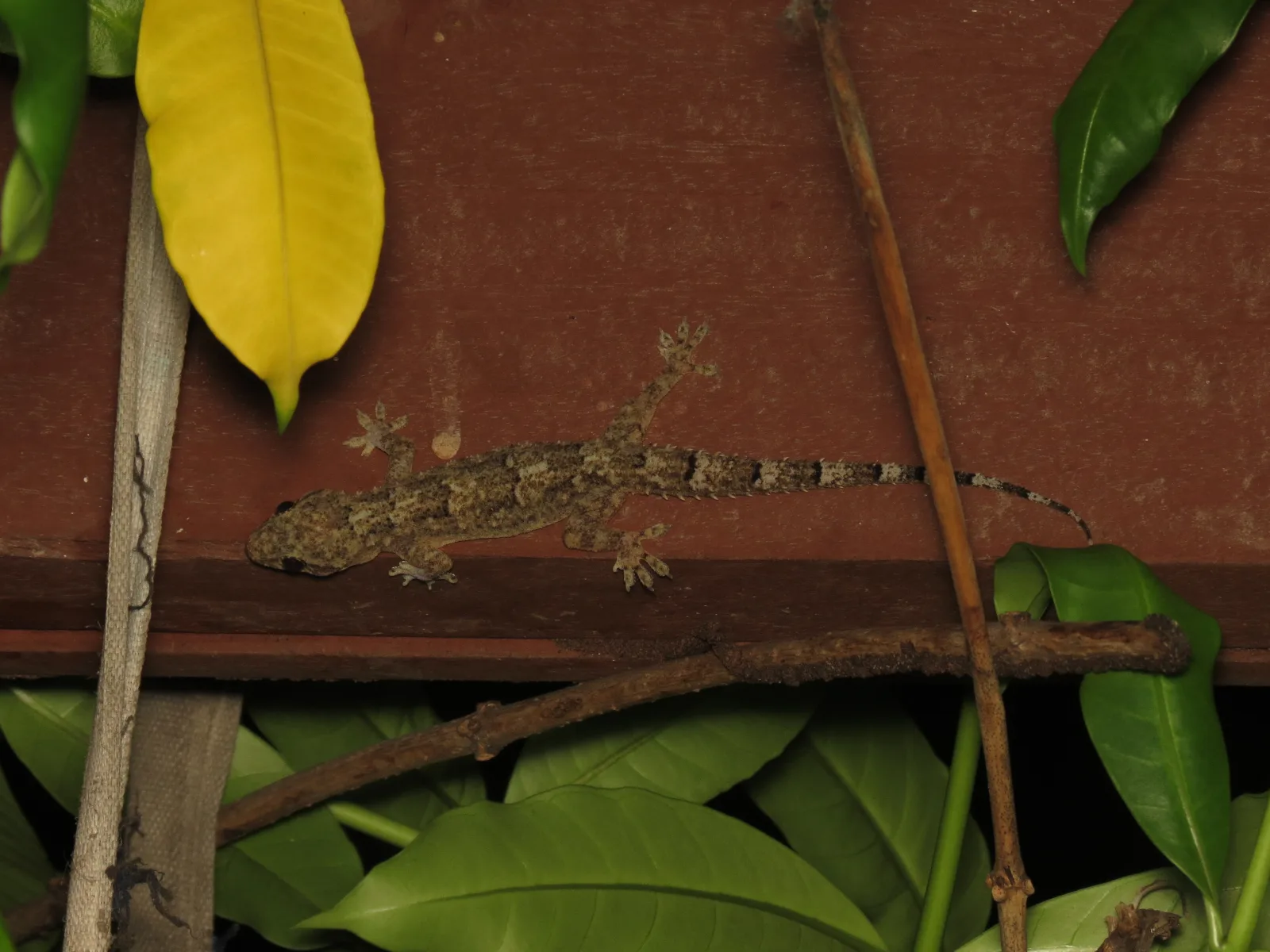
A tropical house gecko on a wall at night. These geckos hunt insects around porch lights, and their color shifts from pale to mottled brown. Photo: Donald Hobern via Wikimedia Commons, CC BY 2.0, resized.
- Brown anole. The small, twitchy brown lizard doing push-ups on every fence post. It isn’t native, but it’s everywhere. Its droppings are tiny (5–10 mm), with a small white tip. Brown anoles stay low, so look on patio furniture, fences, and the lower parts of pool cage frames.
- Green anole. Our native anole. It tends to perch higher than the brown anole, in shrubs, trees, and up on walls and screens, so its droppings turn up higher too.
- House geckos. The pale, almost see-through geckos (usually Mediterranean or tropical house geckos) that sit on your porch light after dark, eating whatever the light attracts. Their droppings land directly under exterior lights and along the tops of window frames, and they’re slightly larger and darker than anole droppings.
- Northern curly-tailed lizard. An introduced lizard established mainly in southeast Florida and Collier County, and uncommon farther up our coast. If you have one, you’ll know: it carries its tail curled over its back. Bigger lizard, bigger pellet, often on driveways and paver walkways.
- Green iguana. If the “droppings” on your dock are the size of a small dog’s, that’s an iguana. That’s a different conversation, and not a standard pest-control call.
If your evidence keeps showing up in a very specific spot — always the same corner of the lanai, always under the porch light — that’s a lizard using that spot as a hunting perch. They’ll come back every night as long as the bug buffet is open.
Waves pro tip: Lizards go where the bugs go. If you’re finding faeces on your pool cage every morning, the real pest problem is what’s flying into your cage lights at night. Cut the bug pressure and the lizards have less reason to hang around. Swapping bright white porch bulbs for warm or yellow “bug light” LEDs is a cheap place to start.
Are Lizard Droppings Actually Toxic?
This is one of the most-searched questions we see, so let’s answer it straight: lizard faeces are not “toxic” in the poison sense, but they can carry Salmonella and other bacteria, so you shouldn’t handle them bare-handed. Reptiles are well-known Salmonella carriers; the CDC notes that even healthy-looking reptiles can carry the bacteria (CDC). Most of the warnings are about pet turtles and bearded dragons, but the same biology applies to a wild anole.
Practically speaking, the risk to a healthy adult in Southwest Florida is low as long as you use basic hygiene. The higher-risk situations are:
- Small kids and pets — toddlers grabbing pellets off the lanai and putting fingers in mouths, or dogs snacking on droppings during a backyard patrol.
- Higher-risk people — the CDC names children under 5, adults over 65, and anyone with a weakened immune system (chemo, transplants) as more likely to get sick.
- Food-prep surfaces — droppings on an outdoor kitchen counter, grill grate, or picnic table need to be cleaned before you cook.
- Pool decks — if droppings actually get into the pool water, don’t count on chlorine to sort it out on its own. The CDC’s advice for bird droppings in a pool works here too: close the pool, scoop the droppings out, then hold free chlorine at 2 ppm with pH at 7.5 or lower for 30 minutes before anyone swims (CDC).
You don’t need a hazmat suit. You do need gloves, a paper towel, and a spray of disinfectant afterward. More on cleanup below.
Cleaning Up Lizard Faeces the Right Way
Nothing complicated here, but a couple of do’s and don’ts:
Do:
- Put on disposable gloves.
- Lightly mist the pellet with a household disinfectant before picking it up — dry droppings can flake and aerosolize if you scrub them cold. Follow the product label and keep the surface visibly wet for its full contact time.
- Wipe up with a paper towel and toss it directly in an outdoor trash bag.
- Disinfect the surface again after removal, keeping it wet for the label-specified contact time.
- Food-contact surfaces are a special case. For grill grates, outdoor-kitchen counters, or anything food touches: remove the droppings with a damp paper towel, wash with soap and water, rinse, then use a sanitizer labeled for food-contact surfaces. Follow its directions exactly, including a potable-water rinse when the label requires one; a no-rinse food-contact sanitizer can air-dry only when its label says so.
- Wash your hands. Actually wash them, not the three-second rinse.
Don’t:
- Don’t dry-sweep with a broom on a screened lanai — you’ll flake dust into the air and all over the furniture.
- Don’t vacuum dry droppings; mist and wipe them so particles do not become airborne.
- Don’t power-wash lizard droppings off your outdoor kitchen counter and call it clean. Disinfect after.
- Don’t try to trap or kill the lizards. They’re harmless bug-eaters, and removing them one by one never keeps up. Focus on the underlying bug pressure instead.
Preventing Lizard Faeces Around Your Home
Since lizards follow bugs, prevention is really about reducing the insect buffet and closing off the perches lizards love. Here’s what actually works around SWFL homes:
Your home, zone by zone
Where lizards leave the most evidence
A typical Southwest Florida home — the numbered zones a local tech walks on every visit.
- Foundation & walkway edges Warm slab edges where curly-tails and anoles sun — pellets collect along the base of the wall.
- Entry doors & thresholds Door frames and porch lights — where the moths go on warm nights, the geckos follow.
- Soffits & eaves Geckos tuck into gaps at the fascia. You'll find droppings on the wall directly below.
- Window sills & lower walls South- and west-facing sills heat up all afternoon — prime sunning + hunting spot.
- Garage door tracks & corners Warm, sheltered, full of overwintering bugs. Anoles love it.
- Pool cage, lanai & outdoor kitchen Screen tracks, top rails, and cage crossbars — nightly hunting perches under cage lights. Droppings on grill grates and outdoor-kitchen counters matter most: clean and sanitize before cooking.
- Landscaping mulch & turf edges Ground-dwelling anoles hunt through mulch and St. Augustine grass edges.
- Interior baseboards & window tracks If pellets show up here, a lizard is getting inside — and so are the bugs it follows.
- Kitchen & bath plumbing gaps Pipe and utility penetrations are how geckos — and the bugs they chase — slip from wall voids into interior rooms.
- Attic access & top plates Occasional gecko route — look for droppings on the ledge below the access hatch.
If you're finding faeces in these spots repeatedly, that's a bug-pressure problem more than a lizard problem.
Practical steps:
- Fix your exterior lighting. Warm-spectrum LEDs (2700K or lower) or dedicated “bug light” yellow bulbs pull way fewer insects than cool white LEDs. Fewer bugs = fewer lizards = fewer droppings.
- Keep the lanai screens tight. Small tears at the base of screen doors are how anoles get inside the cage in the first place. A five-dollar screen patch kit fixes most of them.
- Protect drainage openings without sealing them. Fit masonry weep holes with purpose-built pest screens or guards. Do not caulk them shut; they need to drain moisture. Reserve sealant for ordinary cracks and non-drainage gaps.
- Trim vegetation back off the house. Shrubs and vines touching the wall are lizard highways. Aim for a 12-inch gap between plants and the exterior.
- Manage the sandy-soil bug base. SWFL’s sandy soil and near-daily summer storms create perfect breeding conditions for the flying insects lizards eat. A perimeter pest program shrinks the buffet — this is where a professional service earns its keep.
- Clean up mulch depth. Mulch deeper than 2–3 inches gives ground insects a nursery, which feeds ground-dwelling anoles. Rake it back and refresh annually.
- Kill standing water. Bromeliad cups, saucers under potted plants, clogged gutters — mosquitoes breed there, geckos hunt them there, faeces end up on your wall below.
| Approach | One-off DIY | WaveGuard quarterly program |
|---|---|---|
| Reduces the flying insect buffet | A few weeks | Year-round |
| Covers soffits, eaves & pool cage | Whatever you can reach | Full home exterior every visit |
| Covers the wet season | Only if you keep at it | Yes — quarterly visits run through the rainy months |
| Includes callbacks between visits | No | Yes, free re-treats between quarterlies |
| Impact on lizard evidence | Temporary | Usually drops as bug pressure drops |
Lizards are a symptom — the program treats the cause.
Lizards are really a symptom of the bug pressure around your home. A recurring pest plan treats that cause on a steady schedule, and WaveGuard members get free re-treats between visits.
When to Actually Call a Pro
Lizard faeces on their own almost never justify a service call. What justifies a service call is what the faeces are telling you about the rest of your bug situation. Call us if:
- You’re finding fresh droppings in the same spots every morning — that means nightly heavy insect activity that a homeowner spray can’t touch.
- Droppings are showing up inside the house (window tracks, garage, kitchen sills) — that means a lizard is getting in, which means bugs are also getting in.
- You’re seeing large droppings (pinky-finger sized or bigger) on decks, seawalls, or docks — that’s likely an iguana, which is a wildlife issue, not a DIY project.
- You’re in Bradenton, Sarasota, Venice, Parrish, Palmetto, North Port, Port Charlotte, Englewood, or anywhere in our service area and your lanai has become a lizard nightclub. A targeted perimeter treatment brings the bug pressure down, and the lizards follow the food.
Waves handles the underlying bug problem (ants, spiders, mosquitoes, the flying nighttime buffet) through our standard pest control services. We don’t remove lizards themselves; anoles and geckos are free bug control. But once the food source shrinks, so does the poop trail. Skip the guesswork on cost with our pest control calculator.
For deeper dives into other things you might find crumbling around your home, browse our full pest library or set up a walkthrough with a home pest evaluation.
Frequently Asked Questions
Are lizard droppings toxic to humans or pets?
Not toxic in the poison sense, but they can carry Salmonella and other bacteria. Wear gloves, disinfect the surface after cleanup, and wash your hands. Keep small kids and pets away from droppings until they’re removed. Healthy adults using basic hygiene are at very low risk.
What do lizard droppings look like compared to mouse droppings?
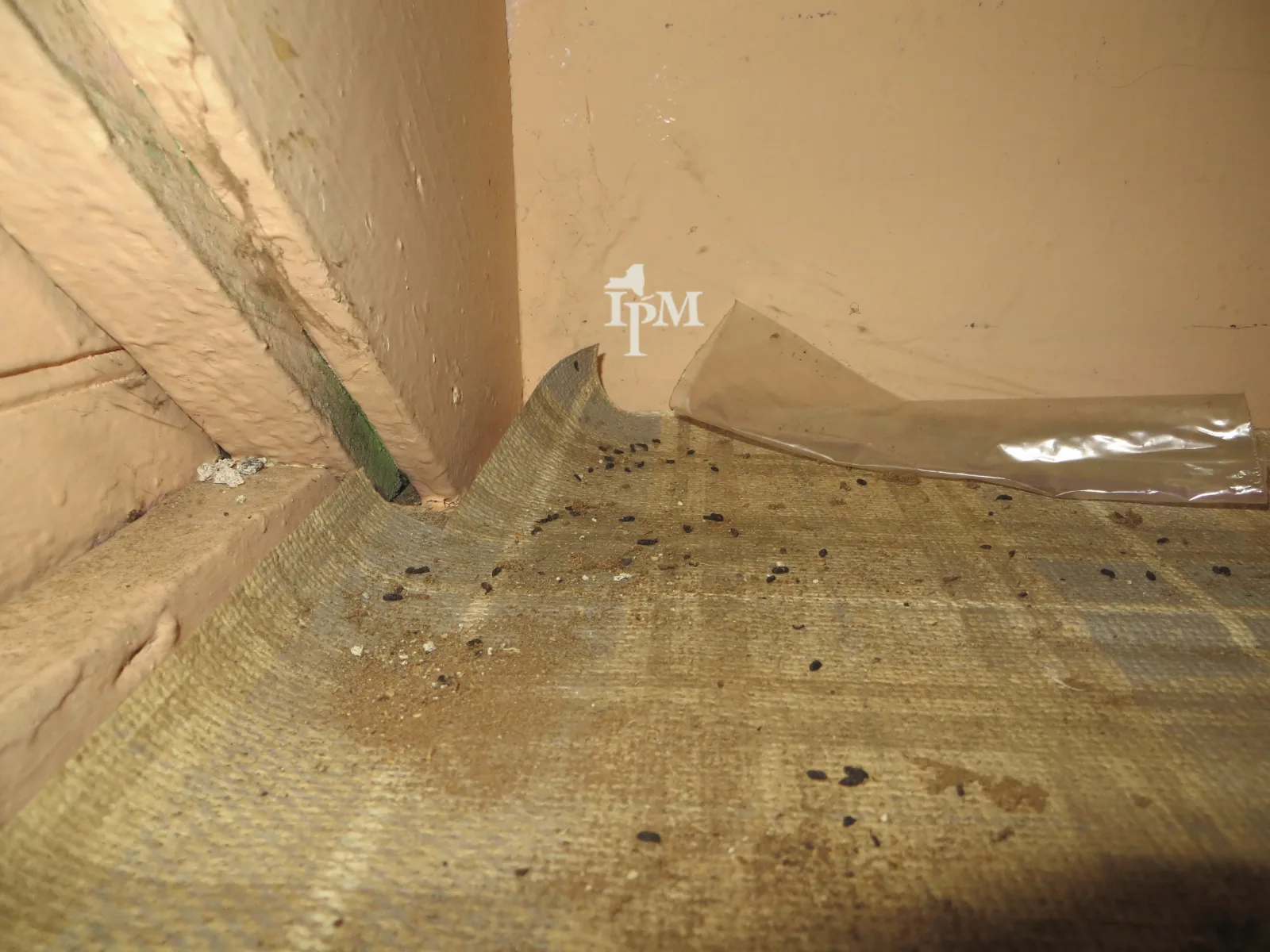
House mouse droppings scattered along a floor edge: small, dark, rod-shaped, and uniformly colored with no white tip. Photo: NY State IPM Program at Cornell University via Wikimedia Commons, CC BY 2.0, resized.
Lizard droppings are dark pellets that usually have a chalky white tip on one end (that’s the uric acid). Mouse droppings are dark, uniformly brown or black with no white cap, pointed at both ends, and usually scattered in groups along baseboards or inside cabinets. Size alone is inconclusive because the ranges overlap, and an old lizard pellet can lose its white cap. Use the shape, location, and surrounding evidence—especially gnaw marks, grease trails, or chewed packaging—before deciding.
How do I keep lizards off my lanai without hurting them?
Two-part plan: cut the bug supply (perimeter pest treatment, warm-spectrum bulbs, tight screens, trimmed shrubs) and close the way in (patch screen tears, add door sweeps, seal soffit gaps). You don’t need to remove the lizards themselves. Shrink the buffet and most of them will hunt somewhere else.
Ready to Deal With What’s Actually Bringing the Lizards?
You can wipe droppings off your railing every morning for the rest of the summer, or you can shrink the flying-insect population that’s drawing lizards to your house in the first place. Give Waves a shout at (941) 297-5749 or request a home pest evaluation online. We’ll walk your property, ID what’s really going on, and set up a treatment plan that fits the way SWFL actually behaves — sandy soil, afternoon storms, bug pressure and all.


.jpg)
.jpg)
.jpg)