Jump to a section (10)
- 01The short answer: yellow jackets are a type of wasp
- 02How to tell them apart at a glance
- 03Why the difference matters in SWFL
- 04Where they nest around your house
- 05What to do (and NOT to do) as a homeowner
- 06Three ways to handle a nest
- 07How to choose what to do about a nest
- 08When to call a pro
- 09Three quick answers
- 10Bottom line
If you’ve ever stood barefoot in your St. Augustine lawn, felt a hot pinch on your ankle, and started sprinting toward the hose — congratulations, you’ve probably met a yellow jacket. And if you’ve ever swatted at what looked like a longer-legged, danglier version of the same bug hanging from the eave over your lanai — that was likely a paper wasp.
Here’s the twist that trips up most Southwest Florida homeowners: yellow jackets are wasps. They just happen to be the meanest, chunkiest cousin at the family reunion. Not every wasp is a yellow jacket, but every yellow jacket is a wasp. Figuring out which one is buzzing your patio matters because the treatment, the risk, and the “should I get closer with a shoe” answer all change. For more on the local stinging cast of characters, our pest library has the rogues’ gallery.
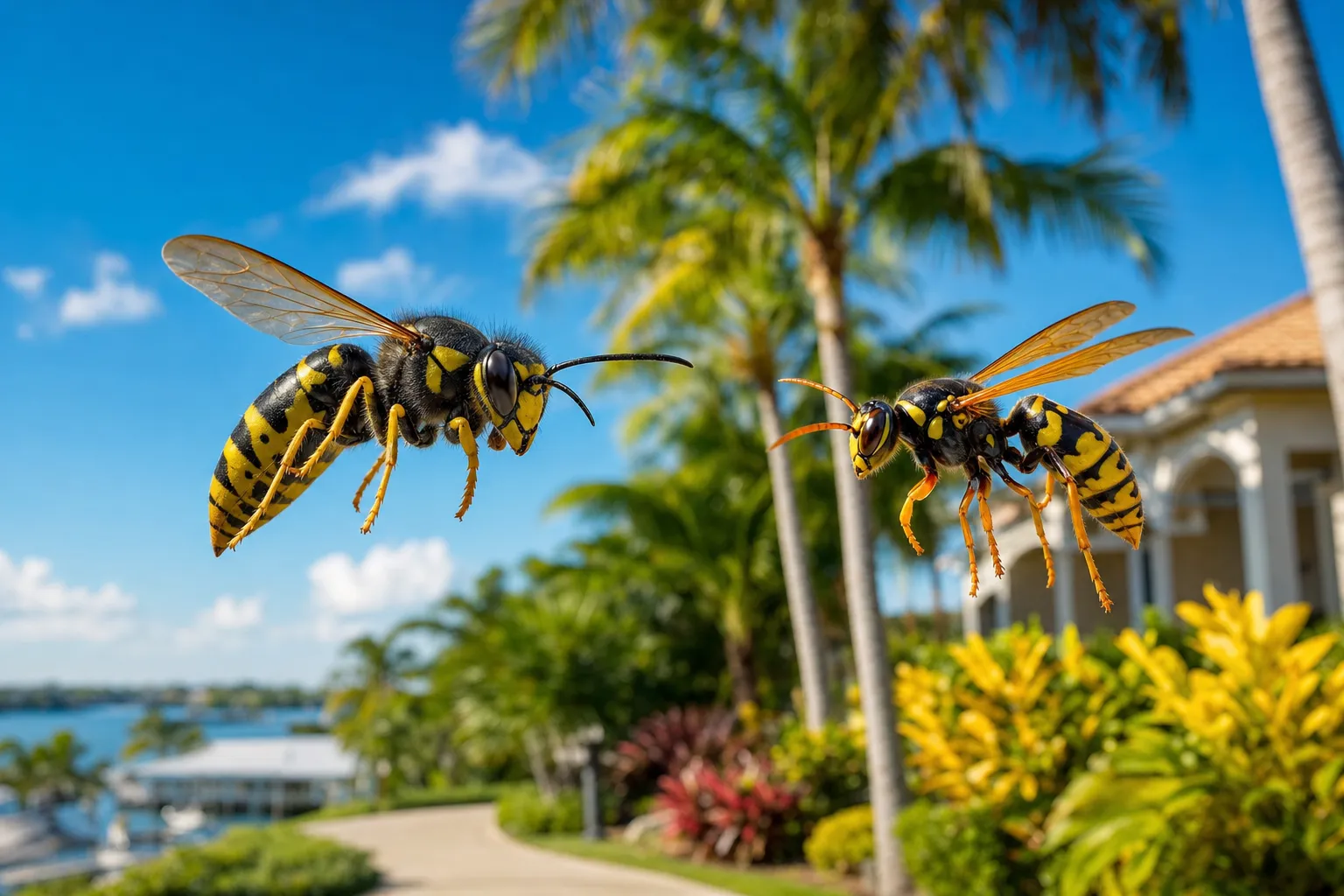
Not in the mood for a nature lesson because there’s already a nest by the front door? Skip ahead and get a quote from Waves — we handle SWFL stingers year-round.
The short answer: yellow jackets are a type of wasp
“Wasp” is the big umbrella. Under that umbrella you’ve got paper wasps, mud daubers, cicada killers, hornets, and yes — yellow jackets. In Florida, the three you’ll actually run into around a house are:
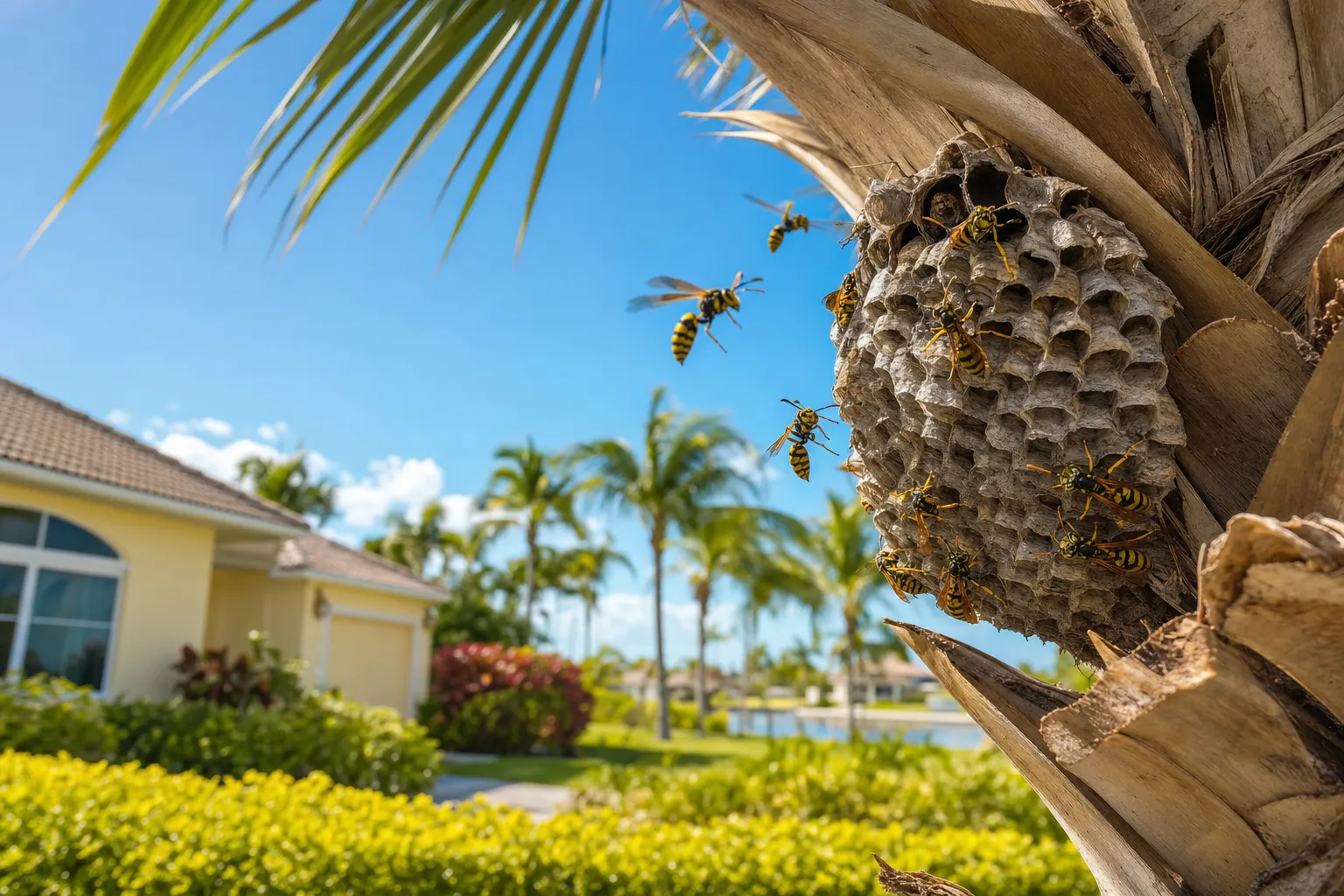
- Paper wasps (usually Polistes species) — the long-legged wasps you see building umbrella-shaped combs under your soffit. According to UF/IFAS, paper wasp nests are typically attached to the protected underside of overhanging structures, such as the eaves of houses.
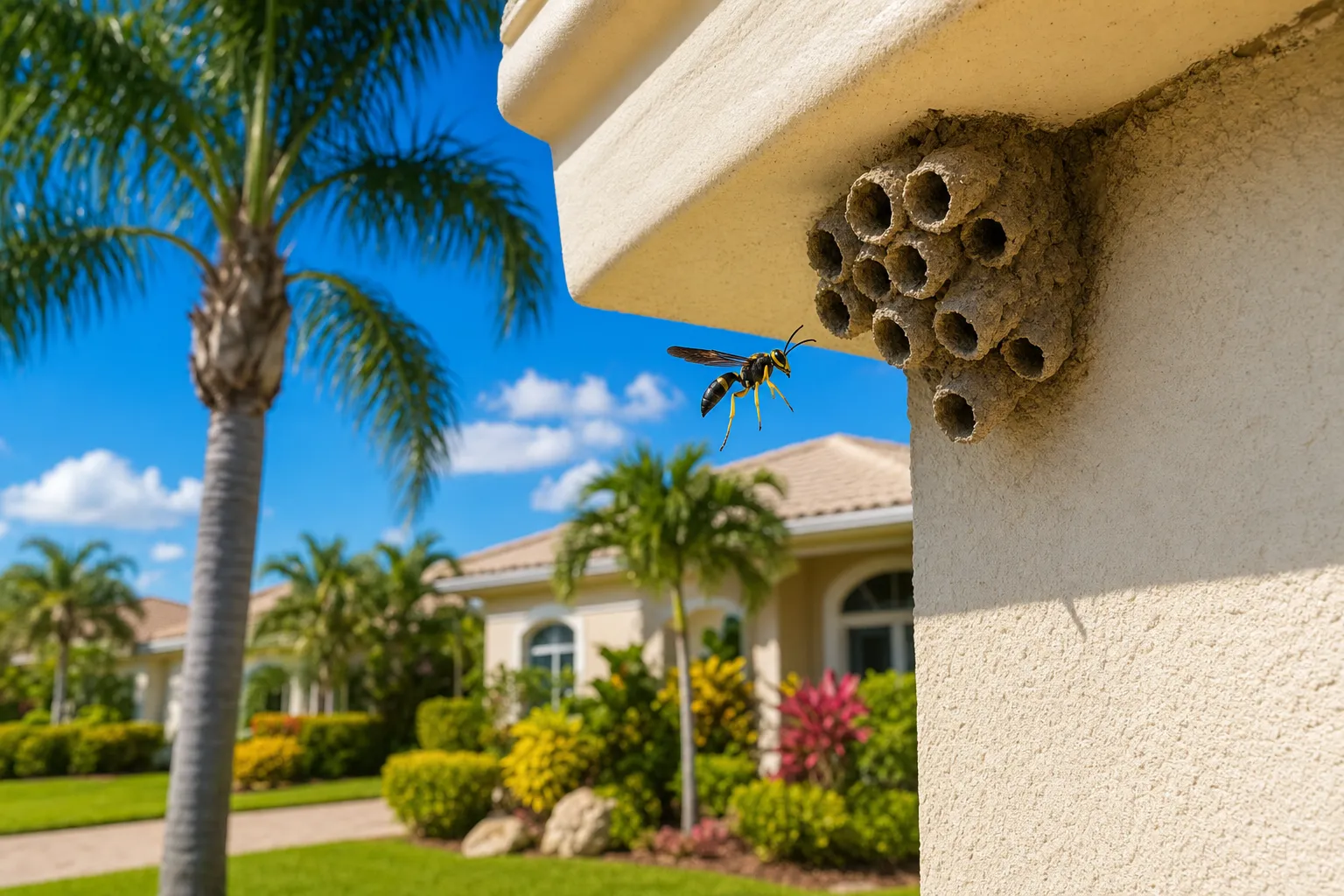
- Mud daubers — skinny, thread-waisted loners that build those weird little pipe-organ mud tubes on your stucco.
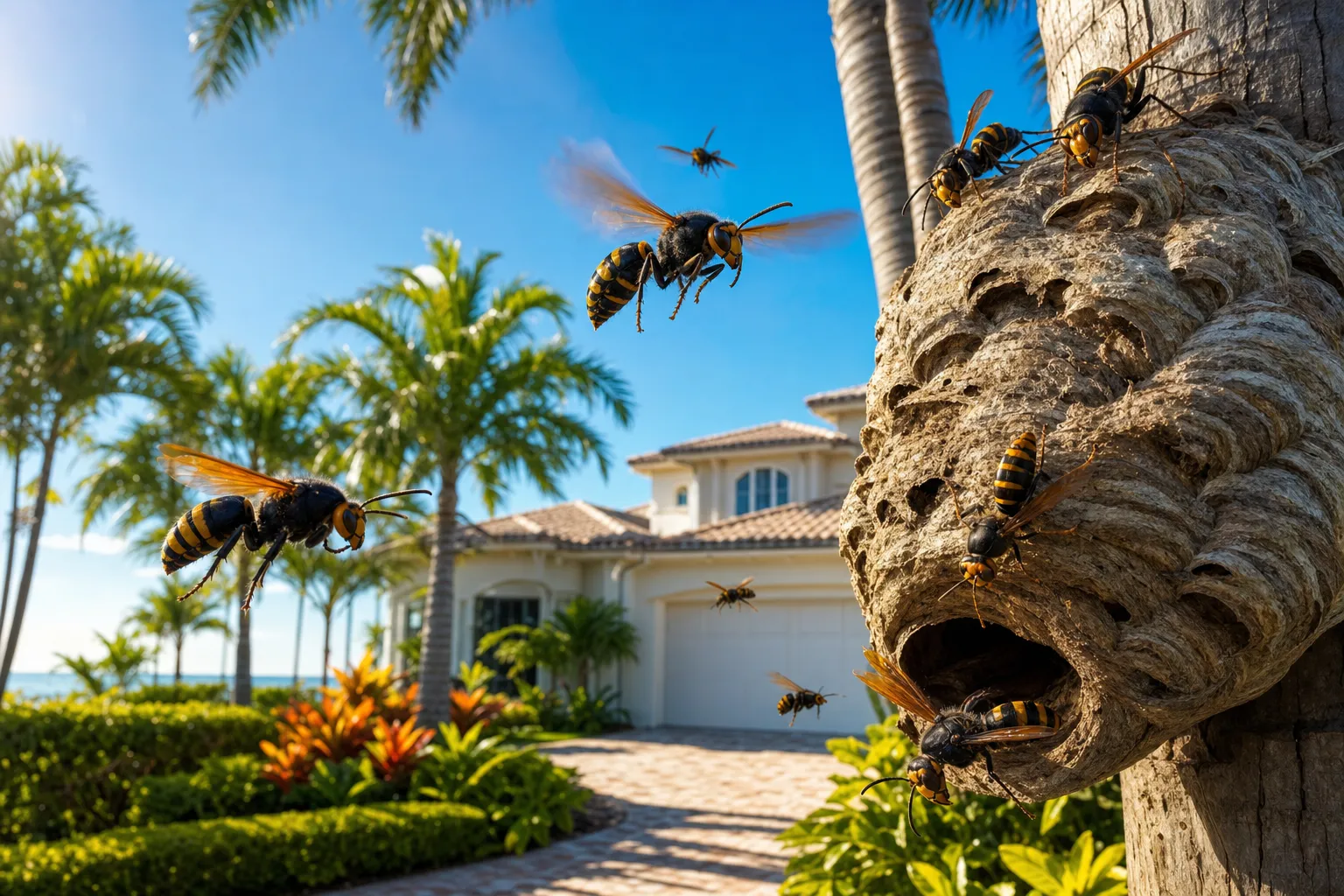
- Yellow jackets — short, stubby, high-strung, and often nesting in the ground or in a wall void. According to UF/IFAS, two yellowjacket species are known from Florida: the eastern yellowjacket (Vespula maculifrons) and the southern yellowjacket (Vespula squamosa).
So when someone asks “yellow jacket versus wasp,” what they usually mean is “yellow jacket versus paper wasp” — because those are the two most likely to be in a homeowner’s face on a July afternoon.
How to tell them apart at a glance
You almost never get a still, cooperative subject when you’re trying to ID a stinging insect. But there are a few tells that hold up even from six feet away.
On every inspection
Field marks: yellow jacket vs paper wasp vs mud dauber
- Body shape Yellow jacket: short, stout, compact — like a football with wings. Paper wasp: long, slender, obvious pinched waist. Mud dauber: thread-thin waist, almost cartoonish.
- Color Yellow jacket: bright, bold yellow-and-black bands, crisp and shiny. Paper wasp: duller brown, reddish, or rust with yellow accents. Mud dauber: often glossy blue-black or black with pale yellow markings.
- Legs in flight Yellow jacket: legs tucked tight against the body. Paper wasp: long back legs dangle noticeably. Mud dauber: legs dangle, but the insect is skinnier and slower.
- Attitude Yellow jacket: touchy, especially near the nest — will chase you across the yard. Paper wasp: defensive at the nest but generally chill otherwise. Mud dauber: basically a pacifist.
- Nest style Yellow jacket: hidden — ground holes, wall voids, tree cavities, old rodent burrows. Paper wasp: open, upside-down umbrella of gray papery cells. Mud dauber: mud tubes stuck to walls, ceilings, sheds.
If you can safely note two of these — body shape, nest, and attitude are the fastest tells.
Quick rule of thumb: if it’s bright yellow, moving fast, and you can’t easily see where it came from, assume yellow jacket and back away. If it’s dangling under an overhang from a papery gray comb, it’s almost certainly a paper wasp.
Why the difference matters in SWFL
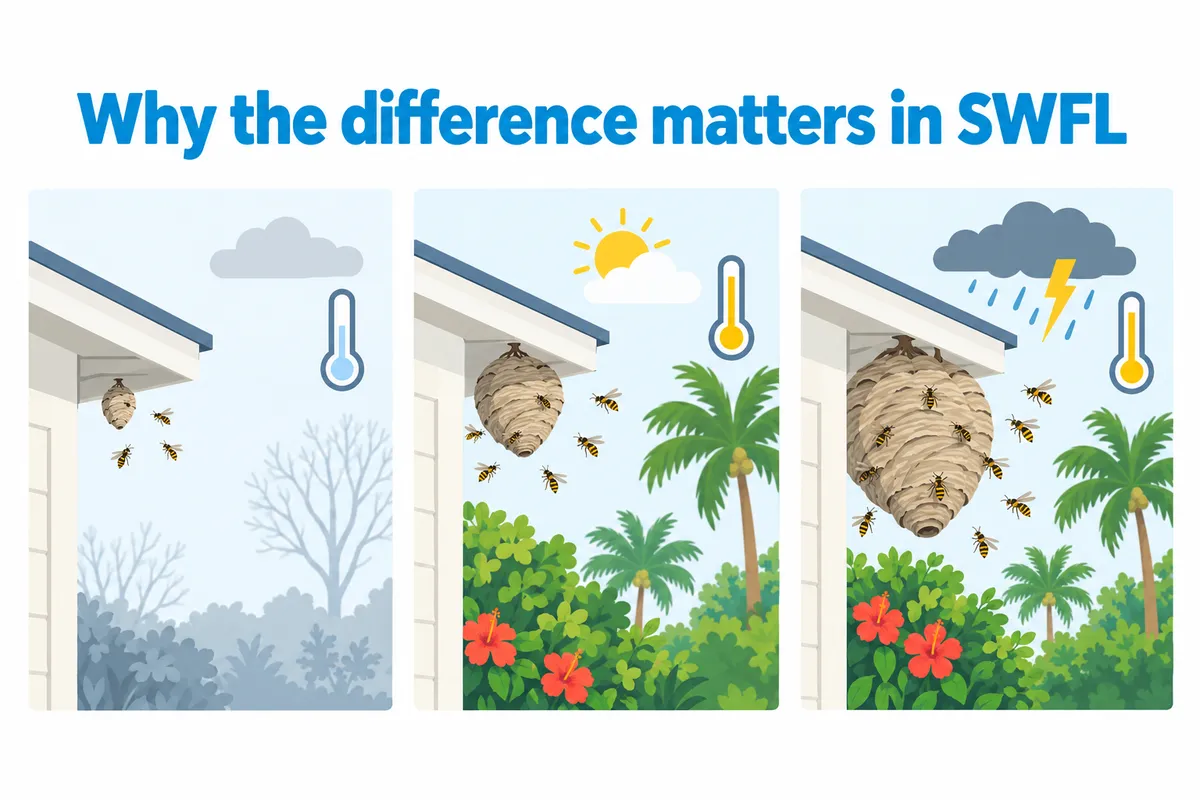
We don’t get a real winter here. Between the sandy soil, the afternoon thunderstorm humidity, and mild “cold” snaps that barely dip into the 40s, stinging insect colonies in Southwest Florida can grow bigger, later into the year, than they do up north. That has some practical consequences:
- Yellow jacket colonies get big. UF/IFAS says colonies are founded in the spring, and the largest eastern yellowjacket nest in its profile held eight levels of comb and more than 2,800 wasps. That’s not a nest you kick.
- Paper wasps peak with the storms. Populations swell through summer and hit their loudest note around late summer/early fall, right when hurricane prep has you poking around soffits and shutters.
- Ground nests hide in your lawn. UF/IFAS reports that most eastern yellowjacket nests are underground, with others in decayed stumps, tree cavities, and between the sidings of a home. A nest entrance can look like nothing more than a nickel-sized hole between St. Augustine runners — until you mow over it.
Sting-wise, both can sting more than once. UF/IFAS puts it this way: unlike the honey bee, vespid wasps “may sting as often as they find a target.” Yellow jackets are the ones most likely to keep coming, because an injured yellowjacket releases an alarm pheromone that sets off defensive behavior in its nestmates, per UF/IFAS. The UF/IFAS profile of the red paper wasp, by contrast, calls that species “not particularly aggressive” and says it typically stings only when threatened. If someone in the house has a known sting allergy, correct ID isn’t a nerdy detail — it’s the whole ballgame.
Seasonal pressure
Southwest Florida pest pressure through the year
- Spring Mar–MayBuilding
Warming weather wakes colonies up — activity climbs week over week.
- Summer / rainy season Jun–AugPeak
Heat + humidity + standing water = the year’s heaviest pressure.
- Hurricane season Sep–OctSurge
Storms and flooding push pests indoors looking for dry shelter.
- Fall NovActive
Cooler nights slow things down, but activity stays well above zero.
- Winter Dec–FebLower (not zero)
Our mild winters keep many pests going year-round indoors.
Summer / rainy season & Hurricane season run hottest. Stinging-insect pressure tracks the SWFL warm season — colonies build through spring, peak in late summer, and stay active well into fall.
Where they nest around your house
Knowing what the nest looks like — and where these things actually set up shop — is half the battle. Yellow jackets and paper wasps are picky about very different real estate.
Your home, zone by zone
Common SWFL nest spots by species
A typical Southwest Florida home — the numbered zones a local tech walks on every visit.
- Slab edge & ground line A yellow jacket ground-nest entrance can be a nickel-sized hole where the turf meets the slab.
- Doorways & thresholds A paper wasp comb directly over an entrance is an automatic pro call.
- Soffits & eaves Classic paper wasp territory — the open umbrella comb hanging from the underside.
- Weep holes & stucco gaps Yellow jackets slip through these to nest inside the wall void. Treat first, seal later.
- Garage & stored gear Grills, playsets, unused equipment. Skinny mud tubes on the walls are mud daubers — mostly harmless.
- Lanai frame & screen enclosure Paper wasps love the sheltered corners and top rails. Check before the season's first pressure wash.
- Mulch beds & lawn edges Yellow jacket favorite in sandy SWFL soil — especially near tree roots and irrigation boxes.
- Interior walls Buzzing in a wall — or wasps showing up indoors — means a hidden void colony. Don't plug the hole.
- Utility penetrations Pipe and cable entries through the stucco are wall-void doorways for yellow jackets.
- Attic & vents Cavity nesters end up here too — we check gable vents and rooflines while we're up top.
Southwest Florida homes give stingers a lot of options. Two-story homes plus screened lanais just multiply the hiding spots.
What to do (and NOT to do) as a homeowner
Do:
- Watch from a safe distance first. Sit on the patio with a cold drink and watch the traffic pattern for 10 minutes. Wasps and yellow jackets fly a fairly consistent line in and out of the nest — that’s how you find the actual entrance, especially with a ground nest.
- Mark the spot and warn the household. A little flag or an upside-down flower pot ten feet away (never on the nest) is enough.
- Treat at dawn or dusk if you must. That’s when most of the colony is home and calmer. Even so, this is where a lot of DIY ER visits start.
- Know the household’s allergy status. If anyone has ever reacted badly to a sting, don’t treat the nest yourself. A known sting allergy means stay away from the nest entirely and call a pro — an EpiPen is emergency backup, not permission to approach.
Don’t:
- Don’t pour gasoline down a yellow jacket hole. Yes, people still do this. No, it doesn’t work the way you think, and it creates a soil, groundwater, and fire problem in about that order.
- Don’t spray a ground nest with the garden hose. You’ll flood a fraction of it and enrage the rest. Sandy soil drains too fast for that trick anyway.
- Don’t knock down a paper wasp comb in the daytime. Even a “small” comb has enough defenders to ruin an afternoon.
- Don’t seal a wall-void yellow jacket entrance from the outside. If you plug the hole they know, they’ll chew a new one — sometimes into the living room. Treat first, seal later.
Pro tip: If you spot workers going in and out of a hole on the ground, tie a strip of ribbon on a nearby stake at the same height as the entrance. Bright color, easy to see from the mower, and you won’t wonder later, “was it here… or here?”
Three ways to handle a nest
You have three real options once you know what you’re looking at. This table is an editorial checklist built on the UF/IFAS guidance above. It does not rank the options.
| What to weigh | Leave it alone | Knock it down yourself | Hire a licensed pro |
|---|---|---|---|
| Fits when | Mud dauber tubes, or a small paper wasp comb far from doors and play areas | A paper wasp nest that is just starting with a single queen, which UF/IFAS says can be removed or knocked down with a broom | A large nest, a nest that needs a ladder, or any ground or wall-void yellow jacket nest |
| Main limit | The colony keeps growing through the warm season | Does not apply to hidden nests, and a sting allergy in the house rules it out | Takes a scheduled visit |
| Cost | None | Low | Quote-based |
| Who is at risk | Anyone who walks or mows near the nest | The person holding the broom | The technician, who has protective gear |
Editorial checklist based on UF/IFAS Featured Creatures profiles of yellowjackets (EENY-081) and the red paper wasp (EENY-640). No option is ranked.
How to choose what to do about a nest
- If the nest is mud tubes on a wall or shed, leave it alone or scrape it off when it is empty.
- If it is an open paper comb with a single wasp on it and nobody in the house has a sting allergy, use a broom, per the UF/IFAS note above.
- If wasps fly in and out of a hole in the ground or a gap in the wall, call a pro. That is a hidden yellow jacket nest.
- If the nest is large, over a doorway, or needs a ladder, hire a pest control operator. UF/IFAS calls that the safest procedure.
- If anyone in the household has reacted badly to a sting, call a pro for any nest.
Stinging insects are one part of our pest control services across Southwest Florida.
When to call a pro
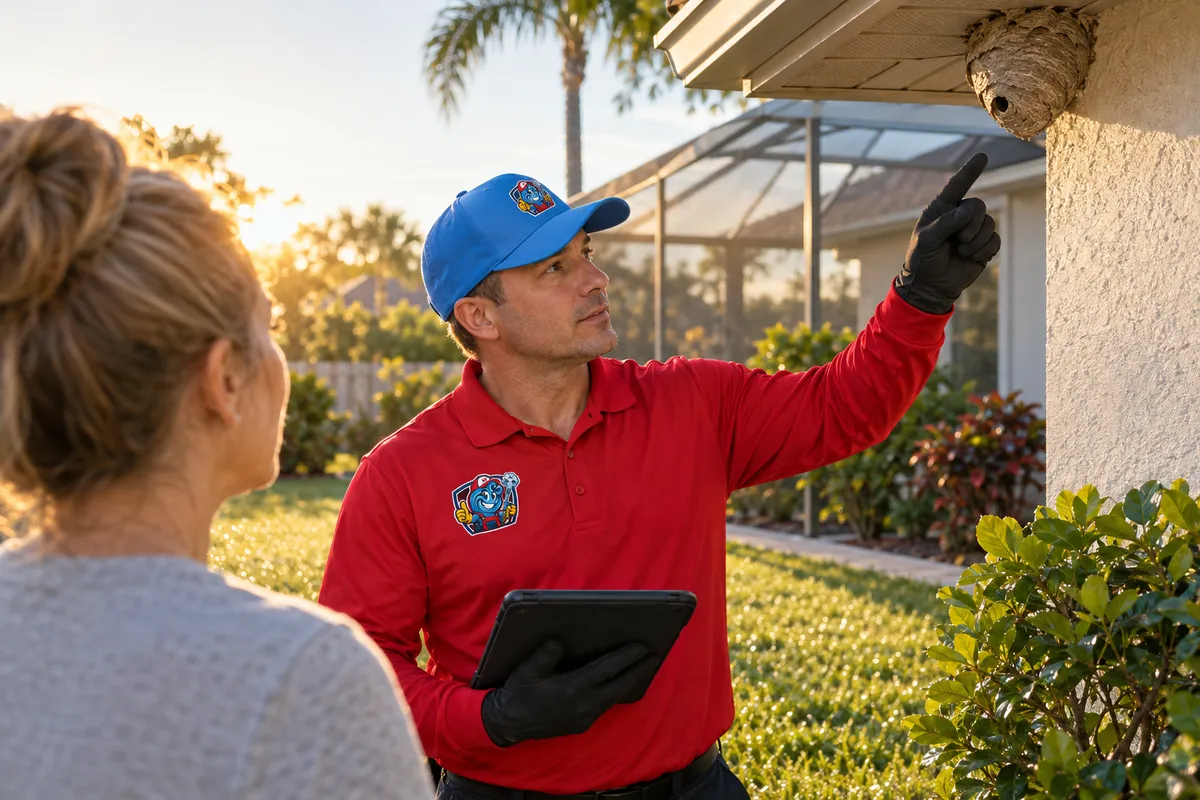
UF/IFAS says that when a nest is large or difficult to approach, the safest procedure is to hire a pest control operator. Some situations you can honestly babysit until the colony dies down in cooler weather (a small mud dauber tube on the shed, a paper wasp starter comb the size of a quarter in an out-of-the-way corner). Others are just not homeowner projects:
- Any yellow jacket ground nest or wall-void nest near a walkway, entrance, or play area.
- Any paper wasp nest larger than your palm, or one directly over a doorway.
- Anything where somebody in the household is allergic, or where you can’t get to the nest without a ladder and both hands.
- Any nest you’ve already sprayed once and it’s still active — that just means the surface layer is dead and the queen is still cooking.
At Waves, our stinging-insect visits usually look like this: walk the exterior first (lanai, soffits, weep holes, irrigation valve boxes, that one shed you forgot about), confirm the species, then treat the nest with a labeled product appropriate for the location — a dust into a void or ground entrance, a residual around the opening, and a knockdown for the open combs. We come back and physically knock the nest down once traffic is zero, because an empty paper comb still attracts new queens next season.
If you’d rather just have prevention baked into a regular schedule so you’re not googling “yellow jacket versus wasp” in a panic at 6 p.m. on a Sunday, our WaveGuard membership covers quarterly stinging-insect prevention and inspection, and members get a discount on one-time specialty treatments like active nest removal. Prefer a one-shot? Ballpark the visit with our pest control calculator, then book.
Three quick answers
How do you tell the difference between a yellow jacket and a wasp?
Yellow jackets are wasps — specifically social wasps in the genus Vespula. If someone’s asking this, they usually mean “yellow jacket versus paper wasp.” The short version: yellow jackets are short, chunky, bright yellow-and-black, and typically nest hidden (ground, wall, cavity). Paper wasps are longer, thinner-waisted, duller brown or rust with yellow markings, and hang an open umbrella-shaped comb under eaves or lanai frames. If the legs dangle in flight, it’s more likely a paper wasp; if the legs are tucked in tight and it’s coming fast, think yellow jacket.
Is a yellow jacket sting worse than a wasp sting?
Individual stings feel about the same — sharp, burning, and swollen for a day or two. The difference is quantity and behavior. Yellow jackets are the pushiest stinger you’ll meet in Southwest Florida. They’ll sting multiple times, they release an alarm pheromone that summons nestmates, and they’ll chase you well beyond the nest. Paper wasps typically only get aggressive if you’re right up on the comb. So “worse” usually comes down to how many stings you catch, not how much one hurts.
What does Dawn dish soap do to yellow jackets?
Soapy water breaks the surface tension around the insect’s spiracles (breathing pores) and can drown workers it directly contacts. That’s a fine trick for a lone wasp on the porch table. It’s a lousy plan for an active ground nest or a wall-void colony, because you’re only killing the few you drench — and now the rest of the colony is airborne and angry. Save the Dawn for the dishes and let a pro dust the actual nest.
Bottom line
Yellow jackets are wasps, but not the polite kind. Paper wasps and mud daubers are also wasps, and mostly want nothing to do with you. Learning the differences is genuinely useful — it tells you whether to grab a broom, walk the long way around, or dial a pro.
If you’ve spotted a nest around your SWFL home and you’d rather not test which species it is with your face, get a quote from Waves Pest Control. We treat stinging insects year-round from Bradenton and Palmetto down through Sarasota, Venice, North Port, and Port Charlotte, and we’re happy to identify what you’re looking at before we do anything else.