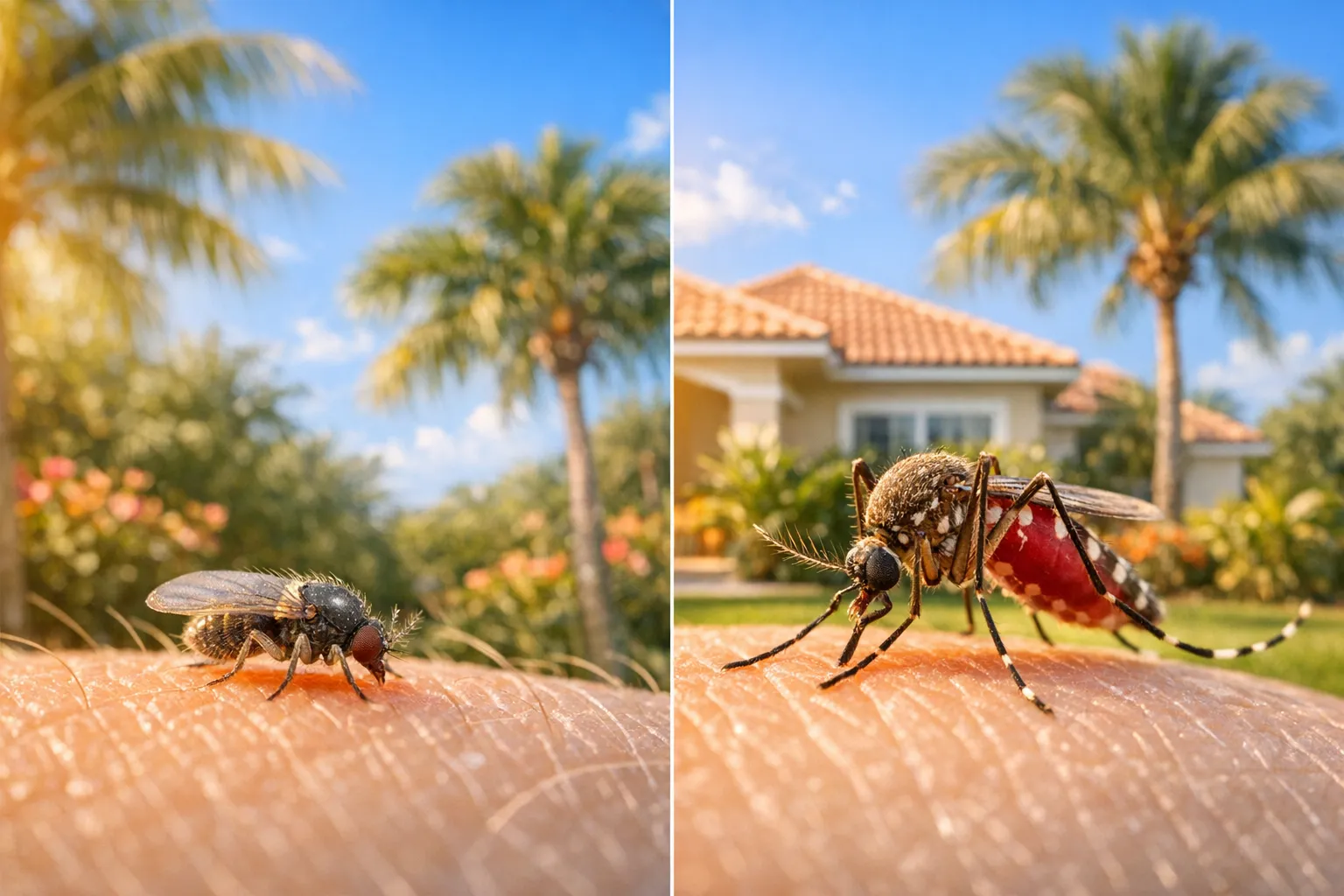
You’re standing on the lanai in Venice at 6:47 a.m., coffee in hand, and something you can’t see is chewing on your ankles. The screens are intact. The yard is dry. You’ve dumped every plant saucer for a week. So how are these “mosquitoes” still landing?
They probably aren’t mosquitoes.
Along the Southwest Florida coast — Venice, Sarasota, coastal Bradenton, Anna Maria — the dawn culprit is usually the biting midge, better known here as the no-see-um. According to the UF/IFAS Featured Creatures profile on biting midges (Culicoides spp.), the two insects don’t just look different, they live in different worlds. Mosquitoes breed in standing water. Biting midges breed in salt-marsh mud. And that one fact rewrites everything you thought you knew about “mosquito prevention.”
This page is an identification reference, not a treatment guide. If you’ve already ID’d no-see-ums and want the how-to-actually-fix-it playbook, jump over to our no-see-um control guide for Bradenton or our mosquito control service page. If you still aren’t sure which bug is biting you, keep reading — and if the answer is “both, and it’s getting old,” you can request a quote and we’ll come look.
The screen clue: standard mesh keeps mosquitoes out — not midges
Look at your window screen. The standard weave — roughly 18 × 16 mesh — stops mosquitoes cold. It does not stop no-see-ums. UF/IFAS Featured Creatures literally puts a photograph of Culicoides furens next to a standard window screen to make the point: the midge is small enough to walk through the opening. UF’s own homeowner guidance repeats it — biting midges “can pass through most wire mesh,” which is why finer “no-see-um” screening is the only exclusion that actually works.
So if the bites started after you patched a torn screen, and they still don’t stop, that isn’t a mosquito failure. Intact standard screen keeps mosquitoes out. Something else is on your porch.
A useful field test: sit outside at 6:30 a.m. or right at dusk on a still, humid evening — the kind we get for weeks between afternoon storms. If you feel a sharp burning pinprick before you see anything land, slap the spot, and find nothing there — that’s the no-see-um signature, per UF/IFAS.
| Feature | No-see-ums (biting midges) | Mosquitoes |
|---|---|---|
| Adult size | Many species around 1 mm (~1/24 inch); adults generally under 1/8 inch | ~4–7 mm |
| Passes standard window screen (18×16) | Yes | No |
| Peak biting times | Dusk, night, morning — dawn/dusk on the coast | Varies by species; many dusk & night |
| Bite sensation | Sharp, burning pinprick on contact | Itchy welt, usually noticed later |
| Where they breed | Salt-marsh muck, mangrove edges, moist organic soil | Standing water: containers, tires, gutters, saucers |
| Does dumping standing water help? | No — wrong breeding site | Yes — core prevention step |
No-see-ums vs. mosquitoes: identification and prevention differences, per UF/IFAS Featured Creatures.
No-see-um ID per UF/IFAS: size, burning bite, dawn and dusk pressure
Here’s the identification checklist, straight from UF/IFAS:
- Size. UF/IFAS describes adult biting midges as “extremely small,” with many species less than 1/24 of an inch (about 1 mm). An older UF/IFAS homeowner fact sheet puts adult no-see-ums at “less than 1/16 inch (1.6 mm) long, dark gray to black.” A typical Florida mosquito runs 4–7 mm — several times bigger. That size gap is why the name stuck.
- Wings. Under magnification, biting midges have two wings marked with distinctive pale-and-dark spot patterns. UF/IFAS notes those wing patterns are what entomologists use to key Culicoides out to species.
- Antennae. Fifteen segments, per UF/IFAS — a hand-lens detail, but a genuine mark that separates midges from mosquitoes and true gnats.
- The bite. UF/IFAS entomologist Dr. Roxanne Rutledge has described no-see-um bites as causing “a sharp, burning pain.” The female uses tiny cutting teeth on her mandibles to open a small wound in the skin. That burn on contact is a giveaway — mosquito bites usually itch later, not at the moment of contact.
- Timing. UF/IFAS notes most biting midge species bite at dusk, night, or morning. Along the SWFL coast, dawn and dusk are the peak windows.
Only females bite. Males lack the mouthparts to pierce skin, per UF/IFAS. Same rule as mosquitoes there — the females need the blood meal to develop eggs.
Coastal geography: why Venice and coastal Bradenton feel it worse
There’s a reason the complaints spike near the water. The UF/IFAS Featured Creatures profile identifies coastal salt marshes and mangroves as major producers of many biting midge species, and older UF/IFAS coastal-midges reporting flags Culicoides furens as one of Florida’s most important human-biting species — a salt-marsh specialist.
The mangroves fringing Sarasota Bay, the tidal creeks behind Venice, the marsh edges around coastal Bradenton and Anna Maria — all classic Culicoides real estate. UF entomologist Dr. Jonathan Day has explicitly told UF News that the fall bite spike follows peak high tides that flood the marshes and hatch dormant eggs stockpiled through the summer. That’s the mechanism behind the “why does October feel worse than August” question every coastal homeowner eventually asks.
Inland Sarasota, east Bradenton, the twenty-miles-in neighborhoods over St. Augustine lawns and sandy soil? Mostly mosquitoes still. The closer you live to a mangrove edge or a brackish creek, the more the calculus tips toward midges.
Breeding difference: salt-marsh muck vs. container water
This is the big one. This is the fact that breaks the standard mosquito checklist.
Mosquitoes lay eggs in or on standing water — a saucer under a bromeliad, a clogged gutter, a bird bath, a tarp that pooled after an afternoon storm. Dump the water, break the life cycle. That’s why every mosquito guide starts with “eliminate standing water.”
Biting midges do not do this. UF/IFAS is unambiguous: biting midges lay eggs in muddy soil, and they cannot deposit them on top of standing water. The eggs go into moist substrate — the mud in a salt marsh, the goop at a mangrove edge, the wet organic soil at the low, damp corner of a coastal lot. As Rutledge told UF News, there is no economical, environmentally sound way to kill larvae across vast tracts of tidal mud, which is why no community in Florida runs a biting-midge control program on par with a mosquito-control district.
Translation for the homeowner: dumping every saucer in your yard is still worth doing for mosquitoes — please do it — but it won’t move the needle on no-see-ums. The nursery isn’t in your yard. It’s in the marsh a quarter mile away.
What actually helps: screen mesh, fans, timing (per UF/IFAS)
Since this is an identification reference, not a treatment guide, we’ll keep this section short and send you to the full playbook below. UF/IFAS’s core homeowner recommendations for biting midges:
- Upgrade to no-see-um mesh. Standard window screen doesn’t exclude them; a tighter weave (marketed as “no-see-um” screening) does. UF/IFAS specifically photographs a midge next to standard screen to underline the point.
- Run fans. UF/IFAS describes biting midges as “weak fliers,” and notes homeowners can “blow the pests away from patios and decks with large electric fans.” A screened lanai with a ceiling fan on medium is a legitimately effective barrier.
- Time your outdoor hours. Most Culicoides species bite at dusk, night, or morning. Move the dog walk, the coffee-on-the-porch ritual, and the sunrise beach photos to mid-morning during heavy pressure windows.
- Use a repellent labeled for biting flies or midges. UF/IFAS lists repellents among the personal-protection tools — check the label, because not every “mosquito repellent” is rated for midges.
Pro tip from the field: If you already have a screened lanai and midges are still getting in, don’t assume the whole enclosure needs re-screening. Nine times out of ten, they’re coming in around the door sweep or through the gap where the screen frame meets the pool cage. Seal the gaps first, then argue about mesh count.
Your home, zone by zone
Where no-see-ums actually get in
A typical Southwest Florida home — the numbered zones a local tech walks on every visit.
- Door sweeps & thresholds Common gap around lanai doors — a 1/16-inch gap is a runway for a 1 mm midge.
- Screen-to-frame seams Where mesh meets aluminum on pool cages and lanai enclosures.
- Standard 18×16 window screen Stops mosquitoes, does not stop biting midges per UF/IFAS.
- Vegetation at the perimeter Damp shaded resting habitat where adults stage before dusk.
- Marsh / mangrove edge Actual larval source — usually offsite and untreatable.
Common entry points and habitat around a coastal SWFL home.
For the identification-to-control side, our no-see-um guide for Bradenton walks through the treatment approach. If your suspicion has shifted back to mosquitoes, the mosquito control service page covers that lane, and our pest library has more of these ID references.
Interesting facts (all UF/IFAS-sourced)
Because the trivia is genuinely good:
- The genus Culicoides contains around 1,350 species worldwide, per the updated UF/IFAS Featured Creatures profile. Florida hosts roughly 50 of them — but only a small handful are meaningful human pests.
- “No-see-um” is exactly as literal as it sounds. UF/IFAS notes that because biting midges measure less than 1/8 inch long, they are “seldom seen by their human hosts.” You feel the bite before you see the bug.
- “Sand fly” and “sand gnat” are UF/IFAS-accepted common names for the same insects. If a neighbor gripes about “sand gnats” at Nokomis Beach, that’s a biting midge.
- The wing spots aren’t decorative. UF/IFAS says the pattern of pale and dark spots on the wings is a primary way entomologists identify Culicoides to species.
- Peak fall bite pressure on the SWFL coast is driven by tide, not weather. Peak high tides flood the salt marshes and hatch dormant eggs banked all summer, per UF/IFAS’s Dr. Jonathan Day.
Setting honest expectations
Here’s the plain-neighbor version: nobody is eradicating no-see-ums from the coastal Bradenton–Venice–Anna Maria stretch, because nobody can. UF/IFAS says so directly — there is no community-scale midge control program in Florida, and no economical, environmentally sound way to treat vast tracts of tidal mud. What you can do is stack the odds: better mesh, moving air, smarter timing, and a repellent actually labeled for biting flies.
For pricing questions on any of our services, please head to the pest control calculator — every coastal property is different (marsh distance, screen condition, prevailing wind), so we don’t ballpark in blog posts.
Frequently Asked Questions
How can I tell a no-see-um bite from a mosquito bite?
The bite itself is the tell. UF/IFAS describes biting-midge bites as producing a sharp, burning pain you feel on contact. Mosquito bites tend to itch later, once the welt develops. Location adds evidence: if the bites cluster on ankles and lower legs after a dawn or dusk visit to a coastal yard, and you never saw the bug, that’s a no-see-um pattern.
Do no-see-ums come from my yard?
Usually not directly. Per UF/IFAS, the human-biting Culicoides species most common on the SWFL coast develop in salt-marsh muck, mangrove edges, and similar wet organic soils — not in a saucer of standing water on your patio. Yard sanitation still matters for mosquitoes, but no-see-ums are usually blowing in from adjacent coastal habitat that isn’t on your property line.
Do no-see-ums spread disease in Florida?
Per UF/IFAS, biting midges in the United States are not known to transmit human disease pathogens. Bites can cause welts and, in some people, mild allergic reactions lasting a couple of days. Livestock and wildlife are a separate story — some Culicoides species transmit veterinary pathogens like bluetongue virus — but that is an animal-health concern, not a homeowner one.
Will fine-mesh screening solve the problem completely?
No, but it’s the single biggest quality-of-life upgrade for a coastal lanai. UF/IFAS is clear that biting midges pass through standard window screen and that finer no-see-um mesh keeps them out. Combine tighter mesh with sealed frame gaps and a moving fan — UF/IFAS notes midges are weak fliers — and a screened space actually functions during dawn and dusk.
Want a professional eye on your specific situation? Every coastal property is different — marsh line, prevailing wind, condition of your screens, how the vegetation is set up. Request a quote and we’ll walk your yard, sort out what’s actually biting you, and lay out the options. For our full service lineup see pest control services, or explore ongoing coverage through WaveGuard memberships.
Sources: UF/IFAS Featured Creatures — Biting Midges, No-See-Ums Culicoides spp. (Burkett-Cadena, Cooper, Addae & Buckner, 2025; earlier editions by Connelly and by Rutledge & Day); UF/IFAS News, “Fewer biting midges expected this fall” (2005, Day & Rutledge quotes). Entry point: entnemdept.ufl.edu/creatures/.