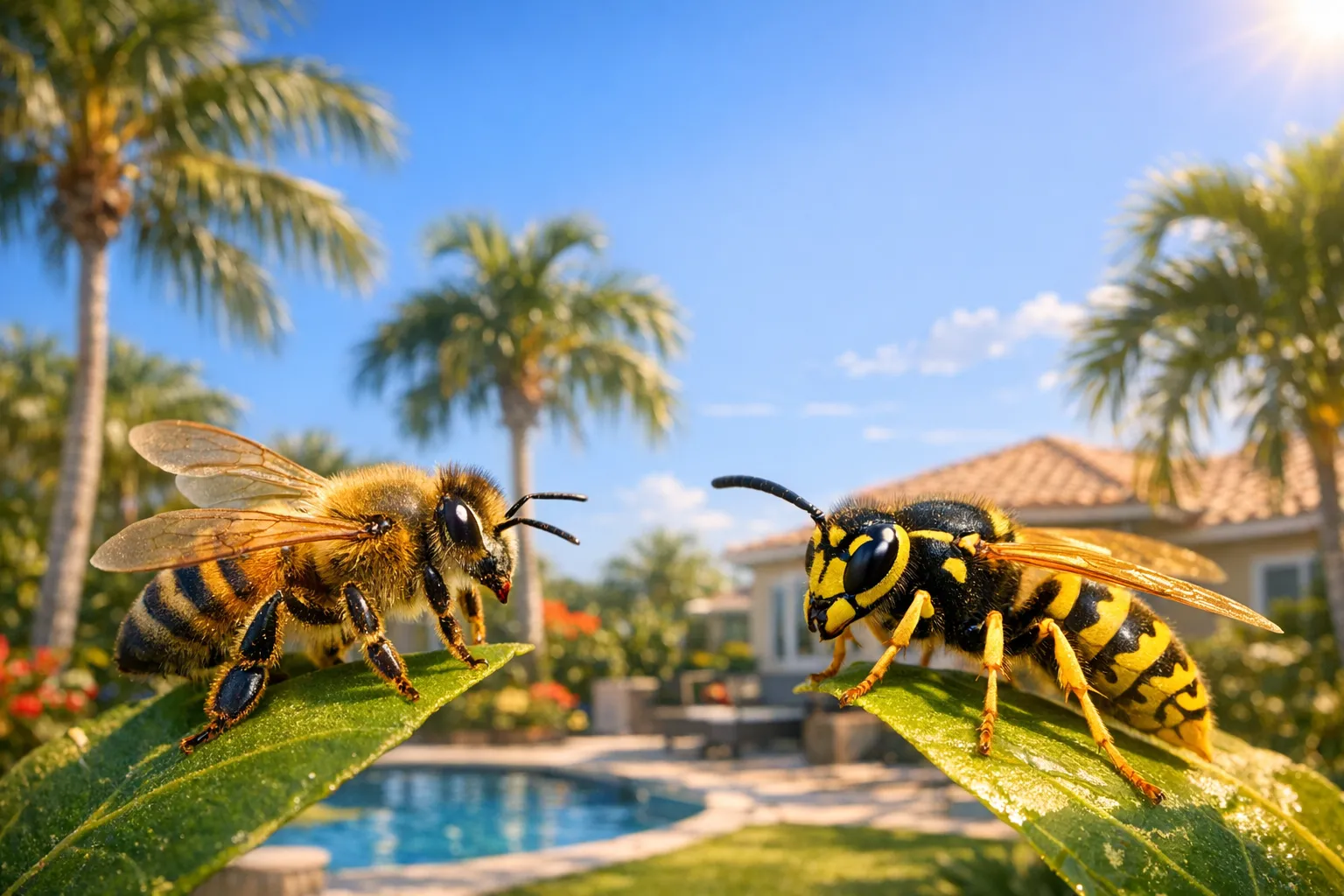
If you’re staring at a stripey little insect drilling into your soffit and wondering whether you should be worried, whether you can DIY it, or whether you’re about to make a very bad decision — you’re in the right place. “Honeybee vs. yellow jacket” is the single most-asked ID question we get every spring and fall from Sarasota to Fort Myers, because getting it wrong costs you either a valuable pollinator or a genuinely awful afternoon.
Here’s how a Southwest Florida homeowner can tell them apart in about ten seconds — and what to do once you know. If you want the wider cheat sheet after this, our pest library has ID cards for every stinging, chewing, and crawling thing that shows up around a SWFL home, and there’s more of this style of guide over on the Waves blog.
Quick ID: The 10-Second Test
Look at three things: the body, the waist, and the fuzz.
- Honey bee. Golden brown to amber. Fuzzy, almost teddy-bear looking. Rounded body with no obvious “wasp waist.” Roughly the size of a pencil eraser. Usually moving in a slow, deliberate zig-zag between blooms and rarely interested in you.
- Yellow jacket. Bright, almost neon yellow with sharp black bands. Smooth, shiny, no fuzz. Pinched wasp waist. Slightly longer and skinnier than a honey bee. Moves fast and darty — often around your soda can, garbage bin, or grill.
If it’s fuzzy and mellow, you almost certainly have a honey bee. If it’s shiny and pushy — especially if it’s crashing your patio lunch — you’re looking at a yellow jacket.
Not sure you’re safe standing where you are? Book a stinging-insect inspection and we’ll ID the nest and lay out a plan before anyone gets stung.
Behavior Differences That Actually Matter
The bug ID is only half the picture. What they do is what determines your risk.
Honey bees are pollinators. Their job is to visit flowers and haul pollen back to the hive. They sting once and die — the barbed stinger stays behind. So a honey bee has to be genuinely defending the colony to sting you. It is not interested in your burger.
Yellow jackets are wasps, and wasps are predators and scavengers. Early in the year they hunt caterpillars and flies to feed their brood. By late summer, when the colony is huge and the queen has stopped laying eggs, adult workers switch to hunting sugar and protein — which is why fall cookouts in Punta Gorda and Cape Coral suddenly turn into wasp battles. Yellow jackets can sting repeatedly and release an alarm pheromone that summons nest-mates when they feel threatened.
Translation: a honey bee foraging in your bougainvillea is doing you a favor. A yellow jacket cruising your trash can around Labor Day is a warning that a nest is nearby.
Seasonal pressure
Stinging Insect Pressure in Southwest Florida
- Winter Dec–FebLower
Honey bee colonies cluster inside cavities; new yellow jacket queens overwinter alone.
- Spring Mar–MayBuilding
Honey bee swarm season peaks; yellow jacket queens start new ground nests.
- Summer Jun–AugActive
Both colonies expand quickly; afternoon storms displace nests into soffits and eaves.
- Fall Sep–NovPeak
Yellow jacket colonies hit max size and get significantly more aggressive.
Fall runs hottest. Yellow jacket aggression peaks in fall. Honey bee swarming peaks in spring — different problem, different response.
Where They Nest Around a SWFL Home
Nest location is your other giant clue.
Honey bees want a dry, defensible cavity. In Southwest Florida that usually means:
- A hollow live oak or the trunk of a dead sabal palm
- A wall void behind stucco or siding (they’ll exploit a weep hole or a gap around a hose bib)
- A soffit, chimney chase, or shed attic
- Occasionally a swarm cluster hanging on a branch for a day or two while scouts pick a permanent spot
If you see a football-shaped cluster of bees hanging on a limb, that’s a swarm — it’s temporary, they’re generally not defensive, and it’s the easiest scenario for a beekeeper to relocate.
Yellow jackets are less picky. Our sandy Southwest Florida soil is basically a yellow-jacket dream substrate — well-drained and easy to tunnel. Common nest spots:
- A single hole in the ground under mulch, palmetto, or a St. Augustine lawn edge
- An abandoned rodent burrow that they’ve moved into
- Inside a wall void, attic, or shed
- Behind fascia, in soffit vents, under grill covers, inside irrigation valve boxes
Your home, zone by zone
Where We Find Stinging Insect Nests
A typical Southwest Florida home — the numbered zones a local tech walks on every visit.
- Soffits & eaves Honey bee wall colonies and yellow jacket cavity nests. Watch for stained wood and steady traffic.
- Ground & mulch beds Classic yellow jacket ground nests — one hole, constant two-way traffic.
- Sheds & attics Both species. Look for wax comb (bees) vs. gray paper (wasps).
- Wall voids Weep holes, hose bibs, and cracked stucco are favorite entry points.
- Trees & palms Honey bee swarm clusters and cavity colonies in live oaks and dead palms.
- Fascia & trim Yellow jackets tuck paper nests behind fascia boards and loose trim.
- Grill covers & furniture Wasps favor sheltered patio spots — check before you lift a cover.
- Irrigation valve boxes Yellow jackets colonize the dry cavity around buried valves.
- Chimney chases Honey bee cavity colonies climb inside unused chimneys and flues.
- Rodent burrows Abandoned burrows in sandy soil become ready-made yellow jacket nests.
If you see steady, one-way insect traffic to the same spot on your house, that is a nest — not casual foraging.
What to Do (and Not Do) If You Find a Nest
Homeowner ground rules for either species:
- Watch the flight path first. Stand 15–20 feet back and see where the insects are going in and out. One hole with steady traffic = nest. Bees scattering across a flower bed = foragers, not a nest.
- Do not plug the hole. People try this in daylight with expanding foam or a rock. Two bad things happen: you trap angry workers who chew back out through your drywall, or (with honey bees) you strand a colony that dies inside a wall and now you have a wax-and-honey-attractant mess dripping down your studs.
- Do not spray a honey bee colony. In Florida, honey bees are an important agricultural resource, though a nuisance colony can be legally removed alive by a beekeeper or eradicated by a certified pest control operator. The responsible move is a registered/licensed removal or treatment plan — not a can of hardware-store spray that kills the workers but leaves the comb and honey rotting in your wall.
- Do not swat. Yellow jackets read swatting as an attack and dump alarm pheromone. Walk — don’t run in flailing circles — to indoor cover.
- Skip the DIY ground-nest can. Homeowner aerosols usually spray the opening, not the nest. You annoy the colony, they come pouring out, you get stung on the back of the neck while running.
Pro tip: If you find a yellow jacket ground nest in the afternoon, mark it from a safe distance with a lawn flag or a stake set a few feet away — don’t cover or disturb the hole — and leave it alone until after dark. Yellow jackets are inside the nest at night, they don’t fly well without sunlight, and that’s when a pro can dust the entrance safely. Middle-of-the-day treatment is when people end up in the ER.
When to Call Waves — and When to Call a Beekeeper
Not every stinging-insect job is the same call.
Call a beekeeper or live-removal specialist if:
- You have a fuzzy, football-shaped cluster hanging in a tree for less than 48 hours — that’s a swarm, and a local beekeeper will often take it for free.
- You have honey bees established in a wall void and you want them relocated instead of killed. Doing it right usually means cutting open the void to remove the comb — a good removal specialist will handle it.
Call Waves if:
- You’ve confirmed yellow jackets (or paper wasps, mud daubers, or hornets) and you want the nest gone.
- You’re not sure what you’re looking at and want a tech to ID it before anyone gets stung.
- Kids, pets, or a sting-allergic family member are living near the nest and you can’t wait.
- You want a preventive plan so you’re not doing this again next fall — our WaveGuard membership rolls stinging-insect knockdowns into the regular quarterly visits.
Curious what a one-time treatment or an ongoing plan runs for your home size and lot? Our pest control calculator gives you an honest ballpark in about 30 seconds — no phone tag, no hard sell.
Frequently Asked Questions
Are yellow jacket stings worse than honey bee stings?
Per sting, the venom is roughly comparable — both hurt, both can trigger allergic reactions, and both should be watched for swelling that spreads beyond the sting site. The reason yellow jackets feel worse in practice is that a single yellow jacket can sting you five or six times in a row, and its alarm pheromone recruits nest-mates. A honey bee stings you once and dies. So a yellow jacket encounter usually means multiple stings; a honey bee encounter usually means one.
What is the “3-3-3 rule” for bees?
You’ll see a “3-3-3” phrase floating around online, but it isn’t a reliable medical triage rule — don’t wait on a stopwatch after a sting. Medical guidance is simpler: seek emergency care immediately if you notice trouble breathing, chest tightness, trouble swallowing, widespread hives or swelling, dizziness, or stomach symptoms like nausea, cramps, or vomiting. Those signal a systemic allergic reaction and are a 911 call. A red, swollen welt right where you got stung is local and usually not an emergency, but any of the whole-body symptoms above mean get help now, not later.
How do I know if I have ground bees or yellow jackets?
Ground bees (sweat bees, mining bees) are usually solitary — you’ll see one bee per hole, dozens of small holes spread across a sunny patch of sandy soil, and they basically ignore you. Yellow jackets are the opposite: one hole, constant two-way traffic, and they get defensive if you mow or walk close. If you spot a single hole in a Sarasota lawn with a steady stream of yellow-and-black insects going in and out, assume yellow jackets and back off.
The Bottom Line
Honey bees pollinate, sting once, and deserve to be relocated. Yellow jackets scavenge, sting repeatedly, and belong in the “get it handled” column — especially by late summer when SWFL colonies are at their nastiest. If you’re not 100% sure which one is buzzing around your soffit, don’t guess and don’t spray. Book a stinging-insect inspection with Waves, send us a photo, and we’ll tell you exactly what you’ve got and what it takes to make it stop — before anyone gets stung.