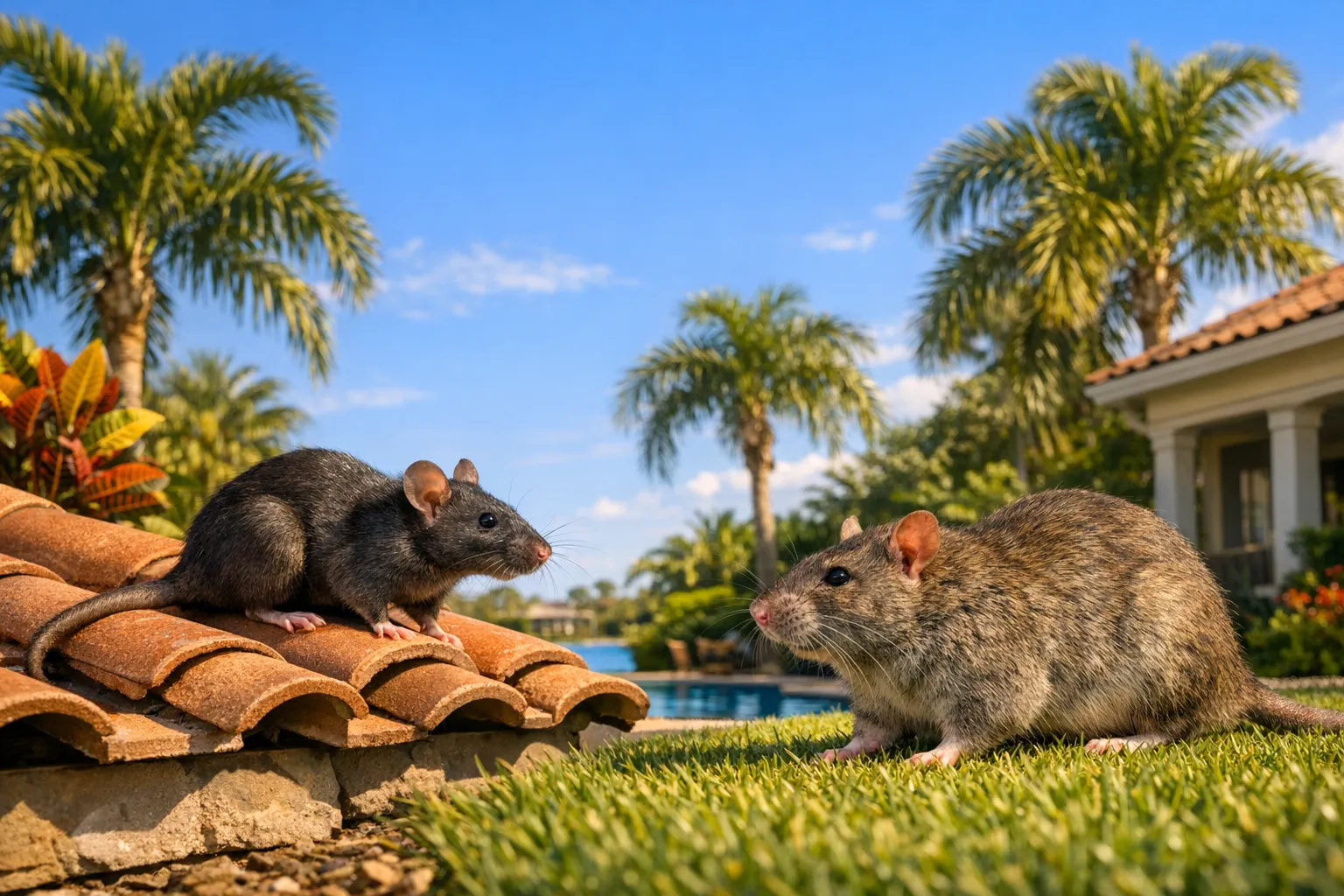
Most Southwest Florida homeowners never actually see the rodent. You see a scatter of droppings behind the coffee maker, hear something running above the ceiling around 9 p.m., or find a greasy black smudge along an attic rafter. That evidence is the diagnosis — because in every neighborhood we work, from Bradenton down through Sarasota and Venice to Port Charlotte, three commensal rodents do almost all of the residential damage, and each one leaves a very different fingerprint. This post is the identification-first reference; treatment is a separate protocol and we link into it at the end. For the full service overview, our pest control services overview is the starting point.
The thesis is simple: you rarely see the rodent — you see evidence. Whether you’re sorting out a roof rat vs Norway rat question or ruling out a mouse, dropping shape, noise location, and greasy rub marks name the species. The species then tells you where the entry point is. Roof rats own SWFL attics; Norway rats own the ground line; house mice work the interior. Read the sign right and the rest of the inspection almost writes itself.
If you’ve already found sign and just want a technician’s eyes on it, you can request a quote any time — the rest of this post is the reference doc.
Start with the droppings
Everything begins with the pellet. UF/IFAS Extension’s Rat and Mouse Control (ENY-224/DH044, Koehler & Kern) puts all three species on the same page, and their scat is unambiguously different in size and shape.
| Trait | Roof rat | Norway rat | House mouse |
|---|---|---|---|
| Dropping length | up to 1/2 in | ~3/4 in | 1/8 in |
| Dropping shape | spindle, pointed ends | capsule, blunt ends | rod, scattered |
| Adult weight | 1/2–1 lb | 3/4–1 lb | ~1/2 oz |
| Tail vs. body | longer than head+body | shorter than head+body | as long as body |
| Typical zone | attic, roofline, upper cabinets | ground level, foundation, garage | cabinets, wall voids, appliances |
UF/IFAS ENY-224/DH044 — three-species reference.
Freshness is the second read. UF/IFAS notes that fresh droppings are black, shiny, and putty-like, while old droppings are gray and dusty. Judge age visually and by size — do not handle dry pellets with bare hands, since the dust from dried droppings is an exposure pathway (see the safety note below). If you need to collect one for comparison, put on disposable gloves, mist it with a disinfectant or bleach-water solution first, then bag it — never pick up or crush a dry pellet bare-handed, and don’t try to size it off a phone photo, which is how people mis-call small roof rat pellets as mouse pellets.
Sound mapping: attic at dusk vs. wall at ground level
Where the noise is tells you what it is, before you ever climb a ladder.
- Scratching or running above the ceiling right after sunset → usually roof rat. UF/IFAS ENY-224 documents that roof rats thrive in attics, roof spaces, palm trees, and ornamental shrubbery, and prefer to nest off the ground.
- Chewing or shuffling behind a wall at ground level, especially near a garage or laundry → more likely Norway rat, which UF/IFAS describes as a reddish-brown burrower that digs in rubbish and under buildings or concrete slabs.
- Tiny, fast skittering behind a kitchen appliance or in the pantry → house mouse, which typically nests in wall voids, cabinets, and furniture.
Reading the sound before the flashlight comes out saves you an hour of crawling in the wrong zone. In Southwest Florida, “wrong zone” usually means the ground floor when the animal is actually in the attic.
Why Southwest Florida is roof-rat country
Roof rats dominate SWFL for structural and horticultural reasons UF/IFAS spells out plainly. Publication SSWEC120 (Control of Roof Rats in Fruit Trees, Kern) states directly that “roof rats are the worst rodent pest in the state of Florida and most abundant” and that “the Norway rat that is familiar to most people is rare in Florida.” Our tree canopy, palm skirts, barrel-tile rooflines, and warm attics are exactly what they want.
Roof rat ID (ENY-224):
- Color from black to grizzled gray to tan, with a lighter belly.
- Tail longer than the combined head and body — the single fastest visual ID.
- Adults weigh 1/2 to 1 pound.
- 6–8 young per litter, up to 6 litters per year — reproduction is fast, so a small attic problem in April is a real problem by August.
Roof rats are also called citrus rats, fruit rats, or black rats — the citrus nickname is not decorative. SSWEC120 notes they live in citrus trees and gnaw on the fruit, and they’ll happily use a mango, loquat, or ornamental palm as a launching pad to your soffit. If you own a home in Sarasota, Venice, or Bradenton and you’re hearing nighttime activity in the attic, roof rat is the default working hypothesis until the evidence says otherwise.
Pro tip: Before you open the attic hatch, walk the exterior first with the sun at your back. Look at every roof-to-wall junction, plumbing stack, gable vent, and soffit return. Roof rats prefer to nest off the ground, so they need a way up — and utility lines, palm fronds, and overhanging branches are the highway. Trim the ladder and you cut the traffic.
Norway rat: heavier, blunter, and ground-level
Norway rat sign points at ground level, not the attic. UF/IFAS ENY-224 identifies them as reddish-brown, heavy-set with a blunt muzzle, with a tail shorter than the combined head and body (not longer, like the roof rat). Adults weigh 3/4 to 1 pound. Droppings are ~3/4 inch and capsule-shaped. UF/IFAS Union County Extension adds that Norway rats “are burrowers and dig in rubbish and under buildings or concrete slabs.”
In SWFL, sandy soil along a foundation line makes Norway rat burrows shallow but obvious — openings roughly 2 to 4 inches across with polished edges, often at the base of a garage frame or where a slab meets landscaping. They’re less common regionally than roof rats, but they show up in coastal and canal-adjacent properties where the water table stays close to the surface and where dumpsters or unsecured garbage give them a steady food source.
House mouse — small, but not “a young rat”
The most common mis-ID we see on inspections: a house mouse called a “baby rat.” Rats and mice are separate species; a small mouse is not a juvenile roof rat. UF/IFAS ENY-224 puts the house mouse at:
- Brown to gray, tail as long as the body.
- Adults ~1/2 ounce — a rat is roughly 16 to 32 times heavier.
- Droppings 1/8 inch long and rod-shaped.
House mice normally live outdoors in fields and migrate into structures; indoors, ENY-224 notes they live behind walls, in cabinets, and in furniture, and they typically range only 10–30 feet from harborage. That’s why mouse sign clusters tight — one drawer, one cabinet, one appliance void — instead of spreading across an entire home the way rat sign does. So if you’re finding pellets in three separate rooms 30 feet apart, that’s worth a second look — but distribution alone doesn’t name the species. Several mice, or more than one nest, will spread sign across a house just fine, and even a single mouse covers a fair amount of ground inside that 10–30-foot range. Go back to the pellets themselves: 1/8-inch rods scattered around still say mouse no matter how many rooms they turn up in, while 1/2-inch spindles or 3/4-inch capsules say rat. Let size and shape make the call, and use the spread to tell you how many harborage points you’re dealing with.
Rub marks, gnawing, and the flashlight checklist
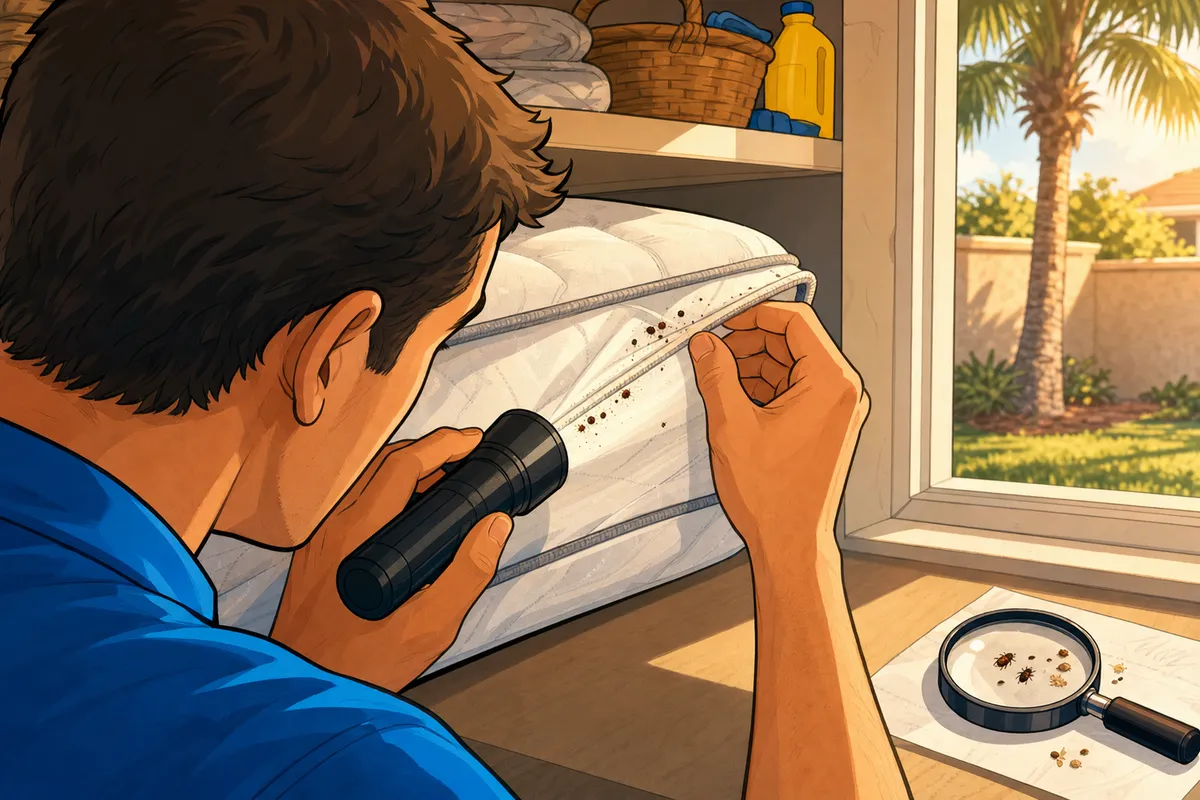
Now the confirmation walk. Rodents move along edges, and they leave three kinds of secondary evidence.
On every inspection
What to look for on your walk-through
- Rub marks Greasy black smudges from oil in the coat — along rafters, wall-floor joints, and around the lip of a hole.
- Gnaw marks UF/IFAS: fresh gnawing in wood is light-colored with sharp, splintery edges; old gnawing is dark and smooth.
- Runways Outside, well-used rat runs are smooth paths about 2–3 inches wide (UF/IFAS Union County). Indoors, they hug walls.
- Droppings Compare against the size chart above — do not vacuum, sweep, or bare-hand dry pellets.
- Nesting material Shredded insulation, cardboard, or fabric jammed into a tight void.
UF/IFAS-based homeowner inspection references.
UF/IFAS ENY-224 also notes rodents “gnaw every day in order to keep their teeth short and sharp.” They’re not chewing your wire out of malice — the incisors never stop growing, and everything solid is fair game. That includes low-voltage wiring, PEX water lines, and the corners of pressure-treated framing.
A note on UV. UF/IFAS points out that rodent urine glows blue-white under ultraviolet light when fresh. A blacklight is a useful way to decide where to look harder — sweep the attic decking and the top of the insulation on a dark night — but treat it as a screening cue, not a confirmation. Plenty of other things in an attic fluoresce: cleaning residue, some adhesives and construction materials, lint, and pet accidents. Older urine may not show at all, and how well anything shows depends on the surface and the lamp. A glowing streak earns a closer look; it takes droppings, rub marks, or another rodent-specific sign in the same spot to actually call it rodent activity.
Homeowner flashlight checklist (safe, no chemicals):
- Roof-to-wall junctions, gable vents, plumbing stacks, and any place a wire enters the wall from outside.
- Attic — sight down the top of the insulation for trails and drop-dents.
- Garage corners, water heater closets, and behind laundry appliances.
- Under kitchen sinks, behind the fridge, and behind the stove.
- Any exterior AC line-set penetration and hose-bib boot.
What NOT to do while you’re diagnosing. Do not sweep or vacuum droppings, urine, or nesting material. The CDC’s rodent-cleanup guidance is to wet the area down with a disinfectant or bleach solution and wipe it up with gloves on, precisely because dry sweeping and vacuuming can push contaminated particles into the air you’re breathing.
That airborne route is one pathway, not the only one — and the diseases UF/IFAS associates with rats and mice on ENY-224 don’t all travel the same way, so lumping them together gets the precautions wrong:
- Leptospirosis is associated primarily with infected urine, including urine-contaminated water and damp material.
- Salmonellosis and other bacterial food poisoning are fecal–oral — the risk is contaminated food and food-contact surfaces. ENY-224 notes rodents contaminate roughly ten times as much food as they eat, with urine, droppings, and hair.
- Rat-bite fever generally follows a bite or scratch, or ingesting contaminated food or water. ENY-224 notes rats do sometimes bite sleeping children who went to bed with food residue on them.
- Murine typhus is flea-borne: it reaches people through the fleas rodents carry, not through the droppings themselves. It’s one reason a rodent problem left alone long enough tends to become a flea problem too.
Practically: gloves and wet cleanup for anything you’re removing, keep food and prep surfaces out of contact, and don’t handle a live or dead rodent bare-handed. And do not set traps blind. Placement in the wrong zone — ground floor for a roof rat problem, or vice versa — is the number one reason a DIY effort catches nothing. That’s treatment territory, and we cover the operational side in the get-rid-of-rats walkthrough for Bradenton.
Interesting UF/IFAS facts that actually change how you inspect
Every item below traces to UF/IFAS ENY-224 or SSWEC120 — no folklore.
- Roof rats are climbers. ENY-224: “They are climbers and prefer to nest off the ground.” That’s why the attic-first assumption in SWFL is usually right.
- Roof rats need water and will travel for it. ENY-224 reports roof rats consume about 1 ounce of water per day and will range 100–150 feet from harborage in search of water or food. AC condensate drips, bird baths, and pool skimmers are all in play.
- Roof rats dominate Florida. SSWEC120: “Roof rats are the worst rodent pest in the state of Florida and most abundant. The Norway rat that is familiar to most people is rare in Florida.”
- They reproduce fast. ENY-224: 6–8 young per litter, up to 6 litters per year for roof rats; 8–12 young per litter and up to 7 litters per year for Norway rats.
- Mice have a tight range. ENY-224: house mice range only 10–30 feet from harborage. Traps set 40 feet from a mouse’s nest might as well be in another building.
- The tail is a species key. ENY-224: roof rat tail is longer than the combined head and body; Norway rat tail is shorter than the combined head and body; house mouse tail is as long as the body.
Species → entry point → next step
Once you have the species, the entry point almost picks itself.
Your home, zone by zone
Where each species gets in
A typical Southwest Florida home — the numbered zones a local tech walks on every visit.
- Soffit gaps & gable vents Roof rat highway — seal from the top down.
- Roofline utility penetrations Roof rat — plumbing stacks and low-voltage entries.
- Overhanging branches & palm skirts Roof rat access — trim clearance from the roof.
- Garage door corners & thresholds Norway rat + house mouse — bottom seals.
- Slab expansion cracks & foundation vents Norway rat — ground-line entries.
- AC line-sets & dryer vents Any species — pipe boots that never got sealed.
- Under-sink & dishwasher pipe boots House mouse — interior tightening.
- Foundation burrows & rubbish piles Norway rat — ground-level harborage to clear.
- Attic vents & ridge vents Roof rat — top-of-structure entries.
- Wall voids & appliance gaps House mouse — tight interior harborage.
Species dictates entry vector; entry vector dictates the exclusion plan.
Which points to a three-line playbook:
- Roof rat evidence in the attic → remove the rats first, then seal the roofline. Trap out the active population or install a controlled one-way exit before you close soffit gaps, ridge vents, gable vents, and any tree branch touching the roof — sealing while rats are still inside traps them, drives fresh gnawing, and can leave carcasses in inaccessible voids. Deeper biology and behavior for this species lives in our roof rats biology reference.
- Norway rat evidence at ground level → clear and remove first, then seal the foundation. Once the animals are out, seal slab expansion cracks, garage door corners, and utility penetrations at grade — after Southwest Florida afternoon storms push activity indoors, ground-line gaps get busy fast.
- House mouse evidence in the kitchen → trap out, then tighten the interior. After removal, close under-sink gaps, dishwasher hose penetrations, and any unsealed pipe penetration — but seal them with something a rodent can’t chew. Pack the gap with heavy-gauge hardware cloth, copper mesh, or steel wool and finish it with sealant or mortar. Expanding foam on its own is not exclusion — rodents gnaw every day to keep their incisors short, and foam is no harder for them than the drywall beside it.
When to call a pro. If activity has been present more than a week; if you’re hearing noise across multiple zones (usually one species running multiple routes rather than two species coexisting); if you can see sign in insulation you cannot easily inspect; or if you’ve already tried a round of DIY and it didn’t hold — that’s the point where an inspection saves you time. Waves is a rodent-control company; our approach is inspection-first, species-confirmed, remove-before-you-seal, and exclusion-driven, and it’s built on the same UF/IFAS framework this post is written from. You can compare service scopes on the pest control services overview, see how ongoing monitoring fits with our program on the WaveGuard memberships page, or browse related identification references in the pest library.
If you want a rough estimate before booking, the pest control calculator is a good starting point. And when you’re ready for a technician on-site to run the flashlight checklist for you and confirm the species, request a quote and we’ll come look.
Sources referenced in this post: UF/IFAS Extension ENY-224/DH044, “Rat and Mouse Control” (Koehler & Kern) — journals.flvc.org/edis/article/view/136514; UF/IFAS Extension SSWEC120/UW120, “Control of Roof Rats in Fruit Trees” (Kern) — archived copy; UF/IFAS Extension Union County, “Rats and Mice: Signs, Characteristics and Control” — archived copy. Rodent-cleanup precautions follow the CDC’s “How to Clean Up After Rodents” — cdc.gov/healthy-pets/rodent-control/clean-up.html. Every identification measurement in this article is drawn from the UF/IFAS publications above. UF/IFAS has since retired the EDIS and county-blog pages for SSWEC120 and the Union County article; the archived snapshots above are the accessible copies of the documents quoted here.