Jump to a section (15)
- 01Seeing pests right now? What to do before a tech gets there
- 02January: roof rats move into the attic
- 03February: the first termite swarms of the year
- 04March: termite season builds
- 05April: subterranean swarmers on window sills
- 06May: drywood termites and the start of mosquito season
- 07June: rainy season starts
- 08July: chinch bugs and peak bug soup
- 09August: storms, wasps and the second lovebug run
- 10September: the rainy season keeps going
- 11October: rodents start pushing indoors
- 12November: rodents and ants settle in
- 13December: holiday boxes and attic noise
- 14Frequently Asked Questions
- 15Plan the year with Waves
Prefer a live version that always shows the current month? See the Southwest Florida Pest Calendar, covering Sarasota, Manatee and Charlotte counties.
Sarasota never gets a hard freeze long enough to reset the bug clock. Humidity keeps roaches, ants and mosquitoes going all year here, while counties farther north get a winter dip that we mostly skip. What changes from month to month is which pest is loudest. Termites own the spring, the rainy season belongs to ants and mosquitoes, and the first cool nights send roof rats looking for your attic.

This calendar leans on University of Florida (UF/IFAS) timing wherever it exists and points you to the source, so you can check it yourself.
Seeing pests right now? What to do before a tech gets there
Request a visit through the Sarasota pest control quote page and the team will give you the soonest open slot for your street. Opening times change with the route. While you wait, a few things make that first visit faster:
- Winged insects inside: scoop a few into a zip bag or a jar and keep them. UF/IFAS says it is important to confirm the species before any termite treatment, because treatments are target-specific. The UF/IFAS termite ID team will identify a sample at no cost.
- Droppings in the pantry or garage: skip the broom and the vacuum. The CDC cleanup guidance says to put on rubber or plastic gloves, spray droppings with a bleach solution or an EPA-registered disinfectant until very wet, and let it soak 5 minutes (or as the label says) before you wipe it up.
- Ant trails: take a photo of the trail and where it disappears. That tells the tech more than a can of spray does.
- Wasps on the lanai: keep kids and pets away from the nest and leave it alone until someone looks at it.
January: roof rats move into the attic
January is when roof rat pressure peaks in Sarasota attics, as cooler nights push them indoors. Tile roofs in HOA communities like Palmer Ranch and The Meadows give them another way in through gaps at the ridge cap.
The light southern subterranean termite is also on the move. Per UF/IFAS, its flights run from early December to early February, and this one swarms in the evening.
What to do:
- Listen for scratching overhead around dusk and after dark.
- Trim branches and palm fronds back from the roofline.
- Look at soffit vents and ridge caps for gaps or chewed screening.
- Lower outdoor pest pressure makes winter a good window for rodent exclusion work. See rodent control in Sarasota for how that works.
February: the first termite swarms of the year
The eastern subterranean termite starts flying in early January and keeps going until April, per UF/IFAS. It likes warm, sunny, windless early afternoons, usually after rain. So that first muggy February day after a front comes through is a good day to check your window sills.
Ghost ants keep foraging indoors through the dry months. UF/IFAS notes they nest in wall voids, between cabinets and baseboards, and in potted plants, and they show a preference for sweets.
What to do:
- Check sills, light fixtures and bathtubs for small winged insects or piles of shed wings.
- Wipe up sugary spills the same day.
- Look under the sink and behind the fridge for leaks. Moisture draws ants and roaches in a dry month.
March: termite season builds
March is busy for termites. The dark southern subterranean termite flies between early February and late May, per UF/IFAS. The West Indian drywood termite is on deck for April. A related drywood termite, Cryptotermes cavifrons, swarms in the evenings all year but peaks from March through May, per UF/IFAS.
Fire ant mounds start to spread after the first warm rains. Mosquito larvae show up in anything that holds water after a spring shower.
What to do:
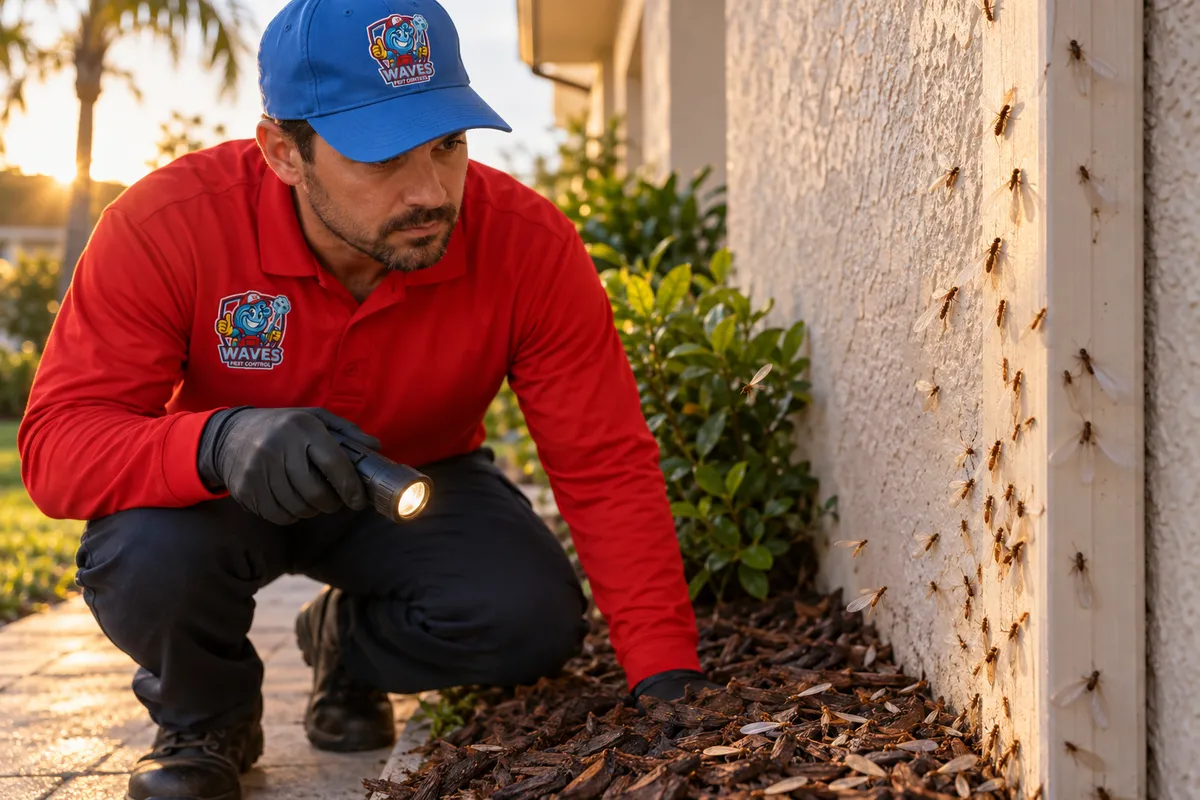
- Learn the difference between a flying ant and a termite swarmer. A termite swarmer has straight beaded antennae, a thick waist with no pinch, and four wings of equal length that shed in piles. A winged ant has bent antennae and a pinched waist. If you find swarmers indoors, see termite control in Sarasota for the next step.
- Empty birdbaths, plant saucers and toys after it rains.
- Keep an eye on fresh sod. Fire ants like it.
April: subterranean swarmers on window sills
April and May are when subterranean termite swarmers show up on window sills, mostly in older inland homes. Sarasota has plenty of 1920s to 1950s wood frame houses in Laurel Park, Gillespie Park, Hudson Bayou and Indian Beach, and those older neighborhoods often need subterranean termite monitoring.
The Formosan subterranean termite starts its season too. UF/IFAS says it typically swarms from early April to late June, shortly after sunset, with the peak in May, and it lives mainly in urban areas across the state.
Lovebugs arrive for their spring run. Per UF/IFAS, each of the two Florida generations lasts about four weeks, in April to May and again in August to September. They are a nuisance for your windshield and screens, and a perimeter spray will not make a lovebug season go away.
What to do:
- Swarmers inside the house are a reason to book a termite inspection. Swarmers on a tree stump in the yard are less urgent, but tell your tech.
- Turn off porch lights on evenings when you see swarms.
- Wash lovebugs off the car within a day or two.
May: drywood termites and the start of mosquito season
West Indian drywood termites leave the colony on multiple mating flights from April to June, per UF/IFAS, though flights are possible any time of year. UF/IFAS says this species has spread through coastal Florida, with the largest populations in older buildings in the southern half of the state. Barrier island homes on Siesta Key, Lido Key and Bird Key tend to see more drywood pressure.
The sign to look for is pellets. Drywood termites push their droppings out of kick-out holes about 1 to 2 mm across, and the pellets are six-sided when you look at them closely. Our drywood termite guide goes into more detail.
Mosquitoes pick up as the first afternoon storms roll in.
What to do:
- Look for small piles of pellets under window frames, door trim and furniture.
- Start the weekly water walk: tip out buckets, toys, coolers and pool covers.
June: rainy season starts
The rainy season runs June through October in Sarasota, and three things happen fast. Ghost ants come indoors. Mosquitoes spike. Fire ant mounds pop up after every storm.
UF/IFAS explains the fire ant part in its red imported fire ant fact sheet: after a heavy rain, a colony may move to higher ground or into homes to get out of saturated soil. Their mating flights usually happen midday on a warm, sunny day after rain, once it is above 74°F.
June 1 also starts the Sarasota County fertilizer blackout, which runs through September 30 and prohibits both nitrogen and phosphorus on lawns. If your St. Augustine needs color, iron and micronutrients are the summer tools.
What to do:
- The Florida Department of Health says to drain water from garbage cans, buckets, pool covers, coolers, toys and flowerpots, and to empty and clean birdbaths and pet bowls at least once or twice a week.
- Watch for ant trails along baseboards after a big storm.
- Give mounds in the yard a wide berth when you mow.
July: chinch bugs and peak bug soup
June through August is chinch bug peak on St. Augustine lawns. Full-sun lawns in Palmer Ranch and The Meadows are especially vulnerable. Yellowing patches next to the driveway or sidewalk on a hot week are the classic spot to check.
Indoors, ghost ants are still pushing in during heavy rain. Big outdoor roaches are active too. “Palmetto bug” is the local name for these. Usually it is the American cockroach or the smokybrown cockroach, which lives in mulch, woodpiles, soffits and tree holes and wanders indoors at night. One in the living room after a storm does not mean your house is dirty.
What to do:
- Pull mulch back a few inches from the slab and keep woodpiles off the house.
- Check door sweeps and the gap under the garage door.
- For lawn spots, see lawn care in Sarasota.
August: storms, wasps and the second lovebug run
Storm season keeps the ants and mosquitoes going strong. The second lovebug generation shows up in late August. Paper wasp colonies that started in spring are full size now, and calls about nests under eaves and lanai corners pick up from late summer into fall.
What to do:
- Walk the eaves and lanai corners for paper wasp nests before the kids find them.
- After a big storm, check the yard for new fire ant mounds before anyone goes barefoot.
- Once an exterior treatment has dried, normal afternoon rain does not wash it away. If a heavy downpour hits right after a visit, tell your tech.
September: the rainy season keeps going
September still sits inside the rainy season, so mosquitoes, ghost ants and fire ant mounds stay active. Lovebugs finish up. September 30 ends the fertilizer blackout, and nitrogen and phosphorus can go back on lawns starting October 1.
What to do:
- Keep doing the weekly water walk.
- Trim trees and vines touching the roof before the rodent season.
- Book a fall lawn feeding for October if your yard needs it.
October: rodents start pushing indoors
In October and November, rodents start their push indoors. Spiders get more visible on porch lights and lanai screens, and wasp nests are at full size. The rainy season wraps up in October.
Most of the spiders in your pool cage are orbweavers, cellar spiders and nursery web spiders. They are harmless and eat other insects. The Florida spider group to take seriously is the widow group. The brown recluse is not established in Florida, per UF/IFAS.
What to do:
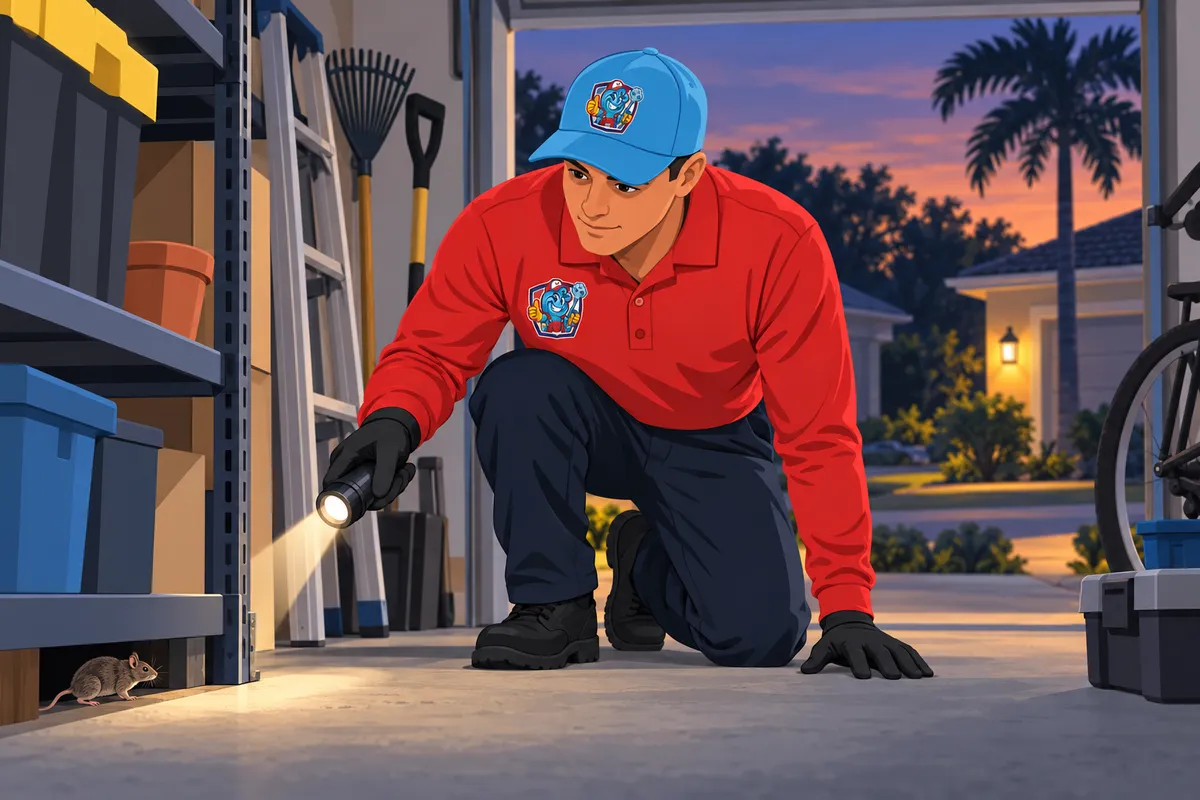
- Check garage door seals and weep holes.
- Store bird seed and pet food in sealed bins, not open bags.
- Leave the orbweavers alone unless they are in the doorway.
November: rodents and ants settle in
The rodent push that started in October continues. Dry season begins, and ghost ants keep coming in to forage for food and water.
What to do:
- Fix door sweeps that leave a gap under the garage door.
- Seal food in hard plastic or glass, not cardboard.
- Check for gnaw marks on stored boxes in the garage.
December: holiday boxes and attic noise
Roof rat pressure in attics climbs through the winter, and evening flights of the light southern subterranean termite begin again in early December. German cockroaches stay indoors all year near kitchens and bathrooms, and they spread between units through shared plumbing in condos.
What to do:
- Open holiday boxes outside or in the garage before bringing them in.
- Store decorations in sealed plastic bins.
- Watch for droppings near the water heater and in the attic access.
Frequently Asked Questions
Can I stop pest control in Sarasota for the winter?
Keeping service through the winter makes sense here, because humidity keeps roaches, ants and mosquitoes active all year here. Winter is also when roof rats peak in attics. A year-round pest control plan in Sarasota covers the termite spring, the mosquito summer and the rodent fall.
Which month is the worst for pests in Sarasota?
It depends on the pest. Termite swarms run from December into June depending on the species, with subterranean swarmers on Sarasota window sills in April and May. Ants, mosquitoes and fire ants peak in the June to October rainy season, and roof rats peak in January.
What are the flying roaches in Sarasota?
They are usually American cockroaches or smokybrown cockroaches, which the locals call palmetto bugs. They live outside in mulch, woodpiles and tree holes and wander in at night.
Is a termite swarm dangerous?
Swarmers do not bite or sting people. Swarmers inside the house can mean a colony is in the structure, so save a sample and book a termite inspection.
Can a tech come out today?
Request a visit through the Sarasota pest control quote page and ask for the soonest open slot. The schedule changes with the route, so the office has the current answer.
Plan the year with Waves
If you would rather not track all of this yourself, our pest control services cover the seasonal swings, and you can see what a WaveGuard membership includes. Want to know what you are looking at first? The pest library has photos and ID tips. For pricing, get a Sarasota pest control quote or try the pest control quote calculator.