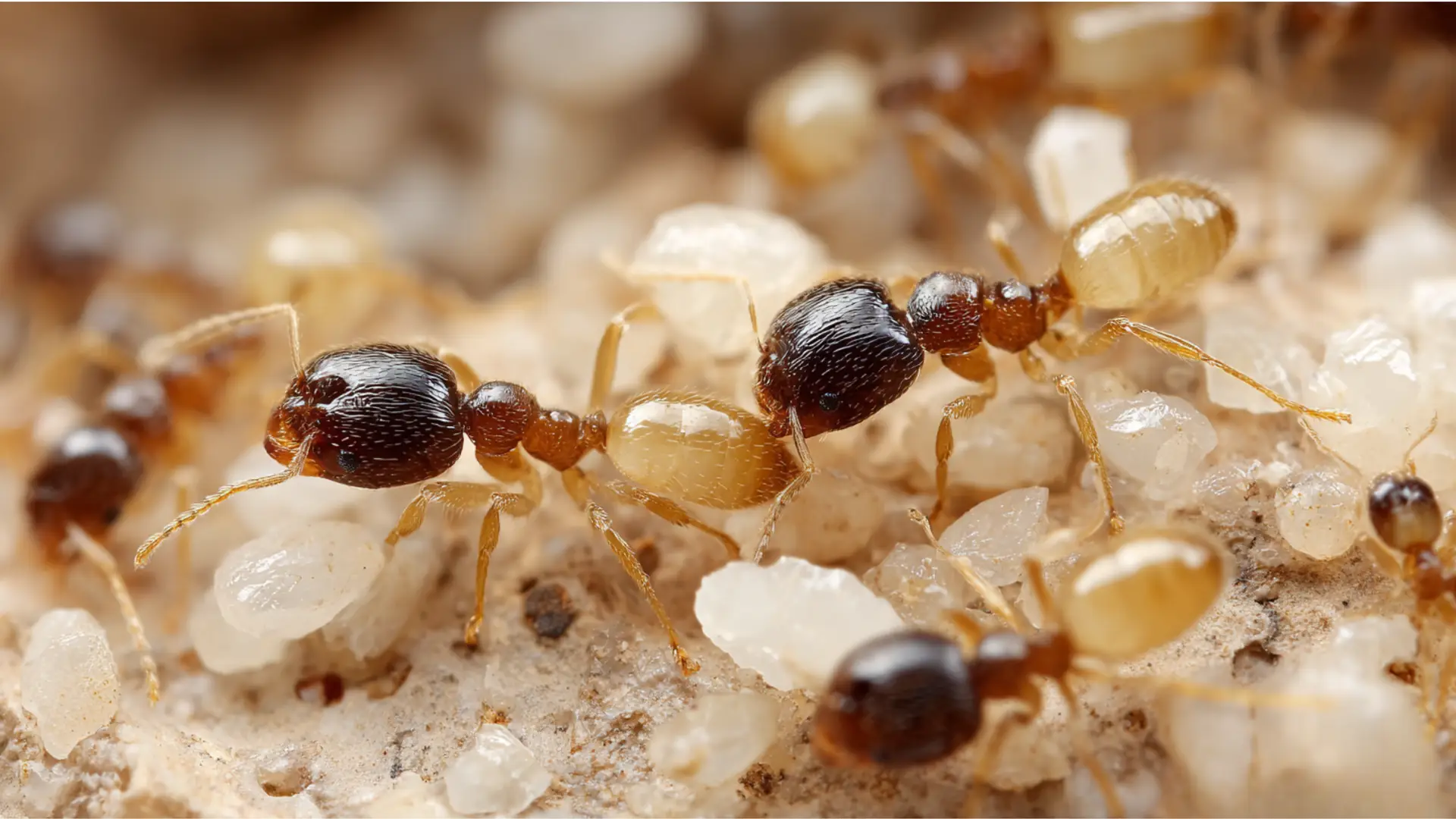
Ghost ants have a dark head and thorax with pale legs and abdomen. Their tiny size and indoor trails can help narrow an identification, but a trail alone does not confirm the species. Start with a close-up and the location of the activity before choosing treatment.
Which clues point to ghost ants?
UF/IFAS describes ghost ant workers as similar in size, with colonies that can contain multiple queens and nesting sites. That matters when visible activity appears in more than one part of a home: the ants on a counter may be only part of the problem. See the UF/IFAS ghost ant reference.
Use the ghost ant identification profile to compare features. If the color pattern does not match, return to the pest identifier instead of treating the closest-looking photograph as a diagnosis.
Compare the insect and the trail separately
| Observation | What it helps establish | What it does not establish |
|---|---|---|
| Dark head with a much paler abdomen | Whether the visible color pattern fits ghost ants | A confirmed identification from a blurred photo |
| Several ants following the same route | Where to document recurring activity | Where every nesting site is located |
| Activity in two rooms | More than one location needs to be discussed | Whether the locations have one shared cause |
| No ants in a later photograph | Activity was not visible at that moment | That the underlying problem is resolved |
For example, a clear close-up from the kitchen and a wide photo of a bathroom trail answer different questions. Keep each photo’s location instead of combining the sightings into a single report of ants everywhere. This helps an inspector explain which areas need attention and which observations still need confirmation.
What should you record before an inspection?
Record which room has activity, where the trail enters, and whether it appears repeatedly. Take a wide photo of the location and a separate close-up. If you already applied a product, save its name and the application date for the technician.
The pest observation checklist gives you a printable place for those notes. You do not need to submit a form to use it.
What can you check around the home?
Look for accessible food, leaks, and gaps around doors or utility openings. EPA recommends reducing food, water, and shelter as a first step in pest prevention. Keep any pesticide in its original container and follow the label for its intended use. EPA pest prevention guidance
Common questions
When is professional help useful?
An inspection is a reasonable next step when identification remains uncertain, trails keep returning, or activity appears in several rooms. Ask what species was confirmed, what areas the proposal covers, and how follow-up will be evaluated.
One sighting does not automatically mean you need an ongoing plan. Compare one-time service with recurring service and use the calculator for current options after the service scope is clear.
Does a photo confirm the colony is gone?
No. A photo records a moment and a location. Keep your observations over time and ask the technician what evidence would show that the treatment achieved its purpose.