Jump to a section (9)
- 01What dollarweed actually looks like
- 02What UF/IFAS says dollarweed is telling you
- 03Why Venice lawns grow dollarweed
- 04Start with an irrigation audit
- 05Dollarweed control: where herbicide fits, and why it flops on its own
- 06Thick turf is your long-term edge
- 07When to call a pro
- 08Frequently Asked Questions
- 09Fix the water, then the weed follows
Walk your Venice yard a day after a wet week and you might spot what looks like a scatter of tiny lily pads sitting in the grass. That is dollarweed, and it is trying to tell you something. The rule we work by at Waves is that a weed like this is usually a symptom, so real dollarweed control in Florida starts with reading it, not spraying it. This one lives alongside the rest of our lawn care articles. If you would rather hand the whole thing off, you can request a quote any time.
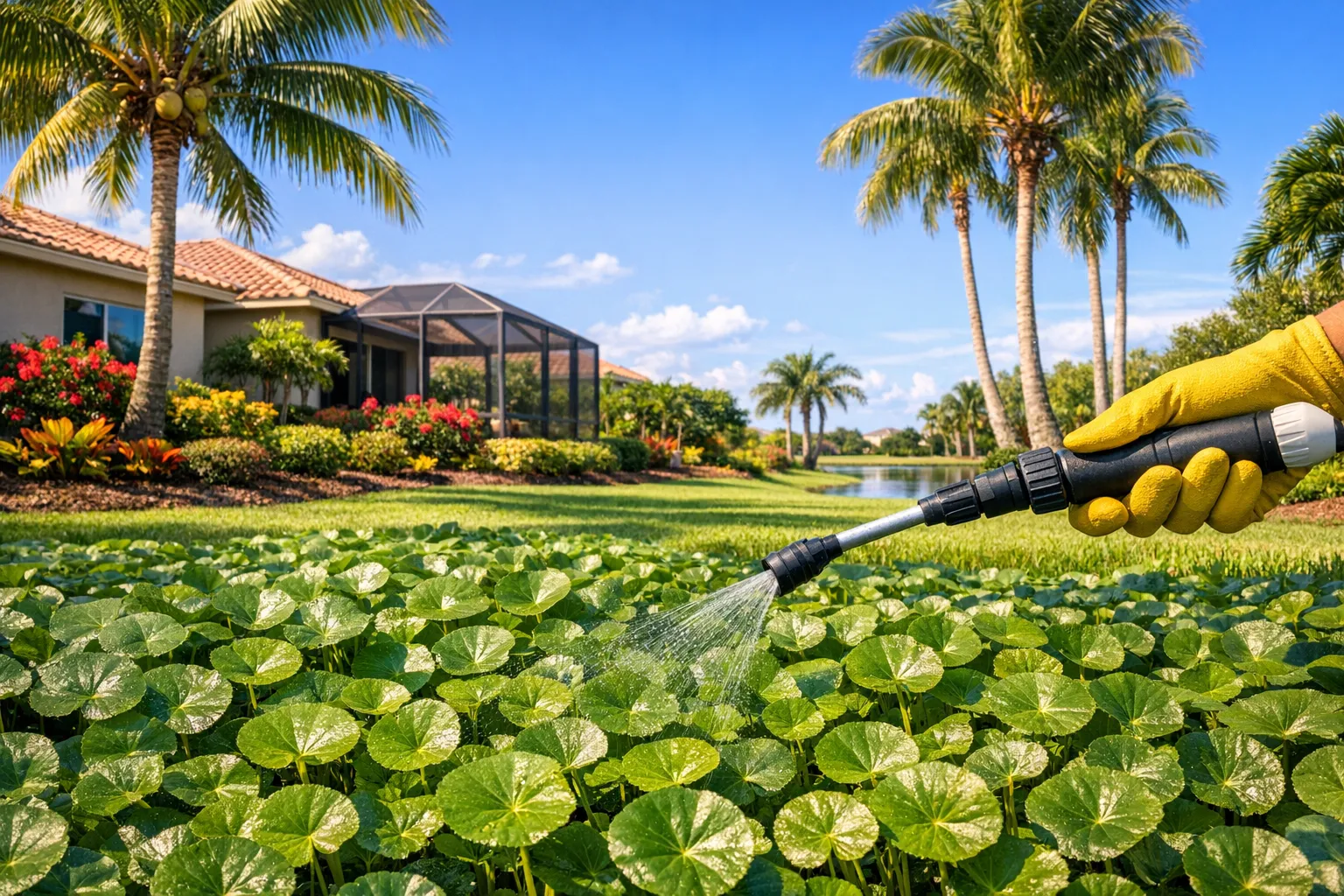
What dollarweed actually looks like
Dollarweed is easy to call once you know the tell. The leaves are round and bright green, about the size of a silver dollar, with scalloped edges and a glossy shine. The giveaway is where the stem attaches. On dollarweed the little stalk connects at the center of the leaf, underneath, so each one stands up like a miniature umbrella or a lily pad floating on a pond. That central attachment is what UF/IFAS uses to separate it from the imposters.
Dollarweed and pennywort are the same plant. The botanical name is Hydrocotyle umbellata, also listed as manyflower marshpennywort. If you have been searching for pennywort in your lawn, you are looking at the same round-leaf weed.
The look-alike people confuse it with most often is dichondra. Dichondra leaves are more kidney or heart shaped, and the stem joins at a notch on the edge instead of the middle. So flip a leaf over and look at the stem. If it joins in the center, you have dollarweed. A stem that joins at the edge points to dichondra or another creeper, and that changes what you would do about it.
What UF/IFAS says dollarweed is telling you
Here is the part most spray-first homeowners skip past. Dollarweed is a moisture indicator. UF/IFAS lists it in “Weeds as Indicators of Soil Conditions in Lawns and Landscapes” as a reliable sign of wet environments, and their EDIS and Gardening Solutions resources both trace it to the same root cause: soil that stays saturated too long. That can come from poor drainage, a water table sitting close to the surface, or plain overwatering, and often more than one at once.
So when dollarweed shows up, your lawn is basically flagging a water problem. UF/IFAS is blunt about the fix, too. Monitoring and restricting moisture is the first step, and a herbicide will control the plant without eradicating it if the ground stays damp. Spray a wet lawn and you are chasing the symptom while the cause keeps feeding new growth.
Why Venice lawns grow dollarweed
Venice hands dollarweed a few advantages. The land here is flat and low and close to the Gulf, so water does not always have anywhere to go in a hurry. Plenty of yards sit on sandy soil that drains fast at the surface, yet the low spots and the ground over a shell or clay sublayer hold moisture far longer than you would guess by looking.
Then there is how we water. A lot of Venice-area communities irrigate on reclaimed water that runs on a set schedule, and those timers love to stay on autopilot long after the rainy season has taken over the job. Add our afternoon storms dumping an inch in twenty minutes, and your St. Augustine can sit in wet feet for days without you ever touching the controller. That is the standing invitation dollarweed has been waiting for.
Start with an irrigation audit
Before you buy anything at the store, spend ten minutes reading your water. Start with the legal ceiling: Sarasota County, which includes Venice, runs a year-round one-day-per-week watering schedule, with your day assigned by the last digit of your street address, so check your assigned day before touching the controller. Within that limit, UF/IFAS guidance is to water an established lawn only when the grass actually shows stress, folded blades or footprints that linger, which on a one-day schedule means one deep soak on your day rather than several light passes. Most dollarweed-friendly lawns are running well past that. If you want a fuller walk-through built around Sarasota County’s schedule, our Sarasota watering guide goes deeper than we can here.
Your ten-minute irrigation audit
- Zone runtimes. Add up how many minutes each zone runs per week. Sarasota County allows one assigned watering day per week, so a controller running more often is over-watering and off schedule.
- Head coverage. Look for heads spraying the driveway, the fence, or the same low corner twice. Overlap is where dollarweed gets its favorite puddle.
- Rain shutoff. A working rain sensor or smart controller should skip cycles after our storms. Trip the sensor and watch whether the next run gets canceled.
- Low, wet spots. Walk the yard a day after watering. Ground that still squishes is holding water long enough to favor dollarweed.
- Catch-can test. Set a few straight-sided cans around a zone, run it, and measure. Most lawns want roughly half an inch to three quarters per watering, not a daily sprinkle.
A short walk-through of your own system tells you more than any spray label.
Pro tip: the tuna-can test is the cheapest lawn diagnostic there is. Rinse out a few empty cans, scatter them across one zone, run a normal cycle, and see how much water each one catches and how evenly. Wildly different levels usually mean a clogged or tilted head that is drowning one patch while starving another. That drowned patch is exactly where you will find your dollarweed.
Dollarweed control: where herbicide fits, and why it flops on its own
So where does a herbicide actually earn its keep? After you have the water under control. Once your soil is drying out between waterings, a selective post-emergent broadleaf herbicide labeled for your turf, St. Augustine for instance, can knock back what is left.
| What changes over a season | Spray only | Fix the water first, then spot-treat |
|---|---|---|
| How long control lasts | Often short. It regrows from tubers and runners if the soil stays wet. | Longer, because the wet conditions that favor it get corrected. |
| Effect on your good grass | Thin, wet turf stays weak and open. | Denser turf that competes for space and light. |
| What it costs you | Repeat sprays that add up. Ask us through the contact page for a quote. | Fewer repeat treatments over time, quoted per yard on the contact page. |
| Does it fix the cause | No. | Yes. |
Based on UF/IFAS guidance that herbicides control but do not eradicate dollarweed, and that excess moisture has to be corrected first.
A few ground rules before you spray a thing. Identify the weed first, because the right product depends on what you are actually treating and on your grass type. Read and follow the product label to the letter, including the rate and any turf restrictions it lists. Keep people and pets off the treated area until it has dried the way the label directs. And skip the temptation to drench the patch with a non-selective consumer weed killer, since that takes your St. Augustine down with the dollarweed and leaves a bare, wet crater that fills back in worse.
Hand-pulling feels productive, and for a stray sprig it is fine. Dollarweed spreads through underground rhizomes and small tubers, though, so yanking the leaves off the top usually leaves the network below to resprout in a few weeks. Drying out the soil does more than your hands can.
Do all of that and you will see far fewer flare-ups. I will not promise it is gone for good, because as long as a low spot stays soggy, some dollarweed can drift right back in.
Thick turf is your long-term edge
The real long game is a dense lawn. Healthy St. Augustine shades the soil and leaves dollarweed almost no room to root. UF/IFAS makes the same point across its turf publications: a lawn mowed at the right height and watered and fed properly stays crowded enough to fend off weeds on its own. Mow on the high side, around 3.5 to 4 inches, so the canopy stays thick. Watering deep and less often beats a light daily mist for building the roots that hold that canopy up.
For feeding, keep the calendar in mind. Sarasota and Manatee counties restrict both nitrogen and phosphorus fertilizer from June 1 through September 30, so plan any feeding around that window rather than pushing growth during the restricted season. Here is the Sarasota County fertilizer restricted-season rundown if you want the dates and the reasoning.
When to call a pro
Some of this is a weekend project. Some of it is not. If your wet spots trace back to grading or a real drainage problem, or the dollarweed has swallowed big stretches of the yard, or you are honestly not sure the round leaf you are staring at is even dollarweed, that is the point to bring in help. A good local crew will factor in how you water and treat the weed in the right order instead of guessing.
Frequently Asked Questions
Is dollarweed the same thing as pennywort?
Yes. Dollarweed and pennywort are both common names for Hydrocotyle umbellata, also listed as manyflower marshpennywort. If a neighbor calls it pennywort and you call it dollarweed, you are both right.
Will pulling dollarweed get rid of it?
Usually not for long. It spreads by underground rhizomes and small tubers, so pulling the visible leaves leaves the root network behind to resprout. Drying out the soil accomplishes more than pulling ever will.
Does dollarweed mean I am overwatering?
Often, yes. UF/IFAS treats dollarweed as an indicator of excess moisture, whether that is too much irrigation, poor drainage, or a high water table. Start with an irrigation audit and find out how much of the problem is just your timer.
Fix the water, then the weed follows
Fixing the water is the unglamorous part that actually holds. The catch cans and controller settings are your side of the job, but our Venice lawn care team notes your irrigation schedule and watering day on the first visit, reads what the lawn is telling us, and spot-treats the dollarweed that survives once the soil dries out. You can request a quote whenever you are ready. Questions about cost? Reach us through the contact page, since lawn work gets quoted per yard.