Key takeaways
- Overwatering lawn damage and underwatering damage arrive at the same place. Underwatering deprives the plant of water; overwatering deprives the roots of oxygen. Both end in the same visible place — thinning, yellowing, wilting, poor response to fertilizer — which is why color alone cannot tell you which one you have.
- A wet lawn can wilt. If the roots are damaged or oxygen-starved, water is present but the plant cannot move it.
- UF/IFAS recommends applying about ½ to ¾ inch per irrigation event, only when the grass shows early wilt signs, in the early morning.
- The diagnosis is below the canopy, not on it. Check soil moisture at rooting depth and look at the roots themselves.
The root zone has to hold water and air
A healthy root zone is not simply “moist.” It holds water films around the soil particles and air-filled pores in between.
Roots are living tissue. They respire — they consume oxygen to produce the energy that drives nutrient uptake, membrane function and new root growth. They do not merely absorb water passively.
When soil sits saturated, water fills the pores that normally hold air, and root-zone oxygen falls. Turfgrass is an upland plant. It has none of the internal air channels that wetland plants use to ventilate submerged roots. So a lawn that is unambiguously wet can experience what is effectively a drought: the water is there, and the roots can no longer take it up.
That single mechanism explains most of what follows.
What overwatering does
It suffocates the root system
As oxygen in the root zone falls, the fine absorbing roots and root tips go first — and those are the parts doing most of the water and nutrient uptake. Root growth slows, fine roots die, and the remaining roots go short, dark and soft.
The lawn then wilts while the soil is wet. Adding more water at that point accelerates the decline.
It builds a shallow, irrigation-dependent lawn
Frequent light watering keeps the top inch or two damp and gives roots no reason to go deeper. The result is a lawn that wilts the moment a cycle is missed, tolerates heat poorly, scalps easily and recovers slowly from insects or disease.
A short daily cycle produces the worst of both: the surface stays chronically wet while the deeper root zone never gets properly wetted. Established lawns do not need daily irrigation.
Overwatering also drives thatch. UF/IFAS attributes thatch in St. Augustinegrass primarily to overfertilization and overwatering — not to leaving clippings. Past about an inch, that layer blocks water penetration, holds moisture at the crown and harbors insects.
It moves nutrients below the roots
Sandy Southwest Florida soil holds a limited amount of water. Once the profile is full, additional water drains past the root zone and takes dissolved nutrients — nitrate nitrogen especially — with it.
The lawn then looks nutrient-deficient after being fertilized. The common response is more fertilizer, which produces a loop: overwatering, root dysfunction and leaching, yellow turf, more fertilizer, more leaching.
It raises disease pressure two different ways
Excess moisture does not manufacture a pathogen. Most are already present. It changes the environment in the pathogen’s favor while weakening the host — through two separate mechanisms.
Leaf wetness. Many foliar fungi need free water on the blade to infect. Watering late in the day bridges one evening’s dew to the next morning’s, creating many unbroken hours of leaf wetness. UF/IFAS notes that late-afternoon or late-morning watering may extend the natural dew period and “can accelerate disease occurrence.” Early-morning irrigation lets the canopy dry in daylight.
Wet soil and crowns. Constantly wet soil favors root and crown pathogens and stops damaged roots recovering. In this region that means large patch in the cooler months, gray leaf spot on St. Augustine in warm humid weather, and take-all root rot thinning that mimics drought.
One diagnostic distinction worth holding onto: large patch rots the leaf sheath, not the roots. If the roots are dark, short or deteriorated, look at take-all, saturated soil or nematodes instead.
It selects for moisture-loving weeds
Dollarweed and sedges thrive where soil stays wet. Their presence is not proof on its own, but a heavy population alongside consistently wet soil is a strong cultural signal. Herbicide will suppress them; they return as long as the site stays saturated and the canopy stays thin.
What underwatering does
The plant conserves before it browns
As sandy soil dries, the remaining water is held more tightly to the particles. Eventually uptake cannot keep pace with transpiration.
The first response is not death — it is conservation. Stomata close to limit water loss, which also restricts carbon dioxide entry. Photosynthesis falls, and shoot and root growth slow. The lawn stops growing before it turns brown. A lawn that has not needed mowing may already be under real water stress.
The three signs to read
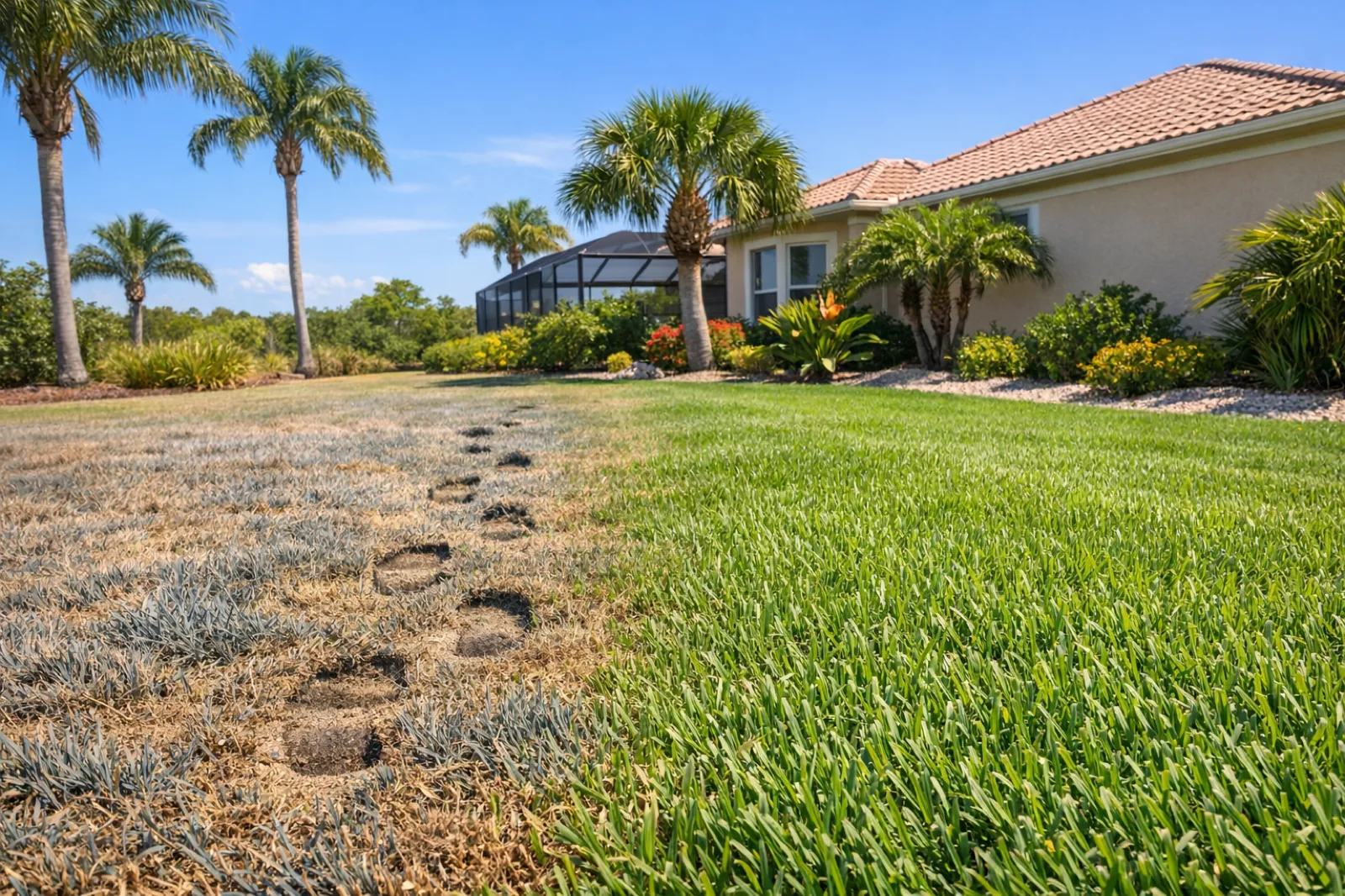
UF/IFAS gives three indicators that the lawn needs water:
- Leaf blades folded in half lengthwise — the plant reducing exposed surface area
- A blue-gray tint instead of green
- Footprints or tire tracks staying visible long after they were made
That third one works because hydrated cells have enough turgor pressure to spring back. Stressed ones stay flattened.
These are the trigger to irrigate — before the lawn goes yellow or brown.
Prolonged drought costs recovery capacity
St. Augustinegrass spreads and repairs itself through aboveground stolons, and that takes stored carbohydrate. Under sustained drought, stolon extension slows, fine roots die back, older leaves senesce and the canopy thins.
Water will rehydrate surviving tissue. It will not resurrect dead stolons — recovery then depends on lateral growth from surrounding turf, or resodding.
Dry soil also blocks nutrients
Nutrients have to move through soil water to reach roots. Dry soil slows diffusion, mass flow and fertilizer dissolution, so drought-stressed turf can look deficient while the nutrients are sitting right there.
Worth knowing: UF/IFAS advises that postemergence herbicides should not be applied when turf is under moisture stress or above 85°F. A stressed lawn tolerates chemistry poorly.
Overwatering lawn damage vs. drought damage: telling them apart
Both produce yellowing, wilting, thinning, weak roots, poor fertilizer response and brown patches. The difference is under the canopy.
Underwatered: soil dry at rooting depth. Blades folded and blue-gray before browning. Footprints persist. Trouble shows first on high spots, slopes, full-sun exposures, pavement edges and the gaps between sprinkler heads.
Overwatered: soil still wet below the surface. Color tends pale yellow-green rather than blue-gray. Roots short, dark, soft, easily pulled. Trouble concentrates in low spots, shade, downspouts, overlapping spray patterns and poorly drained fill. Dollarweed, sedges and thatch often come with it.
Root-damaged: looks drought-stressed at normal moisture, because the root system itself is failing.
Never diagnose irrigation from the color of the grass. Check the soil moisture and look at the roots.
The five ways irrigation goes wrong
- Too much per event — the root zone fills and the rest drains past it.
- Too many events — soil never re-aerates, roots stay shallow, leaf wetness accumulates.
- Too little per event — only the top inch or two is wetted.
- Applied faster than the soil absorbs — it runs off before it can soak in.
- Poor distribution — some areas get twice what others do.
That last one matters most, because a lawn can be overwatered and underwatered inside the same zone. Turning the runtime up to rescue the dry corner floods everywhere else. The fix is coverage — nozzles, pressure, spacing, blocked or misaimed heads — not minutes on the clock.
How much water an established lawn needs here
For an established lawn in unrestricted sand, UF/IFAS recommends about ½ to ¾ inch in a single irrigation event, then waiting until the grass shows those early wilt signs again. Efficient watering wets the root zone and does not saturate the soil.
The amount per event stays fairly constant. The frequency is what changes with rain, temperature, shade, root depth and season.
A useful number: one inch of water over 1,000 square feet is roughly 623 gallons. So ½ inch over a 5,000 square-foot lawn is about 1,560 gallons. One unnecessary cycle after a summer thunderstorm is not a rounding error.
All of this sits inside your county’s watering-day schedule. Sarasota and Manatee both assign irrigation days by address, and the restrictions tighten during drought — so in practice the question is not “how often should I water?” but “has the lawn shown wilt signs by the time my assigned day comes round?” Check your county’s current rule before you set a controller; it overrides anything here.
Some sites cannot hold the full ½–¾ inch — shallow soil over limestone, compacted construction fill, a high water table, or a root system only a few inches deep. There the correct volume follows actual rooting depth, not a statewide number.
Seasonal irrigation demand
Irrigation demand through the Southwest Florida year
- Winter Dec–FebSteady
Cool and dry. Growth slows, so demand is low — but a long rainless stretch still dries sandy soil. Water on wilt signs, not the calendar.
- Spring Mar–MayPeak
The hard season. Heat, sun angle and plant demand all climb before the summer rains arrive — this is when supplemental irrigation matters most.
- Summer Jun–SepLowest
Rainy season. The root zone is frequently refilled for you; running a timer through it is the classic overwatering pattern. Turn the controller off when rain has already done the job.
- Fall Oct–NovBuilding
Rains taper while temperatures stay warm, so demand climbs back. Cooler nights also start favoring large patch — keep watering to the early morning.
Spring needs the most supplemental water. The amount per event barely moves — about ½–¾ inch (UF/IFAS ENH9/LH025). What changes is how often you reach it. Wilt signs are the trigger in every season, and your county's assigned watering day governs when you are allowed to act on them.
Timing
Early morning. UF/IFAS is explicit that daytime watering loses water to evaporation, while late-afternoon or late-morning watering may extend the dew period and accelerate disease. Dew is already present before dawn, so irrigating then adds little to total leaf-wetness hours and the canopy dries after sunrise.
New sod is the exception — it needs frequent short cycles until roots peg down, then that frequency has to come back off. Leaving a new-sod schedule running after establishment is one of the most common causes of chronic overwatering we find.
What we check on a service visit
- Where the damage sits — arcs and circles point to coverage; low spots and shade point to drainage
- Soil moisture at several depths, in both the affected and healthy turf
- The roots themselves: firm and fibrous, or short, dark and sloughing
- Whether stolons are still green and firm inside — brown leaves regrow from living stolons, dead ones do not
- Chinch bugs in hot, sunny St. Augustine, since moisture-stressed turf tolerates their feeding poorly
If you want that read done on your own lawn, a technician does it on every visit — that is what our lawn care in Bradenton — overwatering lawn diagnosis included service covers (diagnosis and treatment, not irrigation-system repair — a broken head is your irrigation contractor). Local to us? Same read is part of lawn treatment in Bradenton. Watering right is only half of it; the other half is mowing height for your grass type.
Frequently asked questions
Can a lawn be wet and still be thirsty?
Yes, and it is common. If the roots are oxygen-starved or diseased, the water is present but the plant cannot take it up. Adding more water makes it worse.
Is it better to water a little every day?
No. Frequent shallow watering keeps the surface wet, keeps roots shallow and increases leaf-wetness hours. Established lawns do better with a deeper soak, less often, triggered by wilt signs.
How do I know when to water instead of guessing?
Use the three signs: blades folded lengthwise, a blue-gray cast, and footprints that stay visible. That is the trigger.
Why does my lawn look yellow right after I fertilized?
Start with fertilizer burn — over-application, a spill, or a high-salt product will scorch turf, and it shows up in the pattern of the application: stripes where the spreader overlapped, a hard-edged patch where it stopped. Check the product label and the rate you used.
If the pattern does not match the application, then look at water. Oxygen-stressed roots cannot take nutrients up, and excess water moves them below the root zone — and more fertilizer will not fix either. Those three are the common causes, not the only ones; if it does not resolve, get it looked at rather than applying more product.
Does leaving clippings cause thatch?
No. UF/IFAS attributes thatch primarily to overfertilization and overwatering. Clippings are mostly soft leaf tissue and break down quickly.
Sources
- UF/IFAS EDIS, ENH9/LH025 — Watering Your Florida Lawn
- UF/IFAS EDIS, ENH5/LH010 — St. Augustinegrass for Florida Lawns
- UF/IFAS EDIS, ENH10/LH028 — Mowing Your Florida Lawn