Jump to a section (7)
If you live on the water in Palmetto and you’ve noticed a coarse, blue-green grass standing a little too proud above your St. Augustine, there’s a good chance you’ve met torpedograss. It shows up along canal banks and the soggy low corners of a yard, then works its way inland toward the house. Adam, our founder, runs into this weed constantly on waterfront lots around here. UF/IFAS ranks torpedograss among Florida’s most troublesome invasive grasses, and once it settles into a lawn it doesn’t leave quietly.
This post is the honest version of the story: what torpedograss is and what really happens when you try to get rid of it on a waterfront lot. If you’d rather have a licensed tech look at the patch in person, you can request a quote and we’ll come out.
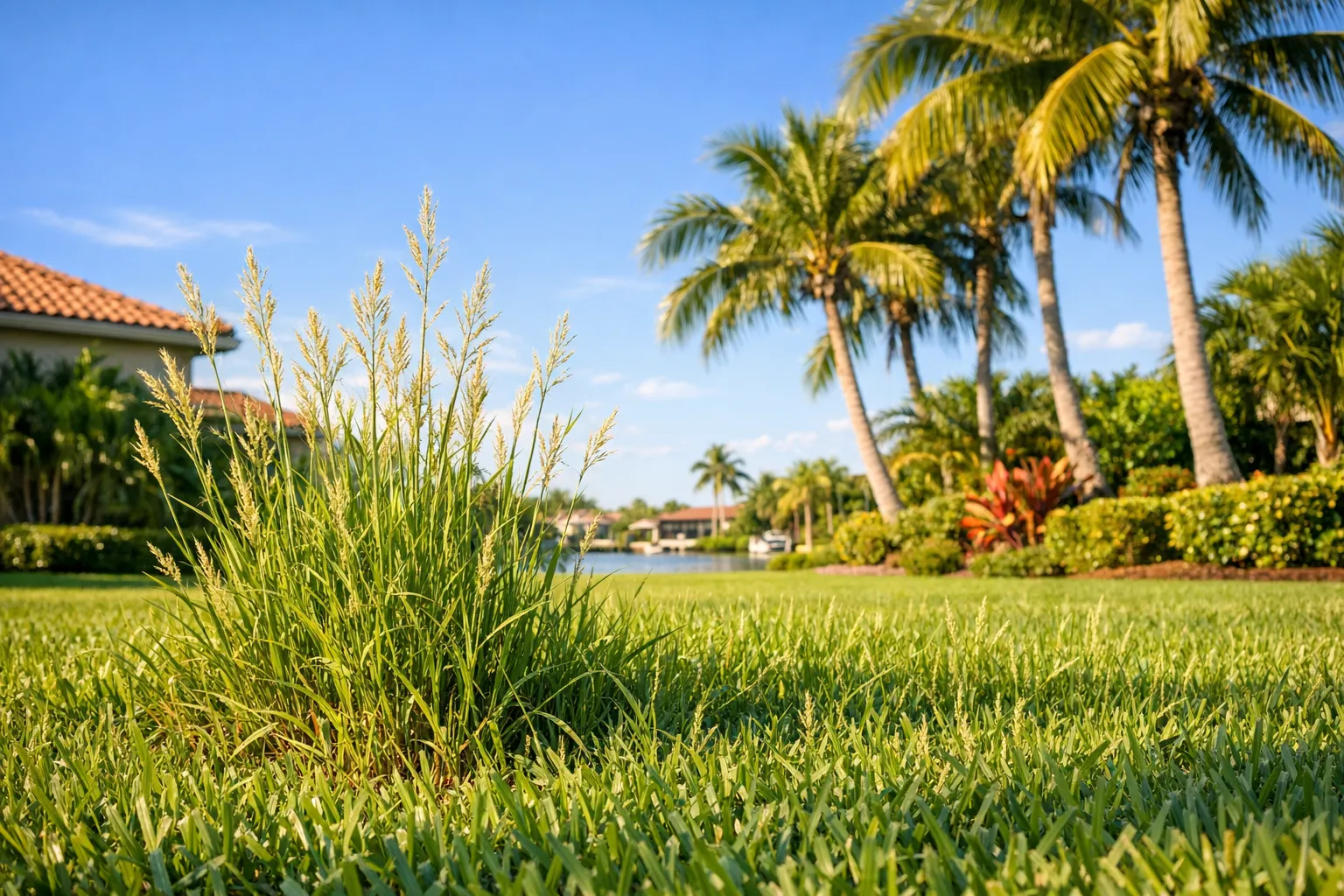
What torpedograss looks like in a St. Augustine lawn
The name is the tell. “Torpedo” comes from the sharply pointed tips on its underground runners, or rhizomes, which UF/IFAS describes as hard, whitish, and torpedo-shaped. If you dig at the edge of a suspicious patch and find a stiff runner ending in a sharp point, you’ve got your ID.
Above ground, torpedograss separates itself from St. Augustine by texture. The blades are rigid with a waxy, blue-green cast, roughly a tenth of an inch wide when flat, and the shoots can climb well over a foot tall if you stop mowing. Set against the softer, wider runners of St. Augustine, it reads as coarser and holds itself more upright. One catch worth knowing: it can pass for a native grass called maidencane at a glance. UF/IFAS notes that maidencane prefers to sit in standing water and, tellingly, does not have those torpedo-shaped rhizomes. So the runner underground is what settles the question.
On every inspection
How to tell torpedograss from your St. Augustine
- Torpedo-tipped rhizome Dig at the edge of a patch. The underground runner ends in a hard, sharp, whitish point. That tip is where the name comes from, and it's the surest ID.
- Stiff, blue-green blades Rigid, waxy blades about a tenth of an inch wide that stand upright above the softer St. Augustine around them.
- A line from the water Shoots often march up in a row from a canal bank, seawall, or soggy low spot rather than popping up at random.
- Not maidencane The native look-alike prefers standing water and has no torpedo-shaped rhizome, so check underground before you decide.
Identification points drawn from UF/IFAS descriptions of Panicum repens.
How torpedograss spreads
Here’s the part that makes it so stubborn. UF/IFAS reports that torpedograss seed barely germinates under Florida conditions, so it isn’t spreading by seed the way a lot of weeds do. It spreads vegetatively, from those rhizomes and from broken stem fragments, and each fragment can root and start a whole new plant. Water carries the fragments around, which matters a great deal on a canal or riverfront lot. Equipment moves it too. A mower deck that rolls through a torpedograss patch and then across the rest of the yard is hauling live pieces with it. Heavier gear and boats do the same. That’s why cleaning equipment shows up on every UF/IFAS management list for this weed.
Why torpedograss loves Palmetto’s waterfront
Palmetto sits on the north bank of the Manatee River, and plenty of the city’s lots back up to canals, seawalls, and tidal edges, from the Riviera Dunes waterfront to the older riverfront streets. That geography is exactly what torpedograss is after. UF/IFAS describes it thriving in warm, wet, sandy ground in full sun, growing anywhere from dry land out into shallow water. Our sandy soil drains fast, our afternoon storms keep the low spots moist all summer, and the shoreline hands it a permanent foothold that a spray can’t fully reach.
The pattern is consistent. It establishes along the water’s edge first and builds a dense mat there, then it creeps landward into the maintained turf a few feet at a time. By the time you spot it out in the middle of the lawn, the shoreline colony feeding it has usually been sitting there a while.
The honest control conversation
Now the part nobody selling you a miracle wants to say out loud. There is no selective herbicide that removes torpedograss from a St. Augustine lawn while leaving the St. Augustine unharmed. UF/IFAS Extension states this plainly. The two grasses are close enough in the plant world that anything strong enough to take out one will injure the other.
That leaves two honest paths. You can suppress it, knocking the top growth back and living with a managed level of it, or you can go for removal in the worst areas, which per the UF/IFAS turf publication generally means a non-selective herbicide (the kind that kills any green plant it touches) followed by resodding the bare ground. UF/IFAS is blunt that torpedograss is difficult and expensive to control, largely because of those deep, starch-loaded rhizomes that keep pushing up new shoots long after the surface looks dead.
Why a partial kill can look worse before it looks better
If you hit a patch and it browns out, that isn’t the finish line. The rhizomes run deep and hold energy reserves, so a single knockdown usually takes the topgrowth while the underground network resprouts. In the meantime you’re left with a dead, open patch, and UF/IFAS points out that open, disturbed ground is precisely where torpedograss and every other weed move in first. A half-finished job can hand the weed a bare seedbed to recolonize.
The digging route backfires the same way. Tilling or yanking the runners chops the rhizomes into fragments, and every fragment is a candidate for a new plant. UF/IFAS specifically warns that mechanical removal tends to multiply the problem through fragmentation. This is the reason the honest plan is measured and repeated instead of one dramatic weekend with a shovel.
What you can actually do about it
You can’t spray your way out of this one, so the practical work is about denying it ground and containing what’s there.
- Keep your St. Augustine thick. A dense, healthy lawn leaves less open ground for torpedograss to colonize, which is the one preventive lever UF/IFAS actually endorses. Build that density during the legal fertilization windows. In Manatee County, remember that the summer fertilizer restriction bans applying nitrogen and phosphorus from June 1 through September 30, so your push-the-turf months fall outside that window.
- Clean your mower. If you know you have a torpedograss patch, mow it last and knock the clippings and mud off the deck before you move on, so you aren’t seeding the rest of the yard.
- Leave the shovel in the shed. Digging feels productive and usually spreads it.
- Identify before you treat. Confirm it’s torpedograss and not maidencane or ordinary St. Augustine runners before anyone puts down a product, because a wrong ID sends you down the wrong road.
Pro tip: Snap a photo of the rhizome tip, not just the blades. Nine times out of ten that torpedo-shaped point is what confirms it, and it saves a guessing game when you show it to a pro.
When the patch is small and near the water, that’s the moment to deal with it, before the shoreline colony gets established. When it’s already through the middle of the lawn, it’s worth having a licensed lawn pro walk the property and lay out the suppression-versus-resod math with you honestly. That’s how we handle it at Waves on Palmetto lots: confirm the ID, then give you the real options based on how far it’s run instead of a promise we can’t keep. You can see what our program covers on our lawn care in Palmetto page. Cost depends on the size and spread of the infestation, so reach out through our contact page for a straight answer on your yard.
Frequently Asked Questions
Can I kill torpedograss without killing my St. Augustine?
No. Per UF/IFAS Extension, there is no herbicide that selectively controls torpedograss in a St. Augustine lawn without injuring the St. Augustine. The realistic options are ongoing suppression or a non-selective treatment followed by resodding the treated area.
Is torpedograss the same thing as crabgrass or maidencane?
No. Crabgrass is a soft, sprawling annual. Maidencane looks a lot like torpedograss but is a Florida native that prefers standing water and lacks the torpedo-shaped rhizome. That hard, sharp-tipped underground runner is the feature that confirms torpedograss.
Will it come back after I resod?
It can. Any rhizome fragments left in the soil, or any colony still holding the shoreline, can push back into fresh sod. UF/IFAS classifies torpedograss as difficult and expensive to control for exactly this reason, so plan on monitoring the area and re-treating stragglers rather than expecting one-and-done.
Torpedograss on a Palmetto waterfront lot is a manageable problem when you catch it early and treat it honestly. If that blue-green patch by the seawall is starting to march toward the house, request a quote and we’ll take a look.