Jump to a section (8)
- 01When the brown patch keeps spreading
- 02What a fall armyworm actually looks like
- 03Why Parrish’s new sod lawns are a magnet
- 04The soap-flush test you can run in five minutes
- 05Why timing beats product choice
- 06After the outbreak: will your lawn bounce back?
- 07Frequently Asked Questions
- 08The bottom line for Parrish lawns
Unlike most lawn pests around here, which take weeks to do visible harm, fall armyworms can chew a healthy lawn down to stubble in a couple of days. That speed is exactly why they blindside Parrish homeowners. New subdivisions keep going up across Parrish with fresh St. Augustine sod and irrigation running all through our humid summers, and that young, well-watered turf is prime armyworm territory.
The same trained eye that catches an off-color patch before most people would ever notice it is what our lawn care team in Parrish brings to local yards. If you are already watching a brown patch grow day over day, that is your cue to move, and you can request a quote to get a licensed tech on it. Here is what UF/IFAS says to watch for, plus the five-minute check you can run yourself.
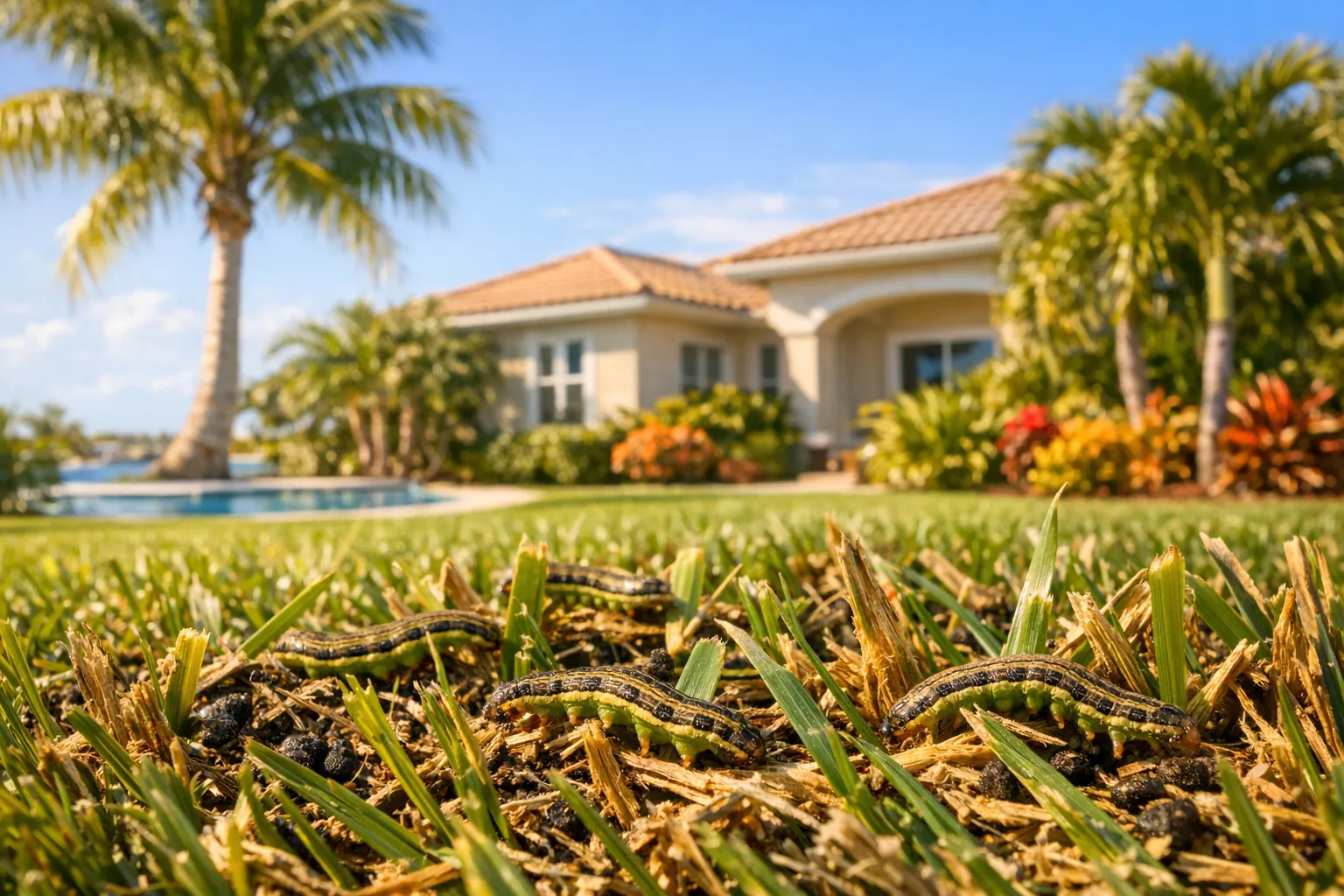
When the brown patch keeps spreading
The first thing you notice usually is not a caterpillar at all. It is a dull, browned-out area that looked smaller the day before. Fall armyworm feeding tends to be uniform across a broad area and shows up as scalped or bare patches, according to UF/IFAS. Because a whole brood feeds together, the edge of that patch can visibly creep outward from one day to the next.
Birds are the other tell. If the grackles and ibis are suddenly working one strip of your lawn at first light, they may be cleaning up caterpillars for you. UF/IFAS lists birds, along with paper wasps and other predatory insects, among the natural enemies of fall armyworm larvae, so a rush of bird activity over a browning patch earns a closer look. The larvae do most of their feeding early in the morning and late in the evening, which is also when you are most likely to spot them out on the blades.
Around here you can run into them from spring through fall, with the heaviest outbreaks usually showing up as the summer season winds down.
Seasonal pressure
Fall armyworm pressure in Southwest Florida
- Spring Apr-MayArriving
Migrating moths arrive and lay the first egg masses on tender new growth.
- Summer Jun-AugBuilding
Overlapping generations build; new sod and lush, watered turf are prime targets.
- Early fall Sep-OctPeak
Populations run high, and this is when most lawn outbreaks turn up.
- Late fall and winter Nov-MarLower
Cooler weather slows them down, though Florida rarely gets a freeze hard enough to end it.
Early fall runs hottest. General pattern for Southwest Florida; local conditions vary. Source: UF/IFAS.
What a fall armyworm actually looks like
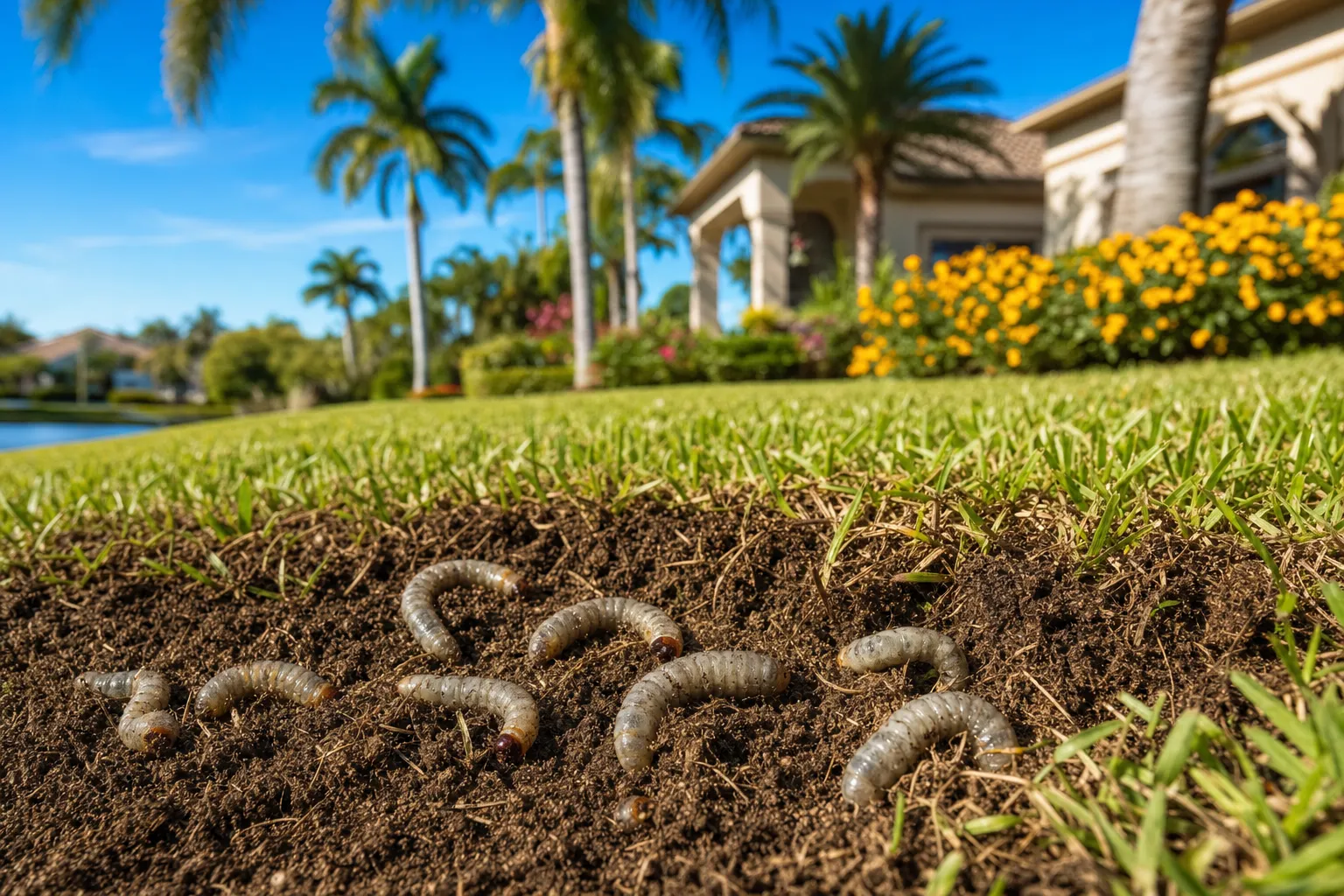
Fall armyworms are the larval stage of a night-flying moth, Spodoptera frugiperda, and per UF/IFAS they grow to about an inch and a half long. Young larvae are greenish with a dark head. As they mature the body turns brownish with pale lines running down the back and sides, the head becomes reddish-brown mottled with white, and raised dark spots with short spines dot the back.
The clincher is on the face. UF/IFAS describes a light-colored, upside-down “Y” on the front of the head capsule of a mature larva, and once you have seen it you will not mistake it. You will need to get down at the soil line to check, ideally at dusk or first light when the larvae are up feeding rather than hunkered down in the thatch. You can read the full write-up on UF/IFAS EDIS.
Here is the short checklist, per UF/IFAS:
- Inverted Y on the face. A light-colored, upside-down Y on the front of the head capsule of a mature larva.
- Up to about 1.5 inches. Grows from a tiny hatchling to roughly an inch and a half over about two weeks.
- Stripes and raised spots. Brownish body with pale lengthwise lines and dark, slightly bristly bumps along the back.
- Uniform, spreading brown patch. Damage is even across a broad area and enlarges day over day.
- Night-flying moths at lights. Adults are brownish with about a 1.5-inch wingspan and are drawn to porch and landscape lights.
When in doubt, confirm with a soap flush.
Fall armyworm damage also gets confused with tropical sod webworm damage — a smaller, patchier lawn caterpillar with a different feeding pattern:
Look-alike check
Is this a fall armyworm?
The tell: Fall armyworm has an inverted "Y" on the head and damages turf uniformly; sod webworm larvae are smaller with patchy, notched blades.
See both alongside the rest of the caterpillars and bagworms we’ve verified in the Which Florida Caterpillar or Bagworm Is This? hub.
Why Parrish’s new sod lawns are a magnet
Here is where Parrish gets singled out. UF/IFAS notes that fall armyworms tend to become a problem in newly established turf, especially when it has been fertilized heavily in late summer. Parrish has been one of the fastest-growing corners of Manatee County, and a lot of those new-build yards are sitting on sod that went down in the last year or two. Young turf is tender and gets watered hard to establish roots. Our sandy soil drains so fast that irrigation runs often, and between that and the daily afternoon storms, the ground stays lush and wet. To an egg-laying moth cruising for soft new growth, that is a billboard.
The fertilizer piece is where a lot of well-meaning homeowners get themselves into trouble. Pushing new sod with heavy feeding through the summer is the exact recipe UF/IFAS warns builds caterpillar populations. It also runs afoul of local rules: Manatee County’s rainy-season fertilizer ordinance restricts nitrogen and phosphorus from June 1 through September 30. So skip the urge to dump a bag of high-nitrogen fertilizer on a struggling lawn during those months. We break down what that means for your yard in our guide to the Manatee County fertilizer blackout.
The soap-flush test you can run in five minutes
You do not have to guess. UF/IFAS recommends a simple soap flush that anybody can run. Mix about one tablespoon of liquid dish soap into a gallon of water, then pour it over a two-foot by two-foot patch right at the edge of the damage, where the green grass meets the brown. Give it a few minutes. If armyworms are down in there, the soapy water irritates them and they crawl up to the surface where you can count them. Check a couple of different spots, since they tend to clump. When you are done counting, rinse the patch with clean water so the soap does not stress the turf.
Pro tip: Run the flush at the boundary between damaged and healthy turf, not dead in the center of a brown patch. The caterpillars follow their food, so they have usually already moved to the green edge. First light or early evening is the best window to catch them up and active.
Why timing beats product choice
With armyworms, when you treat matters more than what you spray. UF/IFAS is blunt about it: treat at the first sign of damage, because insecticides work far better on young, small caterpillars than on full-grown ones. Little larvae barely eat and go down easily. By the time they are an inch and a half and doing the real chewing, they are harder to control and close to burrowing into the soil to pupate anyway, so a late spray can mean you paid to kill caterpillars that were nearly done wrecking your lawn.
That is why the soap flush earns its keep. Confirming armyworms early, while the larvae are still small, is what lets a treatment actually land. I am not going to name products or rates here, and honestly you should not blindly reach for whatever broad-spectrum spray is in the garage. UF/IFAS points out that pesticide applications can knock back the wasps and predatory bugs that were helping you for free, and there are reduced-risk, caterpillar-selective options that a licensed applicator can time correctly. If you do apply anything yourself, identify the pest first, read and follow the product label to the letter, keep the product off any surface where food is prepared, and store and place it out of sight and reach of children and pets.
This is the point where it is worth bringing in help. If your soap flush turns up a bunch of larvae, or the damage is already on the move across the yard, a licensed lawn care team in Parrish can confirm the ID and time treatment to the stage that responds. If you are wondering about cost, our lawn care estimator can put a real number on it in about a minute. No one can honestly promise your lawn will never see another armyworm, but catching an outbreak early gives your turf its best shot.
After the outbreak: will your lawn bounce back?
Good news first. UF/IFAS says fall armyworms rarely kill an established lawn, and most turf survives an attack. They feed on the leaf blades and green tissue rather than the roots and crowns, so a healthy St. Augustine lawn with a solid root system usually greens back up once the feeding stops and it gets a little water and time.
Newer sod is the exception to watch. Turf that only went down a few months ago has shallow roots and less in reserve, so a hard armyworm hit can leave thin or bare spots that will not fill in on their own. UF/IFAS notes that healthy, properly maintained turf recovers faster, which mostly comes down to watering deeply but not constantly, mowing at the right height for St. Augustine, and keeping thatch in check. Resist the temptation to force recovery with a heavy shot of fertilizer, especially between June 1 and September 30 when Manatee County’s nitrogen and phosphorus restriction is in effect. If bare patches are still hanging around once things settle, plugging or re-sodding those areas at the right time of year will get you back to a full lawn faster than waiting them out.
Frequently Asked Questions
How fast can fall armyworms damage a Parrish lawn?
Fast. Because a whole brood feeds together and the larger larvae eat the most, a browned area can visibly expand day over day, and a heavy infestation can scalp a section of lawn within a few days. That speed is why UF/IFAS pushes scouting and treating at the first sign of damage rather than waiting to see how bad it gets.
Are fall armyworms harmful to people or pets?
They are plant-feeding caterpillars and do not bite or sting people or animals. The thing to be careful with is any product used to treat them, so if something is applied, follow the label directions and keep pets off the treated area until the label says it is fine to return.
How do I tell fall armyworms from sod webworms?
Both are caterpillars that chew Florida lawns and both can flare up in the warmer months. Fall armyworms move fast, hit broad uniform areas, and mature larvae carry that inverted Y on the head. Tropical sod webworms are smaller, around an inch, gray-green, feed at night, and curl up on the soil surface during the day, per UF/IFAS. A soap flush helps sort out which one you are dealing with.
The bottom line for Parrish lawns
Fall armyworms reward the homeowner who notices early. Keep an eye on any brown patch that is growing, watch for birds working one spot at dawn, and run a soap flush the moment you get suspicious. If the count comes back high or the damage is spreading, get a licensed tech out before the caterpillars finish the job. You can request a quote or reach our Parrish lawn care team to have someone confirm what is going on and time treatment right. And if your caterpillar turns out to be the other one that chews local lawns, our tropical sod webworm guide covers that ID the same way.