Bundle Lawn + Pest — Save 10% CLAIM DEAL →
Open 24 Hrs (941) 297-5749
Waves Pest Control
Lawn Care

Large Patch Is Coming for Lakewood Ranch Lawns: Beat the Ring Disease to the First Cool Front

Circular yellow rings in your St. Augustine lawn? That's large patch (Rhizoctonia solani). The UF/IFAS temperature window and the irrigation fix.

Adam Benetti, Founder & Lead Technician
Adam Benetti
Founder & Lead Technician
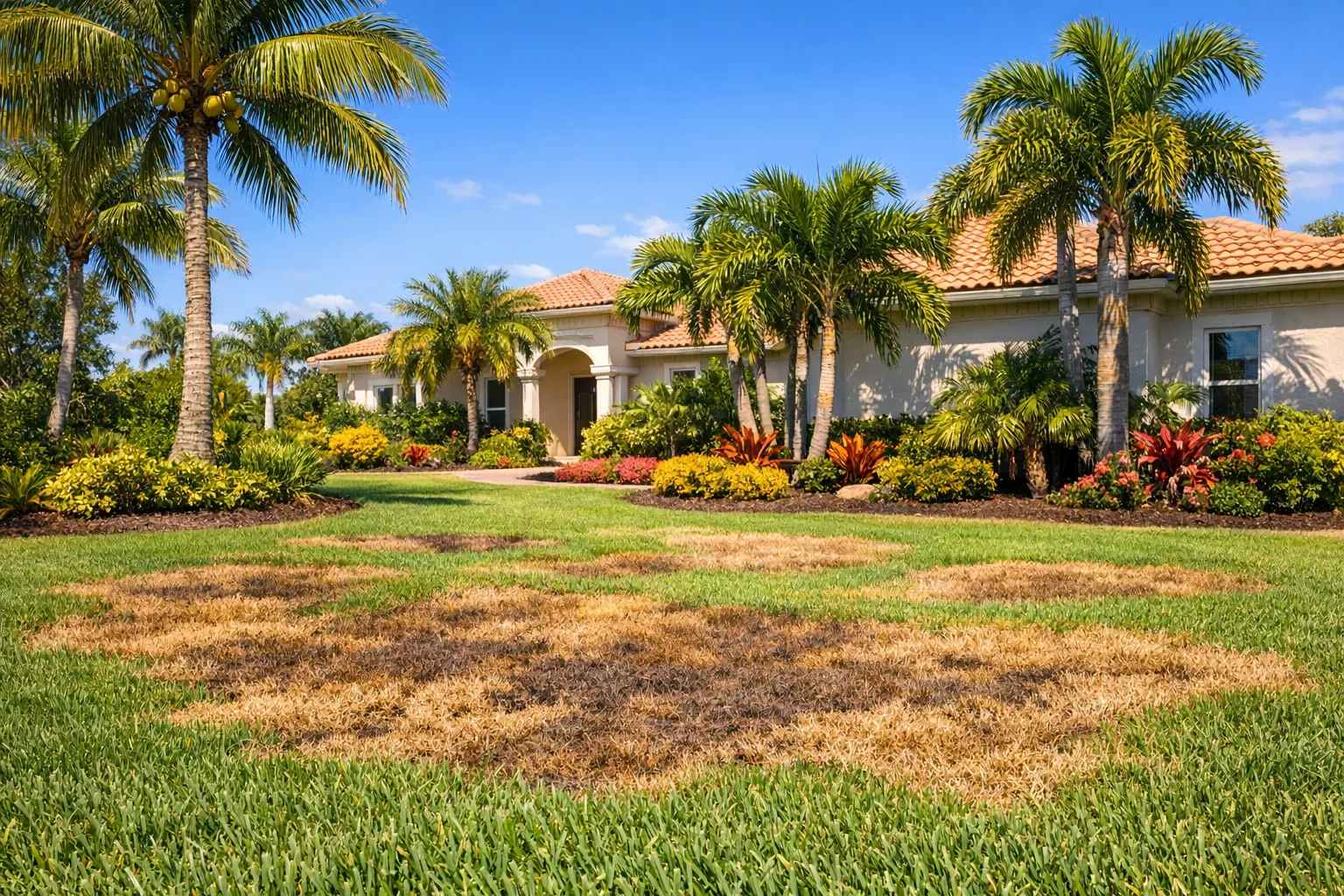
Large brown circular patches of dead grass in a St. Augustine lawn in front of a tile-roofed home with palm trees.
Last Updated: August 7, 2026 12 min read

If your Lakewood Ranch lawn suddenly looks like someone dropped a giant yellow ring in the middle of it, congratulations — you’ve probably met large patch. It’s the cool-season fungal disease that shows up on St. Augustine here every fall, expands through spring, and then quietly disappears when the heat comes back. The maddening part isn’t the diagnosis. It’s how fast a soft 12-inch spot turns into a lawn-wide problem while you’re still trying to figure out what you did wrong.

As a Florida Certified Lawn & Ornamental Technician serving Manatee County lawns, I can tell you the difference between “small ring” and “half the front yard” almost always comes down to two things — the temperature window the fungus wakes up in, and how long the leaf blades stay wet after dark. Everything else is downstream of that. (For the broader picture of what turf care covers here, our Lakewood Ranch lawn care page is the map.)

If you’re already staring at a ring that’s widening week over week, don’t wait for it to “grow out.” Request a quote and get a set of eyes on it before the cool, wet season really settles in.

What large patch looks like (and the pull test that confirms it)

Large patch is caused by the soil fungus Rhizoctonia solani, and it’s the same organism older references call “brown patch” or “Rhizoctonia blight.” According to UF/IFAS, all warm-season turfgrasses can be affected, but St. Augustinegrass and zoysiagrass are especially susceptible.

Identification is straightforward once you know the signs of an active outbreak:

  • Circular, expanding patches. UF/IFAS describes it starting as small patches about 1 ft in diameter that turn yellow and then reddish brown, brown, or straw colored as the leaves start to die. Rings widen outward while the center sometimes recovers, giving that classic “donut” look.
  • A yellow-to-orange leading edge. The active front of the ring is where the fungus is chewing on new tissue. That’s where the color shift lives.
  • The pull test. This is the tell. The fungus infects the leaf area closest to the soil, eventually killing the leaf. A soft, dark rot occurs at the base of the leaf and leaves can easily be pulled off the stem. The base of a pulled leaf has a rotted odor. If you grab a yellowing blade and it slides free with a dark, mushy base — that’s large patch, not drought, not chinch bugs, not dog spots.
  • Roots stay fine. Roots are not affected by this pathogen, which is why lawns generally do recover — the stolons are still alive underneath.

On every inspection

What we look for when we diagnose large patch

  • Ring shape Circular patches roughly 1 ft across at onset, expanding outward week over week
  • Leading edge color Yellow, reddish-brown, or straw at the active front — not uniform browning
  • Pull test Blades slide free of the stem with a soft, rotted base and a sour smell
  • Roots intact The pathogen kills leaf tissue at the base, not the root system
  • Location Low, shady, poorly drained spots go first — reads the irrigation map for you

Confirming large patch in the field — the pull test is the single most useful check.

Pro tip from the truck: Do the pull test in three different spots around the ring — the leading edge, the dead center, and just outside the visible ring. If the edge blades slide free but the outside blades don’t, you’ve caught it in expansion mode. That’s the window where cultural fixes still bend the curve.

The temperature window — and why that means fall through spring here

Here’s the piece a lot of homeowners get wrong: this disease is not a “hot, humid summer” problem. It’s the opposite.

Per UF/IFAS, large patch is most likely to be observed from November through May when temperatures are below 80°F. It is normally not observed in the summer months. The Gardening Solutions companion page says the same thing in plain English — the disease is most often observed when temperatures drop below 80 degrees, usually between November and May, and it often becomes a problem in fall, when cooler temperatures and damp weather create ideal conditions for the fungus. Damaged patches will continue to expand in the spring, until temperatures climb above those favorable for disease.

Translate that to Southwest Florida and it’s not subtle. The first real cold front through Lakewood Ranch — usually the one that finally kills the mugginess and drops overnight lows into the 60s — is the same event that flips the switch on large patch. The fungus has been sitting in the thatch all summer, dormant and waiting. Cooler air arrives, leaf-wetness windows get longer because dew hangs around past sunrise, and R. solani has everything it wants.

That’s why the calendar itself is a diagnostic tool.

Large patch vs. the summer diseases — the calendar is your first clue

St. Augustine gets attacked by different pathogens in different seasons, and mistaking one for another is how homeowners end up throwing the wrong product at the wrong problem.

What you see Large patch (Rhizoctonia solani) Summer leaf/sheath spot (R. zeae / R. oryzae)
When it shows up November–May, temps below 80°F Summer, temps above 80°F
Leaf pulls free? Yes — soft, rotted base, sour smell No — blade stays attached
Leaf appearance Basal rot; blade dies from the base up Leaf spots that expand into a full-blade blight
Roots affected? No No
Confirmation Field pull test is usually enough Send a sample to a plant disease clinic

Adapted from UF/IFAS SS-PLP-5/LH044 (Elliott & Harmon).

UF/IFAS is explicit about this: two other Rhizoctonia species (R. zeae and R. oryzae) cause Rhizoctonia leaf and sheath spot, which shows up during summer above 80°F. Overall symptoms may look like brown patch, but the leaf symptoms are different — those pathogens do not cause a basal leaf rot but rather a leaf spot that expands into a leaf blight, and the leaves do not pull off the stem. Roots are not affected. UF/IFAS specifically states that this disease must be confirmed by a plant disease clinic before any control efforts, because the controls are very different from large patch.

Bottom line: if it’s October through May in Lakewood Ranch and blades pull free at a rotted base, you have large patch. If it’s July, blades stay attached, and you’re seeing spots on the leaves themselves, you have something else and you need a lab confirmation before spending money on a fungicide.

The irrigation connection — the fix nobody wants to hear

The single most useful thing UF/IFAS says about this disease is what triggers infection in the first place. Infection is triggered by rainfall, excessive irrigation, or extended periods of high humidity resulting in the leaves being continuously wet for 48 hours or more.

Read that carefully: 48 hours of continuous leaf wetness. Not soil moisture. Leaf wetness — the blade surface staying wet long enough for the fungus to get in.

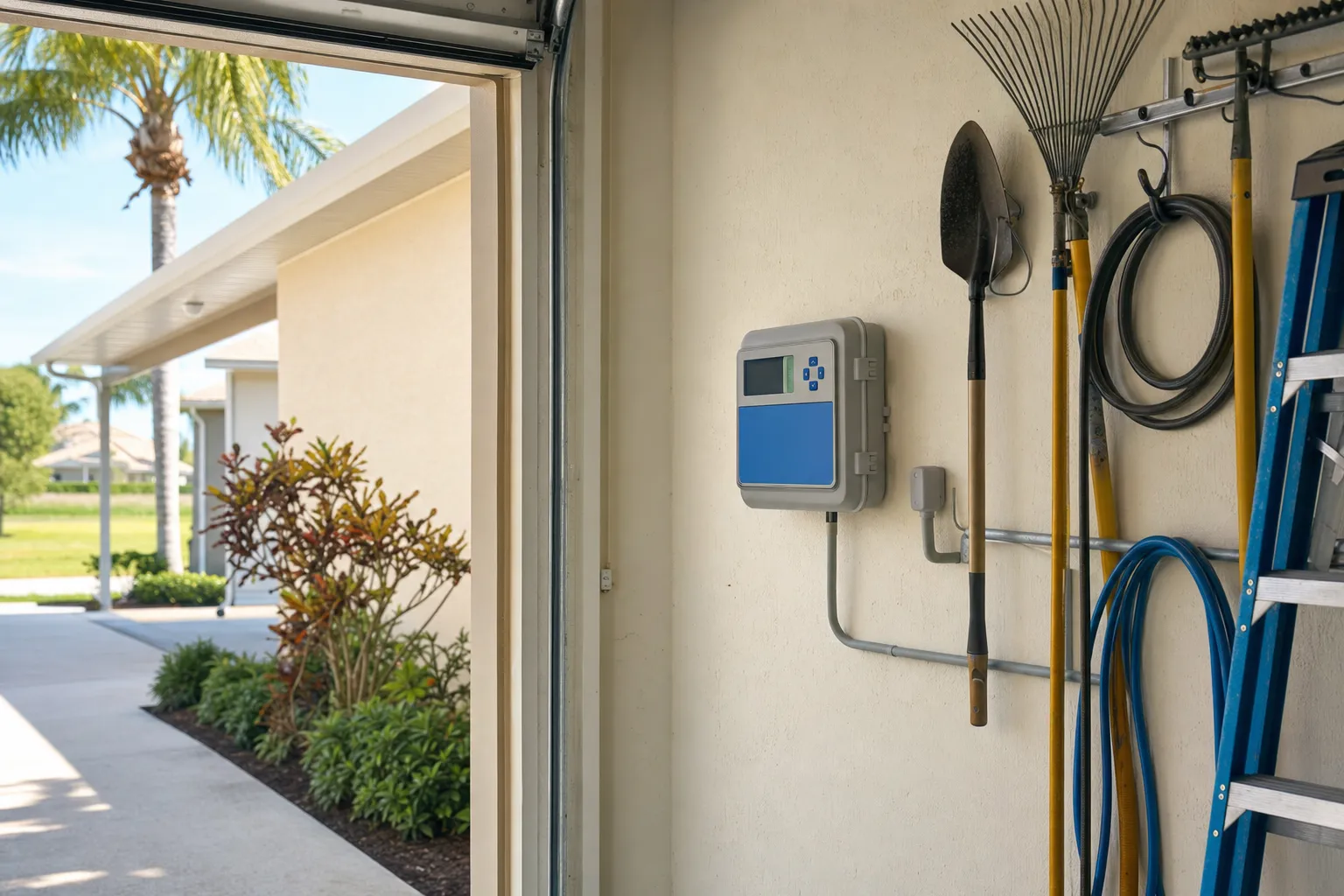
Now think about what a typical Lakewood Ranch irrigation controller is doing from October onward. Sprinklers run at 5 or 6 in the evening because the HOA schedule or the “set it and forget it” from last summer never got changed. Dew sets in a couple hours later. Overnight lows in the 60s mean nothing dries out. Sunrise is late, and morning shade in newer LWR neighborhoods with dense oaks and mature palms means half the yard doesn’t see direct sun until 10 a.m. That’s easily 15+ hours of leaf wetness from a single cycle. Add a cool front with a couple of rainy days behind it and you’ve cleared the 48-hour bar without trying.

Compare that to the same house watering at 5 a.m.: irrigation hits, blades get sun by 8 or 9, wetness ends by mid-morning. That doesn’t make infection impossible — rainfall and stretches of high humidity can still keep leaves wet on their own — but you’re no longer handing the fungus 15 extra hours of wetness per cycle for free.

UF/IFAS is blunt about the fix. Their guidance is to minimize the time your lawn spends damp by watering only when necessary, and always in the morning. Not evening. Not “whenever the timer runs.” Morning.

If you’re on a home in Country Club East, Del Webb, Central Park, or any of the older Lakewood Ranch villages with mature landscaping and shade, this is where I’d start. Not the fungicide aisle. The controller.

Treatment realism — why “spray it and wait” doesn’t work in December

Here’s the part homeowners hate hearing: even a perfect fungicide application in the middle of a Florida winter recovers slowly, because the grass isn’t growing.

UF/IFAS is explicit that turfgrass must be actively growing in order for the diseased turfgrass to recover. Symptoms do not disappear until new leaves develop and the old leaves are removed by mowing or decomposition. Since this disease normally occurs when the turfgrass is not growing very rapidly, recovery may be very slow.

That’s the whole ballgame. St. Augustine barely grows below 70°F. A ring you knock down in January is a ring you’re still looking at in March, because the surrounding turf isn’t producing new stolons to fill it. The patch stops expanding — but the visual scar hangs around until spring warms up.

Which is why the calculus on timing is:

  • Preventive timing (best): treat the known problem areas before the first cool front, when soil is still warm and the fungus hasn’t gotten its foothold yet. This is the play for homes that had a bad ring last winter — you’re not treating symptoms, you’re treating history.
  • Early curative (still good): treat at the first sign of a ring, while it’s still under a foot or two across and you can see the active edge. You stop the spread, and the grass has enough residual growth left to start filling in.
  • Late curative (damage control): treat when the rings have already merged. You’ll still stop expansion, but the visual recovery is a spring project, not a winter one. Reset expectations accordingly.

We’d rather look at a lawn in October — before the first ring — than in February when it’s already a connect-the-dots situation. If you’re not sure which category you’re in, get in touch with a photo and we can tell you what you’re looking at.

What to change for next year if this year was bad

Assume the fungus is already in your thatch. It is — R. solani is present in essentially every Florida lawn, waiting for its window. What you’re actually managing is the environment the fungus wakes up into. That’s cultural, not chemical, and it’s what UF/IFAS leans on hardest.

Per UF/IFAS: as with most fungal diseases, moisture is the primary contributing factor. Excessive irrigation, rainfall, and high humidity all contribute, but homeowners are only in control of their management practices. Incorrect watering, mowing, and fertilizing practices all make your grass more susceptible to disease. The best way to treat large patch is also the best way to prevent it — make sure that your lawn care is seasonally appropriate. Minimize the time your lawn spends damp by watering only when necessary, and always in the morning. To avoid feeding the fungus, apply only slow-release nitrogen and do so sparingly, according to IFAS recommendations for your turf species and location. Finally, steer the lawn mower over the diseased areas last.

Practical version for a Lakewood Ranch lawn:

  1. Move irrigation to early morning — and water deeply, not lightly. 4–6 a.m. is the target. Never evening. Never overnight. Per UF/IFAS, the right dose is roughly 1/2–3/4 inch per watering, applied only when the lawn shows wilt signs. Deep, infrequent morning watering beats frequent light cycles, which keep blades wet, keep roots shallow, and feed the fungus. And stay inside Manatee County’s watering schedule: baseline rules allow two days a week by the last digit of your street address (even ends Thursday/Sunday, odd Wednesday/Saturday, mixed Tuesday/Friday), before 10 a.m. or after 4 p.m. — reclaimed water is exempt unless it’s blended. Morning wilt on a non-assigned day means you wait for your day, not water anyway.
  2. Cut back frequency in cool months. St. Augustine’s water demand in December is nothing like its demand in July. If your controller runs the same program year-round, it’s overwatering all winter and feeding the fungus.
  3. Respect the fertilizer rules. In Manatee County (and Sarasota next door), fertilizers containing nitrogen or phosphorus can’t be applied from June 1 through September 30 — that’s both nutrients, not just N. And in Manatee County, phosphorus stays prohibited year-round unless a soil analysis documents a deficiency — the summer blackout ending on September 30 doesn’t make it legal. When nitrogen applications resume October 1, use at least 50% slow-release nitrogen and go light. Lush, over-fed turf going into fall is a large patch magnet.
  4. Mow the healthy grass first, sick grass last. Mowers spread R. solani on the blades. Ending on the diseased area keeps you from tracking fungus across the rest of the yard.
  5. Fix drainage and airflow where you can. Low corners, dense shrubs pushed against the turf edge, sprinkler heads that overshoot into the same spot every cycle — those are the ring-generator patterns we see across LWR from Greenbrook to Waterside. Small landscape edits pay for themselves in fungus not-showing-up.
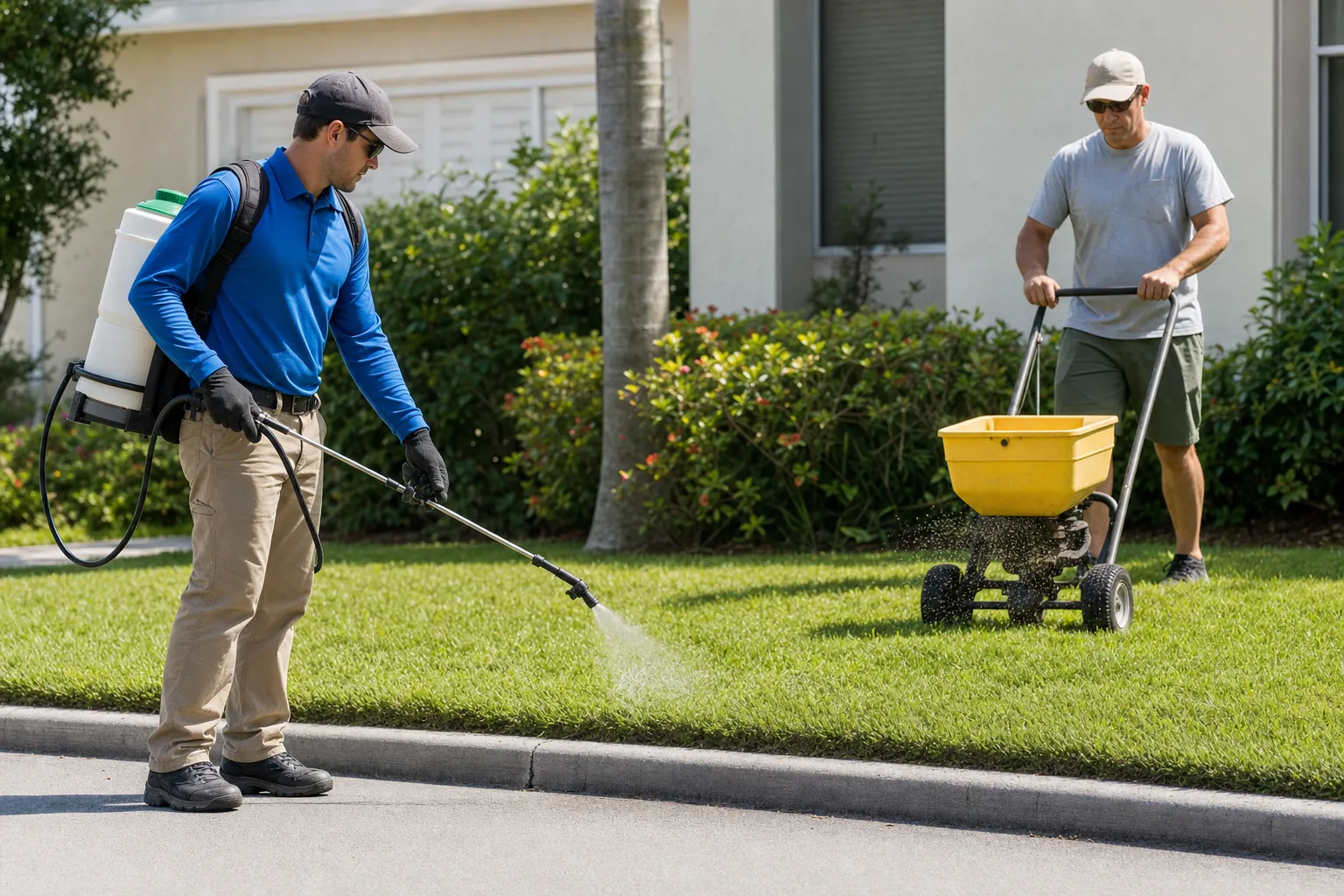
  6. Consider a preventive fungicide plan if the lawn has a repeat history. This is the exception to “fungicides are a bandage.” If the same spot rings up every October for three years running, that’s a case for preventive application timed before the fungus gets its window, done by a licensed professional.

If you want the whole seasonal program on autopilot instead of managing it yourself, that’s what our Lakewood Ranch lawn care service is built to do — right irrigation coaching, right fertilizer timing, and preventive fungicide slots on the lawns that actually need them. That’s the Waves Pest Control approach in general: we treat the conditions that wake the fungus up, not just the rings it leaves behind.

Frequently Asked Questions

Is large patch the same as brown patch?

Yes and no. In warm-season turf like St. Augustine, they’re the same disease — same pathogen (Rhizoctonia solani), same symptoms, same season. UF/IFAS lists “brown patch” and “Rhizoctonia blight” as other names for large patch. The name “large patch” got adopted because the rings in warm-season grasses can get very big — much larger than the small brown-patch rings older northern turf literature described.

Will my grass come back on its own?

Usually yes — the pathogen doesn’t kill the roots, so once temperatures climb back above the fungus’s window in spring, stolons produce new blades and the rings fill in. The catch is that recovery is slow because it happens while the turf isn’t growing quickly. If your rings are still open in March, it’s not that the fungicide “didn’t work” — it’s that St. Augustine hasn’t hit growing temps yet.

Should I treat now or wait to see if it spreads?

If you’re seeing a ring with a soft yellow edge and blades that pull free, it’s already spreading — that’s what the leading edge means. Waiting is how a 12-inch ring becomes a 6-foot ring. The realistic question is whether you’re chasing an active outbreak or setting up preventive coverage for a lawn with a repeat history. Those are different plays. A quick site look tells us which one you’re in.

Get ahead of the first cool front

Large patch isn’t a mystery disease and it isn’t unbeatable — it’s a weather-driven, irrigation-driven, calendar-driven organism, and every one of those levers is something you can influence. Fix the watering schedule, respect the cool-season growth reality, and get eyes on a ring while it’s still small.

Ready to stop guessing? Request a quote and we’ll walk the lawn with you before the next cool front sets the whole thing off.

Sources: UF/IFAS Extension EDIS publication SS-PLP-5/LH044, “Large Patch” (M. L. Elliott and P. F. Harmon), edis.ifas.ufl.edu/publication/LH044, and UF/IFAS Gardening Solutions, “Large Patch,” gardeningsolutions.ifas.ufl.edu.

About the author: Adam Benetti is Waves Pest Control’s Founder & Lead Technician (FDACS JB351547), an FDACS Licensed Pest Control Operator and Florida Certified Lawn & Ornamental Technician. He founded Waves in 2024 and personally handles field service across Manatee, Sarasota, and Charlotte counties.

A greener lawn starts here

Want a Healthier Lakewood Ranch Lawn?

Get a free, property-specific lawn care estimate in 30 seconds from a local tech.

CALL NOWCALL WAVES AI GET A QUOTEQUOTE