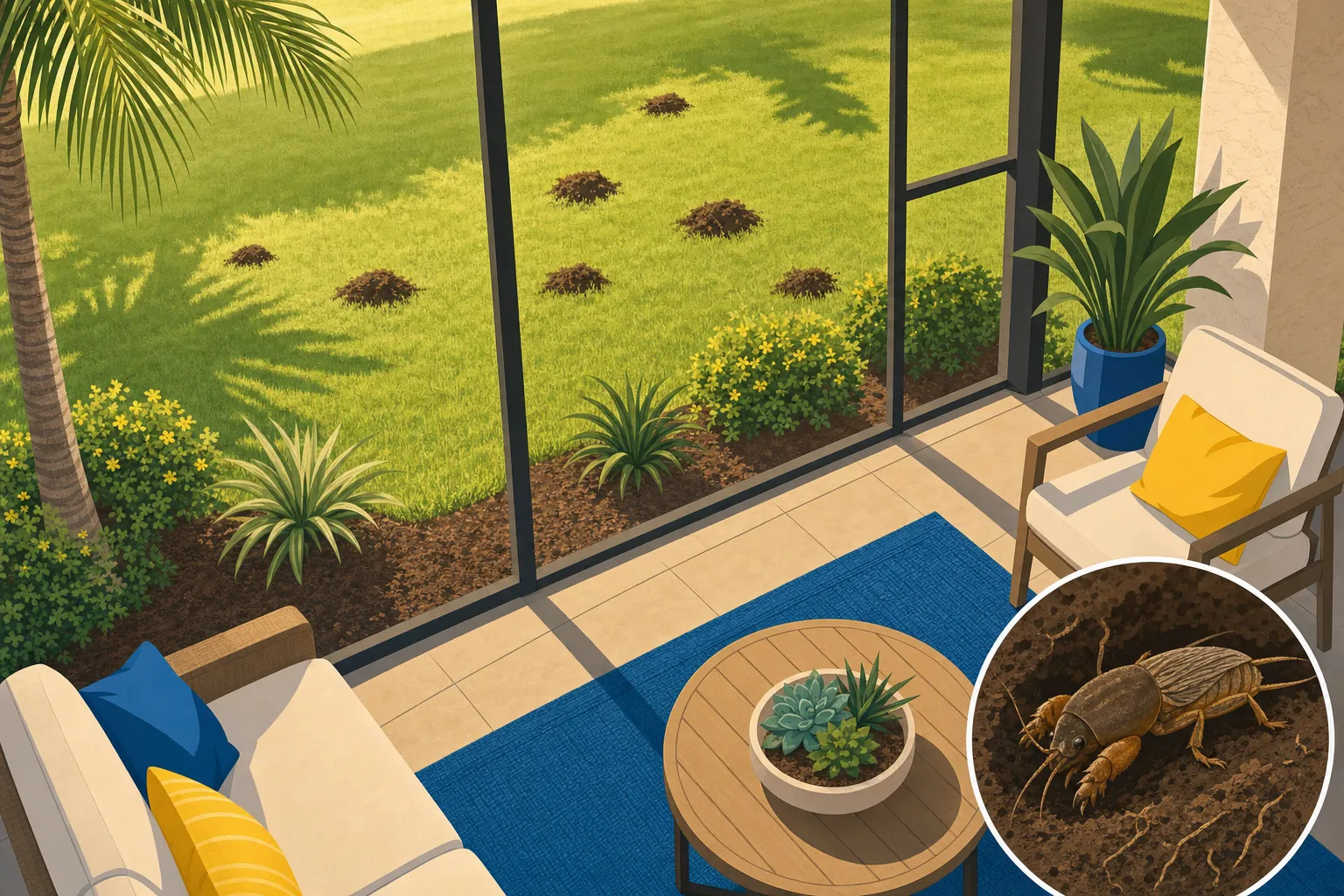
St. Augustine lawns in Sarasota and Manatee counties usually turn brown for one of three reasons: chinch bugs, a fungus such as large patch or take-all root rot, or watering stress. The pattern of the patch, where it sits in the yard and the month narrow it down. Brown grass looks the same from the street whatever caused it, so check before you treat.
Brown St. Augustine grass: clues by cause
Use this table to pick the two or three causes worth checking first. A clue points to a cause; it does not confirm one.
| Likely cause | What the patch tends to look like | Where it tends to start | When it is most likely here | Quick check |
|---|---|---|---|---|
| Chinch bugs | Yellow, then brown, with an uneven edge that keeps moving outward | Hot, sunny turf, often beside a driveway, sidewalk or curb | Warm months; worst in hot, dry spells | Part the grass at the edge of the patch and look for small black-and-white insects; float test |
| Drought stress | Blue-gray, folded blades first, then straw brown; footprints stay visible | High spots, slopes, pavement edges, gaps between sprinkler heads | Dry season, about November to May | Run each sprinkler zone and watch the coverage |
| Large patch (fungus) | Roughly round patches that start about a foot across and grow; yellow, then reddish brown or straw | Low, damp or shaded turf | November to May, when it is below about 80°F | Pull a leaf at the patch edge: a dark, soft base that lets go easily is a clue |
| Take-all root rot (fungus) | Irregular yellow or light green patches that thin out and go bare | Stressed turf, anywhere in the lawn | Summer and early fall, in the rainy season | Lift a runner: short, dark, rotted roots are a clue |
| Overwatering | Pale yellow-green, thin turf; often with dollarweed or sedge | Low spots, shade, downspouts, overlapping sprinklers | Rainy season, or any time a timer runs too often | Dig two inches down: soil still wet a day after watering |
| Tropical sod webworms | Ragged, chewed blades; turf looks scalped in patches | Often along edges and beds first | Late summer and fall | Look for notched blades and small tan moths at dusk |
| White grubs | Thin, wilting turf that does not respond to water | Scattered patches | Late summer and fall | Tug test: turf lifts like a loose carpet because the roots are gone |
| Mowing or a dull blade | Tan cast across the lawn, or a scalped strip | High spots and the edge of each pass | Any time | Look at the cut tips: shredded, brown ends |
| Fertilizer or product burn | Streaks or spots that follow the spreader or sprayer path | Where product overlapped or spilled | Days after an application | Compare the pattern with where product was applied |
| Cold | Tan or purple-brown blades across exposed turf | Open areas away from the house | After the coldest nights, December to February | Check the stolons: green runners mean the grass is alive |
Chinch bug damage and drought stress look alike and start in the same sunny, dry places. UF/IFAS makes the same point about the southern chinch bug, so look for the insect itself. UF/IFAS southern chinch bug management
Five checks before you treat
These take a few minutes and separate most of the causes above.
- Read the pattern. A patch that follows a sprinkler zone, a spreader path or a mower pass points to water, product or mowing. A patch with an edge that creeps outward week by week points to insects or disease.
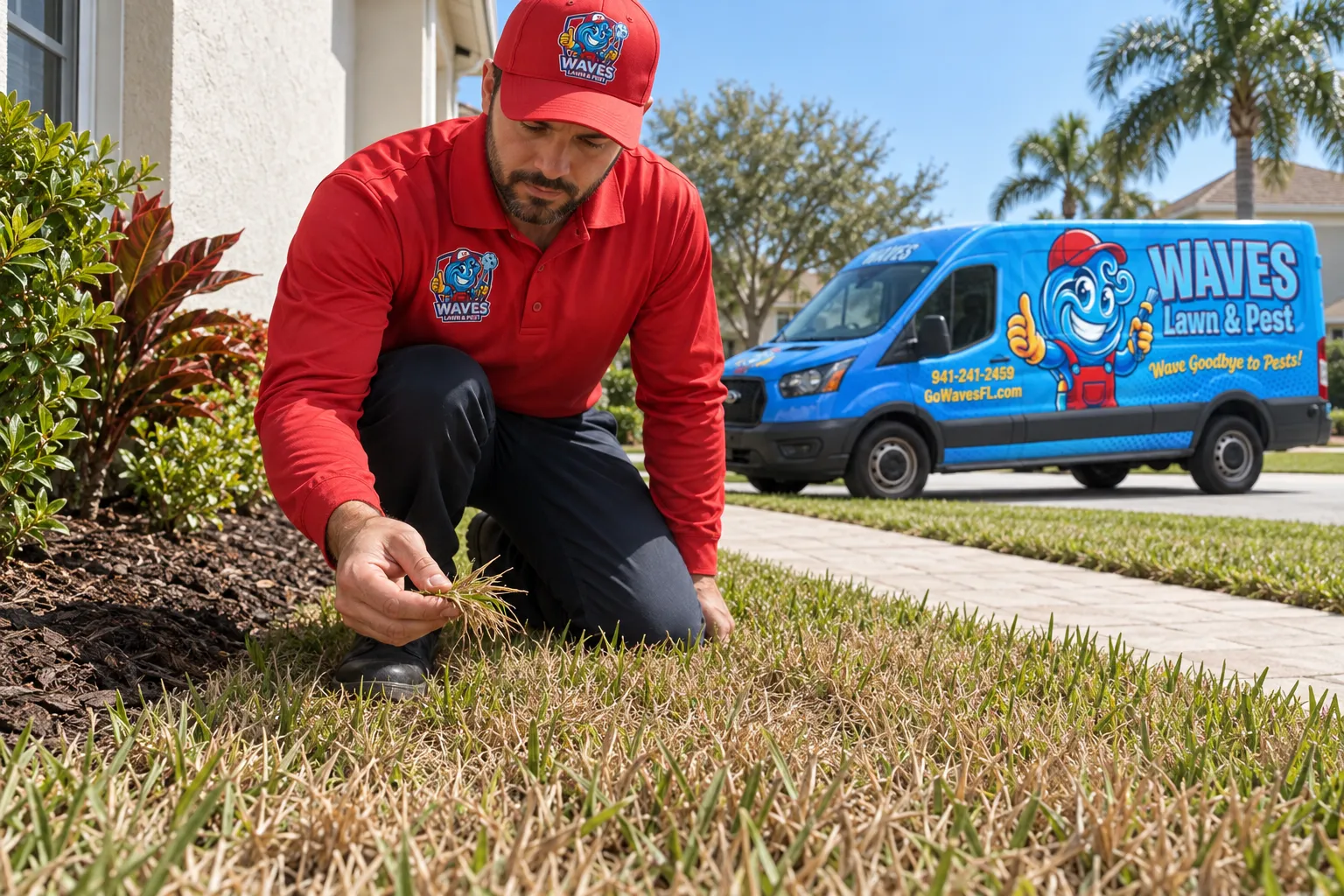
- Check the edge near concrete. Kneel at the line between brown and green turf beside a driveway or sidewalk. Part the grass down to the soil and watch for a minute. Chinch bugs are small, about a fifth of an inch, dark with white wings folded across the back. The young ones are reddish with a pale band.
- Do a tug test. Grip the brown turf and pull. If it lifts with almost no roots, check for grubs. If single leaves slide off the stem with a dark, soft base, large patch is more likely. If the runners hold but the roots are short and black, take-all root rot is more likely.
- Do a float test. Cut both ends off a metal can, push it a couple of inches into the turf at the patch edge, and fill it with water. Keep it full for five minutes and watch for chinch bugs floating to the top. Repeat it in at least four spots around the edge of the damage. Chinch bugs are unevenly spread, so one empty can does not rule them out.
- Run each sprinkler zone. Watch for heads that are blocked, tilted or missing, and for dry gaps between them. Then dig a small plug: soil that is dry at root depth points to underwatering, and soil that is still wet a day later points to overwatering. The overwatering and underwatering guide shows the difference.
Take an overview photo and a close-up at the patch edge on the same day. The lawn observation worksheet has room for the date, the location in the yard and recent products.
The three most common causes
Chinch bugs
The southern chinch bug feeds on St. Augustinegrass and can kill it in patches. Damage often starts in the hottest, driest part of the lawn and spreads outward, which is why it is so often found beside pavement. Finding a few insects in brown grass does not prove they caused it; find them at the moving edge, in numbers. See the chinch bug guide and the chinch bug profile.
A fungus: large patch or take-all root rot
These two diseases show up in opposite seasons. UF/IFAS describes large patch as most likely from November through May, when temperatures are below 80°F and the leaves stay wet. The base of the leaf rots, and the roots are not affected. UF/IFAS large patch reference
Take-all root rot appears in summer and early fall, when most of our rain falls. It attacks the roots, so the lawn yellows and thins in irregular patches, and any other stress makes it worse. UF/IFAS take-all root rot reference The large patch guide covers lookalikes.
Watering stress
Too little water and too much water both end in thin, brown turf. Underwatered St. Augustine folds its blades and turns blue-gray before it browns. Overwatered turf stays pale and soft, with short, dark roots. Sandy soil here dries fast, and fill soil in newer neighborhoods can hold water in low spots, so two lawns on the same street can fail in opposite ways.
Brown lawn calendar for Sarasota and Manatee counties
| Months | Check first | Also check | Local note |
|---|---|---|---|
| December to February | Large patch | Cold browning, drought stress | Dry season: irrigation matters more than rain |
| March to May | Drought stress, chinch bugs | Large patch in cool, wet spells | The driest weeks of the year come in late spring, as the heat builds |
| June to September | Take-all root rot, chinch bugs in full sun | Overwatering, gray leaf spot | Fertilizer with nitrogen or phosphorus is banned June 1 to September 30 in both counties |
| October to November | Tropical sod webworms, white grubs | Large patch as nights cool | Rain tapers off, so drought stress can return |
The summer fertilizer rule matters for diagnosis: a pale summer lawn is not a reason to apply nitrogen. See the Sarasota County and Manatee County guides.
What we recorded on 33 lawns this summer
From May 30 to October 5, 2026, our technicians recorded 73 lawn assessments on the lawns of 33 customers we service in Southwest Florida. These are customer lawns, checked in the warm season, so read the numbers as field notes and not as a survey.
- Technicians noted a history of large patch on 17 of the 33 lawns.
- They recorded a chinch bug float test on 18 of the 33 lawns.
- On our 0 to 100 visit score for fungus control, 12 of the 33 lawns scored below 80 on at least one visit.
- Of our five visit scores, color had the lowest average (72) and fungus control the highest (88).
- On 17 of the 71 assessments that have both scores, fungus control was 85 or higher while color was below 70.
So a lawn can score well on fungus and still look off-color, which is one reason a brown or pale lawn needs more than one check.
City notes
Sarasota
Much of Sarasota sits on fast-draining sand, so drought stress and chinch bugs lead in spring. The county fertilizer ban runs through the rainy season.
Bradenton
Newer neighborhoods on fill soil can hold water in low spots while high spots dry out. Check drainage and coverage before blaming insects.
Lakewood Ranch
New sod in full sun, with little shade yet, takes the most heat stress. Do the tug test early; new turf with shallow roots lifts easily for more than one reason.
Parrish
Lawns here are often only a few years old. Recent fertilizer or product applications are worth writing down before any other check.
Frequently asked questions
Will St. Augustine grass come back after it turns brown?
It can, if the runners are still alive. St. Augustine spreads by aboveground stolons, so look for green at the joints of the runners inside the brown area. Turf with live runners can fill back in once the cause is fixed. Bare areas with no live runners need plugs or sod.
What should I do first when my St. Augustine grass turns brown?
Do the five checks before you buy a product. Then fix what you can confirm: repair sprinkler coverage, raise the mower to the right height for your cultivar, and stop any product you cannot tie to a confirmed cause.
How do I get my St. Augustine grass green again?
Match the fix to the cause. Insects need an insect treatment, a fungus needs the leaves kept drier and sometimes a fungicide, and watering stress needs a schedule and coverage change. Adding nitrogen to a diseased or drought-stressed lawn can make it worse.
How often should I water St. Augustine grass in Florida?
Water when the lawn shows it needs it: folded blades, a blue-gray tint, and footprints that stay visible. Follow your local watering-day rules, and water in the early morning so the leaves dry quickly.
When should a professional look at it?
When the patch keeps growing after you have fixed the watering, when you cannot identify the insect, or when more than one cause seems to fit. Bring the photos, the dates and the names of recent products to a lawn assessment.