Jump to a section (8)
Your St. Augustine looked fine in June. By late summer the rain won’t quit, and whole patches have gone thin and grayish like the yard gave up. If that’s what you’re seeing, there’s a good chance it’s gray leaf spot, and most of what people do to rescue a struggling lawn ends up feeding it.
I’m Adam Benetti, the FDACS-licensed operator behind Waves, and what follows is the UF/IFAS guidance on this disease as it plays out on Bradenton turf. The setup here is almost too easy. Daily afternoon storms roll through and the nights stay warm enough that the grass never really dries off. Add sandy soil that most of us overwater, and conditions line up for gray leaf spot.
If your lawn is thinning faster than you can keep up with and you want eyes on it, you can request a quote. The rest of this is what’s happening and what actually helps, most of which costs you nothing but a change of habit. For the wider picture on keeping turf healthy through a Florida summer, our St. Augustine lawn care guide for Bradenton is a good starting point.
The late-summer pattern: gray lesions that look like drought
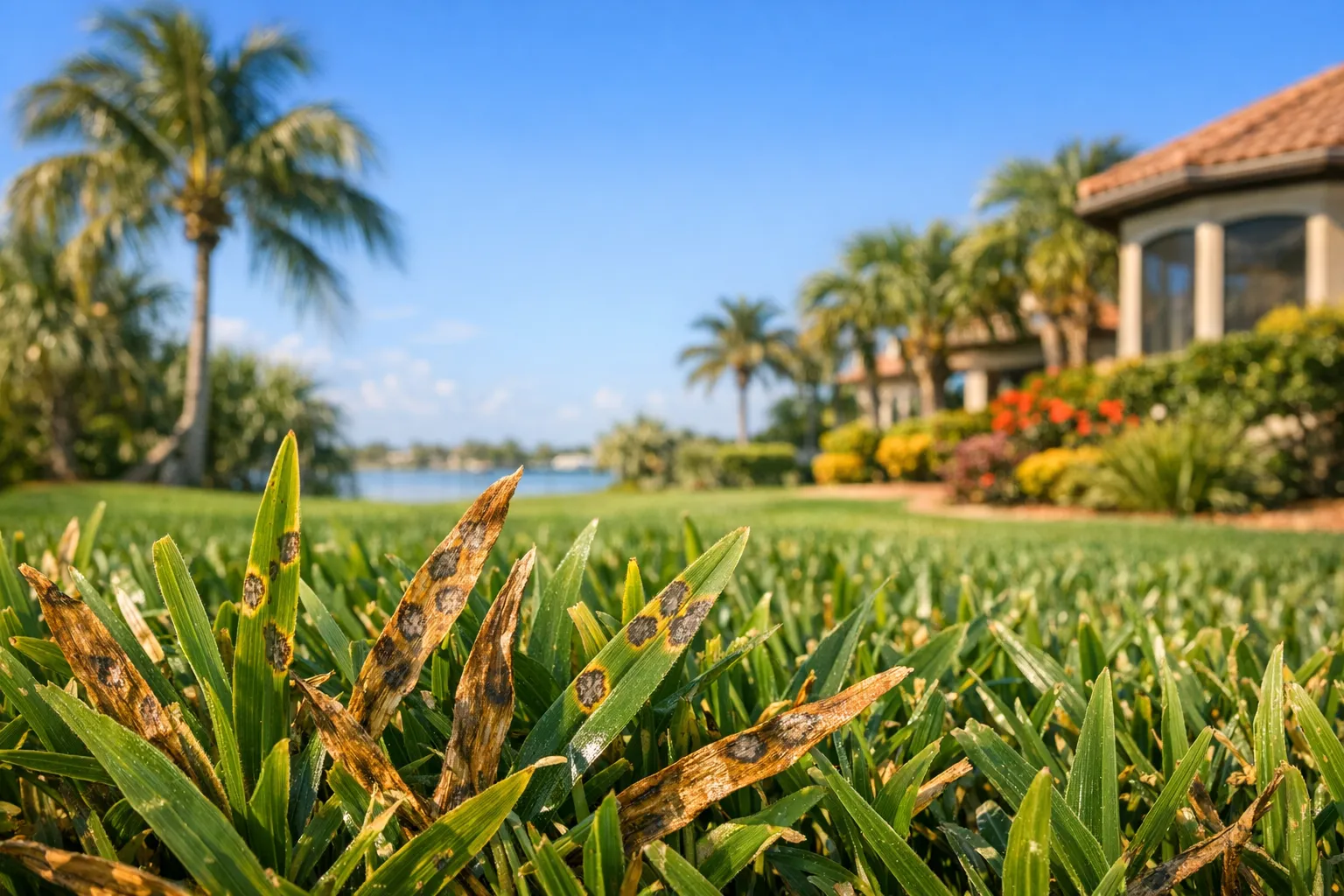
The disease shows up first on the leaf blades. According to UF/IFAS, the lesions are oblong with straw-colored centers and a dark, necrotic border around the edge, and they appear on the blades, the leaf sheaths, and the stolons. Before the fungus starts producing spores, those spots read more olive-green to brown. Look closely at a bad patch and you’ll find dozens on a single shoot.
Step back and the whole stand looks unwell. UF/IFAS describes affected St. Augustine as turning chlorotic and thin with a generally unthrifty appearance, which is the polite way of saying it looks like it’s dying of thirst. Because it mimics drought stress, people reach for the hose, and that keeps the blades wet and makes the disease worse.
What to look for on the blade, per UF/IFAS EDIS:
- Oblong lesions. Straw-colored centers ringed by a dark, necrotic border.
- An olive-green cast. Spots read olive-green to brown before the fungus produces spores.
- Thin, unthrifty turf. Stands turn chlorotic and thin, looking drought-stressed from a distance.
- Worst on new sod. The disease slows grow-in on recently sodded or sprigged St. Augustine.
The timing tracks our rainy season. UF/IFAS notes that warm, rainy spells from roughly May through September regularly leave grass wet for 12 hours or longer with humidity above 95 percent, and that long stretch of leaf wetness is what lets the fungus infect and spread.
Seasonal pressure
Gray leaf spot pressure through a SWFL year
- Winter Dec–FebLower
Cooler, drier air keeps leaf wetness short.
- Spring Mar–MayBuilding
Warmth returns and the first rains lengthen leaf wetness.
- Summer Jun–SepPeak
Daily storms and warm nights leave blades wet for 12+ hours.
- Fall Oct–NovActive
Still warm; pressure eases as the rains taper off.
Summer runs hottest. General SWFL pattern based on UF/IFAS EDIS notes on warm, rainy May–September conditions.
Why St. Augustine, and why fresh sod gets hit hardest
If you’ve got St. Augustine, this disease has your name on it. UF/IFAS reports that in Florida it’s the only warm-season turfgrass gray leaf spot bothers with, and St. Augustine is what most Bradenton yards are carpeted in.
New sod is the most vulnerable of the bunch. UF/IFAS points out that the disease slows the grow-in of freshly sprigged or sodded St. Augustine and drags out the establishment phase, so those brand-new lawns going in around the growing developments east of town are prime targets in their first summer. Lawns that have been pushed hard with fertilizer are in the same boat. The fungus does its best work on soft, fast growth, and UF/IFAS warns specifically against forcing flushes of lush growth during the rainy season.
The two moves that make it worse
Most bad gray leaf spot traces back to two well-meaning habits.
The first is evening irrigation. Run the sprinklers at dinnertime or overnight and the blades stay wet through the dew period and into the next morning, which is a long, comfortable window for the fungus. UF/IFAS is blunt about the fix: water in the early morning, roughly 2 a.m. to 8 a.m., so the sun dries the grass quickly, and skip the late-afternoon and evening cycles.
The second is reaching for quick nitrogen to green up a struggling lawn. It backfires, since soft new growth is exactly what the fungus feeds on. During the summer it is also against the rules. Manatee County’s fertilizer ordinance restricts any fertilizer containing nitrogen or phosphorus from June 1 through September 30 every year, and Sarasota County runs the same restricted season. That window covers the entire rainy stretch, so on a Bradenton lawn nitrogen is off the table for exactly the months gray leaf spot is worst. We broke down exactly what you can and can’t put down in our Manatee County fertilizer guide.
Cultural fixes come first
None of the real fixes come out of a jug. Start here.
- Water in the early morning only. Set the timer for that 2 a.m. to 8 a.m. window UF/IFAS recommends, and run it less often. Sandy Bradenton soil drains quickly, so you’re after dry blades by mid-morning.
- Mow at the tall end of the range for St. Augustine and keep the blade sharp. A clean cut heals faster than a torn one, which gives the fungus an easy entry.
- Keep clippings off driveways and out of the street so they don’t wash into storm drains, which the county ordinance requires anyway.
- Ease off anything that stresses the grass in the heat. UF/IFAS warns that some herbicides applied when it’s above the mid-80s can stress St. Augustine and worsen gray leaf spot, so hold those for cooler, drier weather.
Pro tip: Set a small can under your sprinklers, run a normal cycle, then check the lawn late morning. If the blades are still wet after 10 or 11 a.m., your schedule is keeping the canopy wet long enough for the fungus to move. Shift everything into that early-morning window and water deeply but less often.
Before you treat anything, make sure it’s actually gray leaf spot. Thinning, browning St. Augustine in summer can also be drought stress or insect damage like chinch bugs, and each one calls for a different response. Pull a few affected blades and look for those oblong, dark-bordered lesions. If the blades come up clean, you’re likely chasing something else. The moves that backfire are the obvious ones. More water keeps the canopy wet, and a shot of nitrogen pushes the growth the fungus wants while breaking the county ordinance. Spraying a random bottle before you know the cause usually just wastes money.
When a fungicide program makes sense
Cultural fixes carry most home lawns. UF/IFAS notes that in established, well-kept St. Augustine, gray leaf spot tends to be chronic background noise that doesn’t do lasting damage unless the grass is already stressed. Where it turns serious, spreads quickly, or keeps returning, UF/IFAS recommends bringing in a professional lawn care firm rather than improvising a spray program.
Two things are worth knowing about fungicides. They do more good applied as a preventive during disease-favorable weather than as a rescue after half the lawn is gone. And the fungus can build resistance to a single class of chemistry, so a proper program rotates between different modes of action instead of leaning on one. That rotation is what keeps a program working through the season rather than letting the fungus outrun it.
If you try a homeowner product, read and follow the label to the letter and keep it out of reach of children and pets. Nail down the diagnosis first, because the wrong product on the wrong problem is money down the storm drain.
Cost depends on the size of the lawn and how far the disease has spread, so I won’t throw a number at you. For a straight answer on your yard, reach out through our contact page or see how we handle lawn care in Bradenton.
What recovery actually looks like
Recovery isn’t instant, and most of it waits on the weather.
For the first week or two after you fix the watering, the existing spots will still be there. Lesions already on a blade don’t heal; the grass has to grow past them. What you’re watching for is the disease to quit spreading to new tissue, which is the first sign the cultural changes are landing.
Over the following weeks, as leaf-wetness periods shorten and the grass isn’t being pushed with nitrogen, fresh growth comes in clean. St. Augustine spreads by runners, so thin patches fill from the edges as the stolons creep back across bare ground. In a healthy stand that happens on its own once the pressure eases.
The timeline stretches when the rain won’t let up or the lawn was thin to begin with, and a badly melted-out area can take into the fall to knit back together. A spot that stays bare and mushy long after you’ve corrected the conditions is your cue that something else is going on, and it’s worth a professional look.
Frequently Asked Questions
Is gray leaf spot the same thing as drought stress?
From the porch they look almost identical, which is why so many people misread it. The giveaway is on the blade. With drought the grass just looks uniformly dull and folded. Gray leaf spot leaves the oblong, dark-bordered lesions UF/IFAS describes, so pull a few blades and look closely before you decide.
Can I just water more to bring it back?
Watering more is usually the move that makes it worse, since extra moisture keeps the blades wet and hands the fungus a longer window. Shift to the early-morning schedule UF/IFAS recommends and water less often. The dry look is the disease talking, so more water just drags the problem out.
Will my St. Augustine come back after gray leaf spot?
In a healthy, well-managed lawn it usually does, once you fix the conditions and the rainy pattern breaks. St. Augustine fills its thin areas back in with runners over the following weeks. A lawn that was already stressed, or a patch that melted out completely, takes longer and sometimes needs a pro to work out what’s still holding it back.
Get ahead of it
You can knock most of gray leaf spot down with a smarter watering schedule and some patience through the wettest part of the year. If yours is spreading faster than you can manage, request a quote or see how we approach lawn care in Bradenton, and we’ll help you get on top of it.