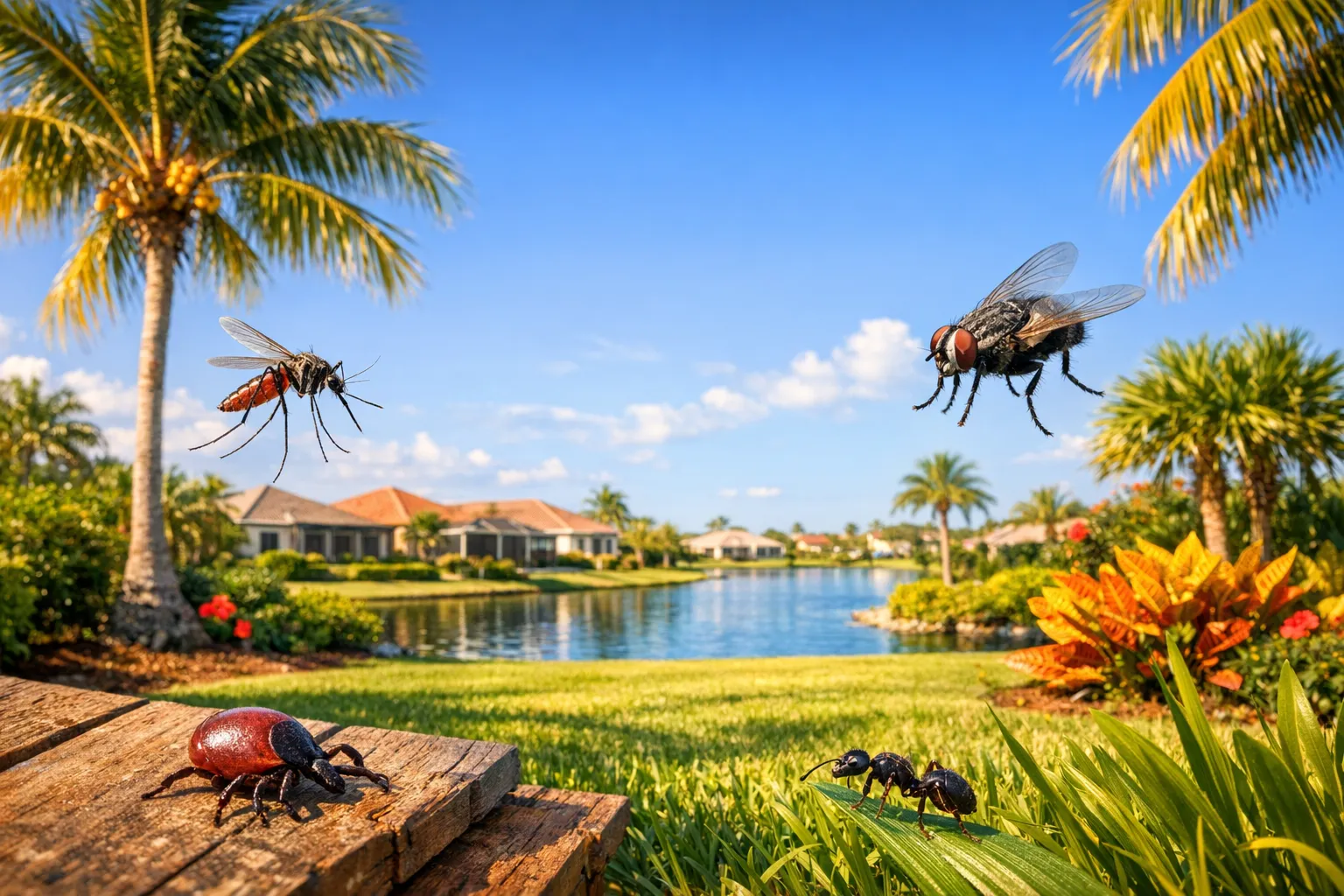
If you’ve ever stepped outside for the mail in Florida and come back looking like you lost a bar fight, welcome to the club. Between the mosquitoes, no-see-ums, fire ants, chiggers, and the occasional yellow fly built like a flying steak knife, Florida runs a full-service biting-bug economy — and your ankles are the customer.
The good news: most of what’s biting you falls into a short list of usual suspects, and once you can tell them apart you can actually do something about them. This guide walks the pest library lineup of Florida’s most common biters, why your Southwest Florida yard is basically an all-you-can-eat buffet, and where the DIY playbook stops and a pro should start. If the bites are already ruining your evenings, you can jump straight to a plan on our pest control services page or price it out with the pest control calculator.
The Florida biting-bug lineup
Different bugs, different bite patterns, different fixes. Skim through and match what’s happening to your legs.
Mosquitoes
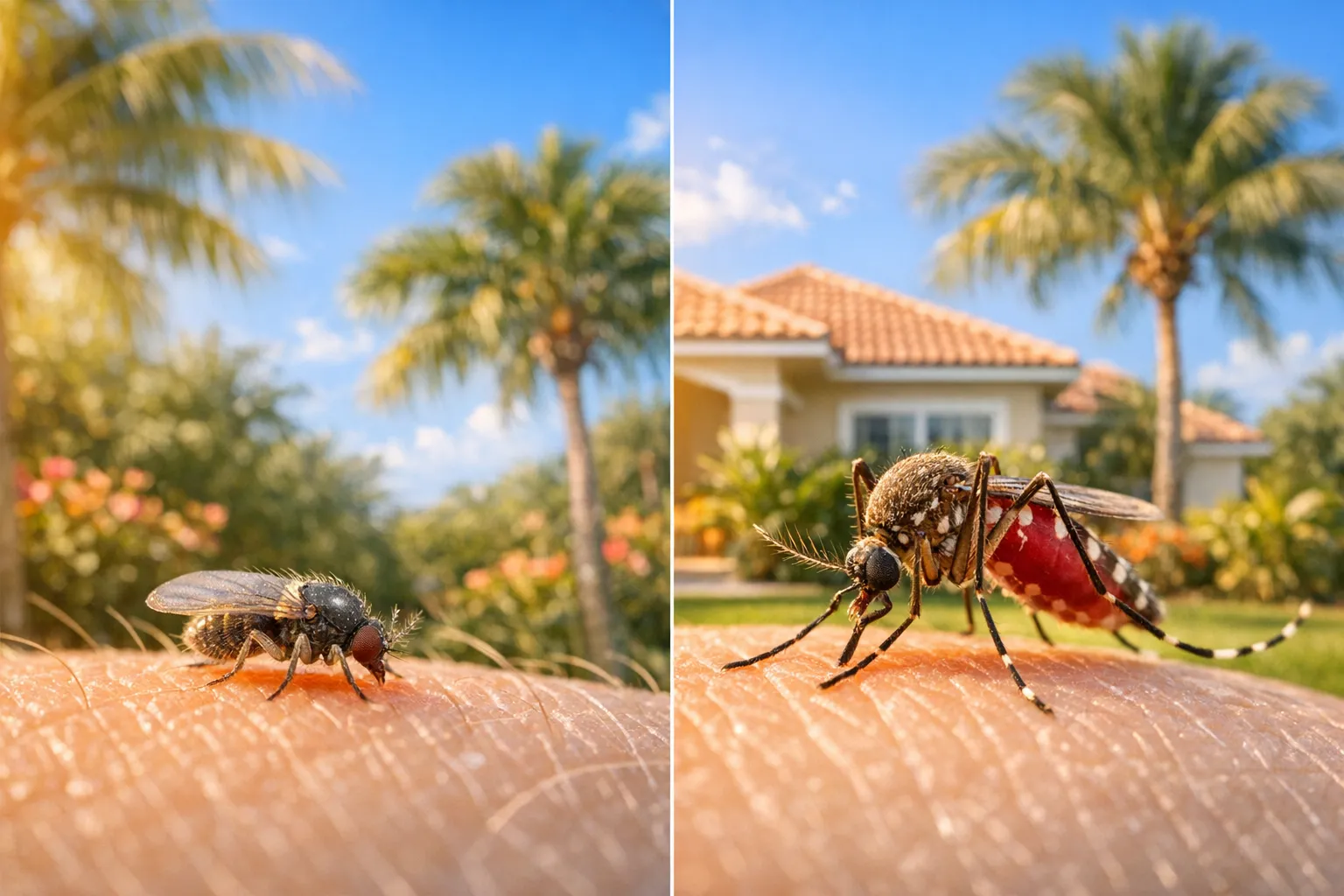
The headliner. In SWFL you’re mostly dealing with Aedes aegypti and Aedes albopictus (day-biting, ankle-loving, container breeders) plus Culex species that dial up at dusk. Bites are puffy, itchy, and usually solo — one welt per landing. Aedes in particular love breeding in the tiniest scraps of standing water: a bottle cap, a bromeliad axil, the saucer under a potted hibiscus. Peak pressure runs May through October, but shaded, irrigated, or water-adjacent yards can push mosquitoes year-round.
No-see-ums (biting midges)
If you feel a bite but literally cannot see the bug, it’s a no-see-um — a Culicoides biting midge. They’re about a millimeter long, punch way above their weight, and swarm at dawn and dusk near brackish water, mangroves, and damp mulch. The bites are tiny red dots that show up in clusters and itch for days. Screened lanais are supposed to keep them out; most standard screen mesh does not. If you’re getting eaten alive on the lanai in Sarasota or on the beach in Venice around sunset, it’s almost always these.
Fire ants
Red imported fire ants (Solenopsis invicta) build the loose, fluffy dirt mounds you’ll find popping up in the yard after an afternoon storm. Step on one and you get a swarm of stings, not one — dozens of ants sting in unison, each leaving a burning welt that turns into a small white pustule 24 hours later. Fire ants aren’t shy in sandy Florida soil; a single colony can throw multiple mounds after heavy rain.
Chiggers
The “I didn’t feel anything and now my sock line is on fire” bugs. Chiggers are larval mites that hang out in tall grass and leaf litter, hitch a ride on your ankles, and feed on skin cells. You’ll get itchy red bumps in a tight band wherever clothing was snug — sock tops, waistband, behind the knees. They don’t burrow (that’s a myth), but the itch can hang around for a week.
Yellow flies, deer flies, horse flies
Big, aggressive, day-flying flies that hurt when they land. Yellow flies (a Florida specialty from May through July) will chase you across the yard. The bite is a sharp jab followed by a bleeding puncture — very different from a mosquito welt. Common near wooded edges, ponds, and pastures.
Fleas and ticks
Not just a pet problem. Cat fleas will bite humans around the ankles when populations get out of hand, and Florida’s warm, sandy yards let them cycle year-round. Ticks in SWFL — mostly lone star, brown dog, and Gulf Coast ticks — hitch on from tall grass and drop onto pets or people.
Seasonal pressure
Southwest Florida pest pressure through the year
- Spring Mar–MayBuilding
Warming weather wakes colonies up — activity climbs week over week.
- Summer / rainy season Jun–AugPeak
Heat + humidity + standing water = the year’s heaviest pressure.
- Hurricane season Sep–OctSurge
Storms and flooding push pests indoors looking for dry shelter.
- Fall NovActive
Cooler nights slow things down, but activity stays well above zero.
- Winter Dec–FebLower (not zero)
Our mild winters keep many pests going year-round indoors.
Summer / rainy season & Hurricane season run hottest. Biting-bug pressure in Southwest Florida — mosquitoes and no-see-ums lead the year, but fire ants surge after storms and yellow flies own early summer.
Why your SWFL yard is a biting-bug buffet
Southwest Florida stacks the deck against you in three specific ways:
- Sandy soil drains fast, then holds pockets. Fire ants love loose, well-drained sand for mound-building, and the pockets between roots and irrigation heads trap enough moisture for mosquito and midge larvae. You don’t need a pond — a bromeliad, a clogged gutter, or a low spot in the St. Augustine is plenty.
- Afternoon storms reset the clock. A single 20-minute downpour refills every container on the property and softens the ground for a fresh wave of fire ant mounds. That’s why populations look controlled on Monday and terrible by Thursday.
- Everything grows year-round. Warm, humid, rarely-a-hard-freeze means most biting insects have overlapping generations. Where the rest of the country gets a winter reset, we get a slower shoulder season and then straight back to peak.
Add in mangrove edges along the coast, retention ponds behind subdivisions, and irrigation cycles keeping the turf wet, and you’ve built a nearly perfect biting-bug habitat without meaning to.
Your home, zone by zone
Where we inspect & treat
A typical Southwest Florida home — the numbered zones a local tech walks on every visit.
- Foundation perimeter Exterior barrier band — the first line where pests cross in from the yard.
- Entry points (doors/windows) Thresholds and frames where ants and roaches slip indoors.
- Eaves & soffits Up under the roofline where wasps and spiders like to nest.
- Weep holes Block-wall gaps that let pests behind the brick veneer.
- Garage corners Dark, cluttered edges spiders and roaches favor.
- Lanai & screen cage The classic SWFL hot spot for spiders, midges and palmetto bugs.
- Mulch beds & turf edges Damp landscaping that harbors ants, fleas and chinch bugs.
- Interior baseboards Where indoor crawlers travel along the wall line.
- Kitchen & bath plumbing gaps Pipe penetrations roaches and ants use to move room to room.
- Attic Top of the home — checked for rodent runs and nesting.
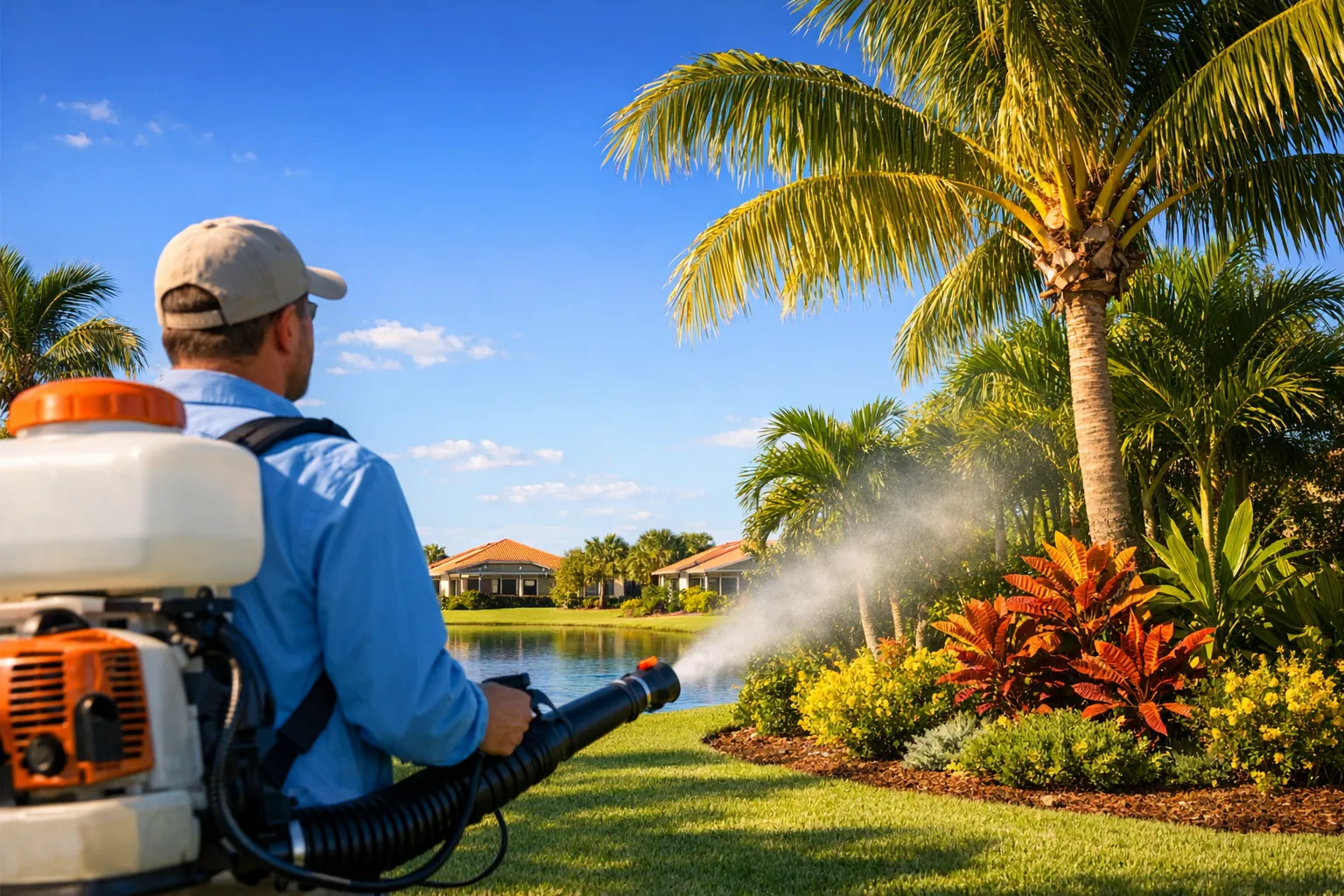
The zones a Waves tech actually works on a biting-bug service — harborage around the foundation, mulch beds, irrigation, standing-water sources, and turf edges.
What you can safely do yourself
Before we get to the pro side, there’s a real DIY playbook — and it’s mostly boring, unglamorous habitat work that punches above its weight.
- Dump anything holding water once a week. Saucers under pots, kids’ toys, tarps, wheelbarrows, boat covers, clogged gutters. Aedes mosquitoes can breed in a bottle cap; if you flip standing water every seven days, you break the cycle.
- Empty and refresh birdbaths and pet bowls. Not “top off” — dump and rinse.
- Cut back overgrown vegetation next to the house. Adult mosquitoes and no-see-ums rest in shaded, humid foliage during the day. Trimming shrubs off the wall and mowing tall grass around the fence line reduces the resting habitat where they hide between meals.
- Keep the St. Augustine mowed to the higher end of its range (3.5–4 inches) — that’s healthier for the turf and doesn’t create the tall-grass ambush zones chiggers and ticks love.
- Skip the bug zapper. They’re extremely effective at killing moths and beetles that were minding their own business, and mostly useless against mosquitoes and no-see-ums.
- On lanais getting eaten alive at dusk, a box fan pointed at seating height is a shockingly effective no-see-um deterrent — they’re weak fliers and give up in moving air.
Pro tip: walk the property with your phone flashlight after a storm. The night after a heavy afternoon rain is when fire ants rebuild mounds and Aedes eggs hatch out. A five-minute lap with a flashlight to spot fresh mounds, dump standing water, and flag wet low spots is the single highest-ROI thing you can do between service visits. Mark problem spots on your phone and your tech (or you) can hit them next round.
When to call in a pro — and how Waves handles it
DIY habitat work handles the easy 60%. For the rest — established fire ant colonies throwing multiple mounds, mosquito pressure that survives your source reduction, midges hammering the lanai every evening — you’re into product and protocol territory, and that’s where we come in.
A real biting-bug plan is not one product sprayed on one day. On a WaveGuard membership, a Waves tech will:
- Inspect and eliminate breeding sources first (larvae are cheaper to kill than adults, and the math isn’t close).
- Larvicide standing water that can’t be drained — retention edges, tree holes, bromeliads — with materials like Bti dunks or IGR briquets that are targeted to mosquito larvae and safe around non-target wildlife.
- Barrier-treat resting vegetation around the foundation, fence lines, and shaded landscape where adult mosquitoes and midges spend the day. Product choice depends on species and label — no one-size-fits-all spray.
- Treat fire ant mounds directly and follow up with a non-repellent bait broadcast so surviving colonies don’t just relocate 15 feet over.
- Come back on a schedule that matches SWFL pressure, not a Midwest quarterly cadence that ignores our May–October surge.
We’re deliberately not going to promise you a bite-free yard — anyone who does is selling you something. What good service does is knock population pressure down to the point where you can actually use your lanai again.
Want an idea of what recurring pest service runs for your specific property before you talk to anyone? Skip the guessing game and use the pest control calculator.
Frequently Asked Questions
What are the tiny bugs biting me in Florida that I can’t see?
Almost certainly no-see-ums — biting midges in the genus Culicoides. They’re around a millimeter long, most active at dawn and dusk, and common anywhere near brackish water, mangroves, or damp mulch. Standard lanai screen mesh doesn’t stop them; a running fan at seat height is the easiest at-home fix, and a real barrier-and-source treatment is the professional one.
How do I tell a mosquito bite from a no-see-um bite from a chigger bite?
Mosquito bites are usually single puffy welts that show up right away. No-see-um bites come in clusters of tiny red dots and get itchier over 24–48 hours. Chigger bites appear in a tight band where clothing was snug (sock line, waistband) and are intensely itchy for several days. Fire ant stings are their own thing — a burning cluster of white pustules that shows up within a day of stepping on a mound.
Do I need year-round pest service in Southwest Florida, or just in the summer?
For biting bugs specifically, peak pressure runs May through October, but SWFL doesn’t get a hard winter reset — mosquitoes, ants, and midges all keep breeding at reduced levels through the “cool” months. Year-round service keeps population baselines low so the summer surge doesn’t start from zero. If budget is the constraint, at minimum don’t skip April (pre-surge knockdown) or the first service after a tropical system.
Stop swatting, start fixing
If the biting is bad enough that you’re reading blog posts about it at 10pm, it’s bad enough to fix. Get a Southwest Florida tech who actually knows the difference between an Aedes breeding site and a Culex resting site on the property — book a Waves pest control service or call us at (941) 297-5749 and we’ll walk the yard with you.