You’re standing on the lanai, slapping at your ankles, trying to decide between two very different fixes: a technician who sprays your yard every three weeks, or a permanent system that mists on its own every single day. Both knock down adult mosquitoes. They just do it on completely different rhythms, at completely different price points, and neither one is the automatic right answer.
This is the honest version, not the sales-pitch version. If you already know you want the equipment, see our mosquito misting systems page for how we design, install, and maintain one. If you’re still deciding, keep reading.
Barrier treatment: a technician visit every 21 days
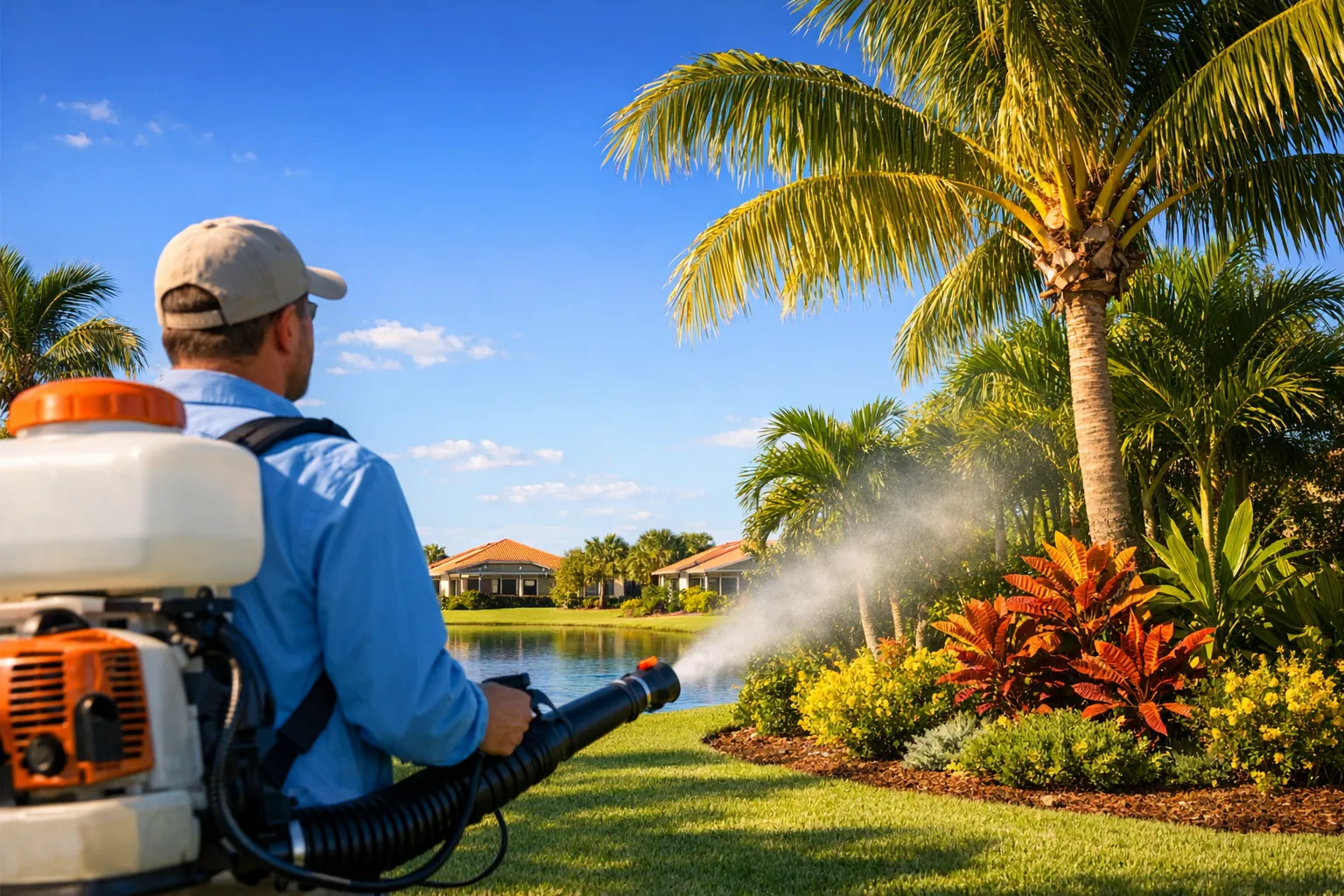
Barrier treatment is the older, simpler model. A licensed technician walks your property on a 21-day cycle and sprays the places adult mosquitoes actually rest during the day — the undersides of shrub leaves, shaded fence lines, mulch beds, anywhere shielded from direct sun and wind. The product leaves a residual on that foliage, so mosquitoes that land there between visits pick up a dose and die.
There’s nothing to install. No equipment on the side of your house, no tubing behind the beds, no controller to program. You schedule the visit, the tech treats the resting sites, and you’re covered until the next one. For most Southwest Florida yards — a typical lot without a pool cage full of entertaining space — that 21-day rhythm handles the bulk of the pressure without any up-front cost.
The tradeoff is the gap. Rain washes residual off faster than dry weeks do, new mosquitoes can blow in from a neighboring canal or retention pond between visits, and the protection isn’t uniform day to day — it’s strongest right after a treatment and tapers as the cycle goes on.
Misting systems: permanent equipment that sprays itself
A misting system flips the model. Instead of a person showing up every three weeks, you install permanent nozzles — typically about every 10 feet along eaves, fence lines, and landscape beds — plumbed to a pump unit in a locked cabinet. A controller fires short automatic cycles, usually right around dawn and dusk when mosquitoes are most active, each cycle lasting roughly 30 to 60 seconds.
Because it’s automatic, the protection is on the same daily schedule whether or not anyone remembers to call for a visit. That consistency is the entire selling point: typically two cycles a day, aimed at the specific zones you actually use — and a scheduled cycle should be paused when rain, fog, wind over 10 mph, or temperatures below 50°F make spraying inappropriate, either by an optional weather sensor where one is installed or from the app.
| What you're weighing | Barrier treatment | Misting system |
|---|---|---|
| Up-front cost | None — pay per visit | Equipment and installation |
| Protection cadence | Residual between visits every 21 days | Short automatic cycles, typically twice daily (paused for bad weather by sensor or app) |
| What's installed | Nothing | Nozzles, tubing, pump unit, controller |
| Ongoing commitment | Recurring visit, no equipment to maintain | Monthly refill/check plus quarterly nozzle cleaning |
| Best fit | Most yards, especially without heavy outdoor use | Pools, lanais, outdoor kitchens, frequent entertaining |
| Failure mode | A missed or delayed visit widens the gap | Clogged nozzles from scale or biofilm reduce output |
Barrier treatment vs. misting system — a category comparison, not a ranking. Neither eliminates mosquitoes entirely.
Maintenance is where the two really diverge
Barrier treatment has almost no maintenance burden on your end — you don’t own anything. A misting system does. It’s mechanical equipment sitting outside in Florida heat, salt air, and hard water, and the single most common failure we see is clogged nozzles. Drum-tank units can build up biofilm in the mixed solution, and hard-water scale collects in the lines over time; either one throttles or blocks a nozzle so it sprays a weak mist — or nothing at all — while the controller still fires on schedule and you assume it’s working. Tankless units, which draw solution straight from a sealed container instead of a mixed drum, and inline filtration cut down on this substantially, which is why every install gets inline filtration, tankless units are offered where they fit the property, and every nozzle gets cleaned quarterly on the service plan.
The practical takeaway: a misting system is only as good as its upkeep. Skip the cleaning cycle and you’re paying for equipment that’s quietly underperforming.
Which one actually fits your yard
Barrier treatment is the right first answer for a lot of homes — a standard yard without a lot of outdoor living space, a renter who can’t install equipment, or anyone who wants mosquito control with zero commitment beyond the recurring visit. If that’s you, our 21-day barrier treatment program is the simpler, lower-commitment option, and we’ll tell you that up front instead of steering you toward equipment you don’t need.
A misting system earns its keep on properties built around outdoor living: a pool deck people use daily, a screened or open-air lanai, an outdoor kitchen, a yard that hosts regular gatherings. If you’re outside enough that a 21-day gap in coverage is a real quality-of-life problem — not just an occasional annoyance — the daily automatic cycle solves a problem barrier treatment structurally can’t.
Products used in misting systems must be labeled for the job
One safety note worth knowing before you compare further: per the EPA, “the label is the law” for any pesticide used in a misting system — the product has to be specifically labeled for that use, and it has to be applied exactly as the label directs (see the EPA’s mosquito misting systems guidance). If you want the full rundown on placement, timing, and what EPA and the American Mosquito Control Association say about automatic misting, we cover that separately in are mosquito misting systems safe?
Many yards do best with both
This isn’t always an either/or choice. Misting knocks down adult mosquitoes resting or flying through the treated zone — it does nothing to larvae developing in standing water, and it can’t reach a canal or retention pond breeding population a few hundred feet away. A misting system paired with larvicide treatment for water features you can’t drain, plus routine standing-water reduction (gutters, saucers, anything that holds rainwater for more than a few days), covers the life cycle instead of just the adults you can see. Barrier treatment can layer in too, especially around the property edges a misting system’s nozzle layout doesn’t reach.
Frequently Asked Questions
Is a mosquito misting system better than barrier treatment?
Neither is universally better — they solve different problems. Barrier treatment gives most yards solid protection with zero installed equipment. A misting system gives daily automatic protection to properties built around outdoor living, at the cost of installing and maintaining equipment. Pick based on how much time you actually spend outside and how much of a gap a 21-day cycle leaves for you.
Can I have both a misting system and barrier treatment?
Yes, and for some properties it’s the right call — a misting system covers the daily-use zones automatically, while barrier treatment or standing-water/larvicide work addresses the parts of the property or the mosquito life cycle the misting nozzles don’t reach.
Does a misting system replace dealing with standing water?
No. Misting kills adult mosquitoes in the sprayed zone; it has no effect on larvae developing in standing water. Removing or treating standing water is still part of any real mosquito program, misting system or not.
How often does a barrier treatment technician come?
Every 21 days. That cadence is built around how long the residual on treated foliage stays effective before it needs to be reapplied.
What’s the most common reason a misting system stops working well?
Clogged nozzles — usually from biofilm buildup in a mixed drum tank or hard-water scale in the lines. Tankless units and inline filtration reduce this, and routine nozzle cleaning catches it before you notice a drop in coverage.
Compare Both Options for Your Yard
Not sure which one fits your property? A free on-site design visit covers both options — we’ll walk your yard, point out where mosquitoes actually rest, and lay out the barrier treatment and misting system paths side by side so you can compare real numbers instead of guessing. See the full mosquito misting systems page for how the equipment and service plan work, or the 21-day barrier treatment program if that’s the simpler fit.
Sources: U.S. Environmental Protection Agency, Mosquito Misting Systems.