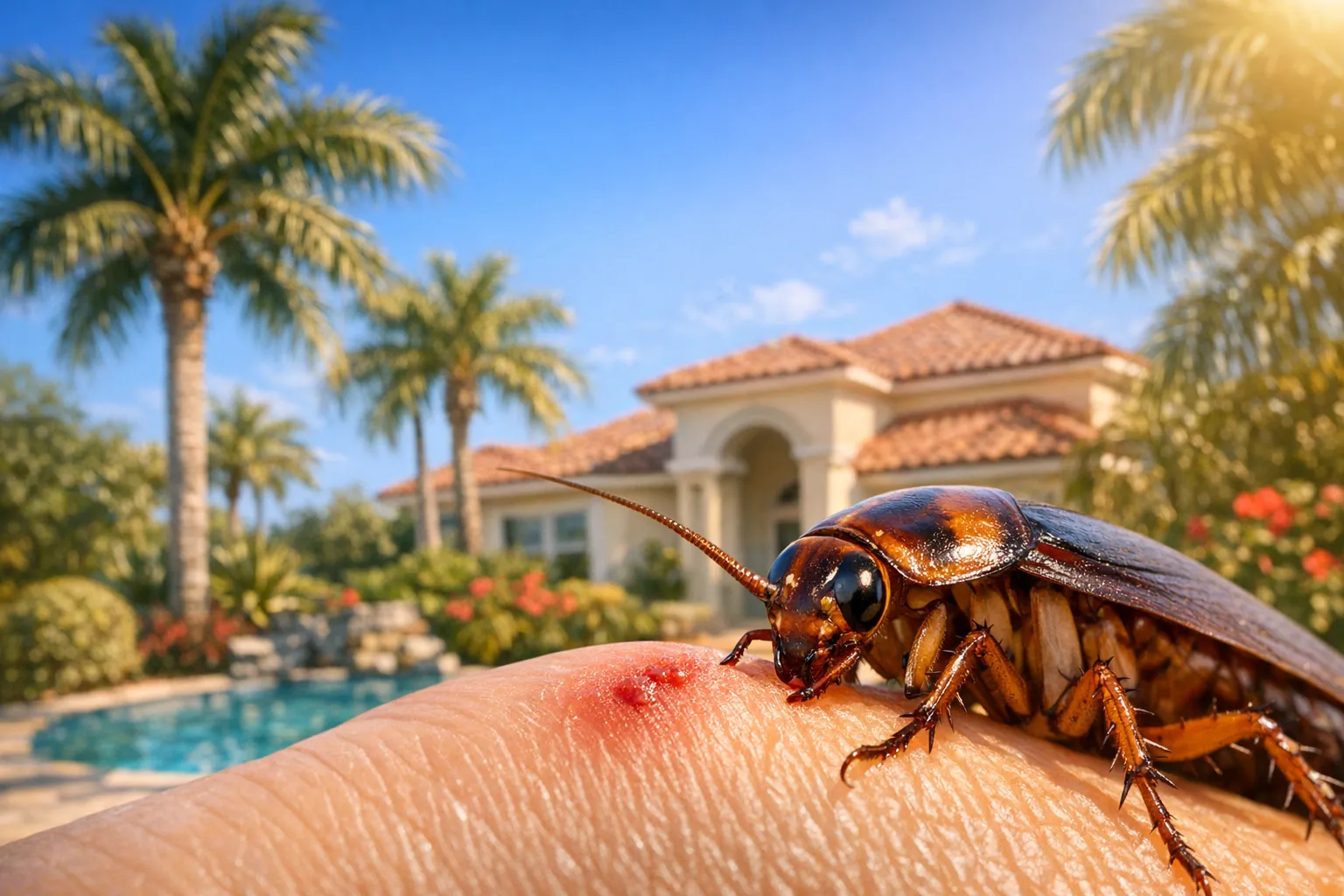
Short answer: yes, cockroaches can bite people — but it’s rare, it usually means something has gone very wrong in the house, and if you’re finding mystery bumps on your arms every morning, roaches are almost never the culprit. That’s the honest, non-clickbait version.
Now the longer version, because if you live in Southwest Florida you’ve seen a palmetto bug the size of a AA battery skitter across your lanai at 10pm and wondered, reasonably, whether that thing is going to gnaw on your ankle tonight. Let’s walk through what the science actually says, how to tell a real cockroach bite from bed bugs / mosquitoes / a rogue ant, and what to do about the roach pressure that comes standard with sandy soil, afternoon storms, and a St. Augustine lawn hugging your foundation. If you’d rather skip the reading and just get a tech out to look, you can check pricing on our calculator or see the full list of pest services we run.
The short answer: yes, but almost never to you
Every major entomology source agrees on the same basic point: cockroaches are capable of biting humans, and they occasionally do, but it’s uncommon and tied to specific conditions. UF/IFAS notes that German cockroaches, “in extremely heavy infestations have been reported to bite humans and feed on food residues on the faces of sleeping humans.” That’s the ceiling — not the norm. The norm is roaches sprinting away from you the second the kitchen light flips on.
Why so rare? A few reasons:
- You’re not on the menu. Roaches are scavengers. They want grease, crumbs, pet food, cardboard glue, and the sludge behind your dishwasher. Human skin is a last resort.
- Their mouthparts aren’t built for it. Cockroach mandibles are chewing jaws adapted for scavenging soft, decaying food — not the piercing proboscis of a mosquito or the stylets of a bed bug, which are purpose-built for feeding on a living host. When roach bites do get reported, they’re described as minor skin wounds rather than deep punctures — though any broken skin can still get infected (more on that below).
- They’re skittish. Roaches are nocturnal and light-averse. A moving, breathing human is basically a predator to them.
The exceptions are the exceptions for a reason: ships, prisons, and homes with severe, long-running infestations where the roach population has outgrown its food supply. If you’re at that stage, biting is the least of your problems.
Not sure what stage you’re at? Get a quote from Waves — we’ll tell you straight, no upsell theater.
Which roaches in SWFL actually bite (and which ones just look scary)
Southwest Florida is a roach buffet. The warm, humid climate means we get German, American, Australian, smokybrown, brown-banded, Asian, and Florida woods cockroaches all sharing our zip codes. Here’s who’s actually documented biting people:
| Species | Bite risk | Where you'll see them |
|---|---|---|
| German cockroach | Highest — indoor, close-to-people species | Kitchens, bathrooms, apartments, restaurants |
| American (palmetto bug) | Documented but rare — needs extreme density | Sewers, garages, mulch beds, wall voids |
| Australian cockroach | Documented but rare — similar profile to American | Landscape, tree cavities, occasional indoor |
| Smokybrown | Very rare — exterior, moisture-driven | Attics, soffits, palm fronds, gutters |
| Florida woods roach | Essentially none — outdoor scavenger | Leaf litter, wood piles, palmettos |
Bite risk by species — the vast majority of SWFL homeowners will never see a bite from any of these.
The species you see running across your Sarasota patio at night is usually a “palmetto bug” — most often an American or a smokybrown cockroach, though Asian cockroaches also fly toward lights on warm evenings. Any of these can bite, but they very rarely do. They live in your mulch, your storm drain, your palm boots — not on you. German cockroaches are the ones to actually worry about, because they live indoors, breed fast, and are the species most commonly linked to bite reports.
What a cockroach bite actually looks like
A roach bite typically shows up as a small red bump — often described as a raised welt somewhere in the 1–4 mm range, larger than a mosquito bite, appearing individually rather than in clusters. That isolated pattern is suggestive rather than diagnostic, though: bed bug, flea, and mosquito reactions overlap a lot, so don’t identify the pest from the skin mark alone — look for physical pest evidence or get an inspection. Common bite spots when they do happen: fingernails, eyelashes, lips, hands, feet — anywhere there’s food residue or dead skin.
Here’s the thing though: bite ID is genuinely hard. Bed bugs, fleas, chiggers, spiders, and even some skin conditions all look similar. If you’re waking up with bites and haven’t seen live roaches, you’re almost certainly dealing with something else — mosquitoes that snuck in during a summer storm, fleas your dog imported from the yard, or bed bugs (which are the actual “bites in your sleep” specialists).
On every inspection
What our techs look for when a customer says 'I think roaches bit me'
- Live sightings at night Turn on the kitchen light after midnight — if you see runners, we have a roach issue.
- Droppings Coffee-ground specks (German) or capsule-shaped pellets (American) near appliances or under sinks.
- Egg cases (oothecae) Small brown capsules glued to cabinet undersides, behind hinges, in warm corners.
- Musty odor Heavy German infestations have a distinct musty, oily smell.
- Grease marks Dark smears along baseboards or entry points where roaches travel repeatedly.
- Bite pattern Isolated red welts on extremities during sleep — but only after ruling out bed bugs and mosquitoes first.
Actual bites are the last thing we check for — the other five signs show up long before biting behavior does.
Why SWFL homes see extra roach pressure
Cockroaches love what makes Florida Florida: warmth, moisture, and shelter. Our sandy soil drains fast but the afternoon storm cycle keeps mulch beds, sod, and slab edges damp for hours after the rain stops. St. Augustine grass right up against the foundation adds harborage. Palms drop fronds and boots that shelter smokybrown roaches five feet from your soffit. Add in tile roofs, block construction with weep holes, and the general SWFL love of screened lanais that are also open to the yard, and you’ve got exterior roach pressure basically year-round.
Seasonal pressure
Southwest Florida pest pressure through the year
- Spring Mar–MayBuilding
Warming weather wakes colonies up — activity climbs week over week.
- Summer / rainy season Jun–AugPeak
Heat + humidity + standing water = the year’s heaviest pressure.
- Hurricane season Sep–OctSurge
Storms and flooding push pests indoors looking for dry shelter.
- Fall NovActive
Cooler nights slow things down, but activity stays well above zero.
- Winter Dec–FebLower (not zero)
Our mild winters keep many pests going year-round indoors.
Summer / rainy season & Hurricane season run hottest. In Southwest Florida, pest pressure eases in winter but never fully stops — that’s why year-round protection beats a seasonal patch.
That’s the short story on why we treat roaches as a year-round issue in Sarasota, Bradenton, Venice, and everywhere in between — not a “summer thing.” Even in January, the palmetto bug moving under your kitchen sink is doing so because the void is warmer and drier than outside.
Safe steps you can take today
Before you call anyone, here’s what actually helps at the homeowner level:
- Fix the moisture. Repair leaky garbage disposals, running toilets, and AC drip pans. Roaches follow water first, food second.
- Seal entry points. Weep holes with mesh, door sweeps on the garage, silicone on plumbing penetrations under sinks. For the clothes dryer, do not cover the exhaust termination with screen or mesh — that traps lint, chokes airflow, and creates an overheating and fire hazard, and mechanical code prohibits it. Use a code-compliant dryer vent hood with a backdraft damper instead.
- Take out the trash nightly. Especially anything greasy or sugary. Store pet food in sealed containers.
- Trim vegetation back from the house. A one-to-two-foot gap between mulch/plants and your exterior wall makes a huge difference for palmetto bug pressure.
- Clean up droppings carefully. Dry roach droppings and debris carry allergens that an ordinary household vacuum can aerosolize and blow straight back out through its exhaust. Use a sealed HEPA vacuum if you have one, or wipe the area down damp with soap and water instead — and wear gloves and a mask if anyone in the house has asthma. Cleaning it up also removes egg cases and the pheromone trails roaches use to recruit friends.
Pro tip: If you have German roaches specifically, do NOT bomb the house with a spray-and-pray fogger. Repellent foggers actually contaminate bait placements and disperse roaches into less accessible harborages like wall voids — you end up with a scattered population that’s harder to reach and a contaminated gel bait that no longer works. Bait-first is the right call, and it’s why our German roach cleanout uses non-repellent gel bait plus an IGR (insect growth regulator) to break the reproduction cycle. Fogger cans undo that work.
When to call a pro
Call us if:
- You’re seeing live German cockroaches during the day (that means the population is big enough it can’t hide anymore)
- You’ve done exclusion + sanitation for two weeks and still see activity
- You’re finding oothecae (egg cases) — a single German cockroach case can hatch 30–40 nymphs (American cockroach cases hold substantially fewer)
- Anyone in the household has asthma; roach allergens are a documented trigger and long infestations are a real health issue
- You’re actually seeing bite marks and can rule out bed bugs
Our approach is species-specific: German roaches get an indoor bait, IGR, and sanitation program with re-treatment as needed between visits, while American / palmetto / smokybrown roaches get treated as an exterior pressure problem with perimeter treatment and exclusion, not indoor spraying. Doing it the other way around is how you end up with a recurring “why do I still see one every week” complaint.
If you want ongoing coverage instead of one-off visits, our general pest plan covers roaches plus the other usual SWFL suspects (ants, spiders, silverfish, the occasional scorpion). If you already run more than one recurring service with us, WaveGuard membership is the bundle discount that applies across any combination of your recurring services — with no separate monthly fee. You can also look up the biology and ID on any of them in our pest library if you’re the “identify it before I kill it” type.
Frequently Asked Questions
Can cockroaches bite you in your sleep?
Technically yes, but it’s rare and almost always German cockroaches in heavily infested homes. If you’re waking up with bites and don’t have visible roach activity — live sightings, droppings, musty smell — bed bugs, fleas, or mosquitoes are far more likely. A pest tech can inspect for the actual source in one visit.
Do palmetto bug bites hurt or spread disease?
Palmetto bug (American cockroach) bites are documented but genuinely uncommon in Florida homes, because these are exterior roaches that only occasionally wander inside. A bite would appear as a red, itchy bump and the main risk isn’t the bite itself — it’s secondary infection from bacteria the roach picked up in a sewer, mulch bed, or dumpster. Wash with soap and water, watch for swelling, see a doctor if it doesn’t settle in a couple of days.
How do I tell a cockroach bite from a bed bug bite?
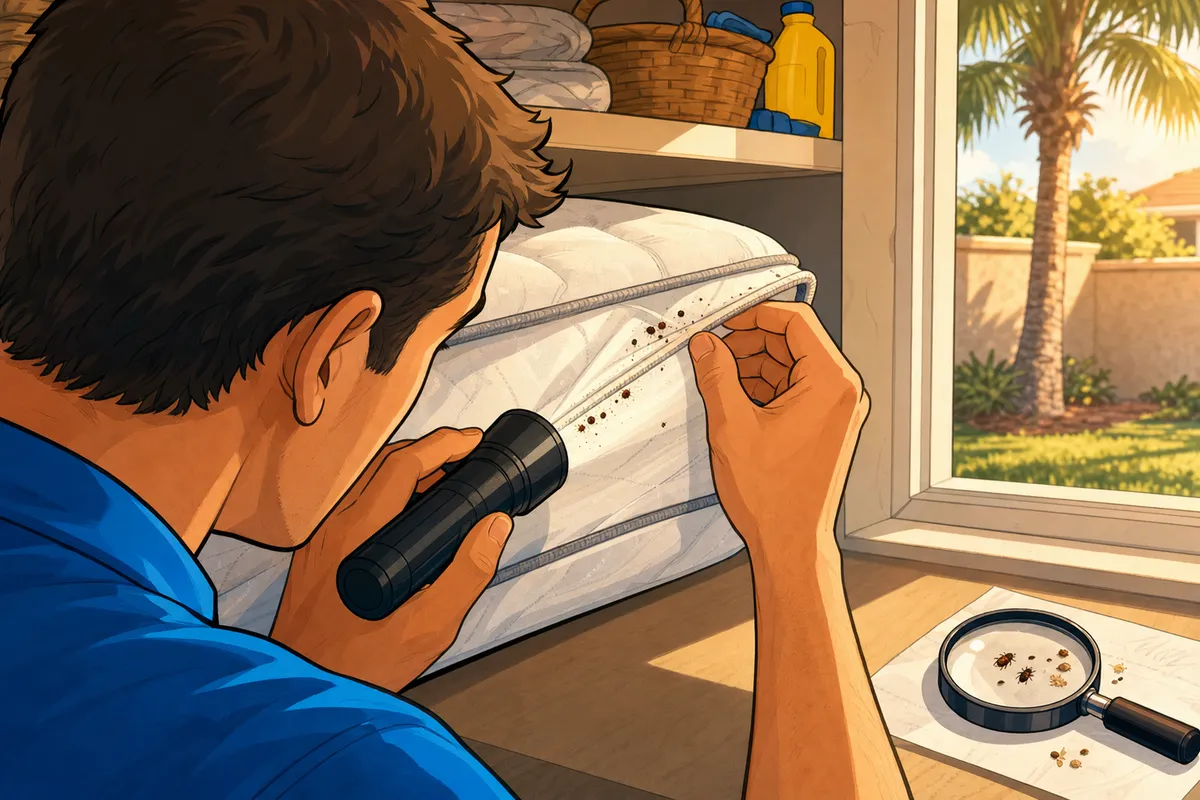
Bed bug bites often appear in clusters or lines of 3+ on exposed skin (arms, shoulders, back), often itchy and showing up in the same spots repeatedly. Cockroach bites tend to be single, isolated welts on extremities (fingers, feet, face). But the pattern alone isn’t diagnostic — reactions from bed bugs, fleas, and mosquitoes overlap a lot. Don’t assume based on skin marks: check for physical bed-bug evidence (blood spots on sheets, shed skins, live bugs along mattress seams) and get an inspection to confirm, since the treatment protocols are completely different.
Bottom line
Cockroach bites are real, but they’re the last thing you should be worried about if you’re seeing roaches in your Sarasota kitchen or Bradenton garage. The allergens, the food contamination, and — with German roaches specifically — the fact that a single visible roach usually means many more hidden in wall voids are much bigger problems, and they’re all solvable. If you want a straight answer on what’s actually happening in your house, get a quote from Waves Pest Control or call us at (941) 297-5749. We’ll ID the species, tell you if bites are actually plausible, and fix the underlying pressure — not just spray a baseboard and leave.