Jump to a section (9)
- 01Side by side: fungus gnat, fruit fly or drain fly
- 02Fungus gnats live in wet potting soil
- 03Fruit flies breed in ripe and fermenting food
- 04Drain flies sit on the bathroom wall
- 05What to look for when small flies show up
- 06Why small flies show up in Southwest Florida homes
- 07What not to do
- 08When to call a professional
- 09Frequently Asked Questions
A fungus gnat is a small, dark, long-legged fly that UF/IFAS says looks more like a tiny mosquito than a common fly. A fruit fly is yellow-brown with red eyes. The fastest way to tell which one you have is where it hangs out: fungus gnats stay around houseplants, while fruit flies go for the fruit bowl and the trash. A third small fly, the fuzzy drain fly, sits on the wall by your sink or shower. For the wider list of household pests we handle, see our pest control services.
Flies still coming after you clear out the source? Get a pest control estimate for your home.
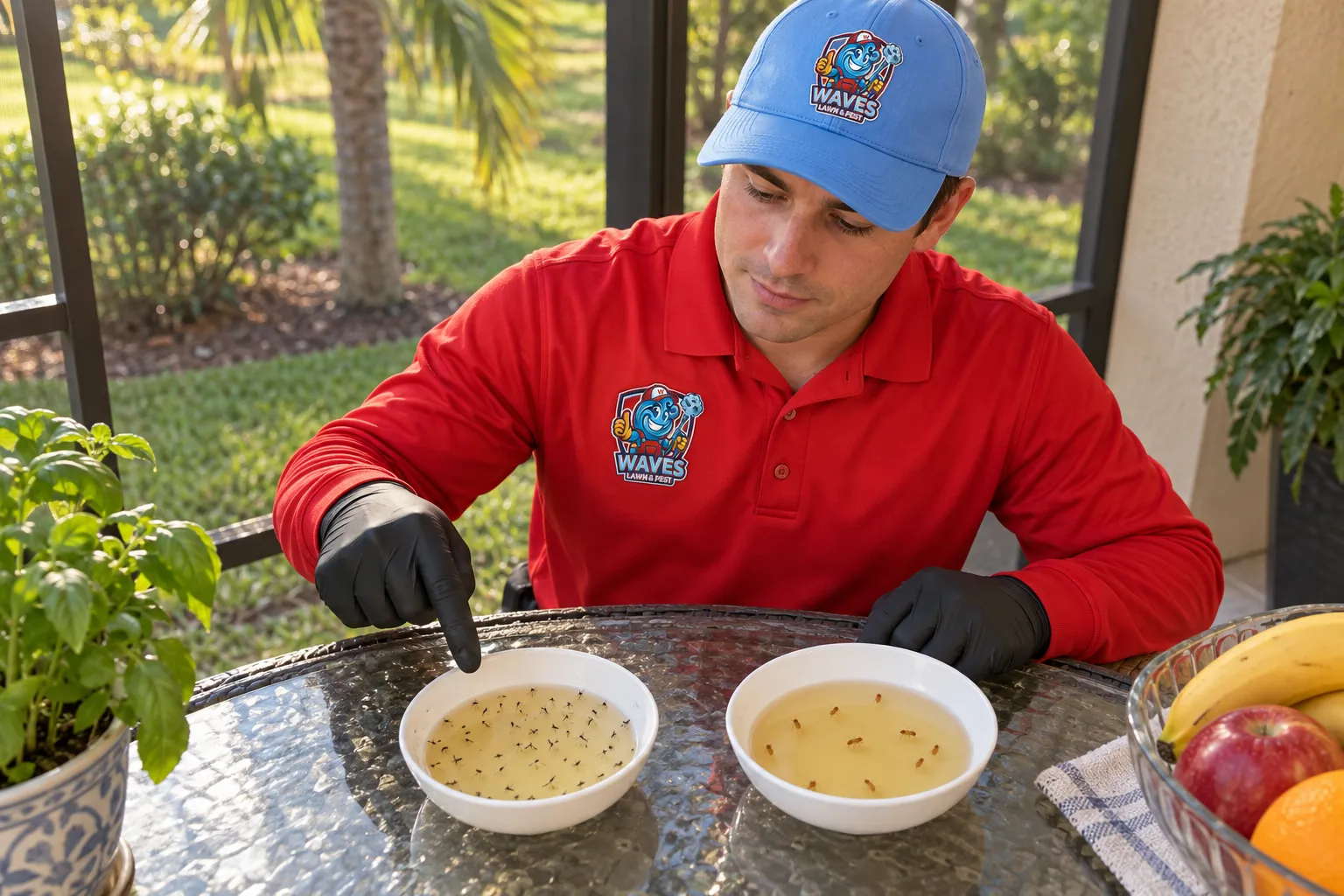
Side by side: fungus gnat, fruit fly or drain fly
Size will not settle it, since all three are tiny, from about 0.1 inch to 3/16 inch long. Check the body first, then check where the fly lands. This table pulls the identification traits from UF/IFAS.
| What to check | Fungus gnat | Fruit fly | Drain fly |
|---|---|---|---|
| Size | Up to 1/8 inch (3 mm) | About 0.1 inch | About 1/8 inch for males, about 3/16 inch for females |
| Look | Dark brown body, dusky wings, long legs and long thread-like antennae, like a tiny mosquito | Yellow-brown body, red eyes, black rings on the abdomen | Mottled and fuzzy, from dense hair-like scales on the wing veins |
| Where adults show up | Around houseplants and moist potting soil | Ripe or fermenting fruit and vegetables, trash containers, garbage disposals, empty cans and bottles | Resting on bathroom and shower walls near a drain |
| Where larvae live | Mostly in the top inch of moist soil | In the ripe or fermenting fruit or vegetable where the eggs were laid | In the film of wet organic material inside drains |
| First fix | Water less and remove rotting plant material | Throw out rotting produce and clean up fruit residue | Scrape the drain with a pipe brush, then flush it with boiling water |
Identification traits from UF/IFAS EENY-215 (fungus gnats), EENY-716 (drain flies) and a UF/IFAS Extension article on Florida fruit flies.
Fungus gnats live in wet potting soil
Fungus gnats come from soil that stays wet. The UF/IFAS profile of darkwinged fungus gnats, EENY-215 (revised October 2024), describes the adults as delicate flies up to 1/8 inch (3 mm) long, with a dark brown body, dusky wings, long legs and long thread-like antennae. When disturbed, it says, they run fast or take off in short, darting flights that hover over a small area.
The larvae are where plant damage starts. EENY-215 describes them as white, slender and legless, with a black head and skin clear enough to show what they ate, growing to about 1/4 inch (6 mm). Most sit in the top inch of soil. An article from UF/IFAS Extension in Charlotte County says the larvae feed on organic matter, rotting plant material, fungi and algae, sometimes on the roots of seedlings and cuttings, and that the trip from egg to adult takes no more than a month at normal temperatures.
To confirm fungus gnats, look closely at the top inch of soil in the pot where the flies gather. The Charlotte County article says the larvae can be seen with the naked eye.
The fix starts with water. UF/IFAS says fungus gnats need moist to very moist soil to develop, and EENY-215 says to remove old plants and rotting material. The Charlotte County article adds these steps:
- Do not water so much that water collects and sits in the pot.
- Check new houseplants before you bring them in, since they may already carry gnats.
- Put out yellow sticky traps. They show you roughly how many gnats you have and catch a good number of adults.
Pro tip: Push a finger an inch into the soil before you water again. UF/IFAS puts most fungus gnat larvae in that top inch, and they need it moist to develop.
The Charlotte County article also says a badly infested pot sometimes just needs to go, and that getting rid of every last gnat is often impractical. The article says steady cultural control can bring them down to a level most people can live with.
Fruit flies breed in ripe and fermenting food
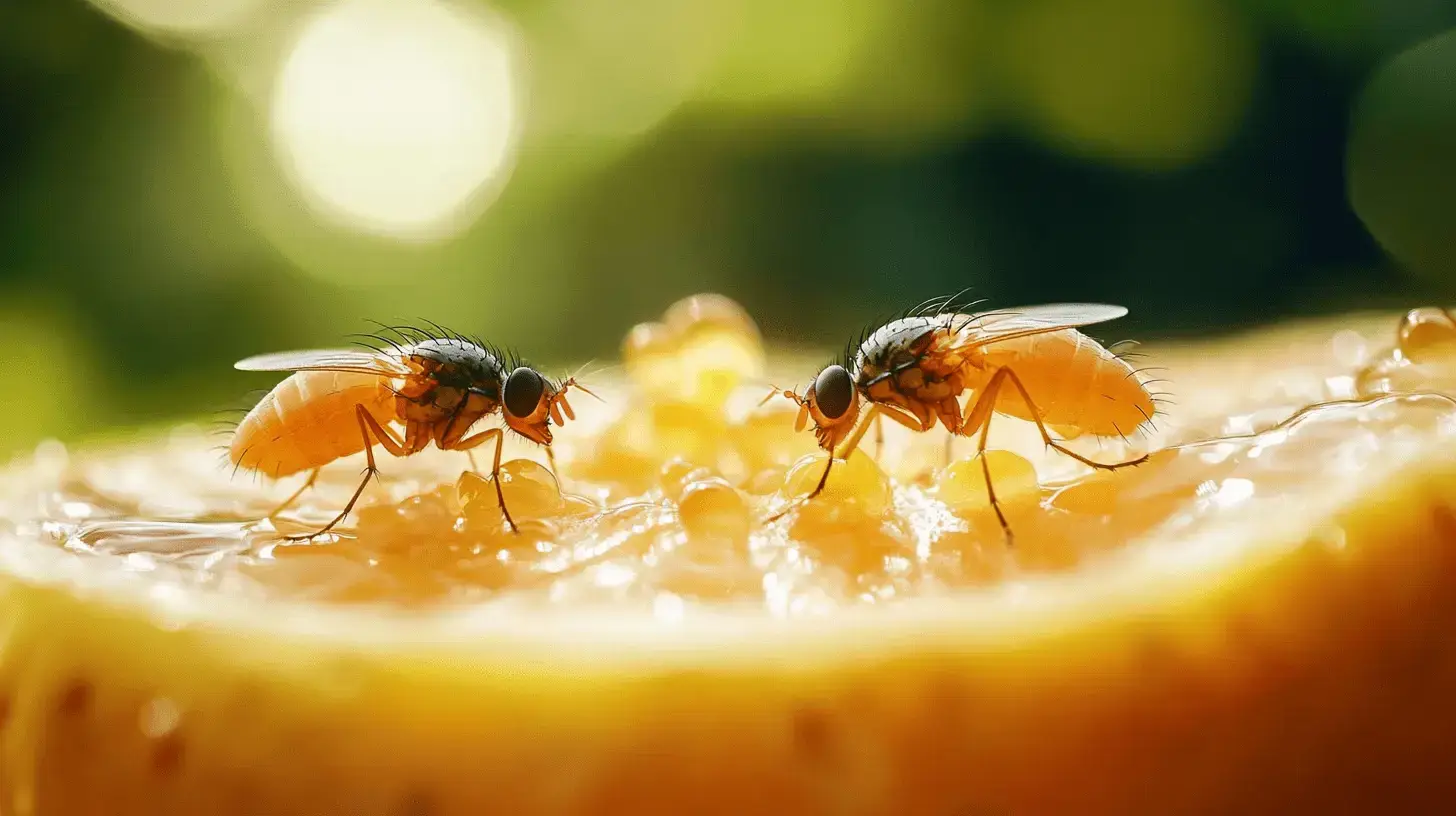
Fruit flies are a food problem. A UF/IFAS Extension article on Florida fruit flies describes the common fruit fly, Drosophila melanogaster, as about 0.1 inch long and yellow-brown, with red eyes and black rings on the abdomen. Females have a longer, pointier abdomen, and the tip of the male’s abdomen is darker. Florida is home to about 27 species of fruit flies, the article notes, so naming the exact species can take an expert.
They come inside with ripe or fermenting fruit and vegetables and lay their eggs on it. The same article lists garbage disposals, trash containers, empty cans and bottles, and moist surfaces holding fermenting material as other places they turn up. With moisture and a food source, it says, a fruit fly can go from egg to adult in about a week, and a female can lay up to 500 eggs in her lifetime.
Sanitation comes first. The article says to throw out rotten or fermenting produce and to clean any surface holding bits of fruit, along with debris that collects moisture and fruit residue. For keeping count, it describes a container of yeast-sugar-water that draws the flies in and drowns them, and sticky traps that do the same job.
Drain flies sit on the bathroom wall
Drain flies are the fuzzy ones. The UF/IFAS drain fly profile, EENY-716 (revised March 2025), says the adults look mottled because of short, dense, hair-like scales along the wing veins. They are weak fliers that get around mostly by hopping, running and short flights. Males are about 1/8 inch long and females a little bigger at about 3/16 inch. You will usually find them resting on bathroom and shower walls near where their larvae live.
Those larvae feed on the film of wet organic material that builds up in drains. Because drain flies fly so poorly, UF/IFAS says the breeding site is usually the closest drain. To check one, cover it with tape for 24 hours, then look for flies stuck to the tape as they tried to come out.
The UF/IFAS fix is mechanical. Scrape the inside of the drain with a metal pipe brush to remove the organic material where eggs are laid and larvae feed, then pour boiling water down it to loosen and flush out what the brush missed. Drain flies can also develop in any spot with standing water and organic material, and there the profile says to scrape away the buildup and dry the area.
UF/IFAS says drain flies do not bite and are not known to carry any pathogen. Large infestations can cause breathing problems from the fine scales they shed, though the profile notes that numbers that high are not common in most homes.
What to look for when small flies show up
Start with where the flies gather, then match the fix to the source:
- If they rise from potting soil or hover around a houseplant → start with the watering, and check the top inch of soil for larvae.
- If they circle the fruit bowl, the trash or the disposal → start with the cleanup: toss rotting produce and wipe up fruit residue.
- If fuzzy flies rest on the wall by a sink or shower → use the tape test on the nearest drain, then scrub it with a pipe brush.
- If you clear the obvious source and the flies keep coming → call a professional to help find a breeding spot you have not found yet.
Why small flies show up in Southwest Florida homes
Fruit flies and fungus gnats are both well documented in Florida. The fruit fly article calls fruit flies a common pest in Florida all year, especially in late summer and fall. EENY-215 says Bradysia fungus gnats have been collected from every region of the state, and it lists an identification of Bradysia coprophila from Punta Gorda in Charlotte County.
If you move potted plants between the lanai and the house, keep in mind that afternoon storms water anything left outside. EENY-215 says pots should be well drained, so empty standing water from saucers and check the soil before the next watering.
What not to do
- Do not keep watering on a schedule while the soil is still wet. Fungus gnats need that moisture to develop, per UF/IFAS.
- Do not count on a spray to fix it. EENY-215 notes that some growers have had difficulty getting adequate control of fungus gnats and that more information is needed on effective insecticides. It says good growing practice takes away the conditions gnats need and reduces the need for pesticides.
- Do not stop at the flies you can see. Fruit flies breed in the produce and residue, and drain flies breed in the film inside the drain, so killing adults leaves the source in place.
If you decide to use an insecticide anyway, read and follow the product label, keep the product off food-preparation and food-contact surfaces, and keep it out of sight and reach of children and pets.
When to call a professional
Get help when the flies keep coming after you have dried out the pots, cleared the produce and scrubbed the drains, or when you cannot find where they are breeding. Write down which rooms they gather in and when you first saw them. Our pest observation log for Southwest Florida properties shows one simple way to keep those notes. If you would like Waves Pest Control to take a look, the first visit starts with a walk of the property to identify what is active.
Not sure what you are looking at? The Waves pest library has photos of common household pests, and if the small thing in your kitchen crawls rather than flies, our guide to beetle-type insects may help. If small flies are one of several pests you see through the year, our WaveGuard memberships page explains how recurring service works. To talk to someone close by, start with pest control in Port Charlotte or request a pest control quote in Sarasota.
Frequently Asked Questions
Do fungus gnats leave without help?
They tend to hang on as long as the potting soil stays wet, because UF/IFAS says fungus gnats need moist to very moist soil to develop. Water less, remove rotting plant material, and use yellow sticky traps to keep track of the adults.
Do gnats come from drains?
UF/IFAS ties fungus gnats to moist soil. The small fly it ties to drains is the drain fly, whose larvae feed on the wet film inside the drain, and fruit flies can also turn up around garbage disposals.
How do you get rid of fruit flies and gnats?
Start with what they breed in. For fruit flies, UF/IFAS Extension says to remove rotting produce and clean up fruit residue; for fungus gnats, UF/IFAS points to less water, removing rotting plant material and yellow sticky traps.