Jump to a section (8)
- 01How do you identify a Florida woods cockroach?
- 02Why is it called the stinking cockroach?
- 03Where do Florida woods cockroaches live?
- 04Is it bad to find a woods cockroach in your house?
- 05How to get rid of Florida woods cockroaches in the house
- 06What is the hardest roach to get rid of?
- 07When to call a professional
- 08How Waves Pest Control handles roaches
Last updated: November 2026.
That big, slow, almost black roach on your lanai that barely bothers to run, and leaves a smell when you nudge it, is most likely a Florida woods cockroach. This guide covers how to tell it from the other “palmetto bugs,” what its spray does, and what one in your Sarasota or Bradenton home means. For what a regular visit covers, start with our pest control services page.
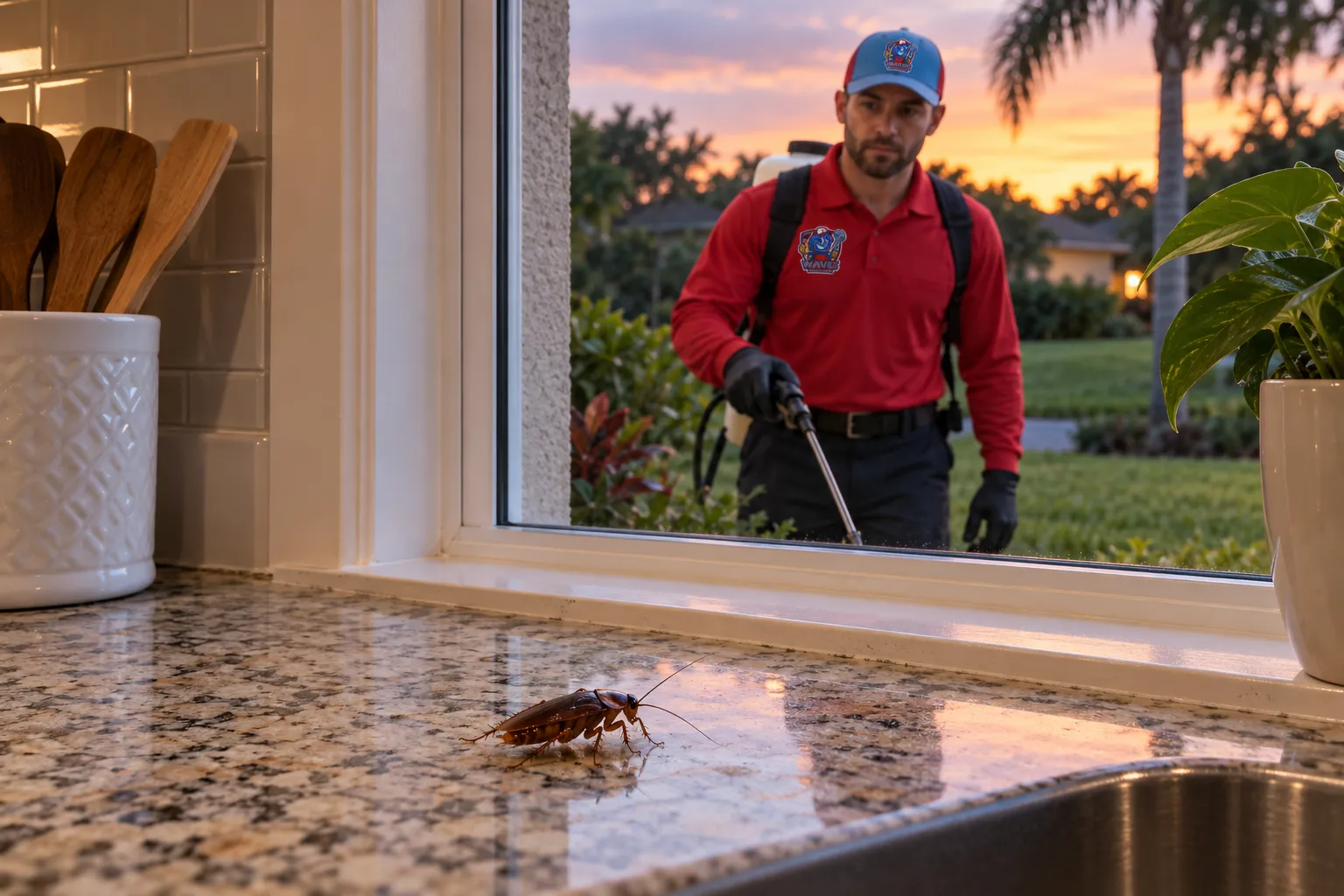
Seeing more than one indoors? Get a pest control estimate online.
How do you identify a Florida woods cockroach?
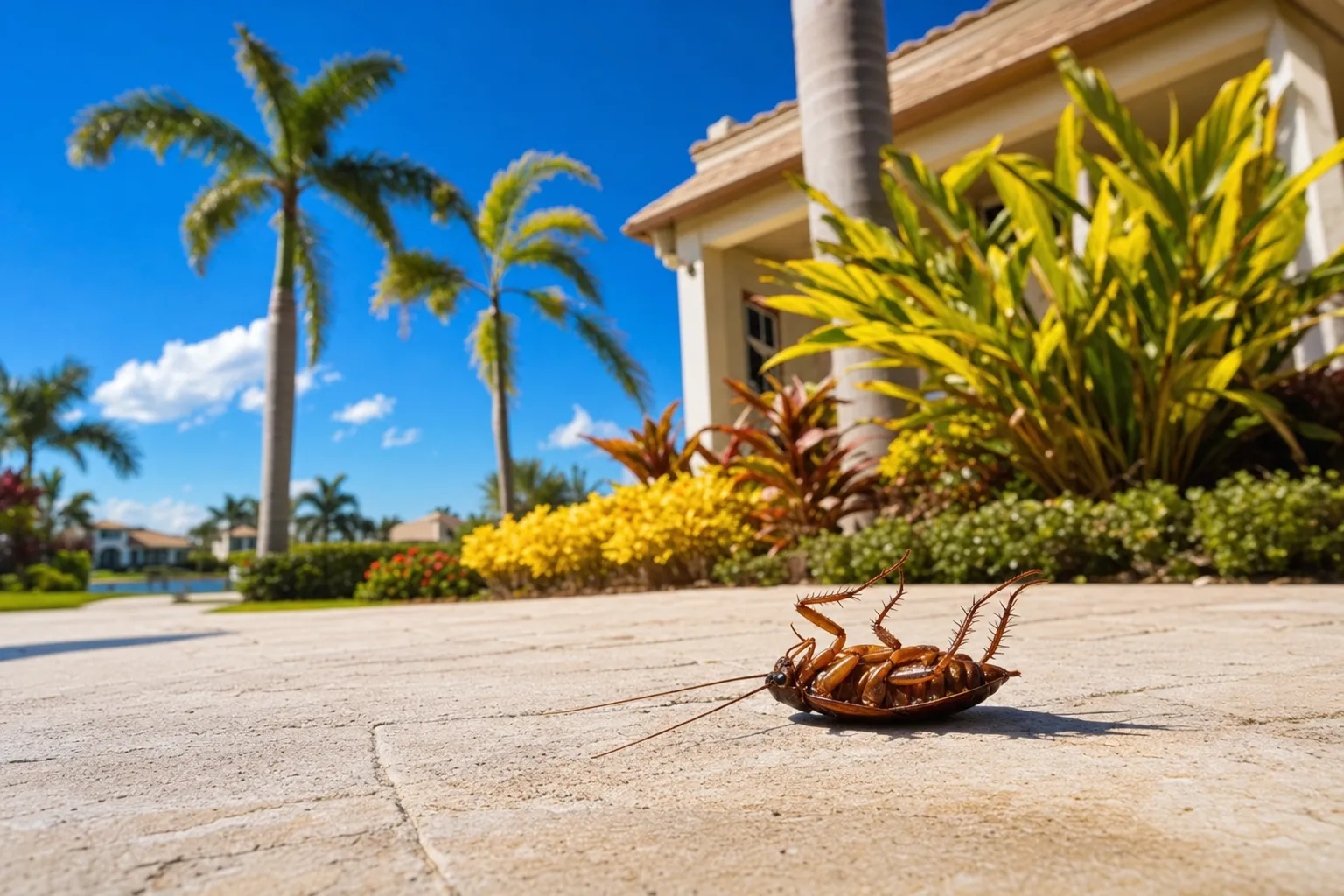
Look for a large, wide, dark reddish-brown to black roach with stubby wing pads that leave its whole abdomen bare. The UF/IFAS cockroach photo gallery puts adults at 1 1/8 to 1 9/16 inches long and says they cannot fly. The UF/IFAS fact sheet EENY-514 (first published December 2011) adds what to check with a flashlight:
- Width. Adults can be up to about 1 inch wide.
- Wing pads. The short, leathery pads barely meet in the middle of the back and cover no part of the abdomen.
- Behavior. It moves slowly and is not quick to run from a disturbance.
- Nymphs. They are reddish brown to black, and older ones commonly have yellow edges on the thorax plates behind the head.
- Egg cases. About 1/2 to 5/8 inch long, reddish brown to black, with 18 to 24 saw-like teeth along the top edge. Females often glue them to a surface, such as a decaying log.
The UF/IFAS gallery profiles of the other big Florida roaches give you the contrast:
- American cockroach: about 1 3/8 to 2 1/8 inches, reddish brown with light markings behind the head. Both sexes fly, though UF rates them poor to average fliers.
- Smokybrown cockroach: about 1 to 1 1/4 inches and one even dark color. Its wings extend past the abdomen, and it flies well and comes to lights.
- Australian cockroach: about 1 1/4 to 1 3/8 inches, with a light-yellow band on the front edge of each forewing near its base. Both sexes fly well.
Those short wing pads also make the woods roach easy to mistake for a beetle, a mix-up our beetle or cockroach guide sorts out. Our guide to the 8 cockroach types in Florida shows it next to the rest, and the Waves pest library has photos of other household bugs.
Why is it called the stinking cockroach?
Adults spray a foul-smelling fluid when something threatens them, which the UF/IFAS gallery says is where the nickname “stinking cockroach” comes from. EENY-514 also lists Florida stinkroach, skunk cockroach and palmettobug, and notes that “palmettobug” gets used for other large roaches too, including the American and smokybrown.
Here is what EENY-514 says about the spray:
- The oily, odorous fluid comes from a gland on the underside of the abdomen.
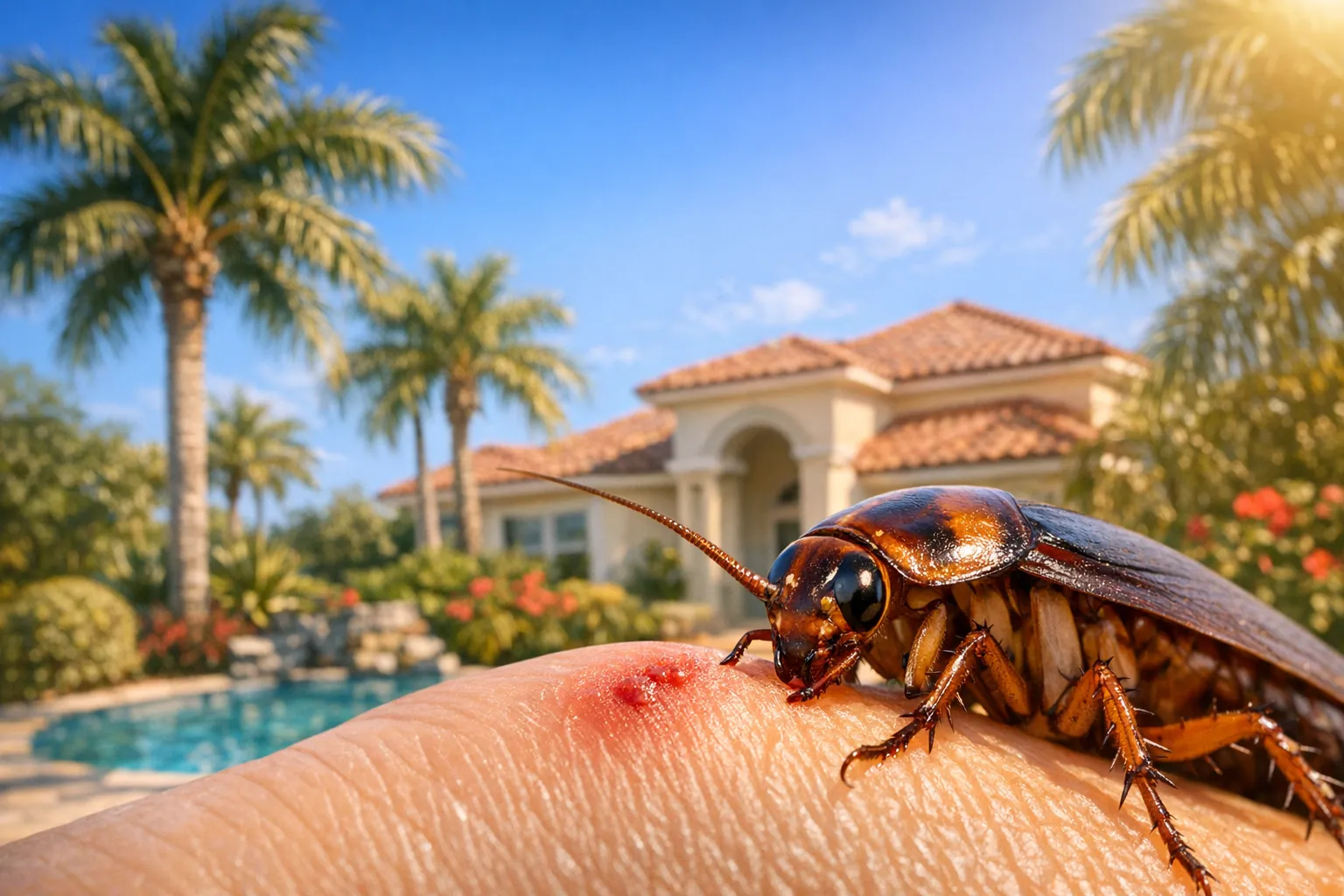
- Direct contact is a potent irritant, harmful to skin and to sensitive tissue such as the eyes.
- The roach can aim it to a degree, and the spray reaches from about an inch to about 3 feet.
- Only adults spray. The gland starts working after the final molt, and it can take up to 30 days to refill after a discharge.
Keep your face back and your hands off when you move one. If the spray gets in your eyes and the irritation does not ease, see a doctor.
Where do Florida woods cockroaches live?
Outdoors, in damp, shaded spots full of decaying plant matter. The UF/IFAS gallery says this roach is commonly found in leaf mulch, wood piles and under rotting logs, and EENY-514 calls it a detritivore that feeds mainly on decomposing plant matter. Around a home, the fact sheet lists holes in signs, the base of ornamental trees such as coconut and other palms, woodpiles, storage areas and greenhouses.
A Southwest Florida yard offers plenty of that, from palm debris at the base of the trunk to mulch beds that stay damp after a week of afternoon storms. The UF/IFAS gallery says the species is native to the U.S. and found in Florida and coastal Alabama, Georgia and Mississippi. EENY-514 cites records throughout most of Florida, including Charlotte County.
Is it bad to find a woods cockroach in your house?
One woods roach inside is usually a stray. EENY-514 calls it an occasional invader that has typically been carried in on something else, such as firewood. It says the species has not been shown to commonly colonize inside structures, with limited instances of attic breeding, and the UF/IFAS gallery says it does not live long indoors. A UF/IFAS entomologist gives one reason in a 2023 UF/IFAS article on household invaders: the indoor environment is too dry for most native Florida insects.
Watch for these clues that you have more than a stray:
- Several adults indoors over a few weeks.
- Nymphs, especially the yellow-edged older ones.
- Egg cases glued in the attic, garage or a storage room.
Treat them as clues. A professional inspection confirms which roach you have and where it is living. Wondering about bites? Our cockroach bite guide covers which species are documented biting people.
Pro tip: Knock firewood and storage bins against the ground outside before you carry them in. EENY-514 says a woods roach indoors usually rode in on an item such as firewood, so a check at the door is a good habit.
How to get rid of Florida woods cockroaches in the house
Identify the roach first, move it out, and then work on the outside of the house:
- Confirm what you have. Check the size and wing pads against the list above. A small roach in the kitchen or bathroom is a different species with a different plan, so get it identified.
- Move it outside. Slide a cup over it, slip a stiff sheet of paper underneath, and carry it out at arm’s length with the open side pointed away from your face.
- Close the way in. UF/IFAS Extension in Charlotte County, in Managing cockroaches without pesticides, says to make sure doors and windows are properly screened and to caulk cracks and gaps.
- Clean up near the walls. The same article tells homeowners to remove dead palm branches and all palm debris, and to clear empty boxes and trash in and around the home.
What not to do
- Do not crush it barehanded or with your face close. Rough handling invites the spray.
- Skip spraying the whole house for one stray. The 2023 UF/IFAS article says chemical use alone is the least effective way to control invasive roaches, and this native one does not live long indoors anyway. If you do use a product, read and follow the product label, keep the product off food-preparation and food-contact surfaces, and place it out of sight and reach of children and pets.
- Do not assume every big dark roach is this one. A roach with full wings that flies is a different species.
What is the hardest roach to get rid of?
The UF/IFAS sources here do not rank roaches by how hard they are to remove, but the 2023 UF/IFAS article singles out the German cockroach. It calls it the most serious structure-invading cockroach of apartment buildings, condominiums, dormitories and restaurants, says it infests houses as well, and says people bring it in, in boxes, backpacks and purses from homes that already have it. The article also warns that relying on chemicals alone can lead to insecticide resistance and very poor control.
The woods roach sits at the other end of that scale, since EENY-514 says it has not been shown to commonly colonize inside structures.
When to call a professional
Call a pro when the clues point to roaches living with you:
- More than one woods roach indoors in a short stretch.
- Nymphs or egg cases inside the house, garage or attic.
- Small roaches in the kitchen or bathroom.
- Big roaches you cannot identify.
How Waves Pest Control handles roaches
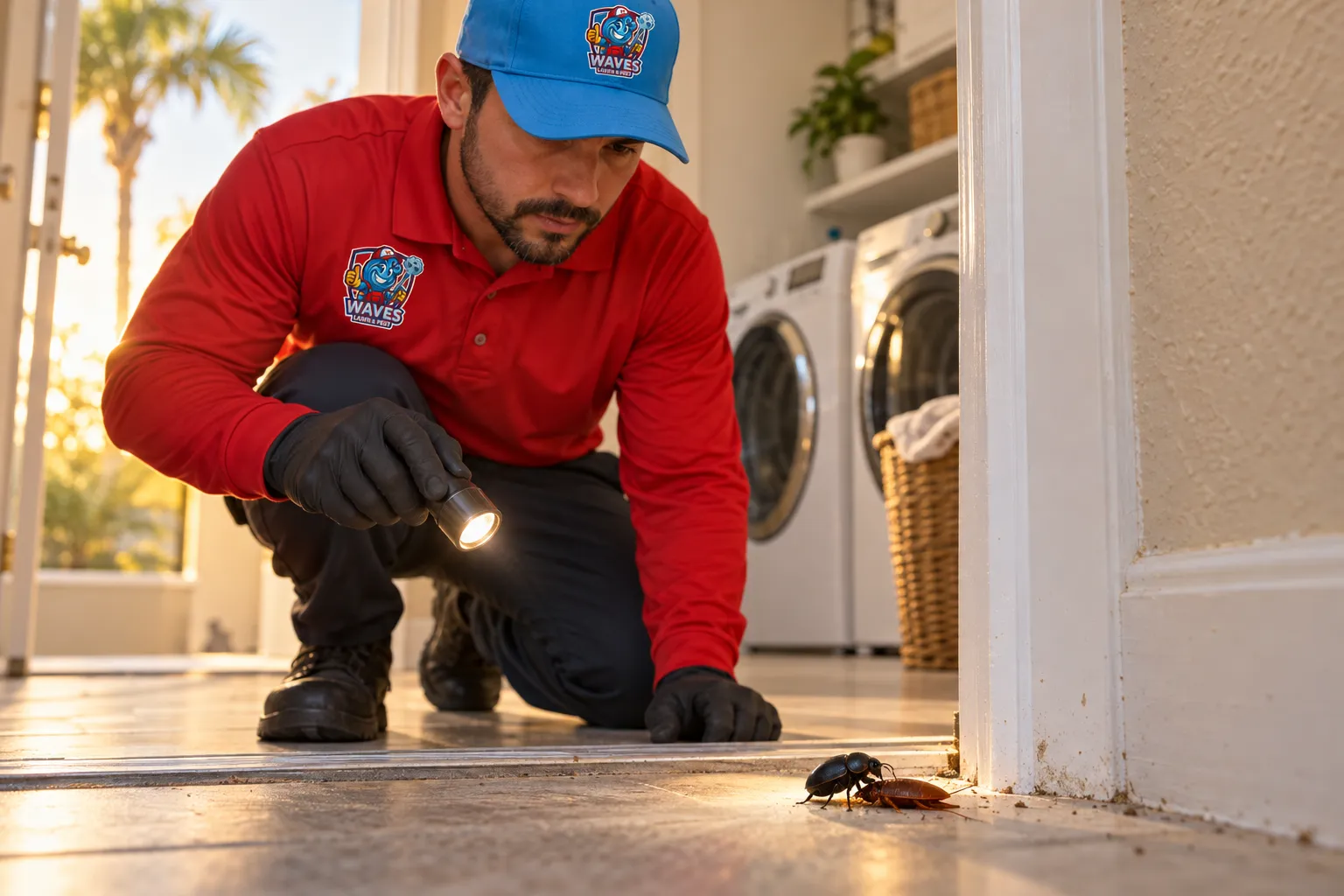
Our approach starts with identification. A first Waves Pest Control visit includes a walk of the property to find active pest pressure, plus an inspection of the soffits, eaves and slab line. We treat the full perimeter and spot-treat inside where there is active pressure. After that, quarterly visits focus on the exterior perimeter, with interior work on request or when pests are active. WaveGuard memberships include unlimited callbacks between scheduled visits at no extra charge: if covered pests come back between visits, Waves comes back free.
Finding big, slow roaches around the slab or in the garage? Start with pest control in Sarasota or pest control in Bradenton, or get a pest control estimate for your home.