Jump to a section (9)
- 01Do rats climb palm trees?
- 02How a frond on the roof becomes a way in
- 03Signs of rats in your palm or yard
- 04What to trim, and what UF/IFAS says to leave
- 05What surfaces can rats not climb?
- 06Is it hard to get rid of rats that reach the roof?
- 07What not to do
- 08When to call a professional
- 09How Waves Pest Control handles rats coming in from the palms
A palm frond lying across your shingles or tile looks harmless until you hear scratching above the ceiling at night. In Southwest Florida the rat most likely to make that trip is the roof rat, an agile climber that travels oak canopy, fences and utility lines and gets into attics through gaps at the roofline and soffits. This guide covers how a palm fits into that route, which fronds UF/IFAS says you can cut, and the signs to check around your Sarasota or Bradenton home. For everything a visit can cover, start with our pest control services page.
Already hearing noises in the attic? Get a rodent control estimate online.
Do rats climb palm trees?
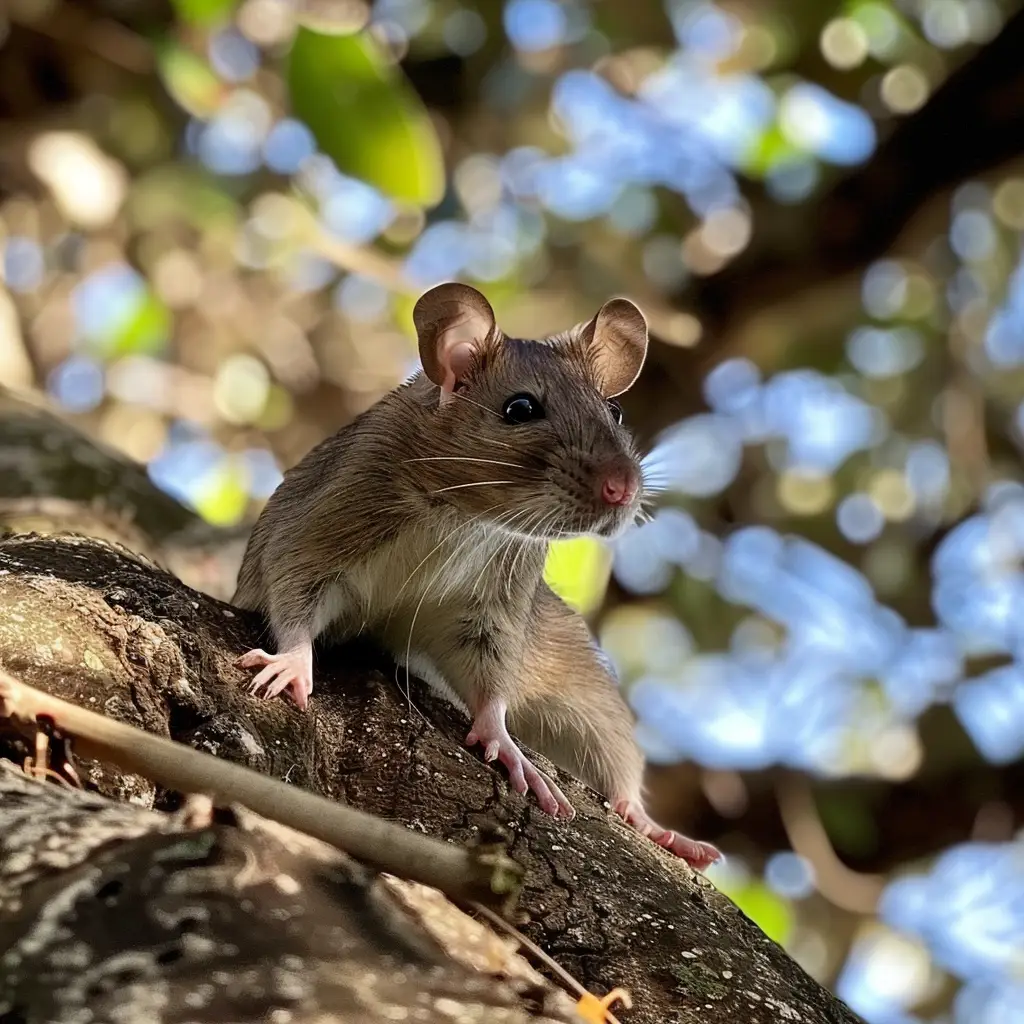
Yes. UF/IFAS Extension in Sarasota County, in its August 2026 article Wondering About Wildlife: What to Do About Rodents, describes roof rats as skilled climbers found primarily in trees and in the upper levels of homes and buildings.
The CDC’s 2006 rodent survey manual, Integrated Pest Management: Conducting Urban Rodent Surveys, says roof rats are climbers that prefer to nest in trees, bushes and attics. It lists palm trees among the kinds of dense growth that can give rodents harborage.
How a frond on the roof becomes a way in
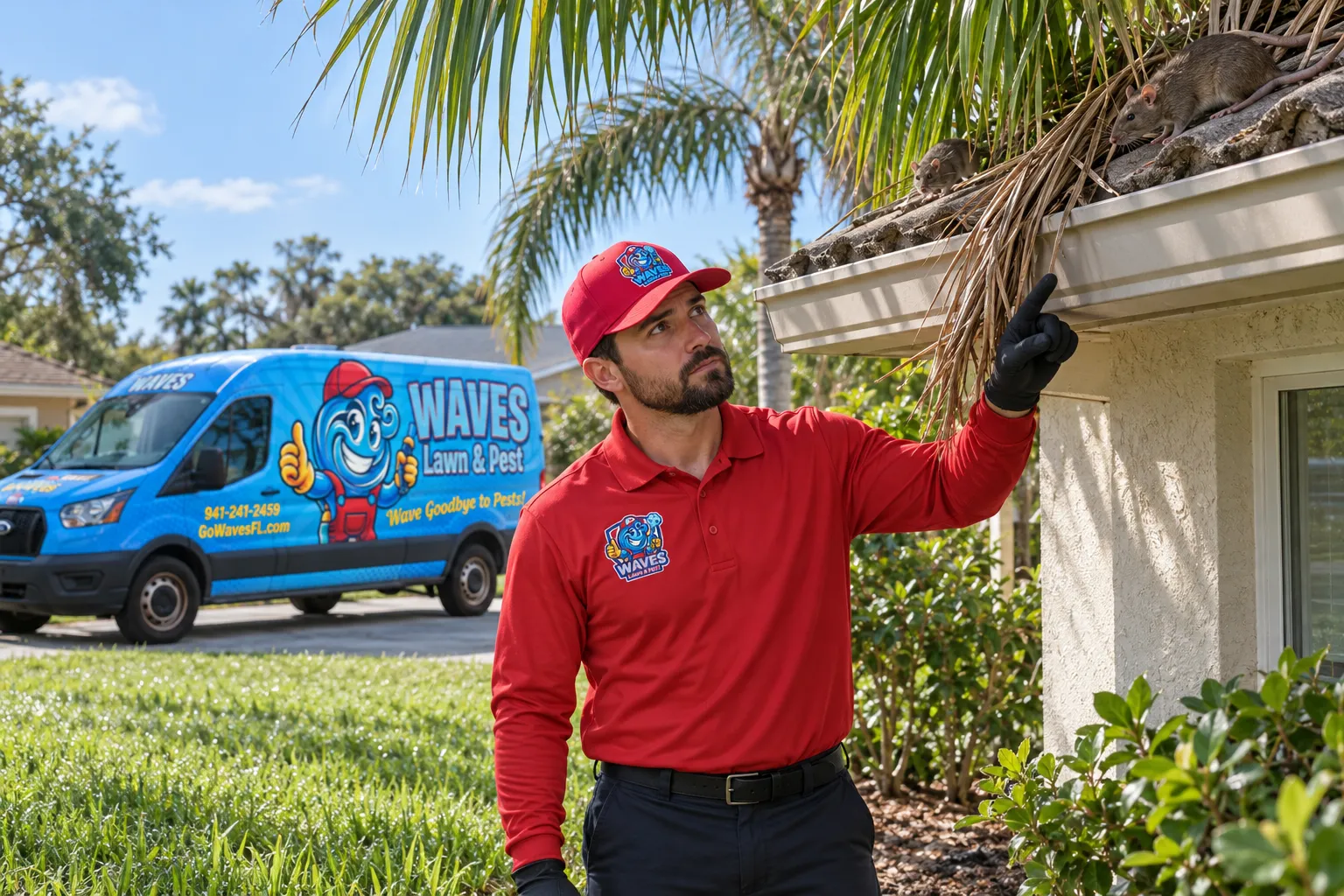
A frond that rests on the roof or hangs over it gives a climbing rat a path from the palm to the roof. The Sarasota County Extension article makes the same point about trees: because roof rats climb trees easily, it tells homeowners to make sure limbs are not overhanging the roof.
Once a rat is on the roof, it needs only a small opening. The CDC manual says structural openings must be less than 1/2 inch across to keep out adult roof rats. The CDC’s How to Seal Up to Prevent Rodents page tells homeowners to check the roof among the rafters, gables, eaves and soffits, and around attic vents.
Palms add two more draws:
- Dead fronds. UF/IFAS Gardening Solutions explains in Pruning Palms that on some palms the dead foliage hangs loosely against the trunk, while crownshaft palms such as royal, foxtail and Christmas palms drop old fronds on their own. The Sarasota County Extension article notes that plant material and other clutter can give rodents shelter in a yard.
- Fruit. Roof rats eat fruits, nuts and seeds along with other foods, per the Sarasota County Extension article, which tells homeowners to remove ripened or rotting fruit from trees promptly. Gardening Solutions says there is no evidence that removing living flower or fruit stalks harms a palm.
Signs of rats in your palm or yard
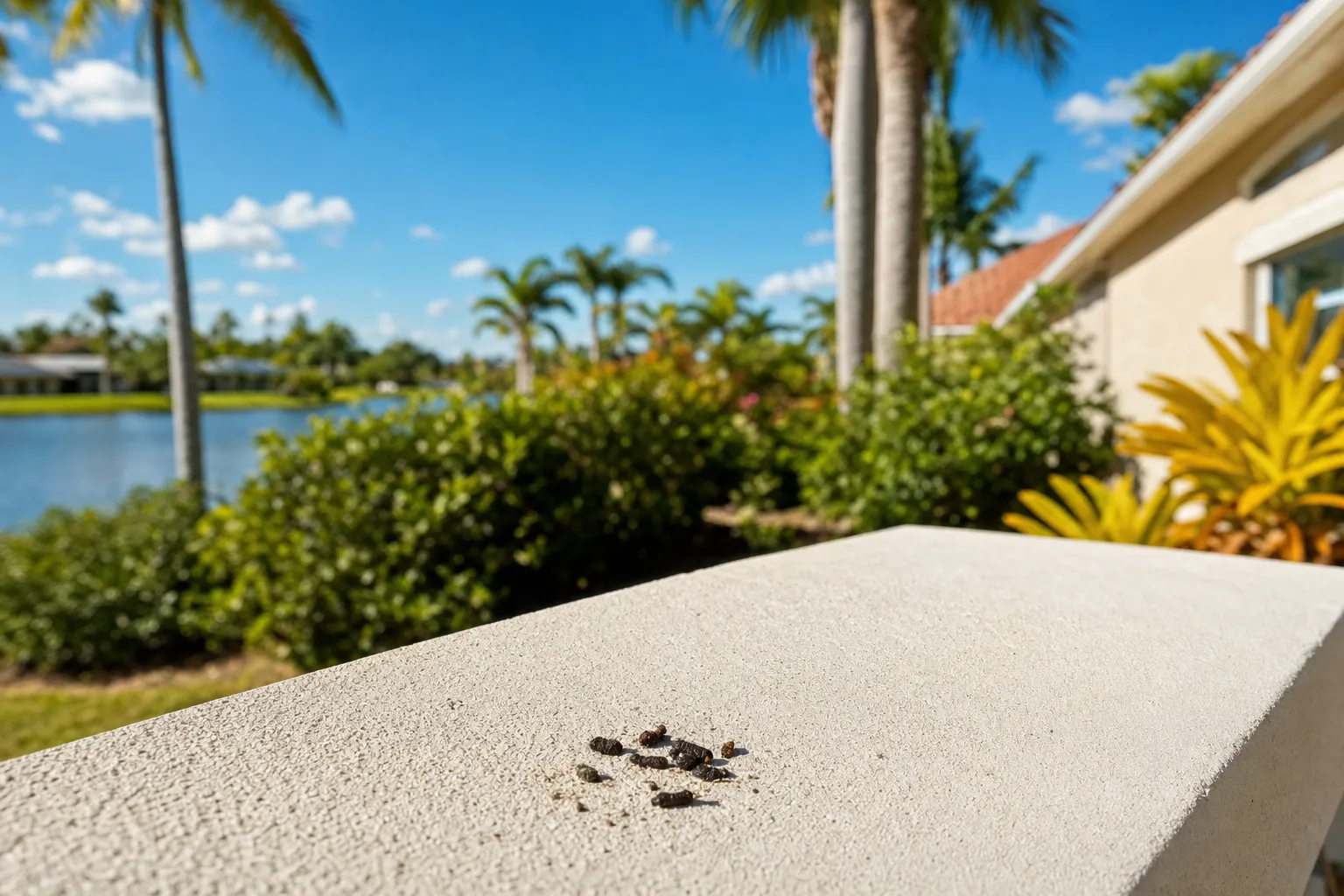
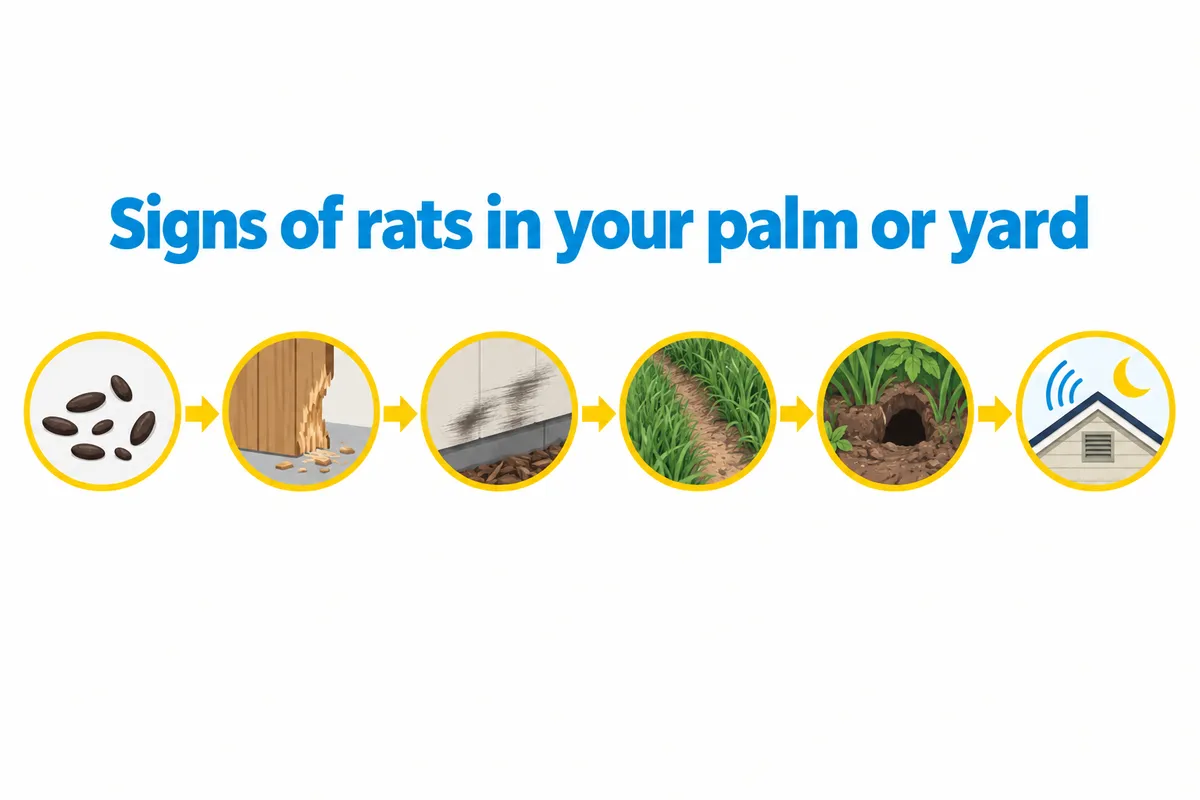
Look for droppings, gnaw marks, rub marks and worn paths, and listen for noise in the attic after dark. The CDC manual lists droppings, gnaw marks, rub marks, runways and burrows among the active signs it checks for:
- Droppings. Fresh droppings are dark and soft; old ones are hard, gray and brittle. Roof rat droppings are pointed and spindle-shaped, about 1/2 inch long. Check under the palm, along the roof edge below the fronds and in the attic near the eaves.
- Gnaw marks. A freshly gnawed surface is usually light in color. UF/IFAS Extension in Nassau County, in Q: Some animal is gnawing on the trunk of my citrus trees, names the roof rat as its first suspect when something gnaws a citrus trunk.
- Rub marks. Fresh rub marks are black, soft and greasy. Look along rafters and around entry gaps.
- Runways. Well-traveled paths that usually lead to food, water and harborage.
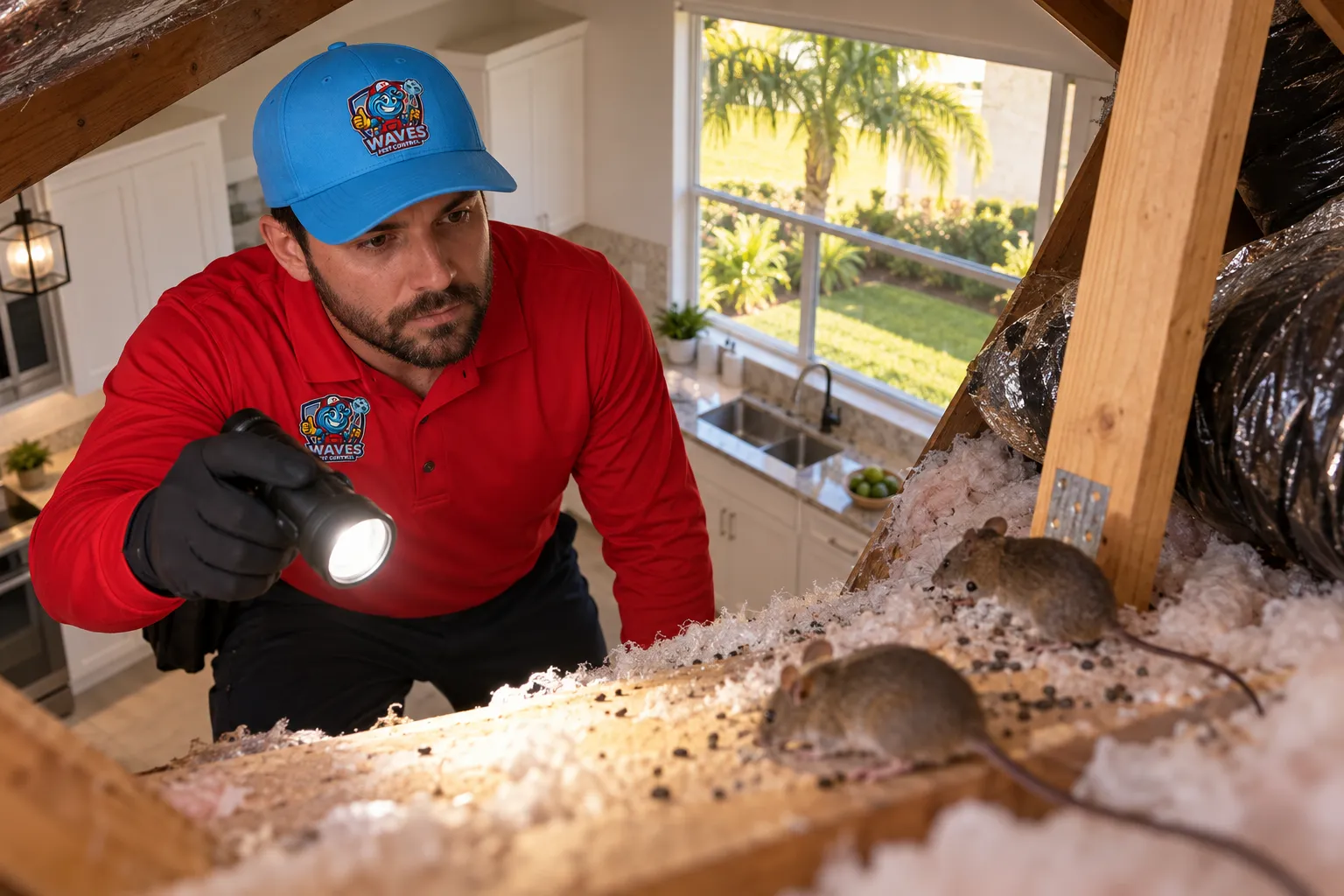
- Noise at night. Scratching or scurrying in the attic or walls at night is the classic roof rat sign.
- Burrows. Holes along the foundation point to the Norway rat, a ground-dweller that burrows and enters low.
Treat these as clues. Confirming which rodent you have, and where it gets in, takes a closer look.
Pro tip: Before you cut anything, stand in the yard and photograph every frond that touches or hangs over the roof, plus any damaged soffit or vent near it. Those photos give an arborist or a rodent inspector a map to start from.
What to trim, and what UF/IFAS says to leave
Cut fully brown fronds and fruit stalks, leave the green fronds, and get help with a green frond that rests on the roof. Work through the palm and the roofline in this order:
- Remove fully brown fronds. The Gardening Solutions rule of thumb is to remove only fronds that are completely brown. It also warns never to pull off a frond that does not come away easily, because that can leave an entry site for disease.
- Take off fruit stalks. Gardening Solutions says there is no evidence this harms the palm.
- Leave the green fronds. The number-one rule on the Gardening Solutions page is never to remove live, green, healthy fronds. They make food for the palm, and cutting them can wound the crown and leave it open to disease. Picture the canopy as a clock face: UF/IFAS treats 9 o’clock and 3 o’clock as the absolute limit, and says that limit is not the goal. It also advises against cutting half-dead or yellow fronds.
- Skip the hurricane cut. Gardening Solutions calls hurricane pruning harmful and says hurricane-cut palms were more likely to have their crowns snapped off by the wind.
- Get advice on a green frond that rests on the roof. Neither UF/IFAS page sets a clearance distance for palm fronds. Gardening Solutions suggests a certified arborist for palm pruning, who can tell you whether that frond can come off without overpruning the palm.
- Cut back overhanging tree limbs. The Sarasota County Extension article says to make sure limbs are not overhanging the roof.
- Seal the roofline. The CDC says to fill small holes with steel wool held in place with caulk or spray foam, and lists lath screen or metal, cement, hardware cloth and metal sheeting for larger holes. The Sarasota County Extension article also tells homeowners to repair storm damage promptly, so walk the roofline again after a stretch of afternoon storms or a tropical system.
What surfaces can rats not climb?
UF/IFAS Extension points to metal guards. The Nassau County Extension post says metal guards placed around the base of a tree discourage gnawing and climbing into the tree. The Sarasota County Extension article says rat guards placed on trees discourage rodents from climbing them.
Both pages say discourage, so treat a guard as one layer. It covers only the trunk, and roof rats also travel fences and utility lines, so a palm that touches a fence, a wire or another tree can still be reached.
Is it hard to get rid of rats that reach the roof?
It usually takes exclusion plus trapping. The Sarasota County Extension article says it is much easier to exclude rodents than to remove them once they have established residence in a structure, and it recommends pairing exclusion with lethal management during an active infestation. Baiting alone, without sealing the building, leaves the openings for the next rodent.
Indoor rodent activity in Southwest Florida peaks in the cooler months, roughly October through February, as rats and mice move into attics and wall voids for shelter, though Florida’s mild climate keeps them active all year.
For rats already inside, the CDC’s How to Trap Up to Remove Rodents page recommends traditional snap traps placed where you have seen droppings, gnaw marks or nesting material. Keep traps out of reach of children and pets, and check them daily.
What not to do
- Do not hurricane-cut the palm or climb it with spikes. Gardening Solutions says both can harm the tree.
- Skip glue traps and live traps. The CDC says these traps can scare rodents into urinating, which can increase your chance of getting sick. The Sarasota County Extension article adds that non-native rodents should not be live-trapped and released into natural areas.
- Treat poison as a last resort. The Sarasota County Extension article calls rodenticides a last resort because of their serious impacts on native wildlife, and says only EPA-registered products should be used, placed in tamper-resistant bait stations away from children and pets. If you use one, read and follow the product label, keep it off food-preparation surfaces, and place the station out of sight and reach of children and pets.
- Do not sweep, vacuum or bare-hand droppings. The Sarasota County Extension article warns against both. For cleanup, the CDC’s How to Clean Up After Rodents page says to wear gloves, spray droppings with a bleach solution or an EPA-registered disinfectant until very wet, let it soak as the label directs, and wipe up with paper towels.
- Do not assume every climber is a rat. Waves Pest Control works on rats and mice and refers squirrels, raccoons, opossums and other wildlife to a licensed wildlife trapper. Compare photos in the Waves pest library if you are not sure what you are seeing.
When to call a professional
Call a pro when the signs move from the yard into the house: scratching in the attic at night, droppings near the eaves, a chewed soffit or vent screen, or fronds you cannot reach from the ground.
How Waves Pest Control handles rats coming in from the palms
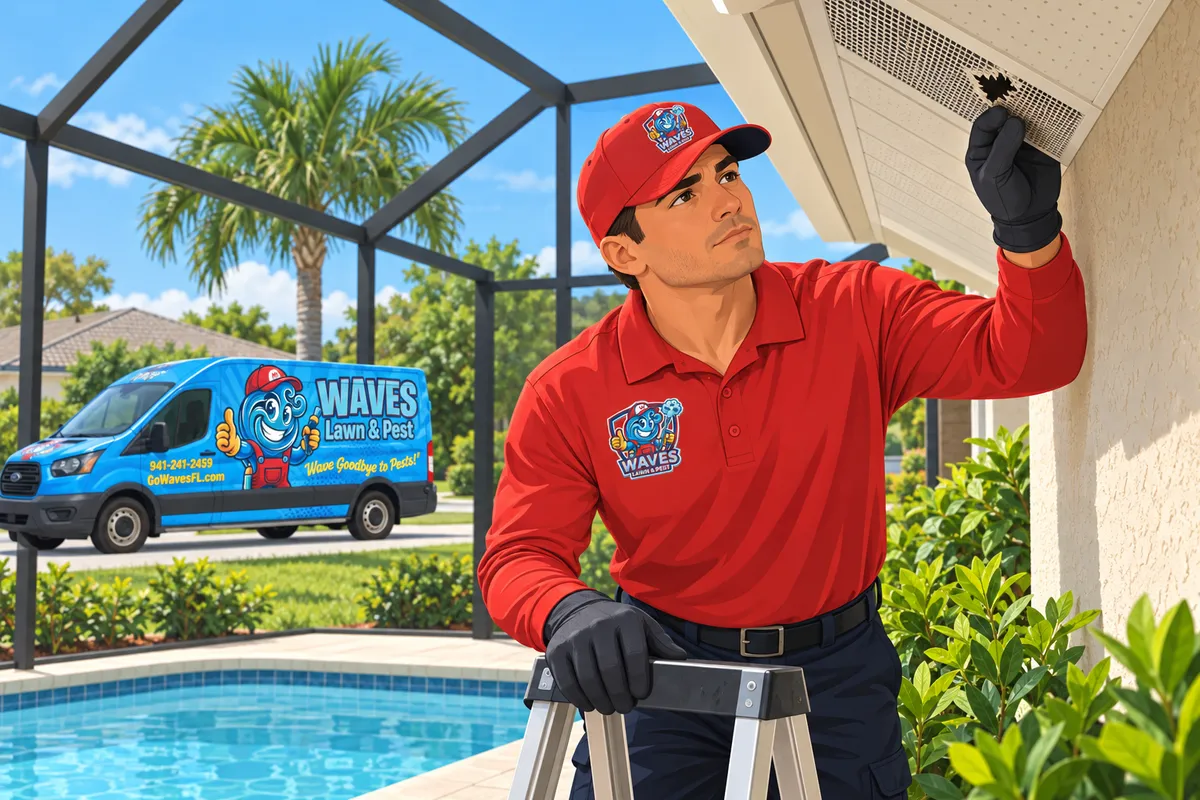
Our approach starts with finding the way in. A Waves Pest Control rodent inspection walks the exterior roofline, including the soffits, vents and A/C line penetrations, then checks the attic for runways, droppings and nesting. Every entry point we find is photo-documented, and those photos drive the exclusion plan.
Exclusion is the core of the service: entry points get sealed with rodent-proof materials such as hardware cloth, sealant, vent covers and door sweeps. Rats already inside are removed with interior trapping, and tamper-resistant exterior bait stations monitor for new pressure. On roof rat jobs we also tell you which tree limbs to cut back so the rats lose their route to the roof. For a green palm frond that rests on the roof, ask a certified arborist.
Seeing fronds on the roof and droppings below them? Start with rodent control in Sarasota or rodent control in Bradenton, or get a rodent control estimate for your home.