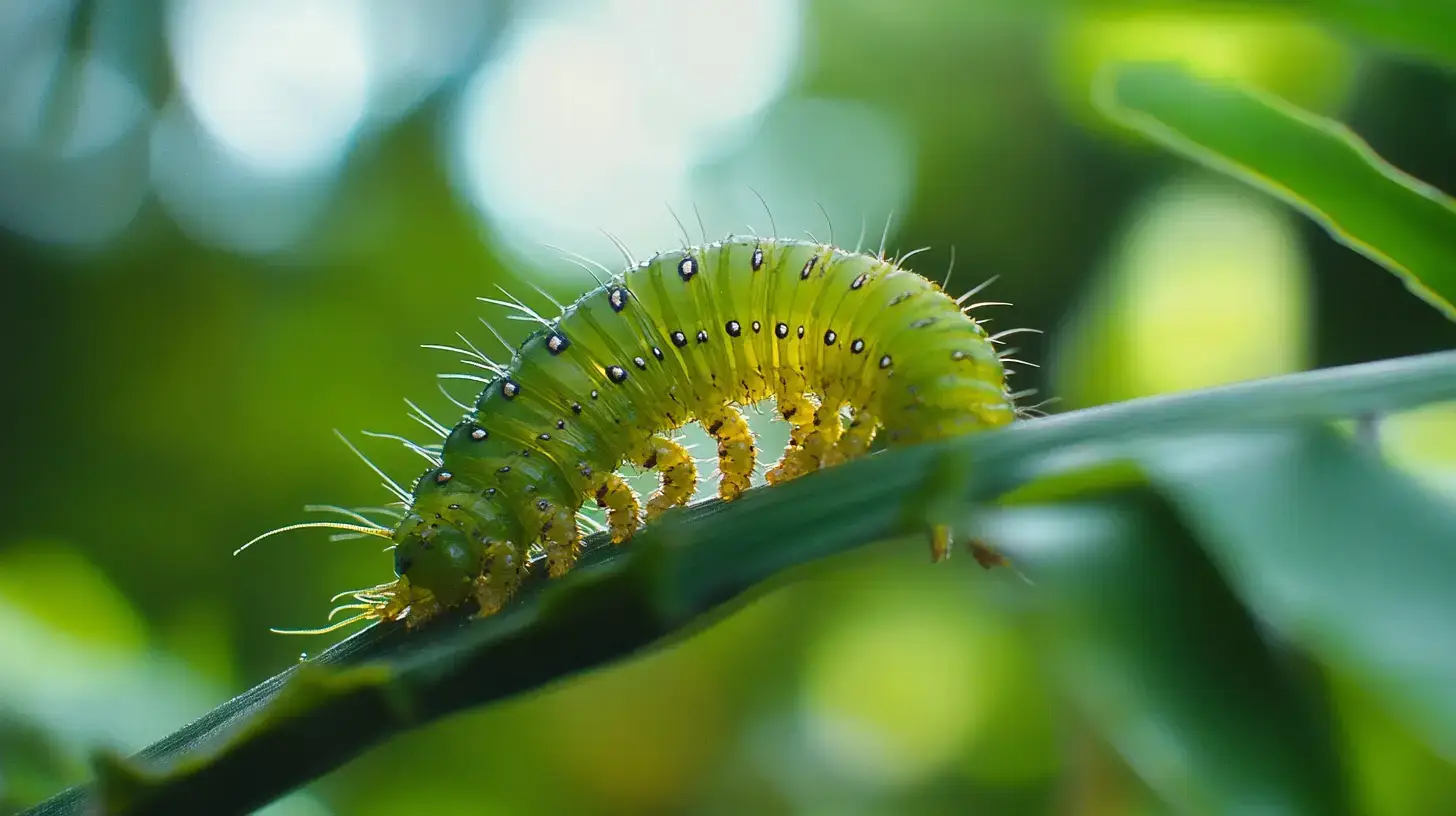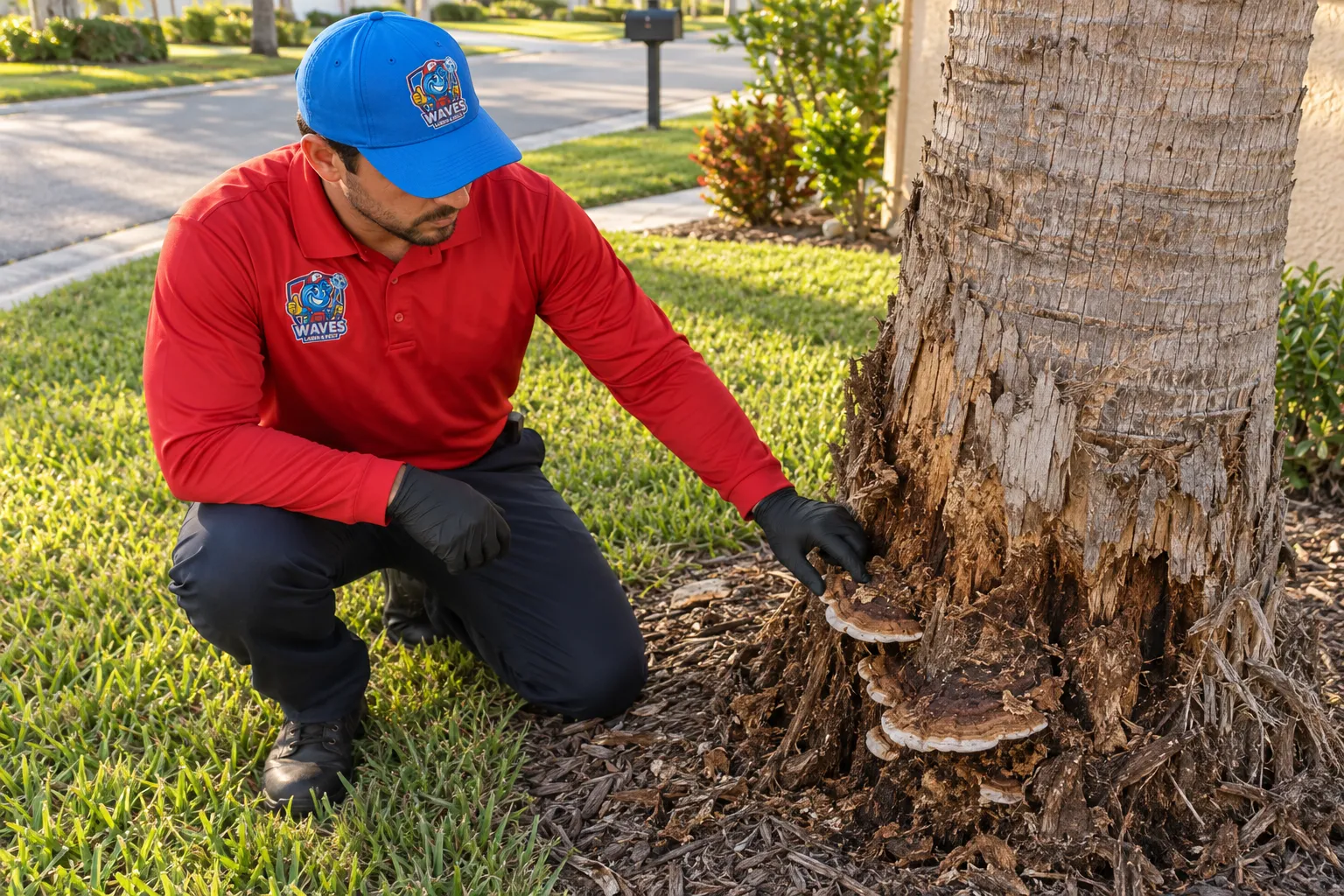
White fuzz packed into the stem joints of a hibiscus, or flat green bumps lined up under croton leaves, usually means a sap-feeding insect has moved in. In a Palmetto yard the two most likely suspects are mealybugs and scale. Both feed on plant sap, both leave sticky honeydew behind, and the tropical shrubs that fill so many Southwest Florida beds are on their host lists. This guide covers how to tell them apart, what the damage looks like, and what UF/IFAS says about managing them. For an overview of shrub and tree care in town, see our page on tree and shrub care in Palmetto.
If you would rather have someone confirm which insect you have before you spray anything, you can request a tree and shrub care quote.
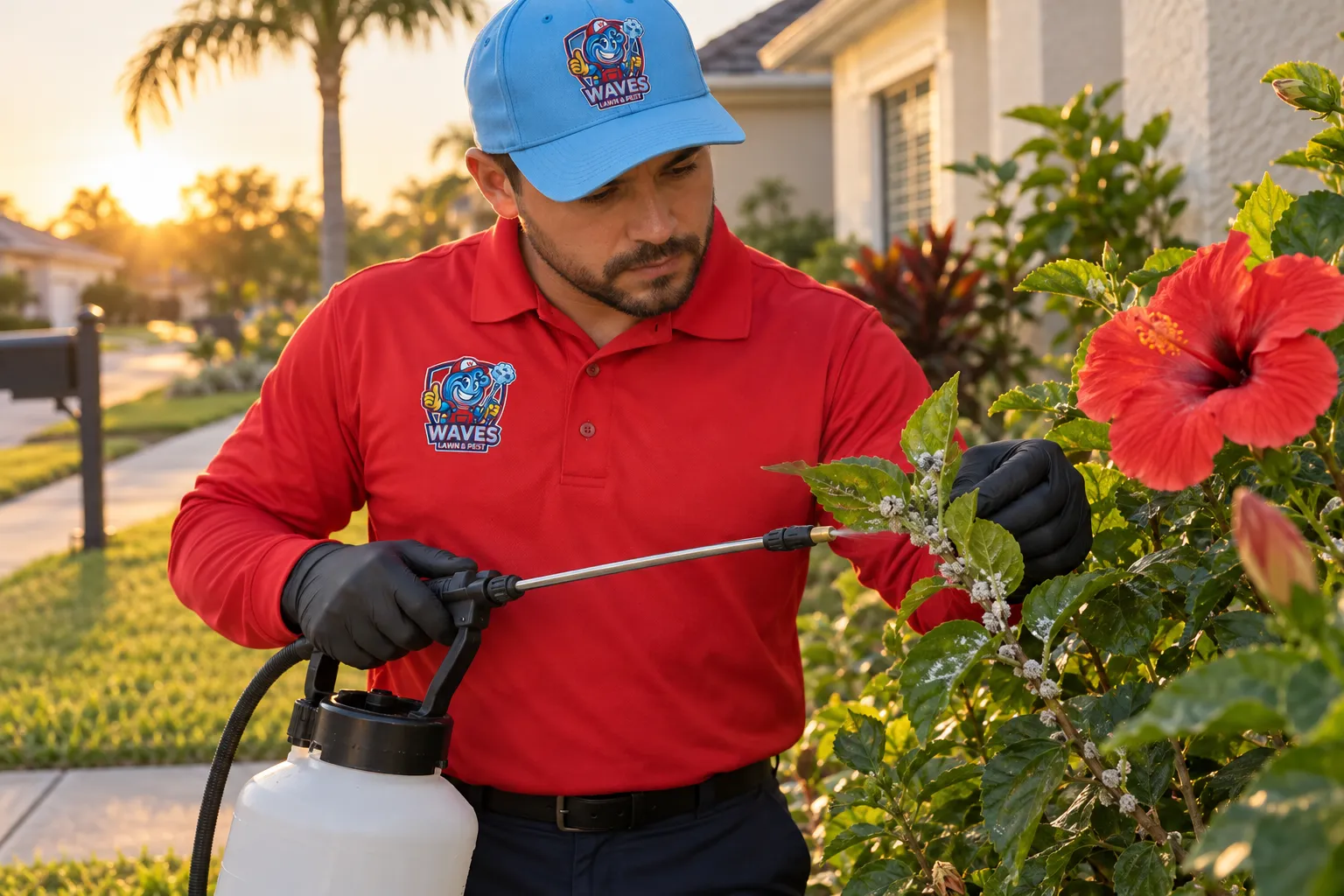
Mealybugs and scale side by side
Mealybugs look like small tufts of white cotton. Scale insects look like bumps stuck to the leaf or stem. Here is how UF/IFAS describes each one.
Mealybugs. UF/IFAS Extension in Charlotte County says mealybugs “cover themselves with white waxy coatings and filaments” and stay mostly in plant “nooks and crannies,” including the roots (Charlotte County Extension). The pink hibiscus mealybug is one species UF/IFAS profiles. Its adults are about 3 mm (about 1/8 inch) long, with a pink body under the white wax (UF/IFAS EENY-029).
Croton scale. This is a soft scale. UF/IFAS describes adult females as about 4 mm long and 2 mm wide, yellow-green to green, with dark markings. They “can be found aggregating densely on the underside of host plant foliage” (UF/IFAS EENY-768).
A quick way to sort them in the yard:
- White, cottony or waxy fluff in stem joints, leaf bases or new growth points to mealybugs.
- Watch the fluff for a few seconds before you spray. A white tuft that is bigger, fuzzier and walks quickly through the colony is likely a mealybug destroyer larva, a lady beetle that eats mealybugs. Leave it alone. Mealybugs are smaller and stay clustered in place.
- Flat, oval green or yellow-green bumps in rows under the leaves point to a soft scale such as croton scale.
- Many other scale species exist, and some look nothing like croton scale. Treat this as a clue. A sample checked by a professional or your county extension office confirms it.
Why crotons, hibiscus and gardenias get hit
These shrubs are on the published host lists for these insects, and they are common in Southwest Florida landscapes. UF/IFAS lists croton, hibiscus, ixora, oleander and bougainvillea among the ornamental hosts of the pink hibiscus mealybug (EENY-029). UF/IFAS records 72 host plant species from 34 plant families for croton scale (EENY-768).
UF/IFAS Gardening Solutions names mealybugs, aphids, scales and whiteflies as problem pests on gardenias. It says crotons are usually pest-free but can occasionally have mealybugs and scales, and it tells you to scout hibiscus regularly for aphids, whiteflies and mealybugs.
Location is not proof either way. UF/IFAS first found the pink hibiscus mealybug in Broward County in 2002, and its croton scale records name other Florida counties. Neither page lists Manatee County, and those records are years old. So a Palmetto yard can’t rule either insect in or out by address alone. Look at the plant.
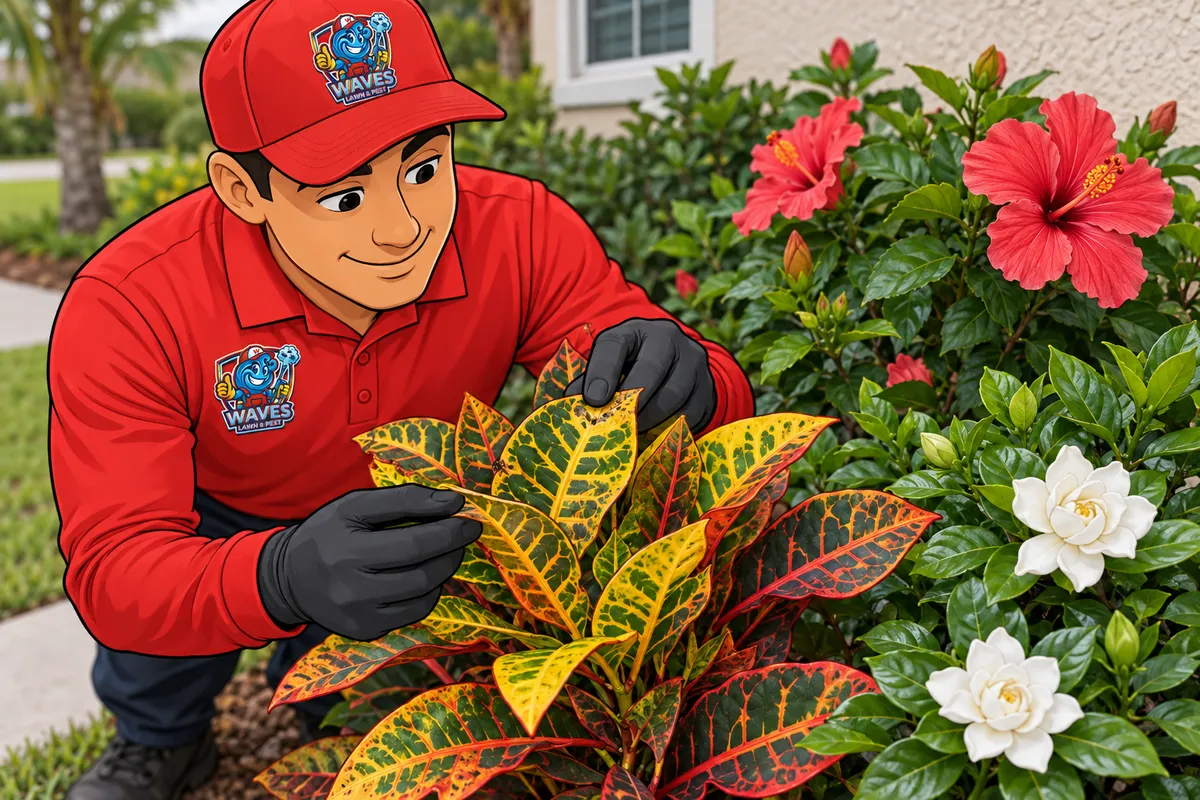
The damage chain: sap, honeydew and sooty mold
Both insects drain sap, and the sugary waste they leave turns leaves black. UF/IFAS says the pink hibiscus mealybug injects a toxic saliva that causes “curling and contortion of leaves.” It usually infests young twigs, which leads to deformed tips, shortened growth between leaves and thickened twigs (EENY-029).
The honeydew is the second problem. Croton scale “produces large amounts of honeydew,” per UF/IFAS, and sooty mold grows on that coating. A heavy layer of mold blocks light from the leaf and cuts photosynthesis (EENY-768). Charlotte County Extension calls the mold itself benign. The fix for black leaves is to manage the insects making the honeydew.
Ants are part of the picture. UF/IFAS says ants protect scale from natural enemies so they can feed on the honeydew, and it suggests you “follow the ants’ path on your plant” to find the colony (EENY-768).
Early scouting: where to look
Check the undersides of leaves, the joints where leaves meet stems, and the soft new growth at the tips. Charlotte County Extension’s advice is to monitor often and spot-treat small infestations before they get out of hand.
- Flip a few leaves on each shrub. Croton scale clusters under the foliage.
- Look into stem joints and flower buds for white fluff.
- Watch for shiny, sticky leaves or a black film on leaves, the patio or a car parked under a tree.
- Follow any ant trail up the stem.
- Inspect new plants before they go in the ground. Charlotte County Extension says mealybugs often arrive on a new plant, and the tiny first stage, called a crawler, is easy to carry in unseen.
Pro tip: Snap a close photo of the insects and of the leaf top and bottom before you treat. If you bring a sample to the extension office or a pro, the photo and a cut stem in a sealed bag make identification much faster.
Healthy, well-placed shrubs are easier to keep an eye on. Our guide to mulch placement around Southwest Florida shrubs covers the basics of bed setup.
Management per UF/IFAS: oils, soaps and the insects worth protecting
Start with identification, then use the gentlest option that fits the insect. UF/IFAS stresses that you need to “correctly identify the scale insect pest” to pick an effective natural enemy and an appropriate chemical treatment (EENY-768).
Horticultural oils and insecticidal soaps. UF/IFAS says horticultural oils “work best against small, soft-bodied insects such as aphids, whitefly nymphs, mealybug nymphs, and scale insect nymphs.” Oils must fully coat the insect, so you need thorough coverage of the leaf undersides. Insecticidal soaps “must contact the insect directly to be effective,” and the dried residue has no effect (UF/IFAS ENY-350). That is why timing matters. The young stages are the ones these products reach best, so check the plant again after a spray and repeat only as the label allows.
A few cautions from the same UF/IFAS guide and Gardening Solutions:
- Avoid oil sprays when it is above 90°F. Charlotte County Extension also says not to spray in the heat of the day, since it can burn the leaves.
- Do not use oils on waxy succulents or other plants the label lists as sensitive.
- Avoid soaps on drought-stressed plants or above 90°F, per Gardening Solutions.
- Read and follow the product label every time. Keep the spray off food-preparation and food-contact surfaces, and store and apply it out of sight and reach of children and pets.
Systemic options. UF/IFAS says insecticide effectiveness against croton scale “has not been thoroughly investigated” (EENY-768). That leaves a systemic product as a choice to make with a licensed professional who has confirmed the species, following the product label.
Beneficial insects. Natural enemies do real work here. UF/IFAS names a lady beetle that eats croton scale. For the pink hibiscus mealybug, UF/IFAS says the lady beetle Cryptolaemus montrouzieri feeds on all stages, though it is not expected to control low populations well. Charlotte County Extension says “mealybug destroyers,” a lady beetle larva, “do a fair job of controlling mealybugs.” Oils leave no residue once dry, which UF/IFAS notes limits their effect on these helpers. Gardening Solutions also warns that misapplied natural products can kill good bugs too (oils guide). Spot-treat the infested branch instead of the whole bed.
What not to do: don’t hose the entire landscape with a broad spray at the first white tuft, and don’t skip identification. Charlotte County Extension notes that a heavily infested plant may need to be removed entirely.
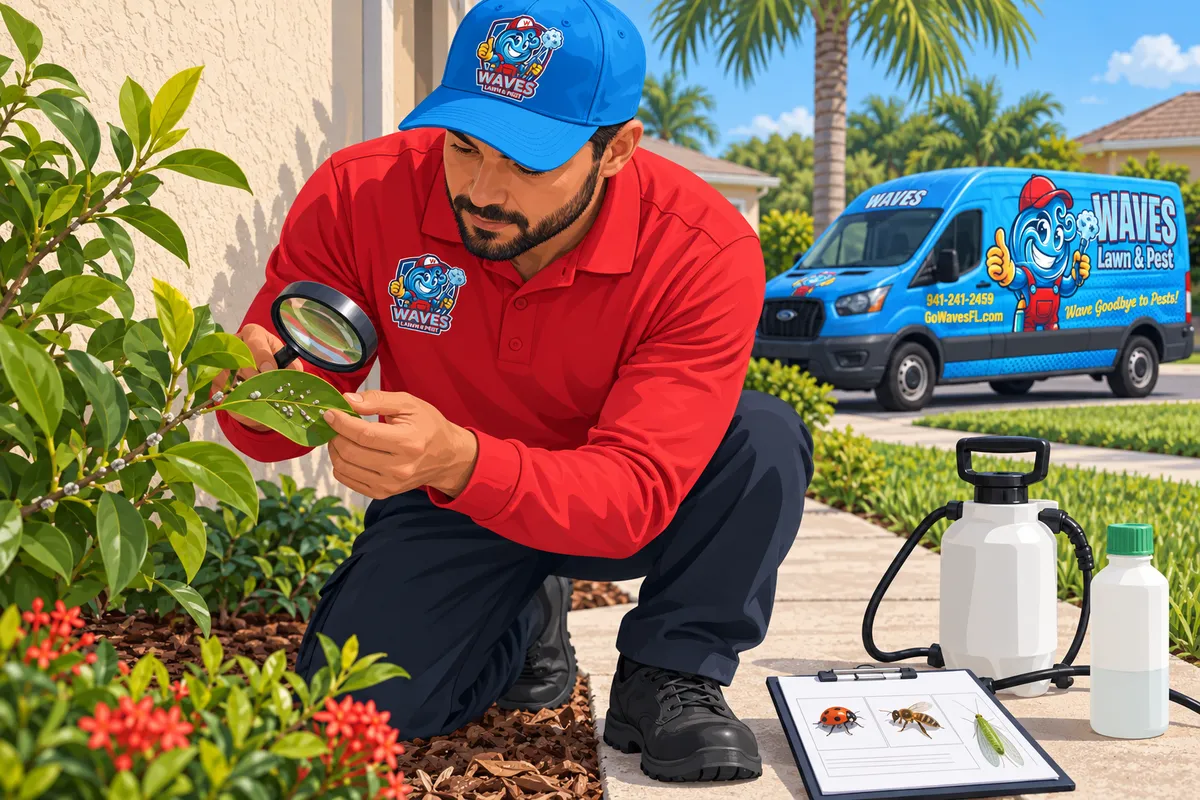
When it keeps coming back every season
If the same shrubs get sticky and black year after year, the colony is surviving your treatments or moving back in from nearby plants. UF/IFAS reports the pink hibiscus mealybug can complete its life cycle in 23 to 30 days and reach up to 15 generations a year (EENY-029). One missed pocket can rebuild fast.
Call a professional when:
- You see the insects again within weeks of a careful round of oil or soap.
- The shrub is losing new growth or tips stay twisted.
- The plant is too big to cover, or the infestation has spread across several beds.
- You can’t tell what the insect is.
A pro can confirm the species and work out a plan around the label and your plants. You can also bring a sample to your county extension office. To have Waves Pest Control look at it, request a tree and shrub care quote.