You walked past the palm by the driveway and saw something that looks like a glazed dinner roll growing out of the trunk. That growth is called a conk. On a palm in Lakewood Ranch it points to one disease, Ganoderma butt rot, and the plan from here is about removal, the stump and what you plant next. Everything below comes from the UF/IFAS publication Ganoderma Butt Rot of Palms by Monica Elliott and Timothy Broschat. For the shrubs, ornamentals and palms that are still healthy, see our tree and shrub care in Lakewood Ranch page, or request a tree and shrub care quote.
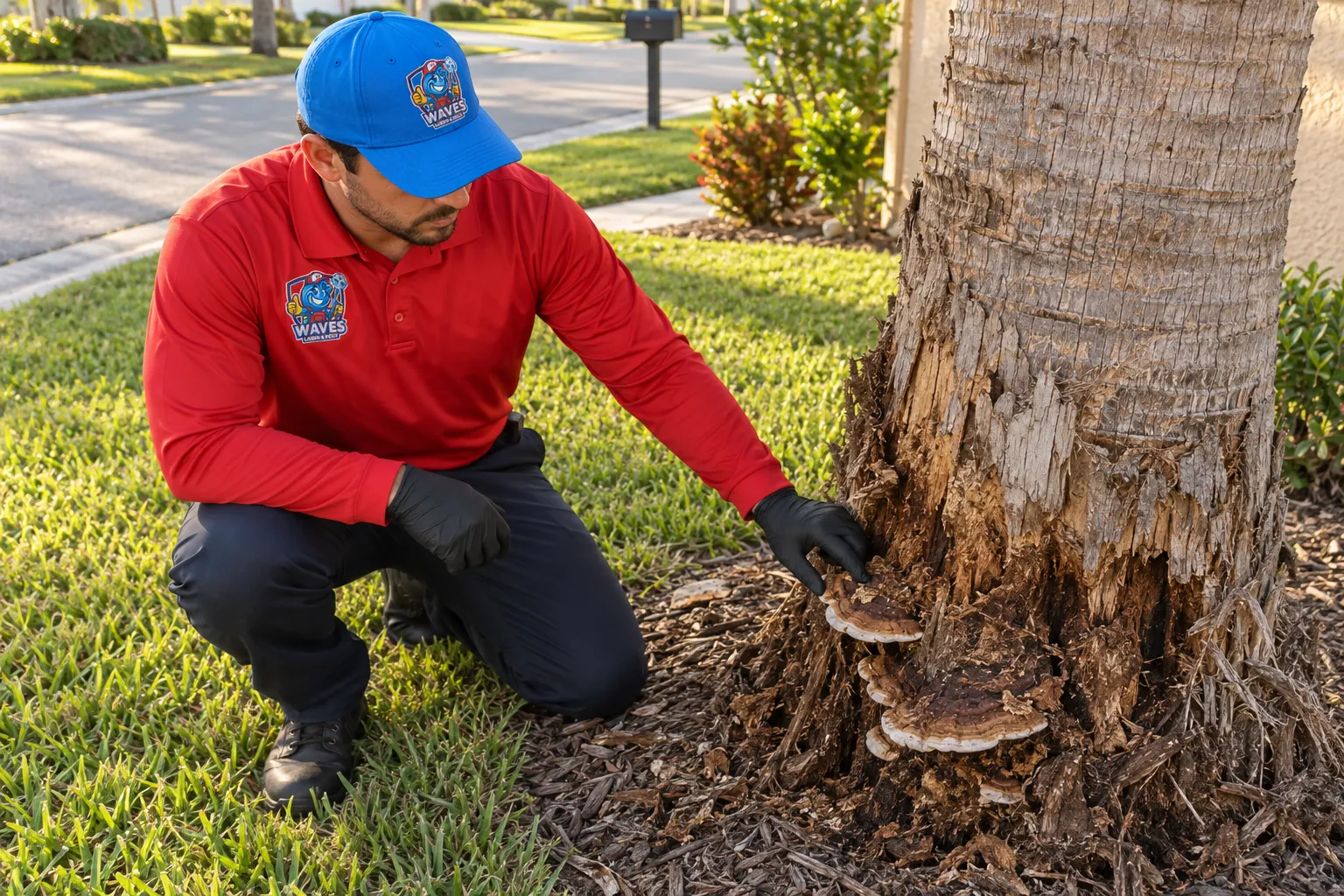
What the conk looks like and where it forms
A Ganoderma conk starts as a soft white lump and hardens into a reddish-brown shelf on the lower trunk. UF/IFAS describes the stages this way:
- Early: “a solid white mass that is relatively soft when touched,” on the side of a palm trunk or a palm stump.
- Mature: a distinct shelf that is quite hard, with a glazed reddish-brown top and a white underside.
- Size: up to 8 inches at the widest point and 2 inches thick.
- Location: the lower 4 to 5 feet of the trunk, which is the same section the fungus decays.
UF/IFAS says that if you see a conk on a palm trunk, especially a palm that is still alive, it is “probably safe to assume” the fungus is Ganoderma zonatum. A conk is a strong clue. The other way UF/IFAS confirms the disease is the discolored wood inside the trunk after the palm is cut down.
Other signs to look for are less specific. UF/IFAS lists wilting of all leaves except the spear leaf, slower growth and off-color foliage. Plenty of other palm problems cause those too, so check the base of the trunk before you blame the fertilizer.
What is happening inside the trunk
The fungus rots the woody tissue in the lower 4 to 5 feet of the trunk, and you cannot see it from outside. UF/IFAS calls Ganoderma zonatum a white rot fungus that degrades lignin. It does not cause a soft rot, so the trunk still seems hard when you press or knock on it.
That is why a palm with a full green canopy can still be a hazard. The decay sits at the base, where the trunk carries the load. UF/IFAS says these palms “are likely to be the first blown down in heavy winds,” and the publication includes a photo of a royal palm that fell on a house. Afternoon storms in Southwest Florida supply the wind.
UF/IFAS also says many diseased palms never produce a conk before they die. A palm with no conk has not been cleared.
The hard truths, per UF/IFAS
There is no treatment for this disease. The UF/IFAS wording is direct: “There are currently no cultural or chemical controls for preventing the disease or for curing the disease once the palm is infected.”
Three points follow from that sentence:
- No chemical cure. Do not pay for a fungicide drench or a trunk injection sold as a cure for Ganoderma. UF/IFAS lists no chemical control for it.
- No preventive. UF/IFAS has observed no growing conditions that favor the disease. It shows up on well-fed palms and stressed palms, in well-drained sites and in swamps. Soil type shows no relationship either, so the sandy soil under your St. Augustine lawn neither caused it nor protects the next palm.
- The palm should come down. UF/IFAS says “the palm should be removed” once a conk is observed, “primarily for safety reasons.”
UF/IFAS also says wounds are not a likely factor, and neither are mulch against the trunk, irrigation heads hitting the trunk or plants growing close to it. You did not cause this with a string trimmer.
Pro tip: UF/IFAS says to remove a conk as soon as it forms, because the earlier it comes off, the less likely it is to release spores. One conk can produce 3 cups of spores. Put the conk in trash that goes to a landfill or an incinerator. Do not put it in yard waste that gets recycled into the landscape.
Why the stump and soil matter
The fungus stays in the stump, the roots and the soil after the palm is gone, so a new palm in the same spot is a gamble. UF/IFAS says spores get into the soil, germinate and grow over palm roots, and that the fungus is “probably capable of living in the soil almost indefinitely.”
UF/IFAS gives these steps for the removal:
- Remove as much of the stump and root system as possible, or grind the stump.
- If neither is possible, watch the stump for conks and remove each one as soon as it forms.
- Do not chip the lower trunk section for mulch. UF/IFAS says to send the diseased section to a landfill or an incinerator when possible.
On replanting, UF/IFAS says “replanting with another palm is risky.” Replacement palms planted where a palm died of this disease have also become diseased and died. Nobody knows how long to wait before a palm can go back in that spot. UF/IFAS says the time “is measured in multiple years, not months.”
The better answer is a different kind of plant. UF/IFAS says Ganoderma zonatum affects only palms, and that replacing the diseased palm “with any other plant except a palm would be a wise choice.” A shade tree or a flowering shrub can take the spot.
The neighborhood angle in Lakewood Ranch
One diseased palm changes how often you should look at every other palm on the property. UF/IFAS says to check palms once every six months on a property that has never had the disease. After you have seen a conk, or after any palm has been cut or has fallen, check at least once a month.
Lakewood Ranch plants palms close together along entries, streets and pool decks. All palms are assumed to be susceptible, according to UF/IFAS, which has records of the disease on at least 65 palm species. If the palm with the conk sits near a lot line, tell your neighbor. If your community association maintains palms in a common area, tell the association or its landscape manager and send a photo.
Here is a monthly check you can do in five minutes:
- Walk the base of every palm and look at the lower 4 to 5 feet of trunk on all sides.
- Look for a white lump or a brown shelf. Check old palm stumps too.
- Watch for a palm whose older leaves wilt or droop while the spear leaf stays normal.
Here is what not to do:
- Do not leave a conk in place to see what happens.
- Do not hang a hammock or a swing from a palm that has a conk.
- Do not plant a new palm in the hole the old one left.
Assessment and removal are professional jobs
Removing a palm with a decayed base is work for a qualified, insured tree professional. Do not cut it down yourself. The trunk has lost strength in the section where a cut would go, and the palm may stand near a roof, a pool cage or a street.
When you call a tree professional, ask how they will handle the stump, where the lower trunk section goes and whether the conks leave the property in the trash. Those questions come from the UF/IFAS steps above. Removal of a diseased palm in a common area usually goes through the association, so check your community’s process before you schedule anything.
Waves Pest Control wrote this guide so you can recognize the conk and act on it early. For the rest of the landscape, our lawn care in Lakewood Ranch page covers the turf side. For cost questions on palms and shrubs, request a tree and shrub care quote or use the tree and shrub quote form.