Placement and depth decide whether mulch helps your shrubs, more than the bag you pick. UF/IFAS Gardening Solutions gives two numbers in its guide to choosing and installing mulches: mulch to a depth of 3 inches, and leave the base of every plant clear. Most beds in Bradenton and Sarasota get the first number roughly right and miss the second one.
This guide covers how to check the beds you already have, which organic mulch fits, and how much to buy. For the plants themselves, see our tree and shrub care in Bradenton page. If you want to know whether a shrub problem is something we handle, request a tree and shrub care quote and we will confirm the scope first.
What UF/IFAS says about depth
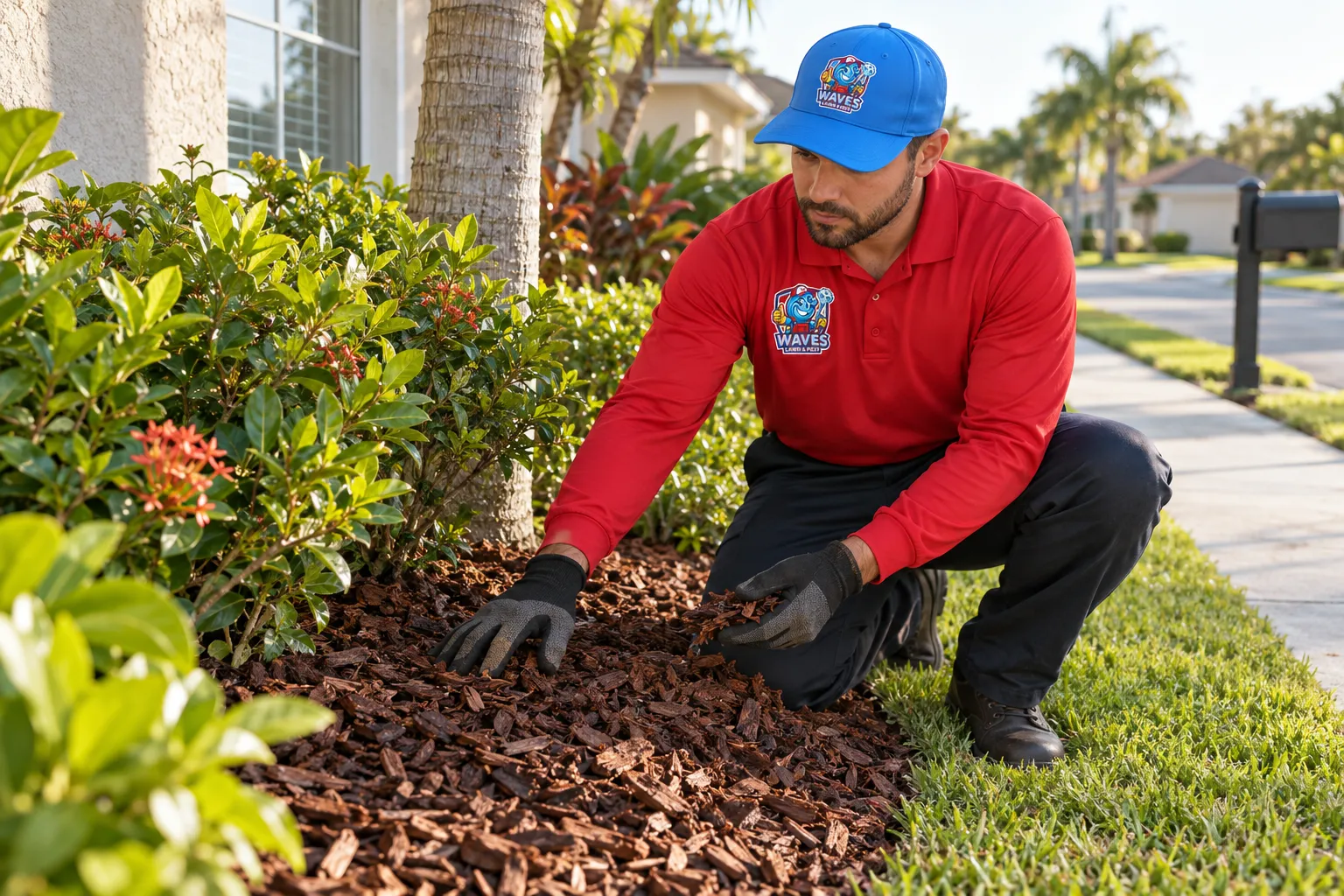
The standard depth is 3 inches, with a shallower layer for small plants. UF/IFAS Gardening Solutions states that Florida-Friendly Landscaping “recommends mulching to a depth of 3 inches.” The exceptions it gives:
- Seedlings, small vegetables and herbs: mulch only 1 inch deep so growth is not inhibited.
- Topping up: when the depth falls below 2 inches, add another thin layer on top of the existing bed.
- Matted mulch: some mulches mat and stop water and air from getting through. UF/IFAS says to rake older mulch lightly to fix that.
UF/IFAS lists the reasons to bother. Mulch conserves water, suppresses weeds, controls erosion and buffers roots from extreme temperatures. In sandy soil that dries out a day after an afternoon storm, the water part matters most.
How to tell a mulch mound from correct placement
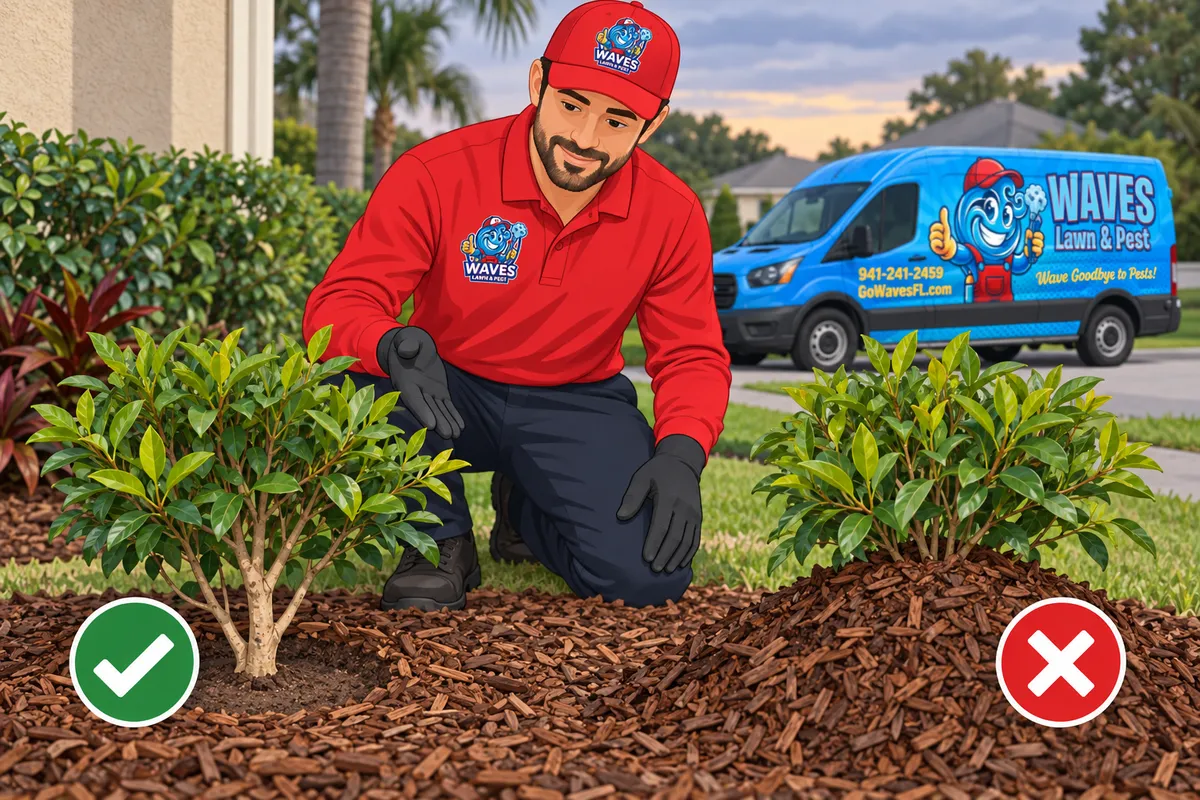
Correct placement leaves bare ground around the base of the plant, and a mound buries it. UF/IFAS gives the gap by plant size:
- Large plants and trees: place the mulch about 1 foot from the base.
- Smaller plants: leave a couple of inches free of mulch around the base.
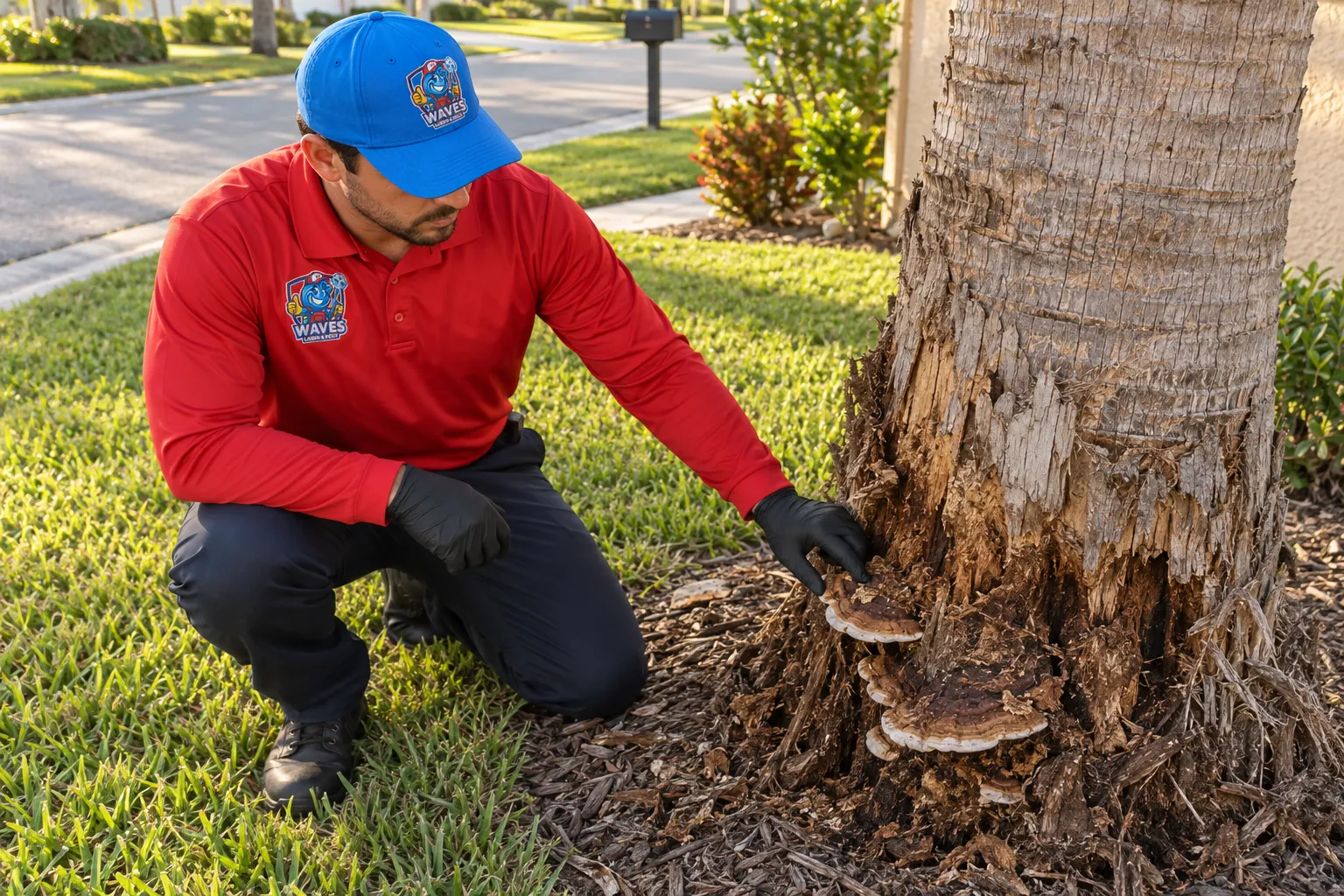
The mound has a name, volcano mulching. UF/IFAS says to avoid it for this reason: “When mulch is piled against the base of a tree, it holds moisture. This encourages rot in the trunk.” It adds that mulch piled against the trunks of young trees may create a habitat for rodents.
Picture a correct bed from the side. Read it from the stem outward:
- The stem or trunk, with no mulch touching it.
- A ring of bare soil. A couple of inches wide on a small shrub, about 1 foot on a large plant or tree.
- A flat, even layer of mulch 3 inches deep that covers the rest of the bed.
A mound is the reverse of that picture. The mulch is deepest against the stem and thins out toward the edge of the bed.
Pro tip: check depth with a ruler, not your eye. Push the ruler down to the soil in three spots per bed. Fresh mulch looks deeper than it is, and old mulch looks thinner.
Check your beds in ten minutes
You can inspect every bed with a ruler and your hands. Walk the beds and look for these:
- Mulch touching a stem or trunk. Pull it back by hand until you see the gap UF/IFAS describes.
- Depth over 3 inches. Rake the extra out to thin spots.
- Depth under 2 inches. Add a thin layer.
- A crust on top. Rake it lightly so water gets through.
Here is what not to do:
- Do not add a fresh full layer every year without measuring. That is how a 3-inch bed turns into a 6-inch bed.
- Do not pile mulch against a trunk to hide surface roots or a graft.
- Avoid judging a shrub’s health from the mulch alone. A mound is a placement problem you can see and fix. Whether it has harmed the plant is a separate question that a photo cannot answer.
Mulch placement is a plant-care step. This guide makes no claim that it controls insects or brings back a shrub that is already declining.
Organic mulch choices compared
UF/IFAS describes several organic mulches and how fast each one settles. The table below repeats only what the UF/IFAS Gardening Solutions page states.
| What to weigh | Pine bark | Pine straw | Melaleuca | Eucalyptus | Mixed hardwood |
|---|---|---|---|---|---|
| Where it comes from | Byproduct of the forest industry | Managed pine forests | An invasive tree species, cured at high temperature to kill seeds | Farms in South and Central Florida, considered renewable | Scrap lumber, recycled pallets and small tree stems |
| How fast it settles | Slowly. Kept two-thirds of its depth after two years in one UF/IFAS study | Quickly. Expect to re-mulch often | Very slowly. Outlasted pine bark and cypress in one UF/IFAS study | Slightly less durable than cypress, longer-lasting than pine straw | Faster than pine bark, much slower than pine straw |
| What to know first | Sold as ground pieces or nuggets | Needles knit together, so it is not likely to wash away | Looks like hardwood or cypress mulch | Grown specifically for mulch | Can carry CCA from treated lumber. Look for the Mulch and Soil Council logo |
Source: UF/IFAS Gardening Solutions, Choosing and Installing Mulches. Cells restate that page and are not Waves test results.
Two mulches are left out of the table on purpose. The Florida-Friendly Landscaping program does not recommend cypress mulch, because it may be sourced from endangered wetlands. Rock, gravel and shell are not recommended around plants, per UF/IFAS, since they add nothing to the soil and do not balance soil temperature.
How to choose a mulch for your beds
Pick by how the bed behaves, then by looks. No option wins for every yard.
- If the bed sits on a slope or under a roof edge with no gutter, pick pine straw. UF/IFAS says the needles knit together and are not likely to wash away.
- If you want to top up as rarely as possible, choose melaleuca or pine bark, the two UF/IFAS describes as slow to settle.
- If the bed is near an herb or vegetable garden, use mixed hardwood only when the bag carries the Mulch and Soil Council certification logo.
- If you rake up a pile of oak leaves every winter, use them. UF/IFAS says fallen leaves are free and high in nutrients. They break down fast, so plan to rake more in.
How much to buy: a worked example
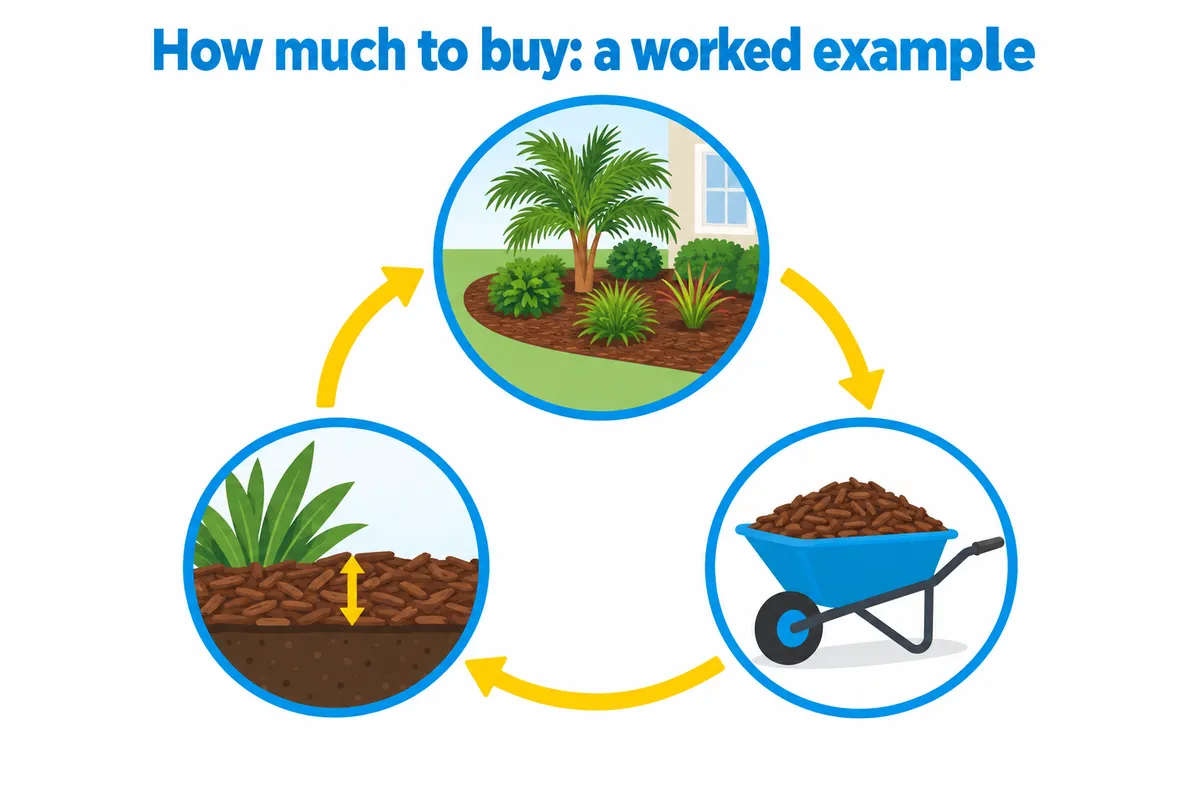
Multiply the bed area by the depth in inches and divide by 324. UF/IFAS gives the rule: one cubic yard of mulch covers 324 square feet at 1 inch deep, or 108 square feet at 3 inches deep.
Here is a hypothetical bed. The numbers are made up for the example and are not from a customer’s yard.
- The bed is a rectangle 20 feet long and 6 feet wide. 20 x 6 = 120 square feet.
- You want 3 inches of mulch. 120 x 3 = 360.
- 360 divided by 324 = 1.1 cubic yards.
For a round bed, UF/IFAS says to measure from the center to the edge, multiply that number by itself, then multiply by 3.14. Split an odd-shaped bed into rectangles and circles and add them up. If the bed already holds 2 inches of old mulch, you are buying for 1 inch, not 3.
When a shrub is declining and you are not sure why
Fix the placement, write down what you see, and ask someone qualified to look. Mulch is one of several things that can go wrong around a shrub in Southwest Florida, and guessing leads to the wrong fix.
Before you call anyone, record these:
- The mulch depth at the stem and at the edge of the bed, in inches.
- Whether mulch was touching the stem, and for how long if you know.
- Which parts of the plant look off, and when you first saw it.
- How often the irrigation runs on that zone.
Then have a professional assess the plant in person. Waves Pest Control can tell you whether the problem falls inside our tree and shrub service or belongs with an arborist or a landscape installer. Get a tree and shrub care quote and include your notes and a few photos.