Jump to a section (6)
Step out onto your lawn barefoot in February, feel a sharp little bur stab your heel, and congratulations, you’ve met lawn burweed. Here’s the annoying part. The plant that got you already lived through your entire winter. It germinated back in the fall, grew low and quiet in your St. Augustine while nobody noticed, and saved the spiny payback for spring.
That timing is the whole story with this weed, and it’s why so many Southwest Florida homeowners lose to it every year. According to UF/IFAS Extension, burweed (Soliva sessilis) is a winter annual: it sprouts as temperatures cool in fall, creeps along through the cool months, then forms those hard, spiny burs in spring before the plant dies off. By the time your feet find it, the plant has already done its job and set next year’s seed.
Adam Benetti, who founded Waves after a career in technology and medical-device sales, wrote this guide so you can get ahead of next year’s crop. If you’d like a technician to look at your lawn, you can request a lawn care quote. Want to see how a full turf program runs? Our Bradenton lawn care page walks through it.
Why spring treatment misses the burweed window
By spring the plant has already made the burs, and that’s the part that hurts. UF/IFAS is blunt about it. Once the burs have formed, control isn’t feasible anymore. The plant has set seed, which guarantees a fresh crop next fall, and killing the leftover foliage does nothing to pull the burs out of your turf. Spraying in March scratches your I-did-something itch and little else.
There is a smaller, earlier post-emergent window that does work. UF/IFAS says post-emergent products land hardest while burweed plants are young, small, and actively growing, during the winter before the burs harden. Treat then and you’re dealing with a soft little seedling instead of a mature seed factory. Wait until you can feel it and you’ve waited too long.
One more thing UF/IFAS wants you to know. Mowing burweed down doesn’t fix it. It buries and scatters the seed, which just sets up next fall’s germination.
The fall pre-emergent window, and why you watch the thermometer
The dependable move is a fall pre-emergent, put down before the seed germinates. A pre-emergent doesn’t kill a plant that’s already up. It stops the seed from establishing in the first place, which UF/IFAS says can greatly reduce the burweed population for the season.
So when do you pull the trigger? This is where you read the weather instead of the wall calendar. UF/IFAS’s Weed Management Guide for Florida Lawns lists lawn burweed among the broadleaf weeds a pre-emergent controls, and for winter annual weeds it says to apply when nighttime temperatures drop to 55 to 60°F for several consecutive days. It puts that at early October for north Florida and late October to early November for central and south Florida. Our nights cool off later than the Panhandle’s do, so watch the overnight lows and get the product down when they settle into that range.
Timing is the hard part, and it’s easy to miss by a couple of weeks. Water matters too, since most pre-emergents need moisture to activate. If you’d rather not gamble on the window, that’s a good reason to have a pro look at the lawn.
What young burweed looks like, and how to scout for it
You can’t beat a weed you can’t find, and young burweed is easy to walk right past. UF/IFAS describes it as a low, spreading winter annual in the sunflower family, also called spurweed or sticker weed. The leaves are finely divided and set opposite along the stem, and they look a lot like tiny parsley or carrot tops. Early on it hugs the ground and forms small mats, which is how it hides in the canopy of a St. Augustine or Bahia lawn all winter.
Why does it show up so reliably down here? Our mild winters hand a cool-season weed plenty of runway, and thin or stressed turf gives the seed the open ground it wants. Sandy Southwest Florida soils drain fast and don’t hold a dense stand of grass together the way heavier soils do, so bare patches left by summer wear, shade, or pest damage turn into prime burweed real estate.
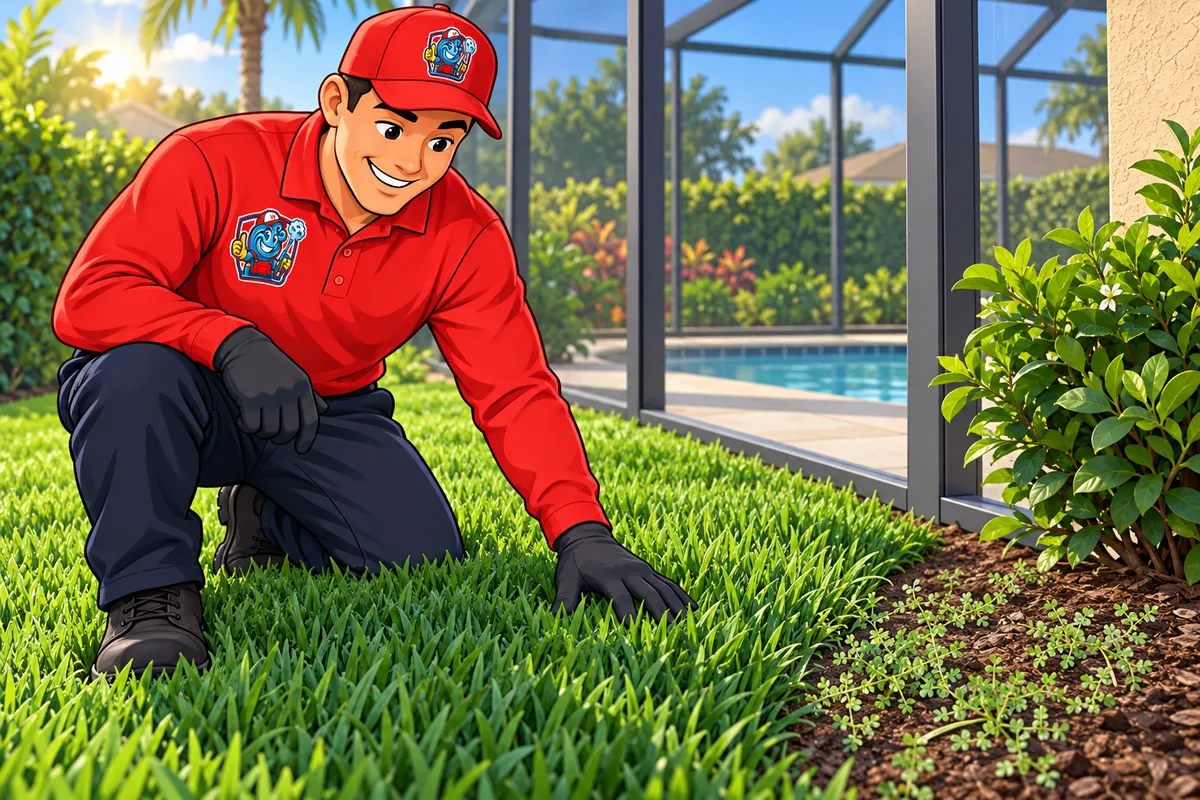
Here’s the hands-on scouting you can do yourself, no chemicals needed. Get down on your knees in late fall and early winter and look closely at the low canopy, paying the most attention to spots that had burweed last spring, since UF/IFAS notes it tends to come back to the same patches. Wear gloves and scout by eye rather than feeling around bare-handed, since a patch can be further along than it looks and a few burs may already be hardening. If you can’t tell what you’re looking at, bag a sample and take it to your county UF/IFAS Extension office for a positive ID before you treat anything.
Pro tip: Flag last spring’s sticker patches or snap a phone photo of them. Those exact spots are where you scout first in the fall, and where a pre-emergent earns its keep.
A few things to skip. Don’t reach for a random bottle of weed killer in the spring heat once the burs are set, because it’s too late to matter and UF/IFAS notes some broadleaf products can injure St. Augustine and centipedegrass, especially at full rates or when temperatures climb. UF/IFAS also cautions against applying most broadleaf herbicides during spring green-up. And don’t just mow it off and call it a win.
If you do treat it yourself, match the product to your grass type, read and follow the label to the letter, keep it off any food-prep surfaces, and store and place it out of sight and reach of kids and pets. When the patches are widespread, the window is tight, or you’re not sure your grass can handle the product, that’s the moment to bring in a pro. On a Waves lawn visit, the technician looks for weeds like burweed and spot-treats what’s there with products labeled for your lawn.
Thick turf gives burweed less room to start
Every UF/IFAS weed guide circles back to the same starting point. A healthy, vigorous lawn crowds out weeds before they get a foothold. Burweed needs open ground and light reaching the soil surface to establish, so a dense canopy that shades that surface leaves a seedling far less to work with.
The boring maintenance stuff matters here. Mow at the right height for your grass type. Water deeply and less often instead of chasing every afternoon storm with the sprinkler. Feeding on a schedule keeps the stand thick, and in our region that means working around the local fertilizer ordinances. Manatee, Sarasota and Charlotte counties prohibit applying any fertilizer containing nitrogen or phosphorus from June 1 through September 30, regardless of concentration, and North Port’s turf blackout starts earlier, on April 1, so check your local ordinance before you spread anything. By the time cool nights arrive and burweed goes looking for a home, you want the canopy already filled in.
Keep your expectations straight, though. A thick lawn is the groundwork that gives your whole weed plan a better shot, and it does its part by denying seedlings the bare, sunlit soil they need. It’s one layer of the plan and sits alongside your seasonal treatments. A shaded or worn-down yard anywhere from Sarasota to Lakewood Ranch will let burweed in regardless, which is why those thin spots deserve the most attention come fall.
Fold burweed into your whole fall weed plan
Burweed isn’t the only thing waking up as the nights cool. That same fall window is when you’d set up your broader pre-emergent program and get ahead of the rest of the cool-season crew. If you’re mapping out the season, our winter weed control in Bradenton rundown covers the other winter annuals that show up alongside burweed, from annual bluegrass to chickweed.
Handled together, one well-timed fall pass does a lot of quiet work through the whole winter. Miss it, and you’re back to post-emergent cleanup in the winter, or pulling stickers out of your socks in March.
Frequently Asked Questions
Why do I only notice burweed in the spring?
Because it does almost all of its growing out of sight. UF/IFAS explains that burweed germinates in fall and stays low and inconspicuous through winter, then produces the hard, spiny burs in spring right before it dies. By the time you feel it underfoot, the plant is near the end of its life cycle and has already dropped next year’s seed.
Can I just pull it or mow it out?
Hand-pulling can work for a tiny patch while the plant is still young and soft. Mowing a mature stand backfires, though. UF/IFAS notes that mowing scatters and buries the seed, which feeds next fall’s germination. For anything beyond a small spot, timed treatment beats trying to yank it out.
It’s already got burs. Is it too late to do anything?
For this season, mostly yes. UF/IFAS says once the burs have hardened, control isn’t feasible, and the burs stay in the turf even if you kill the foliage. Mark those patches now, target the fall pre-emergent window next time around, and remember the young-plant post-emergent option in winter, before the burs form, for the years you catch it early.
Burweed is a timing game, and the fall clock is the one that counts. If you’d like a technician to look at your lawn, request a lawn care quote, or get a lawn care estimate and tell us where burweed keeps turning up.