Jump to a section (9)
- 01Signs of rust on your grass
- 02Why fall is rust season in North Port
- 03How to grow the lawn out of rust
- 04When a fungicide is worth it, and when it is not
- 05Does rust do lasting damage to grass?
- 06How to cut the carryover into spring
- 07What not to do about rust
- 08When to call a professional about rust
- 09Frequently Asked Questions
That orange powder on your shoes after you walk the lawn in November is the classic sign of rust, a fungal disease of lawn grass. UF/IFAS ties it to slow growth: rust turns up from late fall to early spring, when cool weather slows the grass, and it hits hardest on turf stressed by low fertility or shade. So on a North Port lawn, the fix is usually getting the grass growing again, and a fungicide rarely enters the picture. For how a year-round program works on a yard here, see our page on lawn care in North Port.
If you would rather have someone look at the lawn before you buy anything, request a lawn care quote.
Signs of rust on your grass
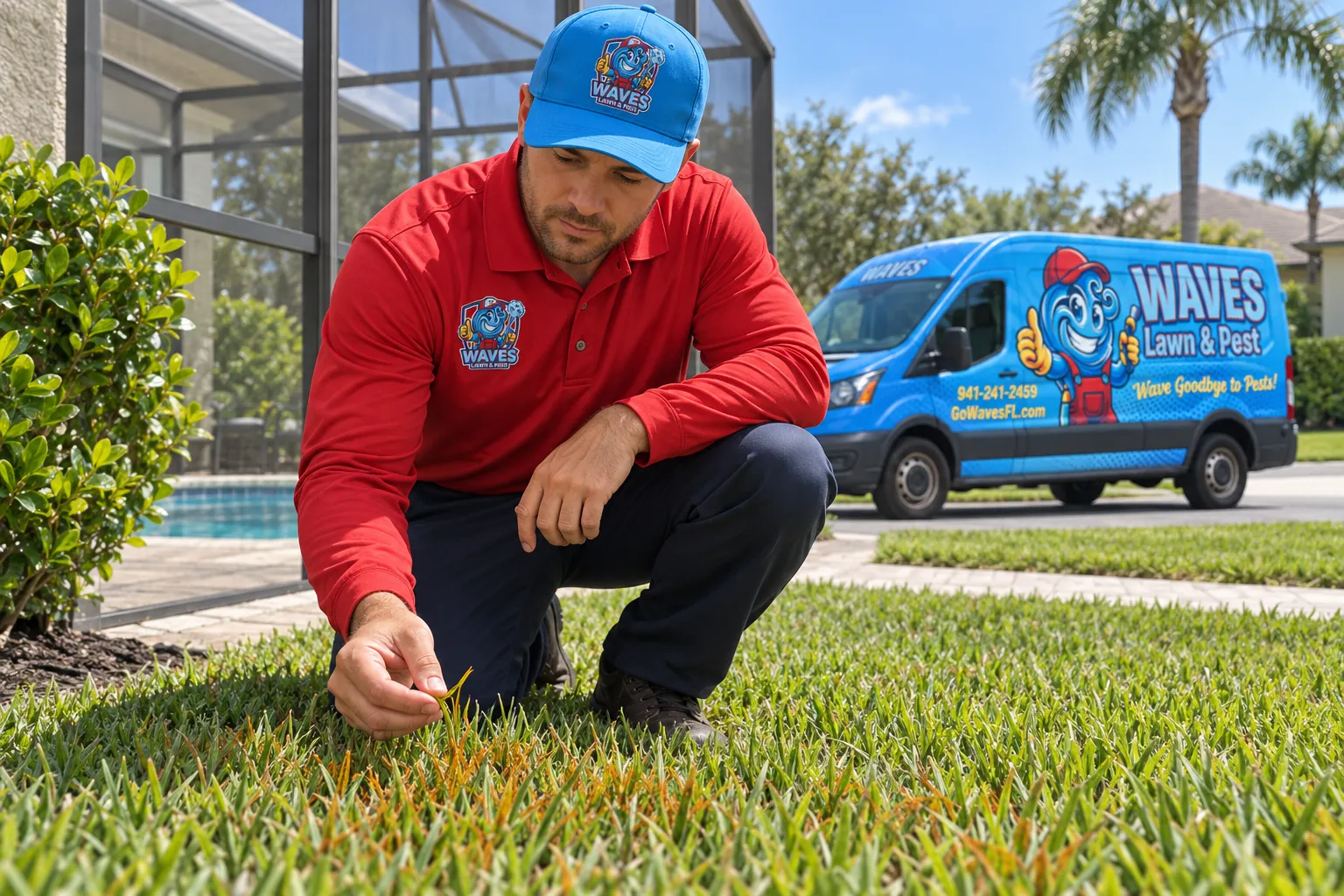
Rust starts as tiny flecks and ends up on everything that brushes the lawn. The UF/IFAS fact sheet on rust, LH051, describes how it builds:
- Light yellow flecks appear on the leaf blades.
- The flecks grow into spots that run parallel to the leaf vein.
- Orange pustules full of spores form on those spots.
- The spores rub off when touched.
That last step is the tell. Anything that moves through the grass, from your shoes to the mower deck to the dog’s paws, can come out dusted orange. Where the infection is heavy, LH051 says the turf looks thin and yellow to light brown.
LH051 names the grasses it affects: St. Augustine and zoysia, plus the perennial ryegrass some people overseed for winter color. That covers a lot of North Port, where Floratam St. Augustine is the usual grass on irrigated home lawns and zoysia shows up in the newer gated communities.
Pro tip: Wipe a white paper towel along a few blades from the worst spot. Orange powder on the towel matches what LH051 describes. If the blades are yellow but the towel comes away clean, look closer before you treat anything, because plenty of other problems turn grass yellow.
Why fall is rust season in North Port
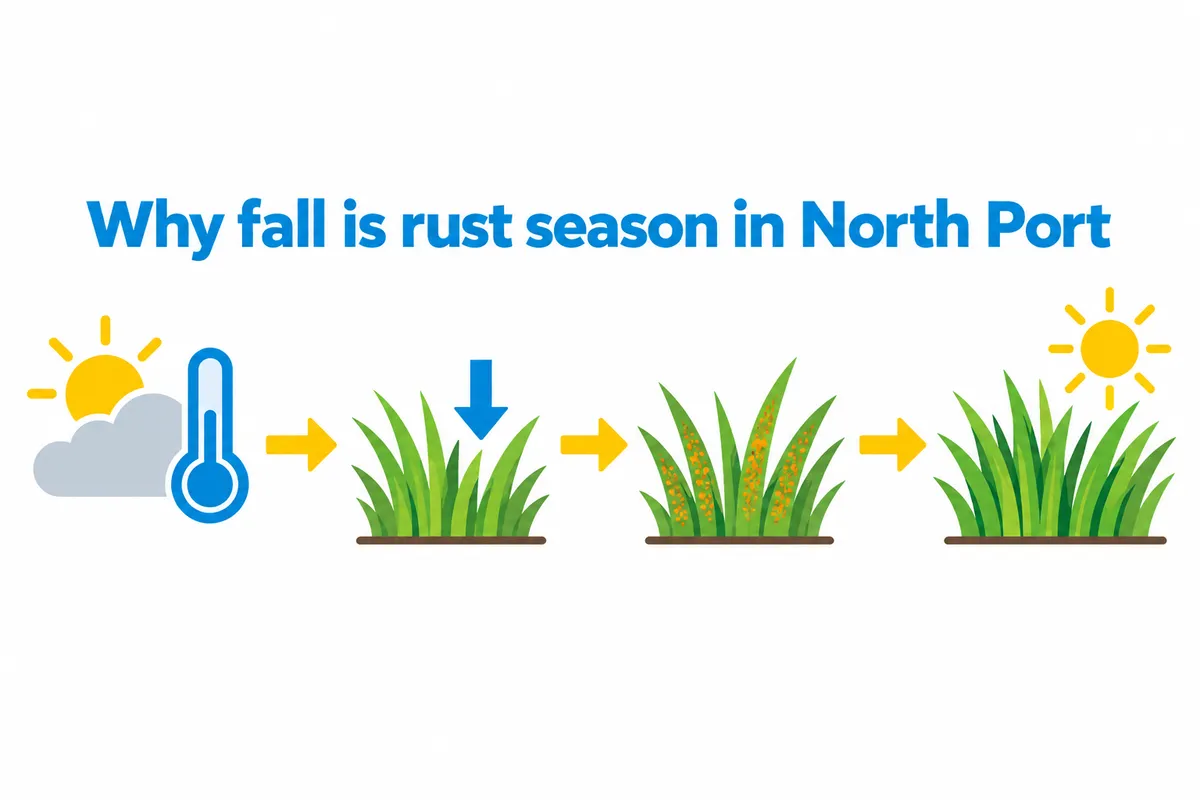
Rust shows up when the grass slows down. LH051 says the disease occurs from late fall to early spring, when cool weather slows turfgrass growth, and that in most cases it disappears once the weather warms and the grass grows vigorously again. The UF/IFAS turfgrass disease management guide, LH040, explains why: a diseased spot stays on the leaf until mowing removes it and a new leaf replaces it. A lawn that has nearly stopped growing holds on to its spotted blades.
LH051 lists two conditions that make rust worse:
- Stress. Rust is more severe on turf stressed by nutrient deficiencies or shade, such as grass under trees or on the north side of a building.
- Wet leaves. The leaves must be wet for infection to happen, whether from dew, humidity, rain or irrigation.
North Port’s calendar adds a local twist. Inside city limits, the city’s fertilizer ordinance prohibits nitrogen and phosphorus fertilizer on turf from April 1 through September 30. If your lawn’s last feeding came before April, it reaches October with no nitrogen since spring, right as the cooler weather slows it down.
How to grow the lawn out of rust
The UF/IFAS cultural steps come down to feeding, mowing and watering so the grass keeps growing and the leaves dry off fast.
What to feed, and when
LH051 calls for an adequate, balanced fertility program using slow-release nutrient sources. LH040 adds that too much and too little nitrogen both contribute to lawn diseases, so apply the smallest amount of nitrogen your grass type needs, at least as much potassium as nitrogen, and slow-release sources of both.
The calendar matters as much as the bag. In North Port, fertilizing turf is allowed from October 1 through March 31, and the city code requires at least 50% slow-release nitrogen outside the restricted season. The city also asks residents to skip fertilizer when heavy rain is expected and to keep it at least 10 feet from a waterway or swale. Addresses in unincorporated Sarasota County follow the county rule, which restricts nitrogen and phosphorus on turf from June 1 through September 30.
So a light, slow-release feeding in November is legal inside North Port’s limits. Keep it light: the UF/IFAS homeowner’s guide to fungicides, PP154, warns that excessive fertilizer can produce a flush of growth that is more susceptible to disease. Our December lawn care guide explains why a lawn heading into winter can’t use much nitrogen.
How to mow a lawn with rust
LH040’s mowing rules all help:
- Keep mower blades sharp, and mow often enough that no more than one-third of the leaf comes off at once.
- Raise the cutting height when any disease shows up. The extra leaf gives the grass more energy to recover.
- Don’t mow wet grass.
- Mow the diseased area last, then wash the mower with water to rinse off the clippings.
If someone else mows, put those asks in writing. Our note for your mowing crew is a good starting point.
Water early, and only when the lawn needs it
LH051 says to water in the early morning, between 2 and 8 a.m., when dew is already on the grass, so the sprinklers don’t stretch out the time the leaves stay wet. LH040 says to irrigate only when the lawn shows drought stress, such as curled leaf blades. A few minutes every day can feel right on sandy soil, but LH040 says it doesn’t get enough water to the root zone and it helps the pathogens. Stay within your local watering-day rules.
When a fungicide is worth it, and when it is not
On most home lawns, a fungicide for rust is hard to justify:
- Rust passes on its own. LH051 says it usually disappears once the weather warms and the grass grows.
- Small outbreaks may not need one. LH040 says to use fungicides only when absolutely necessary. If the affected areas are small and the weather does not favor an epidemic, a fungicide may not be necessary, or a spot application may be enough.
- A fungicide doesn’t make grass grow. Per LH040, the spots stay until mowing removes them, so in cool weather the lawn can look like the product failed.
- Diagnosis comes first. PP154 generally discourages homeowners from using fungicides, because picking the right product takes a correct diagnosis, and diagnosis by eye is hard. LH040 says misuse of a product can waste money.
A fungicide earns its place in a narrower case. LH040 says preventive use is acceptable when you know which disease is likely in that spot at that time of year. A shady corner that rusts heavily every winter, even after you fix the feeding, mowing and watering, fits that description.
Check the label before you buy. LH051 notes that some fungicides cannot be used on residential lawns. If you apply one yourself, use a fungicide labeled for rust on your grass type, read and follow the product label, keep it off food-preparation surfaces, and store it out of sight and reach of children and pets. PP154 recommends a lawn and landscape service for fungicide applications.
Does rust do lasting damage to grass?
Not according to UF/IFAS. LH051 says rust may give the grass an ugly look, but it will not kill the turfgrass. Expect a slow recovery in cool weather, though, since the orange hangs on until new growth replaces the spotted leaves.
If grass is thinning or dying, look for another cause. LH040 says diseases are the exception and not the rule for lawns, and that mowing too short, herbicide damage, drought and nutrient deficiencies can all look like disease. Spotted St. Augustine in the summer heat may be a different disease, covered in our post on gray leaf spot. To confirm what you have, PP154 points homeowners to a lawn and landscape professional or their UF/IFAS Extension office. For North Port, that is the UF/IFAS Extension office in Sarasota County.
How to cut the carryover into spring
Rust usually clears once spring growth kicks in, per LH051. What you do this winter makes next fall easier. LH040 says that when a lawn has a history of a disease at a certain time of year, it makes sense to put cultural fixes in place ahead of its yearly return.
- Mark where it showed up. LH040 says many disease outbreaks happen in the same location each year, and each side of a building can have its own microclimate.
- Fix those spots first. Water early and only when needed, raise the mowing height, and keep the feeding balanced and slow-release.
- Plan spring feeding around the ordinance. Inside North Port city limits the turf fertilizer window closes April 1, so any feeding happens by March 31.
- Think twice about winter rye. LH051 says rust can show up on perennial ryegrass used to overseed lawns. Our post on fall lawn mistakes covers what overseeding St. Augustine costs you.
What not to do about rust
- Don’t scalp the lawn to get rid of orange blades. LH040 says it is especially important not to mow St. Augustine too low.
- Don’t dump fertilizer to green it up fast.
- Don’t water in the evening. LH040 says evening irrigation before dew forms stretches out the time the leaves stay wet.
- Don’t spray a fungicide on a guess.
When to call a professional about rust
Call a professional when the orange comes back in the same spots every year, when patches thin out instead of just looking dusty, or when you can’t tell rust from another problem.
Here is how Waves Pest Control approaches it. Our lawn program covers turf fertility, weed, insect and disease control, and diagnosing what is wrong with a lawn. On a first visit, the technician walks the property, checks root depth, soil compaction and thatch, looks for active pests, and notes your irrigation schedule. In fall the program resumes nitrogen on October 1, with at least 50% slow-release. Mowing and irrigation repair go to a landscaper or irrigation contractor.
If you want help reading what your lawn is doing, ask about a lawn care quote, or start with our lawn care in North Port page. In Venice, see lawn care in Venice.
Frequently Asked Questions
When does rust on grass clear up?
LH051 says rust usually disappears once the weather warms and the grass starts growing vigorously again. Until then, regular mowing removes spotted leaves as new ones replace them.
Should I fertilize a lawn with rust in North Port?
A light, slow-release feeding can help if it fits the city’s rules: no nitrogen or phosphorus on turf from April 1 through September 30, and at least 50% slow-release nitrogen the rest of the year. Excess fertilizer makes grass more susceptible to disease, per PP154.
Do I need to bag the clippings from a lawn with rust?
No. LH040 says mulching mowers do not increase diseases. Mow the rusty area last, then wash the mower with water.