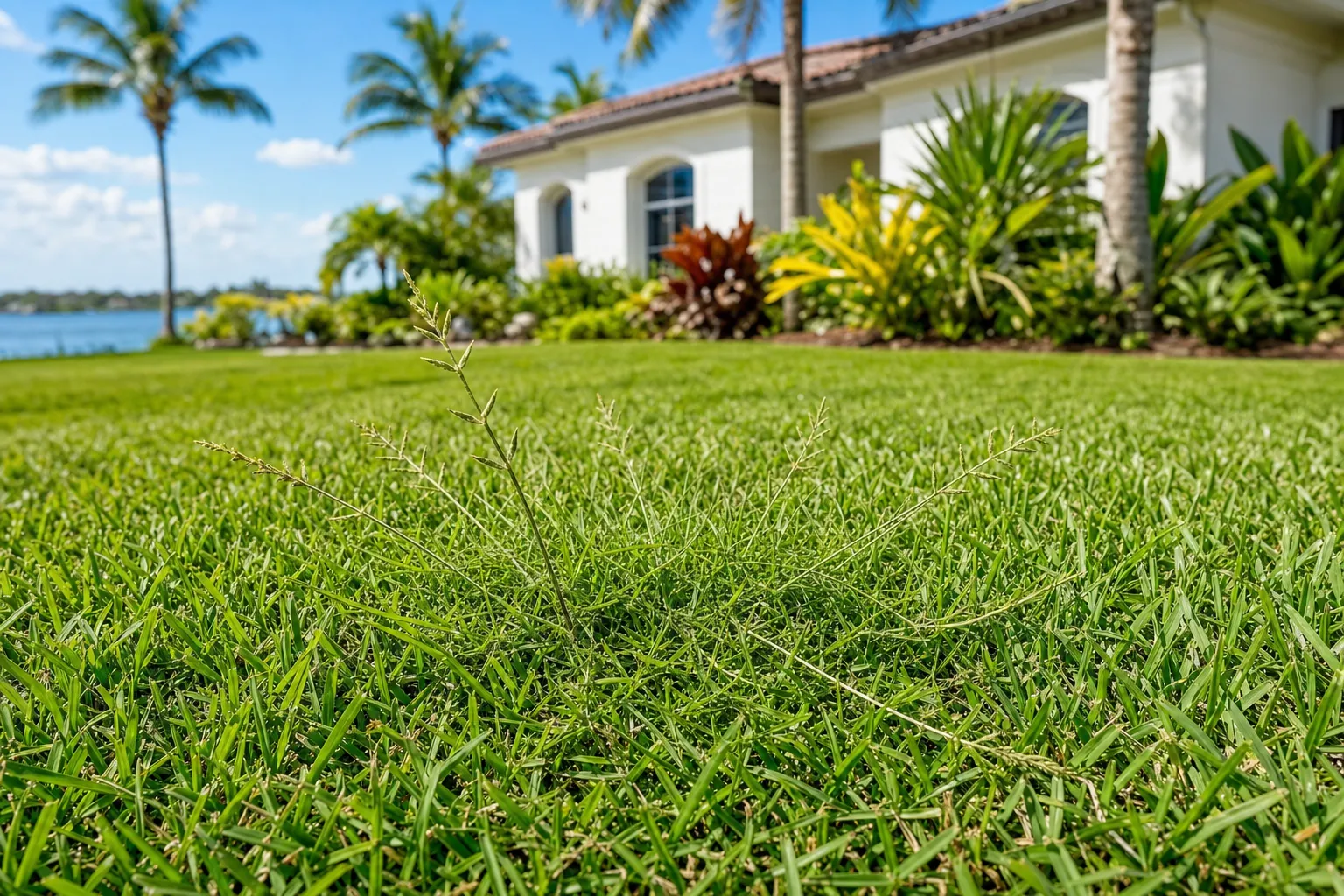
For as long as I have been treating lawns, the honest answer to “can you get the bermudagrass out of my St. Augustine?” was no.
Not “no, it’s expensive.” Not “no, it takes a while.” No. Both grasses are warm-season grasses that share the same biochemical machinery, so anything strong enough to kill one killed the other. The options were live with it, spot-kill everything and re-sod the hole, or renovate the whole lawn.
That changed. A herbicide called Recognition, tank mixed with an old grass killer called Fusilade II, is the first combination that reliably removes bermudagrass from established St. Augustine while the St. Augustine lives through it. UF/IFAS calls it exactly that — “the first effective option for selectively removing bermudagrass from St. Augustinegrass” (SS-AGR-503).
It is a real breakthrough. It is not a miracle, it is not one spray, and on a few St. Augustine varieties it is a bad idea. This is the full picture, including the parts that don’t sell well.
If you would rather have someone confirm what you are looking at before reading four thousand words about it, that identification is part of our lawn weed control in Bradenton work, and the same assessment runs through lawn care in Sarasota.
Key Takeaways
- Fusilade II is what kills the bermudagrass. Recognition is what saves your St. Augustine. Recognition carries a safener called metcamifen that lets St. Augustine tolerate a rate of Fusilade that would otherwise damage it.
- Neither product does this job alone. Fusilade II applied to St. Augustine without Recognition causes injury, and Recognition by itself does not control bermudagrass at all.
- Spring is the window. UF/IFAS specifically recommends prioritizing spring applications and avoiding late summer and fall, when injury risk climbs.
- Your cultivar decides whether this is even on the table. The Florida 2(ee) flatly prohibits the mix on Captiva; the label allows it on ProVista and Captiva only where injury can be tolerated. We exclude both outright, which is our policy, not the label’s wording. Florida research found a higher risk of injury on Seville.
- Two treatments per growing season is the ceiling, not a target. Bermudagrass regenerates from rhizomes and stolons, so the second pass is timed to actual regrowth rather than to a fixed date — but the label’s resistance-management direction caps this chemistry at two applications in a season. A stand that needs a third pass gets it the following spring.
- This is a removal program, not a cure. Bermudagrass creeping in from a neighbor’s lawn or a bed line will keep coming back until that source is dealt with.
- If bermudagrass is most of what’s green out there, killing it leaves a hole. Sometimes renovation is the more honest answer.
Why this was impossible until recently
Bermudagrass and St. Augustine are both warm-season grasses. Fusilade II — fluazifop-P-butyl, a Group 1 ACCase inhibitor — works by shutting down an enzyme both plants need to build fatty acids for new cell membranes. Growth stops, the plant loses vigor, it yellows or reddens, and the growing points die. Syngenta’s own label describes symptoms appearing in 7 to 14 days with complete control at 10 to 21 days.
The problem was never that Fusilade doesn’t kill bermudagrass. It’s that at the rate needed to kill bermudagrass, it also hurt the St. Augustine you were trying to save.
Recognition solves that from a different direction. Its active ingredient, trifloxysulfuron-sodium at 20.4%, is a Group 2 herbicide that handles sedges and a long list of broadleaf weeds — but not bermudagrass. What makes it matter here is the other thing in the jug. Syngenta formulated Recognition with a proprietary safener, metcamifen, which in their words “triggers certain grass species to tolerate certain herbicides, like Fusilade II, without impacting its activity on weed species like bermudagrass” (GreenCast technical article).
That is the whole trick. The safener raises St. Augustine’s ability to tolerate the treatment. Bermudagrass gets no such protection and takes the full hit.
Two things the safener does not do, because I hear both misunderstandings constantly:
It does not neutralize anything in the spray tank — the two products are not cancelling each other out. And it does not coat or shield the St. Augustine physically. It produces a physiological difference in how the plant handles the herbicide. That is exactly why cultivar, turf health, season, and rate accuracy all still matter enormously. A safener that works by changing plant metabolism only works as well as the plant’s metabolism is working.
One more piece of honesty about the chemistry: even though this tank holds a Group 1 and a Group 2 herbicide, the Group 2 does nothing to bermudagrass. For resistance purposes this is a single mode of action program. Repeating it season after season on the same stand is how resistant bermudagrass eventually gets selected.
What has to be true before we spray anything
It has to actually be bermudagrass
This sounds obvious. It is the single most common reason the program fails, because several Florida lawn grasses look similar at a glance and respond completely differently.
Bermudagrass has fine, narrow blades, thin wiry stolons running across the soil surface, underground rhizomes, nodes that root and throw new shoots, and a seedhead with several finger-like spikes radiating from one point. St. Augustine, by contrast, has much broader blades and thick, flattened stolons.
Torpedograss is the dangerous lookalike. It has stiff, sharply pointed leaves and distinctive pointed white rhizomes, and this mix only suppresses it — the label word is suppression, not control. If your fine-bladed invader is torpedograss, nobody should be selling you an eradication program.
The mix does control common and hybrid bermudagrass and goosegrass, and the Florida 2(ee) recommendation adds dallisgrass. It should not be used as a crabgrass treatment: the Recognition label explicitly warns against tank mixing the two for crabgrass “because of herbicide antagonism.” The products fight each other on that weed.
It has to be a cultivar that can take it
This is where I turn jobs down. Not all St. Augustine is the same grass as far as these herbicides are concerned, and the evidence comes from two different places that deserve to be kept separate.
What the labeling says is narrow and binding, and it comes in two separate statements that are easy to conflate.
In its precautions for Recognition generally, the label states the product “has been shown to be safe on the St. Augustine varieties Floratam, Raleigh, Palmetto and SunClipse,” and directs that safety on other varieties “should be confirmed on a small scale prior to commercial application.” Read that carefully: it is a statement about Recognition on its own, not about the Recognition-plus-Fusilade tank mix. It is real evidence and it covers the varieties most Southwest Florida lawns actually are — but it is not a clearance for the bermudagrass treatment described here.
The tank-mix section carries its own, stricter cultivar statement: ProVista and Captiva “may be more sensitive to injury by Recognition,” and applicators are directed not to apply the mix to those varieties “unless injury can be tolerated.” That conditional matters, and it is worth being precise about rather than rounding off — the label does not flatly forbid the application on those two cultivars, it puts the consequences on whoever makes it. The Florida 2(ee) recommendation goes further and prohibits the mix on Captiva outright, without a tolerance clause, but says nothing about ProVista.
So the honest statement of the rule is: Captiva is prohibited in Florida by the 2(ee); ProVista is permitted only if you are willing to accept injury. We exclude both, and that is our policy rather than the label’s wording. On somebody’s established lawn there is no version of “injury can be tolerated” that we are comfortable signing up for.
What the research says covers more ground but carries less legal weight. UF/IFAS reports that “reduced safety has been observed on Captiva, ProVista, and Seville,” and Florida cultivar trials run in 2022 and 2023 confirmed CitraBlue’s safety to these treatments while finding a higher injury risk in Seville.
| St. Augustine cultivar | What the evidence says | How we treat it |
|---|---|---|
| ProVista | Label permits the mix only where injury can be tolerated; the Florida 2(ee) does not address it | Excluded — our policy, stricter than the label |
| Captiva | Florida 2(ee) prohibits the mix outright; label adds the injury-tolerance condition | Excluded from any broadcast program |
| Seville | UF/IFAS reports reduced safety; Florida trials found higher injury risk | Not broadcast — we do not treat Seville lawns this way |
| CitraBlue | Florida trials confirmed safety to these treatments | Eligible, still gets a test area first |
| Floratam, Palmetto, Raleigh | Label states Recognition alone has been shown safe on these; the tank mix itself is not separately addressed | Eligible, treated as the standard case |
| SunClipse | Same label statement as above — Recognition alone, not the tank mix | Eligible, treated as the standard case |
| Unknown cultivar | Label directs confirming safety on a small scale first | Test area only, watched 3-4 weeks before anything broadcast |
Cultivar positions come from the EPA-approved Recognition label, the Florida 2(ee) recommendation, and UF/IFAS research. The label's Floratam/Raleigh/Palmetto/SunClipse safety statement covers Recognition on its own — we don't stretch it into a tank-mix clearance it doesn't make.
Do not identify a cultivar by looking at it. I can’t do it reliably and neither can anyone else. Use the sod invoice, the installation records, the builder, or the sod farm. If none of that exists, the lawn is an unknown cultivar and it gets a test area — a small patch in a spot where injury is survivable, watched for three to four weeks.
The turf has to be healthy enough to survive it
The safener works by helping the plant metabolize the herbicide. A stressed plant metabolizes badly. We don’t treat St. Augustine that’s dealing with drought stress, saturated or flooded soil, chinch bug damage, gray leaf spot or other active disease, nematode or root decline, recent scalping, chemical injury, patchy irrigation coverage, or serious nutrient deficiency.
Newly installed turf is out too — the Recognition label requires waiting at least four weeks after sprigging, seeding, seed emergence, or sodding.
There’s also a math problem worth being blunt about. If most of the green out there is bermudagrass rather than St. Augustine, selectively killing it leaves a large bare area that the surviving St. Augustine cannot realistically close. In that situation, killing everything and re-sodding is more predictable and often cheaper than a two-year removal program that ends with a thin lawn.
Why we schedule this for spring, not right now
The bermudagrass needs to be actively growing to take the herbicide up and move it into its stolons, rhizomes, and growing points. But the St. Augustine also needs to be actively growing — to metabolize the treatment and then to spread into the gaps left behind. Both conditions have to be true at once.
UF/IFAS’s Florida guidance is direct about the timing: prioritize spring applications when turf is actively growing and avoid treatments during late summer or fall. The cultivar research points the same way, finding greater phytotoxicity from later-season applications and noting increased sensitivity in more susceptible cultivars as the season progresses.
You’ll hear a rule of thumb that this mix should never be used above 85°F. That specific number isn’t printed on either label, so I won’t repeat it as though it were. What is true is that high heat combined with drought, heavy rainfall, disease, root problems, and late-season plant physiology stacks the odds toward injury — and a Southwest Florida August delivers most of those at once.
So if you’re reading this in August with bermudagrass spreading through your lawn: the right move now is to map the infestation, fix whatever is stressing the turf, deal with the source along the property line, and put the actual treatment on the spring calendar. Spraying today buys you a worse outcome than waiting seven months.
What the application involves
I’m including the technical detail because I think homeowners deserve to know what’s being put on their lawn and why. This is not a do-it-yourself guide — applying these products on someone else’s property in Florida requires licensing, and the failure modes below are mostly precision problems that a calibrated commercial setup exists to prevent.
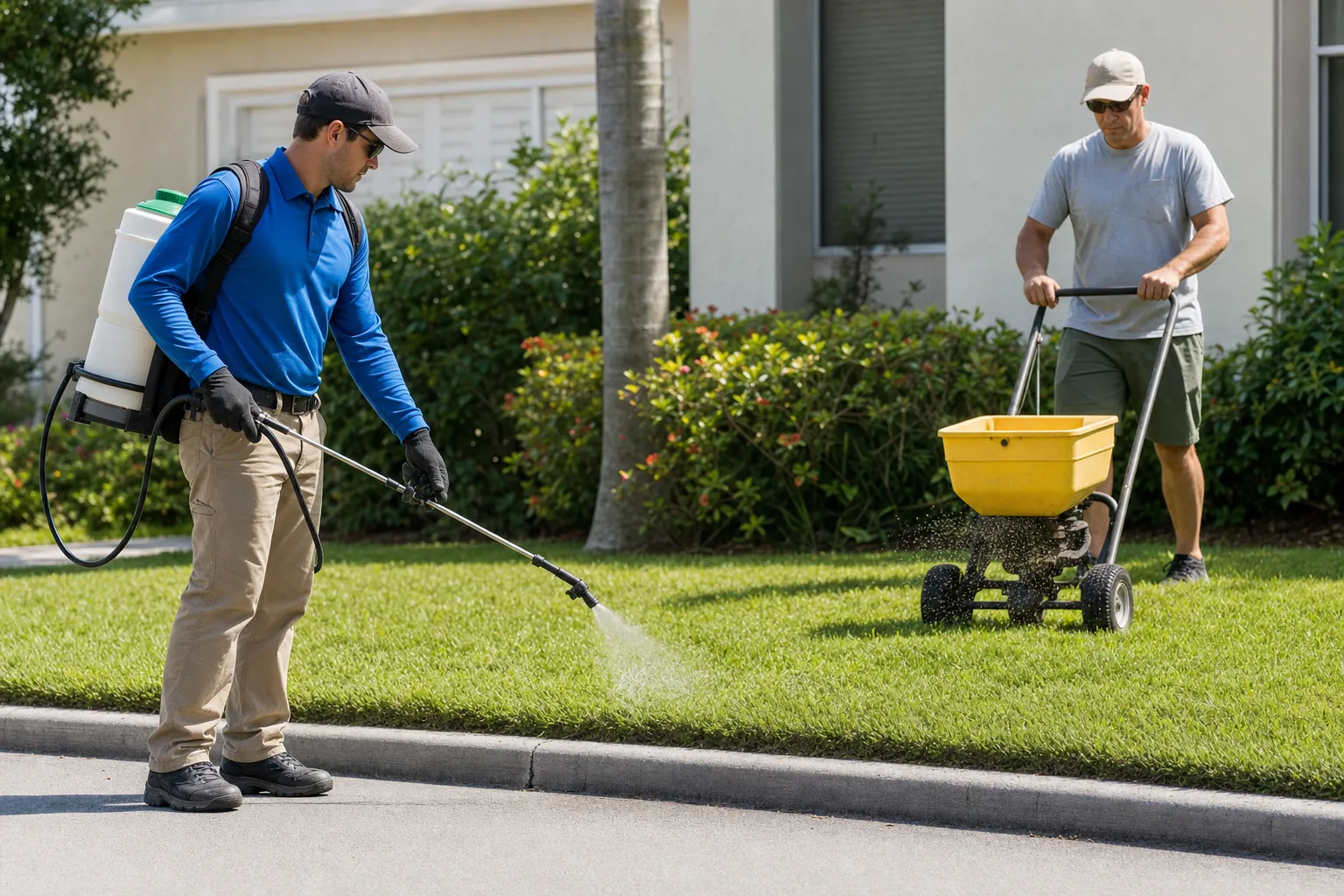
The rates. For St. Augustine, the EPA-approved Recognition label specifies 1.95 ounces by weight per acre (0.045 oz per 1,000 sq ft) with Fusilade II at 12–24 fluid ounces per acre (0.28–0.55 fl oz per 1,000 sq ft). A FIFRA Section 2(ee) recommendation dated May 11, 2023 that covers Florida allows Recognition down to 1.29 oz per acre. A 2(ee) has to be in the applicator’s possession at the time of use — and separate 2(ee) documents exist for zoysiagrass with different terms, so the right one matters. For bermudagrass specifically, Syngenta recommends the full 24 fl oz Fusilade rate for greatest efficacy. Both labels call for a nonionic surfactant of at least 80% active at 0.25–0.5% of spray volume.
Recognition is a dry granule measured by weight, not volume, at doses small enough that a gram scale reading to 0.01 g is the right tool for a residential tank.
The order matters. Water first, agitation on, dry Recognition in and fully dispersed, then Fusilade, then surfactant last, agitating throughout. If carrier water is below pH 5.5, the label directs buffering toward 7 — and specifically warns against mixing with acid-forming compounds, so the acidifier some of us add by habit is the wrong reflex here. Recognition also must not be tank mixed with organophosphate insecticides or nematicides.
I keep this tank deliberately boring: Recognition, Fusilade, surfactant, water. Every additional product is another turf-safety variable. Swapping the nonionic surfactant for a methylated seed oil or crop oil to make the application “hotter” is a known way to buy extra St. Augustine discoloration — the Recognition label notes those adjuvants can be effective but may cause temporary injury.
Mowing and water. Fusilade’s label advises against disturbance — mowing, hand weeding — within 7 days before or after application; Recognition says 1 to 2 days. We follow the more conservative one. Mow at normal height about a week out, and do not scalp: low mowing removes the bermudagrass leaf area that has to absorb the herbicide, and low mowing is what favors bermudagrass in the first place. Soil moisture should be adequate going in; Fusilade notes best results within 7 days after irrigation.
Rain. Fusilade is rainfast in one hour, Recognition in three, so the mix needs a minimum three-hour dry window. Both labels also advise avoiding application when rain or irrigation is expected within 48 hours, to limit runoff. In a Southwest Florida summer that window is genuinely hard to find, which is one more argument for spring.
Overlap is the real risk. The largest injury hazard on a residential lawn isn’t the label rate — it’s a technician slowing down over a dense patch, spraying “until it looks wet,” or crossing an already-treated strip. Any of those can double the dose on that spot. Rates are determined by the square footage covered, not by how much is sloshing in the tank.
What you should expect to see
| Time after treatment | What's happening | What you'll see |
|---|---|---|
| Days 1-7 | Bermudagrass growth shuts down | Often nothing obvious — this is normal |
| Days 7-14 | Loss of vigor as membranes fail | Yellowing, reddening, thinning of the bermudagrass |
| Days 10-21 | Treated shoots and growing points die | Visible dieback; St. Augustine may show mild temporary discoloration |
| Weeks 4-6 | Surviving rhizomes push new growth | We inspect for fresh green stolons and nodes |
| Weeks 5-6 | Follow-up window at the high Fusilade rate | Second treatment only if there is real regrowth to hit |
| Following months | St. Augustine fills the openings | Gradual closure; outside bermudagrass may reappear at edges |
Symptom timing from the Fusilade II label; follow-up interval from Syngenta's bermudagrass removal guidance.
The follow-up is triggered by regrowth, not by a calendar reminder. Fusilade is absorbed through foliage, so the surviving bermudagrass has to produce enough new leaf to intercept the second application. Spraying bare dirt where bermudagrass used to be accomplishes nothing except spending your money and your annual rate allowance.
We also don’t repeat while the St. Augustine still looks injured. Recognition’s limits are firm: minimum 28 days between applications, maximum 1.95 oz per acre in a single application, maximum 6.26 oz per acre per year, and no more than three applications at the maximum rate in a year. The Fusilade II master label EPA accepted on July 15, 2026 adds an annual cap of 1.125 lb of fluazifop-P-butyl per acre per year across all products containing it — worth flagging because that cap does not appear on the older revisions of the label still circulating, and the 2026 labeling supersedes them.
There is also a resistance limit that binds tighter than any of those rate caps, and it is the one most likely to be missed. The 2026 Fusilade II label directs applicators not to use “more than two applications of this or any other herbicide with the same mode of action in a single growing season unless mixed with an herbicide with a different mode of action which provides overlapping spectrum for the difficult to control weeds.”
Read that against what this tank mix actually is. Recognition’s Group 2 active does not control bermudagrass — that was established at the top of this article. So for bermudagrass, the mix supplies no overlapping second mode of action, and the exception does not apply. Two applications per growing season is the ceiling, regardless of what the annual ounce limits would otherwise permit.
Two high-rate treatments are commonly what it takes anyway. Where an old, dense stand needs more, the third application belongs to the next growing season — not to a third pass in the same spring because the annual cap still had room in it. Even then, I won’t promise permanent eradication, and you should be suspicious of anyone who does.
Why bermudagrass comes back
Bermudagrass is hard to remove because it survives in more ways than one plant reasonably should: aboveground stolons, underground rhizomes, seed, deep interconnected growing points, encroachment from neighboring lawns and beds, and fragments moved around by mowers, string trimmers, topsoil, and sod deliveries.
In South Florida it frequently stays green and physiologically active year-round, so there’s no dormant season doing part of the work for you. Any piece of rhizome or stolon that didn’t receive or translocate enough herbicide can regenerate the stand.
Pre-emergent herbicides are not a dependable way to stop bermudagrass encroachment in warm-season Florida turf — it arrives as runners, not mostly as seed. What actually holds the ground is the boring part of the program:
- Mowing St. Augustine at the upper end of its correct height range. UF/IFAS specifically recommends raising mowing height to increase canopy density. Standard cultivars like Floratam generally sit around 3.5–4 inches; CitraBlue and Seville are maintained shorter. Low mowing favors bermudagrass and can make selective control nearly impossible.
- Deep, infrequent irrigation instead of shallow daily watering, and fixing the weak zones that leave dry stripes.
- Staying ahead of insects, disease, and root problems, since the whole program depends on healthy turf.
- Edging at least six inches deep where a bed or a neighbor’s lawn is the source.
- Cleaning mowers and trimmers before leaving a contaminated property.
- Removing bermudagrass seedheads before the seed matures.
- Plugging or re-sodding large openings once the label’s establishment interval allows.
If the St. Augustine doesn’t take the space the bermudagrass vacated, something else will — often the same bermudagrass.
The ways this program fails
Nearly every failure I’ve seen or read about traces to one of these:
- The grass was actually torpedograss, crabgrass, zoysia, or another fine-bladed grass.
- The cultivar was ProVista, Captiva, Seville, or never identified.
- Fusilade was applied without Recognition, which the labeling warns causes injury.
- Monument or another plain trifloxysulfuron product was substituted for Recognition. Those don’t contain the safener. Recognition is not interchangeable with old Monument 75WG — the safener is the entire reason this program exists.
- Someone used a per-gallon rate without calibrating actual square-foot coverage.
- Fusilade’s ornamental spot-spray rate of 0.75 fl oz per gallon was used on a lawn. That rate appears in a section of the label headed “NOT FOR USE ON TURFGRASS.”
- The lawn was drought-stressed, diseased, waterlogged, or freshly scalped.
- The bermudagrass was mowed right before treatment, leaving too little leaf to absorb anything.
- Rain arrived inside the three-hour window.
- Spray overlap doubled the rate on part of the lawn.
- An oil concentrate, acidifier, organophosphate, or untested tank partner drove up injury.
- The customer was sold one application against an established perennial grass.
- The source along the property line was never addressed.
Safety and the water we live on
Both labels are worth taking seriously here, and we work to the more restrictive of the two: long sleeves, long pants, chemical-resistant gloves, shoes and socks, protective eyewear, and a chemical-resistant apron for mixing and loading Fusilade. People and pets stay off during application and until the spray has dried. Sod farm applications carry a 12-hour restricted-entry interval under the Worker Protection Standard.
The environmental language matters more here than in most of the country. Sandy soils, a shallow water table, and a landscape stitched together with ponds, canals, lakes, and stormwater systems mean runoff has somewhere to go. Fusilade is toxic to fish and aquatic invertebrates, and Recognition is toxic to non-target plants. Neither goes anywhere near standing water, saturated soil, or severe slopes, and neither label supplies a universal numeric buffer distance — so I’m not going to invent one. A level, well-maintained vegetated buffer between the treated area and any surface water is what both labels actually call for.
A few more restrictions homeowners should know about, both from the Recognition label: fresh clippings from treated areas must not be used as mulch around trees, shrubs, or in vegetable and flower gardens, and no crop other than turfgrass may be planted in a treated area for 12 months. If you have been thinking about putting in a raised vegetable bed where the bermudagrass is, tell your applicator before the treatment, not after.
One operational note that matters to anyone maintaining their own equipment: Recognition residue can severely injure sensitive turf and ornamentals, so a sprayer used for it should be dedicated to herbicides. Its label specifies an ammonia-based cleanout — 2.5 ounces of household ammonia per gallon of water, recirculated at least 15 minutes, with nozzles and screens cleaned separately, repeated, then rinsed with clean water. Never combine ammonia with bleach or any chlorine cleaner.
How we handle it
Bermudagrass removal sits inside our regular lawn weed control work rather than standing apart from it, because the things that let bermudagrass in — thin turf, low mowing, weak irrigation zones — are the same things every other weed exploits. We treat it as a program with a defined sequence, not a service call:
- Confirm it’s bermudagrass and document how far it has spread.
- Confirm the St. Augustine cultivar from records, not appearance.
- Exclude ProVista, Captiva, and Seville lawns, stressed turf, and lawns already dominated by bermudagrass.
- Run a spring test area on anything questionable, including unknown cultivars.
- Apply at label rates with the surfactant, on healthy, actively growing turf, in a dry window.
- Re-inspect at five to six weeks.
- Re-treat only visible, active regrowth, and only after the St. Augustine has recovered.
- Stop at two applications in a growing season. If more is needed, it waits for the next season.
- Fix the irrigation, mowing, pest, border, and fill-in problems that let it in.
- Exclude outside reinvasion and unidentified cultivars from any control expectation.
That last point isn’t fine print. A lawn that shares a property line with untreated bermudagrass will see it come back across that line, and no herbicide program changes that.
Frequently asked questions
Can I buy Recognition and Fusilade II and do this myself?
Both products are sold to the public, and neither is a restricted-use pesticide. But this program punishes imprecision more than almost anything else in lawn care: Recognition is dosed by weight in fractions of an ounce per 1,000 square feet, injury risk climbs with overlap, and the mix is off-limits or conditional on several St. Augustine cultivars. Applying pesticides on someone else’s property for hire in Florida also requires licensing. If you do it on your own lawn, weigh the product on a gram scale, calibrate to square footage, and start with a test area.
Will one application get rid of it?
Almost never on an established stand. Plan on two high-rate treatments five to six weeks apart, which is also the ceiling for a single growing season under the label’s resistance-management direction. Dense old infestations often need a third pass, and that one waits for the following spring. Bermudagrass regenerates from rhizomes and stolons that a single foliar application may not fully reach.
Will my St. Augustine be damaged?
Some temporary discoloration or slowed growth is possible and is noted on the Recognition label. That’s different from the serious injury seen on sensitive cultivars, which is why cultivar identification and spring timing carry so much weight. Healthy, actively growing, correctly identified turf treated at label rates is the low-risk case.
Why can’t you just spray the bermudagrass patches with something stronger?
You can — with a non-selective herbicide that kills the St. Augustine too, leaving a dead patch to re-sod. That’s a legitimate option for a few small, well-defined clumps. It stops being sensible once the bermudagrass is threaded through the lawn, because the patch you’d have to kill is the lawn.
It’s August and my lawn is full of bermudagrass. What should I do right now?
Not this treatment. Late-summer and fall applications are what UF/IFAS advises against, and Florida research found greater injury from later-season timing. Use the rest of the season to fix irrigation coverage, mow at the upper end of your cultivar’s range, address any insect or disease pressure, and deal with the source at the property line. Then treat in spring, into turf that’s healthy enough to take it and grow into the gaps.
What I’d tell a neighbor
If you have Floratam, Palmetto, Raleigh, or CitraBlue, a healthy lawn, and bermudagrass that hasn’t taken over yet, this program is genuinely worth doing — and it’s the first time in my career I’ve been able to say that.
If your cultivar is ProVista, Captiva, or Seville, or nobody knows what it is, or the bermudagrass has already won most of the ground, the responsible answer is still no. Not because the chemistry doesn’t work, but because on those lawns the cure risks costing more turf than the problem.
Either way, the timing answer in August is the same: map it now, treat it in spring.
If you want the identification and the cultivar question settled before next spring, that assessment is part of our lawn weed control service — and if the answer turns out to be no, we will tell you that instead of selling you the program. In the meantime the highest-leverage thing you control is mowing height for your grass type, because low mowing is what let the bermudagrass in.