Jump to a section (8)
New sod arrives with almost no root system, so new sod care in the first month is mostly a watering job. The University of Florida’s guidance is to start with several short waterings a day and then water less often and a little deeper as the roots grab the soil.
Here is the UF/IFAS schedule, how to check that your sprinklers actually match it, what changes in our sandy soil and rainy season, and when mowing and fertilizer can start.
The UF/IFAS watering schedule for new sod
According to the UF/IFAS guide to establishing a Florida lawn, “multiple, short (5-10 minute) irrigations throughout the course of the day for 7-10 days following planting help the grass establish without drying out.” After that the schedule steps down:
| Time after laying sod | How often | How much per watering |
|---|---|---|
| Days 1 to 7-10 | Several short waterings through the day | 5-10 minutes each |
| Next 7-10 days | Once a day | 1/4 to 1/2 inch |
| After that | 2 to 3 times a week | 1/4 to 1/2 inch |
| 3 to 4 weeks in | As needed | Water when the lawn shows stress |
UF/IFAS says the grass should be fully established three to four weeks after sodding. For St. Augustinegrass, its St. Augustinegrass guide says to keep new plantings “continuously moist with light, frequent irrigations several times daily until runners develop or sod is well rooted,” then cut back the frequency while increasing the amount to about 1/2 to 3/4 inch per watering.
Match the schedule to your sprinklers
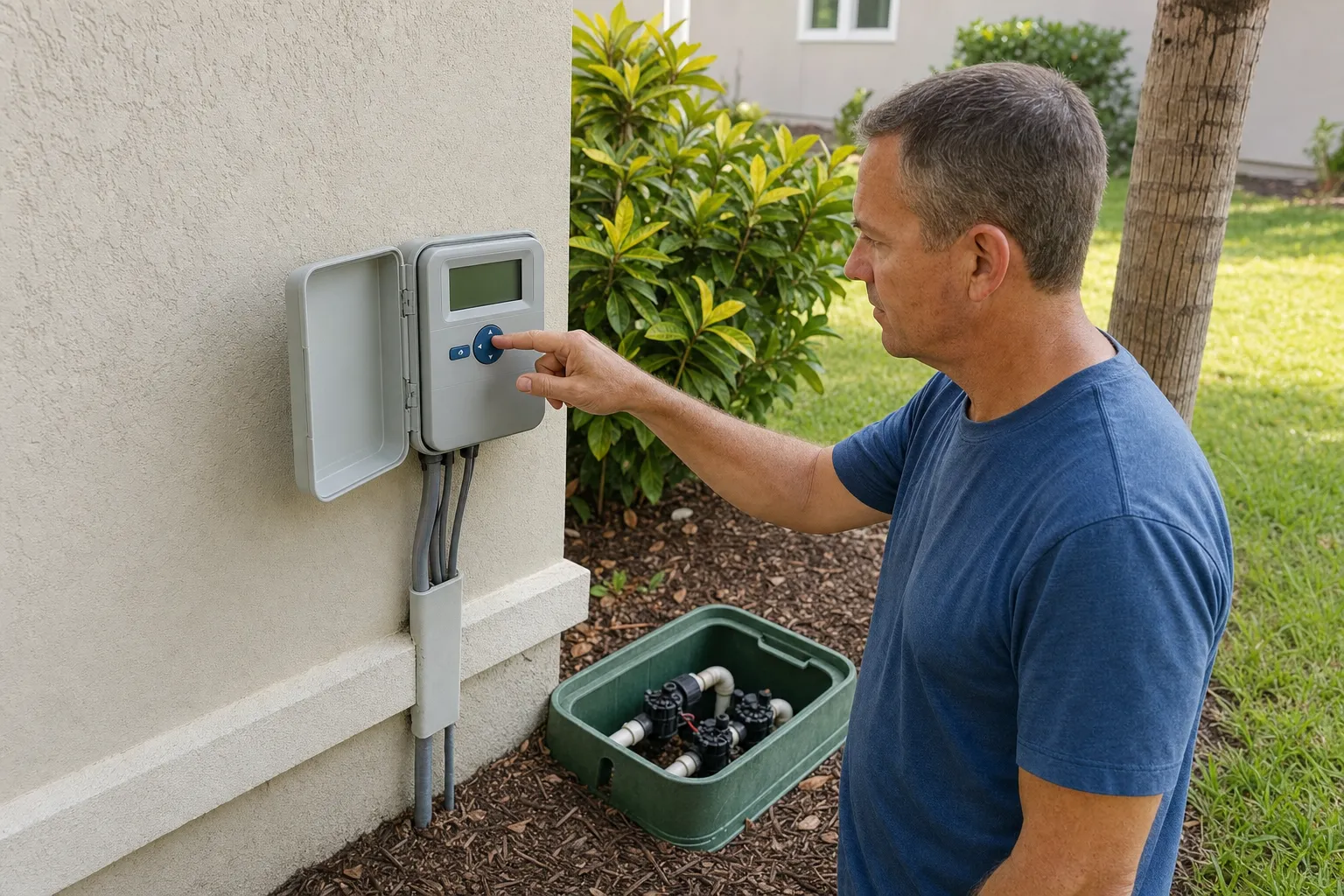
Minutes are only a guess until you know what your system puts out. UF/IFAS describes a catch-can test in its guide to watering Florida lawns: set straight-sided cans in a line from the sprinkler, run the system for 15 minutes, and measure what landed in each can. Uneven cans point to spots that will dry out.
Sod on top of sandy soil dries fast. UF/IFAS notes that “sandy soils do not hold water for long and dry out faster than soils with more clay content,” so a new lawn here can show stress sooner than the textbook timeline suggests.
Too dry or too wet
Dry sod shows the same stress signs UF/IFAS lists for any Florida lawn: blades folded in half lengthwise, a blue-gray tint instead of green, and footprints that stay visible long after you walk across the grass.
Too much water is the other risk. UF/IFAS says overwatering “greatly increases disease susceptibility and thatch buildup and leads to a shorter root system,” and it favors dollarweed and sedges. On St. Augustinegrass, UF/IFAS describes gray leaf spot as a summer rainy-season disease that mainly hits new growth. Our guide to overwatering versus underwatering shows what each looks like.
To check rooting, use the tug test UF/IFAS describes: sod is ready for its first mowing once the roots have “pegged down” and the grass no longer lifts when you pull on the edges.
Rainy season and summer installs
Most of our rain falls in summer. About 63% of Manatee County’s annual rainfall arrives between June and September, based on the NOAA 1991-2020 climate normals. UF/IFAS says that when rainfall is adequate, supplemental irrigation should be turned off, and that rainfall of at least 1/2 to 3/4 inch usually lets you reduce how often you water. So skip timer runs after a real soaking, and turn them back on when the soil starts to dry or the grass shows drought stress, such as folded blades or a blue-gray tint.
Timing the install helps too. UF/IFAS says St. Augustinegrass can be planted year-round in warmer regions of Florida, but that in south Florida the best time to establish it is late fall, winter, or spring. The same guide to establishing a lawn warns that “sod life on pallets during summer is less than 48 hours,” so have the ground ready and the irrigation working before the delivery truck arrives. A soil test before planting tells you if the pH needs adjusting; our guide to getting a soil test in Parrish and Manatee County walks through how.
County watering rules for new lawns
The Southwest Florida Water Management District sets a 60-day establishment period for new lawns. On its water restrictions page, the district says that during the first 30 days new lawns and plants may be watered any day of the week, and during days 31 to 60 they may be watered three days a week. Those days are assigned: Tuesday, Thursday and Sunday at even-numbered addresses, and Monday, Wednesday and Saturday at odd-numbered addresses. The user must keep a written schedule of establishment watering.
The district also limits watering hours. As of October 2026, its Modified Phase III water shortage order runs through March 31, 2027, and covers all of Manatee and Sarasota counties and part of Charlotte County. It limits watering to midnight to 4 a.m. or 8 p.m. to 11:59 p.m., unless your city or county has stricter hours. Properties under one acre may use only one of those windows. The district says its restrictions apply to potable, well or surface water. If you water only with reclaimed water, only voluntary watering hours apply, unless your local government or utility restricts it. The UF/IFAS schedule above calls for several short waterings through the day in the first week, so ask your utility what it allows for new sod while the order is in effect.
Water-shortage orders can change, and your county or city utility may add its own details. Check the district page and your utility before you set the timer.
New sod care: mowing, fertilizer and foot traffic
- Mowing. UF/IFAS says not to mow until the roots have pegged down, generally 14 to 21 days after planting. Use a sharp blade and avoid mowing wet grass when you can. Standard St. Augustinegrass cultivars are mowed at 3.5 to 4 inches and dwarf cultivars at 2.5 inches. For other grasses see mowing height by grass type.
- Fertilizer. UF/IFAS says to wait at least 30 days after sodding, because nitrogen can leach through the soil if applied in the first 30 to 60 days and most sod is fertilized before harvest.
- Summer fertilizer rule. Sarasota County restricts nitrogen and phosphorus fertilizer from June 1 through September 30, according to UF/IFAS Extension Sarasota County. That page notes an exception: new plantings may be fertilized only for a 60-day establishment period. Manatee County restricts nitrogen and phosphorus products over the same dates, per the Manatee County fertilizer ordinance summary. Read the county details before you fertilize any lawn in summer, and see our guides for Sarasota County and Manatee County.
- Traffic. UF/IFAS says new sod is still vulnerable and not ready for play or other activities until the roots have grown down into the soil.
Year-one problems on new-construction lawns
Many new Southwest Florida lawns are fresh sod laid over compacted fill and sandy, low-organic soil. The usual year-one issues are uneven establishment, settling and low spots, and fire ants moving in with the sod, and the watering needs differ from a mature lawn.
If you see brown patches, check the watering first. Chinch bugs are the other thing to rule out on St. Augustinegrass: UF/IFAS calls the southern chinch bug the major insect pest of the grass. Chinch bug damage usually does not recover with watering, which is a clue that it is not drought stress; checking for the insects confirms it. Our guide to St. Augustine lawns turning brown covers the lookalikes.
Weeds will show up in thin spots. UF/IFAS says “the best approach to weed control is a healthy, vigorous lawn.”
Waves Pest Control keeps new sod on the standard lawn program, with some products held while it roots. See lawn care in Venice for what that program covers.
Frequently Asked Questions
How often should I water new sod in Southwest Florida?
UF/IFAS recommends several short waterings a day for the first 7 to 10 days, then once a day for another 7 to 10 days, then two to three times a week. Three to four weeks after sodding, water as needed.
How long should I run the sprinklers each time?
UF/IFAS gives 5 to 10 minutes per watering for the first week or so. Use a catch-can test to see how much water your own system delivers.
Can I overwater new sod?
Yes. UF/IFAS says overwatering raises disease risk and leads to a shorter root system. Back off when rain has soaked the lawn and the sod is no longer drying out between waterings.
When can I mow new sod?
When the roots have pegged down and the sod no longer lifts when you pull the edges, generally 14 to 21 days after planting, according to UF/IFAS.
When can I fertilize new sod?
UF/IFAS says to wait at least 30 days after sodding. In summer, also check the county fertilizer rules above before applying nitrogen or phosphorus.
Do watering restrictions apply to new sod?
The Southwest Florida Water Management District allows new lawns to be watered any day for the first 30 days. For days 31 to 60, even-numbered addresses may water Tuesday, Thursday and Sunday, and odd-numbered addresses Monday, Wednesday and Saturday. Its hour limits apply to potable, well and surface water (reclaimed-only watering has voluntary hours unless your local government or utility restricts it), so confirm what your utility allows for new sod before you set the timer.