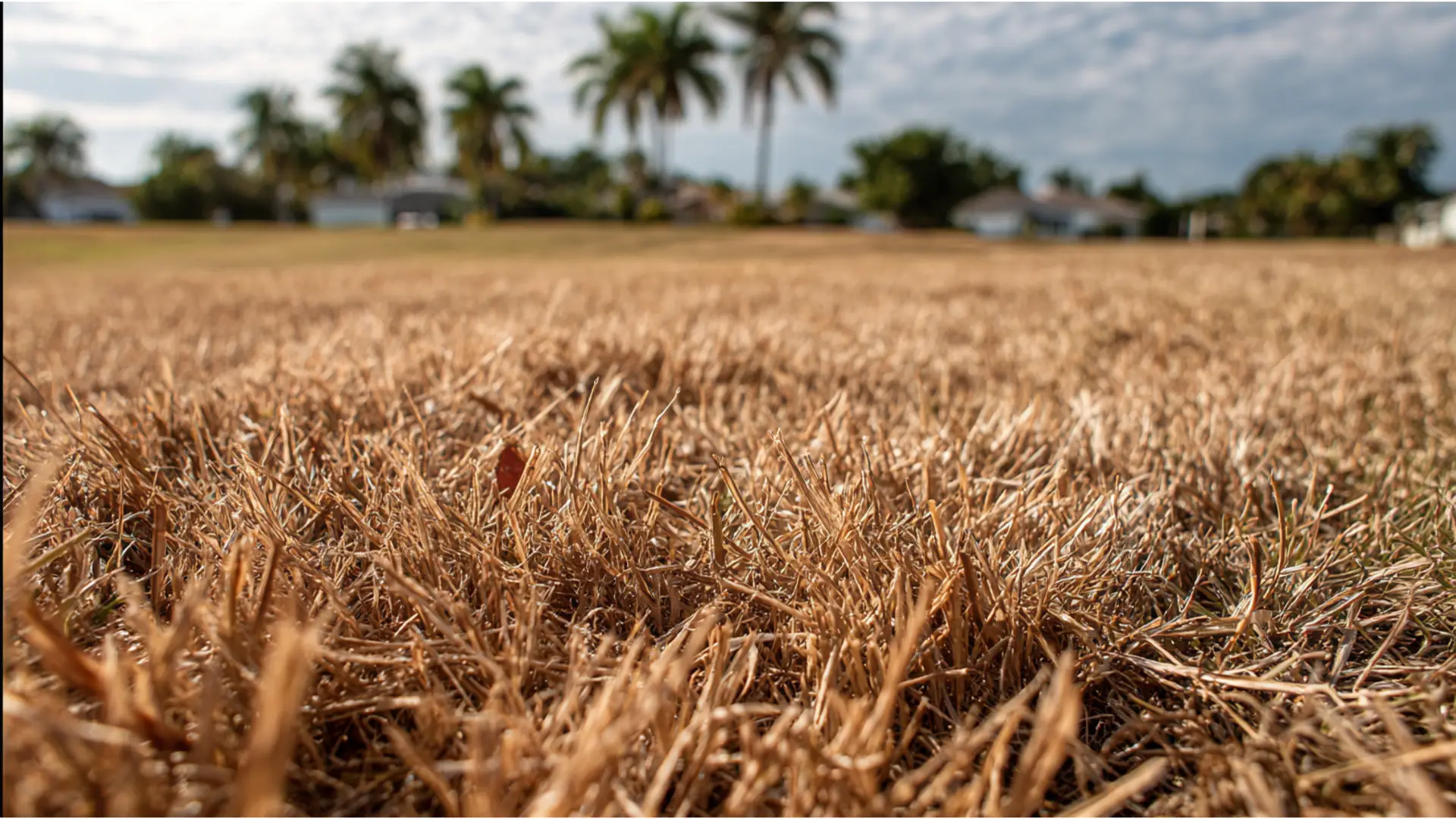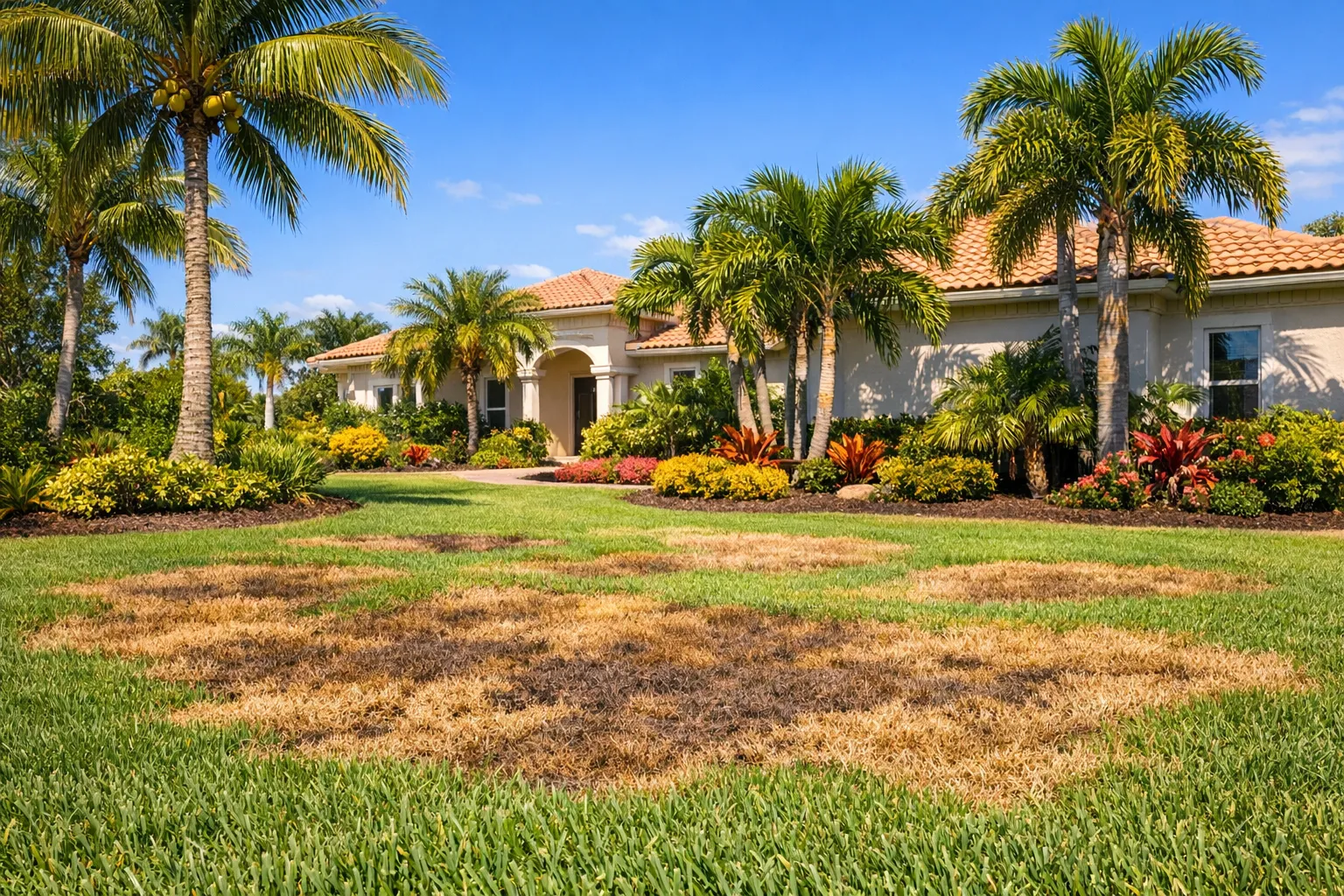
Small tan or straw-colored spots, each about the size of a silver dollar, are what most people picture as dollar spot. If you think you have dollar spot in Venice, there is a catch: most lawns here are St. Augustine, and the UF/IFAS St. Augustinegrass guide does not name dollar spot among that grass’s diseases. Other problems cause spots that look similar.
This guide covers what UF/IFAS says dollar spot looks like, which grasses it affects, why nitrogen is the key clue, and what to do next in Sarasota County.

What dollar spot looks like
According to UF/IFAS, dollar spot “starts by causing tan-colored lesions on individual leaf blades.” As it progresses, it creates round, straw-colored patches that start out the size of silver dollars and can spread to six inches or more.
The most useful clue is on the individual blades. UF/IFAS’s diagnostic key for turfgrass diseases describes dollar spot as distinct patches under 3 inches across, with leaf spot lesions that have light tan to straw-colored centers. The same key says it can occur on any grass. A lawn with larger patches and no leaf spots points to a different disease.
UF/IFAS long called the fungus Sclerotinia homoeocarpa. Newer UF/IFAS grass guides use the genus name Clarireedia. Lesions and patch size are clues, not proof, so confirm before you treat (see “Get it confirmed” below).
Which grasses get dollar spot in Venice
St. Augustine dominates Venice lawns, with zoysia in some higher-end communities and bahiagrass on inland acreage. UF/IFAS grass guides name dollar spot for bermudagrass, zoysiagrass and centipedegrass. Its St. Augustinegrass guide names three other diseases instead:
- Large patch “occurs in warm, humid weather and is encouraged by excessive nitrogen,” and is “generally most noticeable during the spring and fall months.”
- Gray leaf spot “occurs during the summer rainy season and is primarily a problem on new growth.”
- Take-all root rot starts in the roots and “occurs under high moisture or stress conditions.” UF/IFAS says that by the time symptoms show above ground, the disease is usually advanced. Its diagnostic key describes irregular patches 8 to 24 inches across or larger, with yellow and dead grass mixed through them, and roots that are short and black.
So if your St. Augustine has spots, check them against those three before assuming dollar spot, and pull up a few plants to look at the roots. Our guides to large patch and gray leaf spot show what they look like in Southwest Florida lawns.
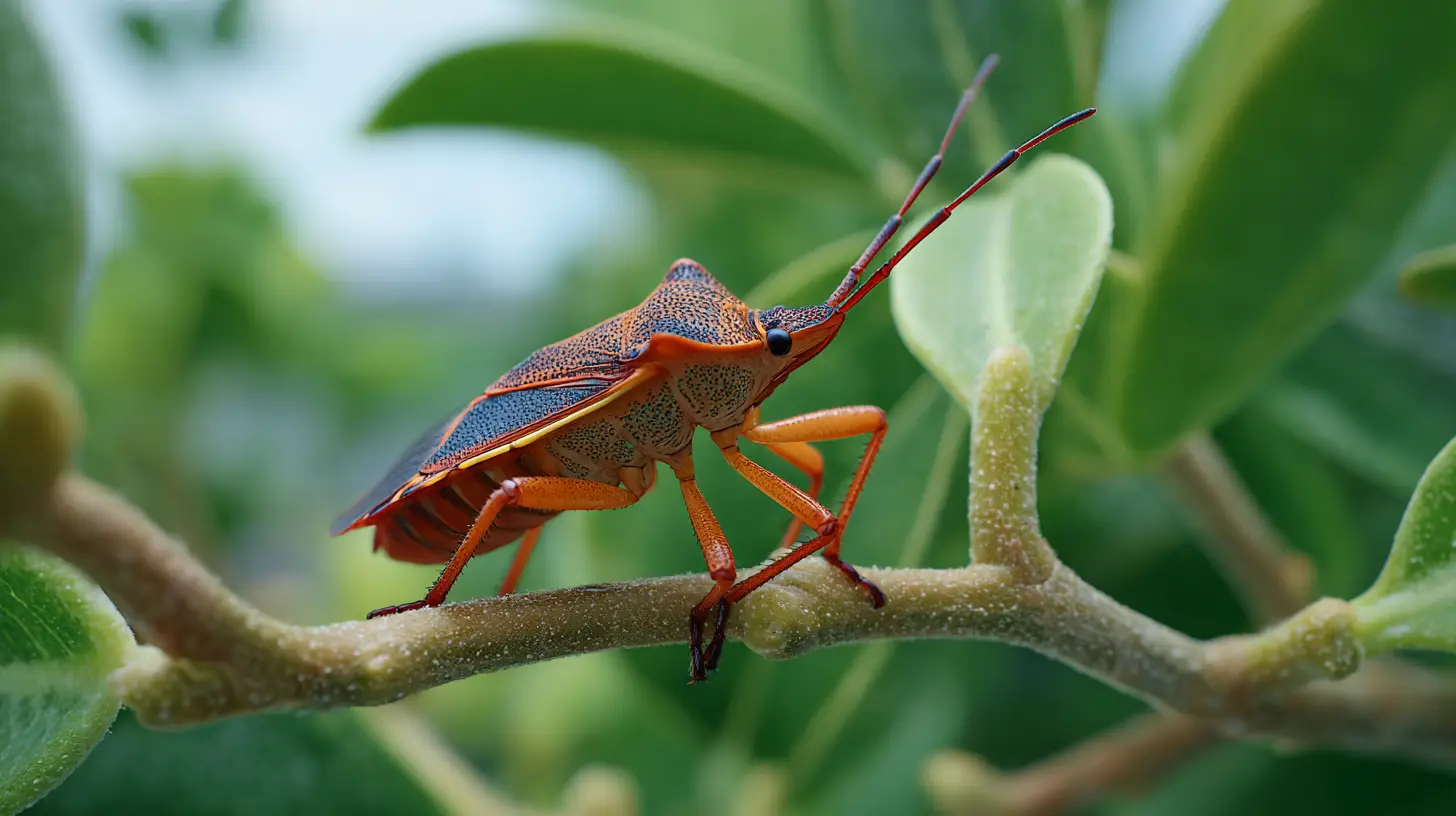
One non-disease lookalike is the southern chinch bug, a year-round St. Augustine pest in Venice that shows up first in full-sun, water-stressed turf near sidewalks and driveways. Chinch bug damage usually does not recover with watering, which is a clue that it is not drought; checking for the insects confirms it. See common lawn pests in Venice.
Why nitrogen is the key clue
Dollar spot is tied to low nitrogen. UF/IFAS’s turfgrass disease management guide says: “Very low nitrogen levels are conducive for the development of dollar spot disease.” Its zoysiagrass guide says dollar spot “typically occurs when nitrogen is below optimal levels. This can easily be corrected with a light application of nitrogen.”
That is the opposite of large patch, which UF/IFAS says is encouraged by excessive nitrogen. So adding fertilizer to every spotty lawn is a gamble. The right move depends on which disease you have.
Venice adds a timing problem. Sarasota County restricts nitrogen and phosphorus fertilizer from June 1 through September 30, according to UF/IFAS Extension Sarasota County, which also lists an exception for new plantings. So a lawn that runs low on nitrogen in summer generally cannot get more until October, outside the exceptions the county lists. Read the county page before you fertilize, or see our Sarasota County fertilizer blackout guide.
A soil test will not settle the question either, because the UF/IFAS lab does not test nitrogen.
Water and mowing
Cultural care is the first line of defense. UF/IFAS says overwatering “greatly increases disease susceptibility and thatch buildup and leads to a shorter root system.” In its watering guide, UF/IFAS advises:
- Water in the early morning. Watering in late afternoon or late morning “may be detrimental if it extends the time the lawn is naturally wet from dew,” which “can accelerate disease occurrence.”
- Water only when the grass shows stress, such as blades folded in half lengthwise or a blue-gray tint, and then apply 1/2 to 3/4 inch.
- After rain, hold off on watering until the grass shows stress again.
Mow at the height recommended for your grass: 3.5 to 4 inches for standard St. Augustinegrass cultivars and 1.75 to 2.5 inches for medium- to coarse-textured zoysia. Our guide to mowing height by grass type has the rest. UF/IFAS notes for bermudagrass that low cutting heights and high maintenance levels predispose turf to many weed and pest problems.
Fungicides
The UF/IFAS turfgrass disease management guide says to put cultural practices in place first or alongside any fungicide. Its bermudagrass guide says “a sound cultural program can minimize most disease problems, and fungicides can be used to cure major outbreaks.” The disease management guide adds that when a disease recurs in the same spot each year and the long-term forecast favors it, a fungicide “may be useful in preventing an outbreak.” The centipedegrass guide says both large patch and dollar spot can be “minimized by following proper nutrition and controlled with fungicides.”
If you consider a fungicide, UF/IFAS’s homeowner’s guide to fungicides reminds readers that “any use of a pesticide that is not in accordance with its label is illegal” and to check the label on the container before buying. Make sure the label covers your turfgrass and dollar spot, and follow it as written.
Waves Pest Control’s lawn program covers turf fertility, weed, insect and disease control, and agronomic diagnosis. See lawn fungus control in Venice for how the service works.
Get it confirmed
Because several diseases and chinch bugs can make spots, get the cause confirmed before spending money. UF/IFAS Extension Sarasota County lists a plant clinic for pest and plant help at its office at Twin Lakes Park. Ask the office what kind of sample it needs.
Frequently Asked Questions
Is it dollar spot or large patch?
Patch size is a clue. UF/IFAS describes dollar spot as patches under 3 inches with tan-centered leaf lesions, and large patch as larger circular patches without leaf spots. Confirm with a plant clinic.
Does dollar spot affect St. Augustine lawns?
UF/IFAS’s diagnostic key says dollar spot can occur on any grass. Its St. Augustinegrass guide names gray leaf spot, large patch and take-all root rot instead, so check for those too.
Should I fertilize a lawn with dollar spot?
UF/IFAS ties dollar spot to low nitrogen, but large patch is encouraged by excess nitrogen. Confirm the diagnosis first, and follow the county fertilizer rule if it is June through September.
Do I need a fungicide?
Not always. UF/IFAS says cultural practices come first or alongside any fungicide. A fungicide can help with a major outbreak, and UF/IFAS says one may also be useful to prevent an outbreak of a disease that recurs each year when the forecast favors it. Follow the label if you use one.
Is it okay to water in the evening?
UF/IFAS recommends early morning, because late-afternoon watering can extend the dew period and speed disease.
Where can I get a diagnosis in Sarasota County?
UF/IFAS Extension Sarasota County lists a plant clinic. A licensed lawn professional can also diagnose it.