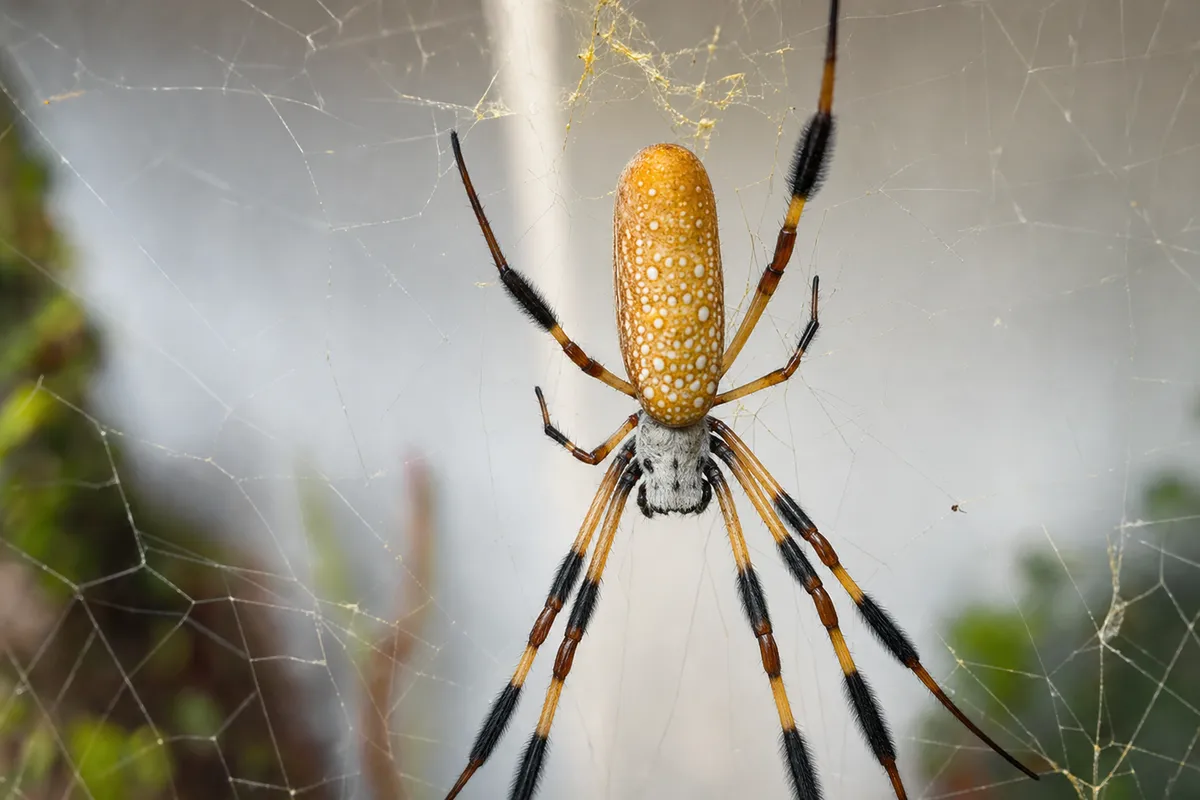
You brushed a golden web off the side of the lanai this morning, and hanging in the middle was a spider with legs longer than your thumb. Deep breath. Around here, that description often points to a golden silk orb-weaver, the Florida spider commonly called a banana spider.
If the spiders showing up around your place have you side-eyeing the whole backyard, our pest control services can help identify recurring spider activity and the conditions supporting it. You can also get a pest control estimate before anyone comes out.
Why it’s called a banana spider
The name throws people because “banana spider” is a common name rather than a precise identification. In Florida, UF/IFAS identifies the golden silk orb-weaver (Trichonephila clavipes) as the spider commonly called a banana spider. You will still see the older name Nephila clavipes in field guides because the genus changed after a 2019 taxonomic revision.
The “golden” part refers to the silk. On a sunny afternoon, those strands can look like fishing line dipped in honey between your shrubs. Color alone is not enough for a confident ID, though, because Florida has several large orb-weavers.
How to tell you’ve got a banana spider
The female is the one you notice. The UF/IFAS guide to common Florida spiders puts females at 25 to 40 millimeters in body length, among the country’s largest orb-weavers. Look for a silvery front body, a dull orange-to-tan cylindrical abdomen dotted with yellow, and brown-and-orange banded legs with dark hair tufts. The male sharing her web is easy to miss at 4 to 6 millimeters and dark brown. You might also spot tiny dewdrop spiders in the same web, feeding on prey the larger spider left behind.
The web itself is a giveaway. Golden silk orb-weaver webs are large, finely meshed, asymmetrical, and often 1 to 2 meters across. They are semi-permanent: the spider repairs sections instead of routinely replacing the entire structure. The UF/IFAS profile most often places them along wooded edges and insect flight paths, attached to trees and low shrubs.
Pro tip: Before you panic-identify anything, snap a clear phone photo of the spider and the web from a safe distance. Body shape, leg banding, and web structure tell you far more than color alone.
A common lookalike is the yellow garden spider. It has a bold yellow-and-black abdomen, lacks the golden silk orb-weaver’s leg tufts, and often sits in the middle of a web with a thick zigzag silk decoration. Both are large Florida orb-weavers and both help control insects. When the markings do not match either description, start with our pest library or ask a professional to identify the photo before choosing a treatment.
Are banana spiders dangerous?
Golden silk orb-weavers have venom for subduing prey, but they present little danger to people. UF/IFAS reports that they bite when held or pinched and that a bite typically causes brief localized pain and slight redness, less severe than a bee sting. Do not handle one bare-handed, and check gloves or clothing before putting them on if they have been stored outdoors.
Why you keep bumping into them around SWFL
Timing has a lot to do with it. UF/IFAS Extension’s seasonal account reports that most females mature in August and remain into late fall. Their large webs are placed across insect flight paths, so a shrub-lined opening or quiet garden edge can become a natural anchor point.
Banana spider season
When golden silk orb-weavers are easiest to spot
- Winter through spring Dec–MayLower
Large mature females and their full-size webs are less conspicuous during this part of the annual cycle.
- Early summer Jun–JulBuilding
The year's spiders are growing, and adult males begin appearing in July.
- Late summer Aug–SepPeak
Most females mature in August, and large golden webs become hard to miss along open edges.
- Fall Oct–NovActive
Mature females remain into late fall and produce egg sacs before the annual cycle turns over.
Late summer is when most females mature. UF/IFAS reports one generation per year in temperate North America, with the largest spiders and webs most noticeable from late summer into fall.
Exterior lights can concentrate flying insects near doors and lanais. If a web keeps appearing beside a fixture, turn the light off when it is not needed or use a motion control. UF/IFAS Sarasota County’s exterior-lighting guidance also recommends warmer, longer-wavelength bulbs to reduce the insects gathering around a light.
What banana spiders are good for
Give them a little credit. Golden silk orb-weavers catch a wide range of small and medium flying insects. UF/IFAS records prey including flies, moths, small beetles, wasps, and bees. That makes them useful insect predators, although they do not distinguish between nuisance insects and pollinators. An out-of-the-way web can be left alone; the practical problem is usually a web stretched across a path, doorway, or other space people use.
What homeowners can do around the house
Identify first, then act. Since the right move depends on which spider you actually have, start with that photo and a calm look before you do anything else.
For banana spiders specifically, here is the homeowner playbook:
- Knock down and remove webs from the spots people use, like walkways, doorways, the lanai, and the pool cage, using a broom or a rake.
- Leave the ones out in the garden or along the tree line alone if they are not in your way.
- Cut back shrubs and branches so they are not touching doors, screens, and paths where webs get anchored.
- Turn off unnecessary exterior lights after dark, use motion controls, or choose warmer bulbs that attract fewer insects.
- Repair torn screens and seal gaps around doors to keep wandering spiders and their prey outside.
- Give patio furniture, cushions, and play equipment a quick check before anyone plops down.
And what to skip:
- Grabbing one bare-handed or flicking it off with your fingers is how the rare bite happens, so leave the hands out of it.
- Blanket-spraying a web or the surrounding landscape skips the identification and inspection steps that should guide any pesticide use.
Routine cleaning is the first line of control. UF/IFAS guidance for spiders in Southwest Florida lanais recommends removing webs, sealing gaps, clearing clutter, and reducing the insects spiders feed on before considering a pesticide. No treatment can promise that an outdoor web will never return.
Our approach to recurring spider webs
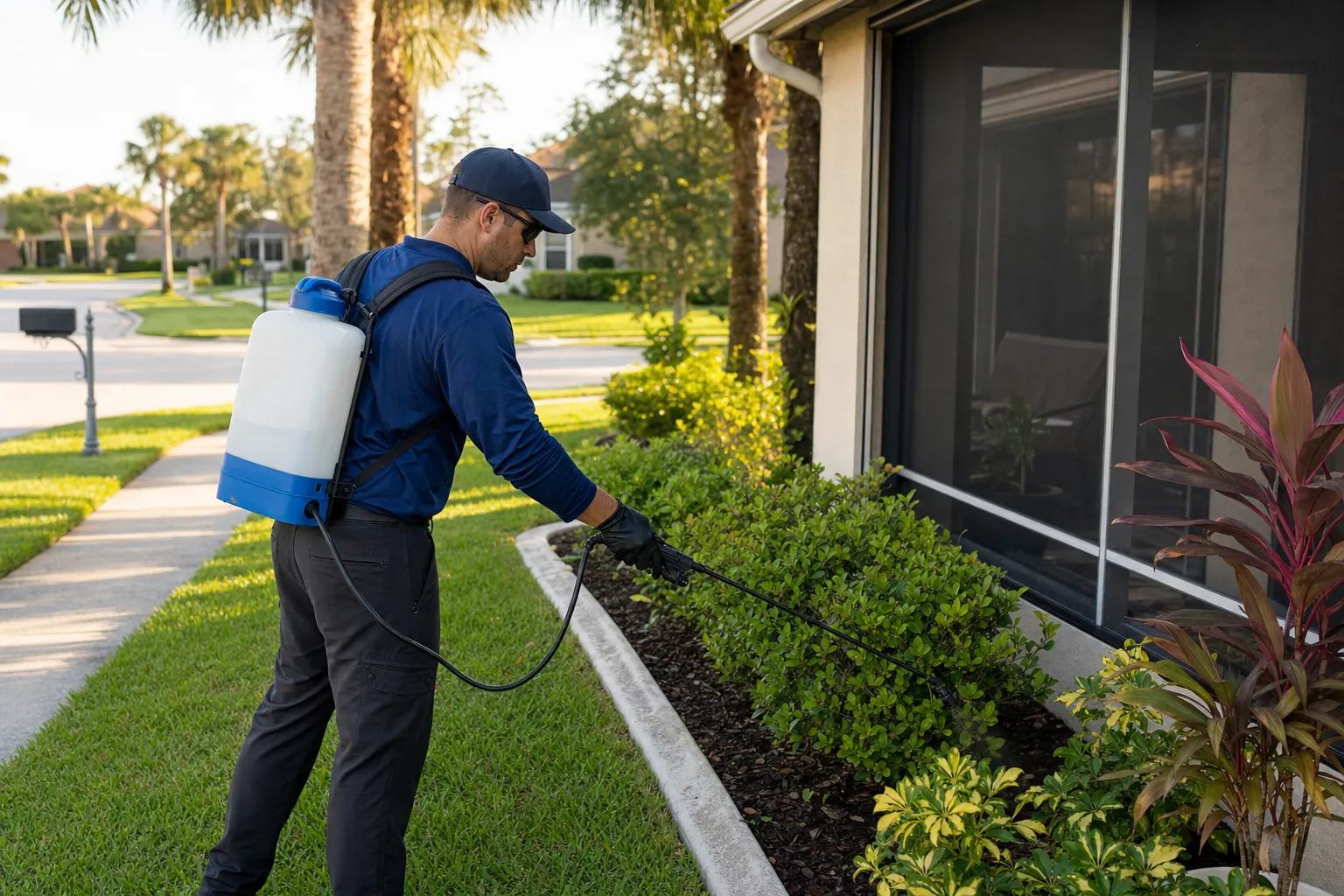
We start with identification and inspection. A technician should confirm the spider, look for repeated web sites and egg sacs, trace the insect activity supporting it, and check screens, doors, eaves, lighting, vegetation, and clutter. The plan can then combine web removal, exclusion, lighting or habitat changes, and monitoring. If a pesticide is appropriate, it should be targeted to the identified problem and applied according to its label rather than broadcast without a reason. That inspection-first approach follows UF/IFAS guidance for selecting a pest-control service.
On every inspection
What a Waves tech checks first
- Species Body shape, markings, leg tufts, and web structure before recommending control.
- Web hot spots Doorways, eaves, lanai corners, and pool-cage posts where webs keep reappearing.
- Prey sources Exterior lighting and nearby insect activity that make a web site productive.
- Entry points Gaps and torn screens where the occasional wanderer slips indoors.
The inspection connects the spider's identity with the reason it chose that location.
This is the point where a lot of folks decide the DIY broom routine has run its course. If banana spiders and their webs keep taking over the parts of the yard you want to enjoy, that is a fair time to call in help. Our WaveGuard membership plans cover recurring exterior pest control, and they come with unlimited callbacks between scheduled visits at no extra charge, so if covered pests turn up between services, we come back free.
Frequently asked questions
Are banana spiders poisonous?
The golden silk orb-weaver is venomous, not poisonous: it uses venom to subdue prey. UF/IFAS describes bites as unusual unless the spider is held or pinched, with brief local pain and slight redness. Avoid handling any spider you cannot confidently identify.
How can I tell a banana spider from a yellow garden spider?
A female golden silk orb-weaver has a long orange-to-tan abdomen with yellow spots, a silvery front body, dark hair tufts on banded legs, and golden silk. A yellow garden spider has a broad black-and-yellow abdomen, no leg tufts, and often a thick zigzag decoration through the center of its web.
Should I remove a banana spider web?
Remove a web if it crosses a doorway, path, play area, or another place where someone could walk into it. Use a long broom or vacuum attachment and avoid bare-hand contact. An out-of-the-way web at a garden edge can be left alone.
Why does the web keep coming back in the same place?
That spot probably provides sturdy anchor points and regular insect traffic. Remove the web, trim vegetation away from the route, adjust nearby lighting, and repair screen or door gaps. If webs keep returning in a busy area, a professional can identify the species and inspect the conditions attracting it.
Ready to hand off the cobweb patrol?
Homeowners across the area, including those looking for pest control in Sarasota, can request a pest-control quote for an exterior inspection. From Bradenton down to Venice, the banana spiders are just doing their thing, and we can help you share the yard on your terms.