If you poked around under your patio furniture lately and found a spider wearing an hourglass on its belly, you probably want one answer fast. Is this the dangerous one? Around Southwest Florida you are most likely looking at one of two spiders that wear that mark: the black widow or the brown widow. They are close cousins that build the same kind of messy, low web, so people mix them up constantly. Telling them apart is easier than you think once you know where to look, and it changes how worried you need to be. Waves handles both as part of our regular pest control services, and if you just want a ballpark on what a plan runs for your place, you can check the pest control calculator before you read another word.
Florida is also home to the northern black widow and the rare red widow, but around SWFL homes the two you will actually meet are the southern black widow and the brown widow. Here is how to sort them out.
What a black widow looks like
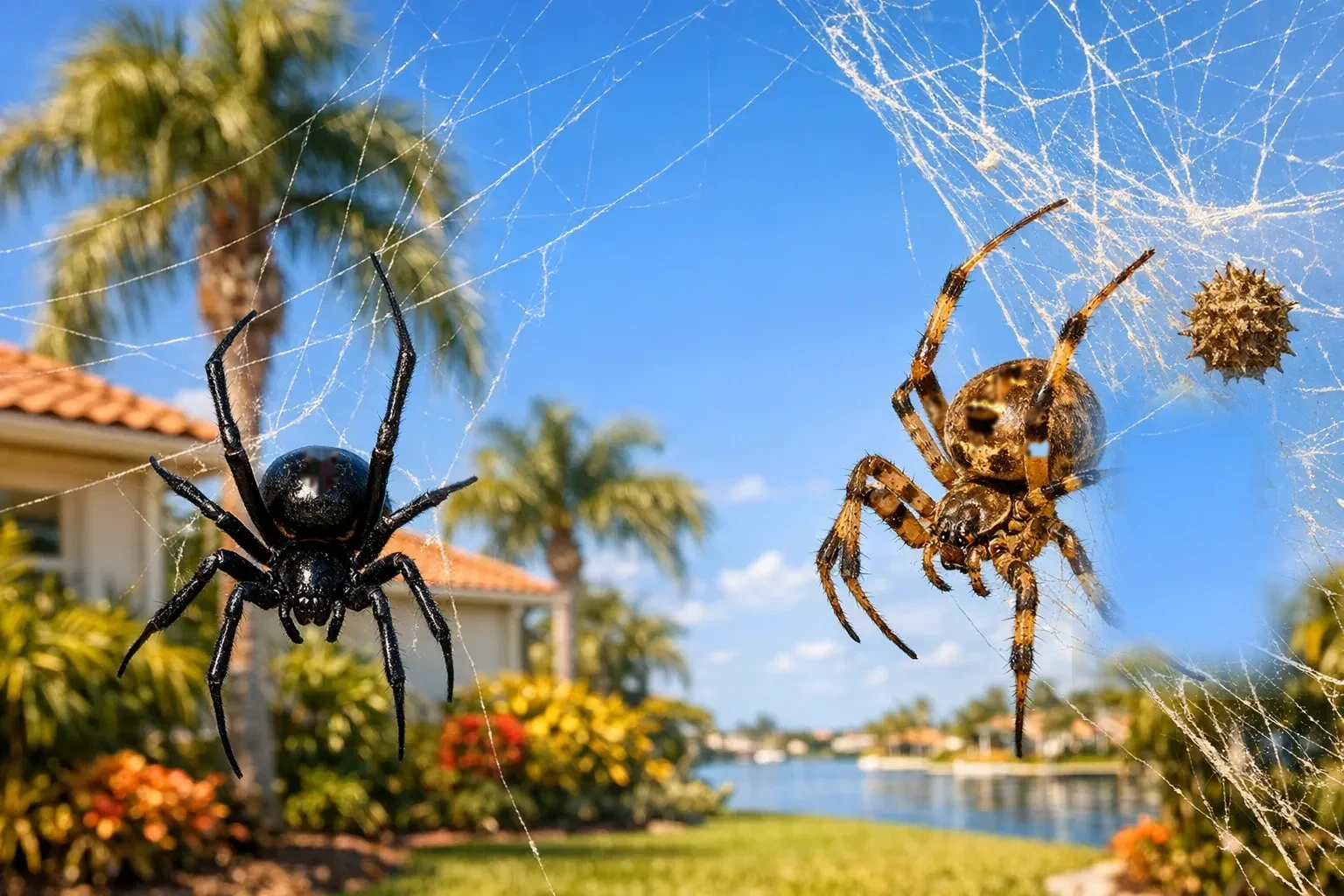
The black widow most people picture is the southern black widow, and it earns the reputation. Per UF/IFAS, the female is a shiny, jet black spider with a bright red hourglass on the underside of her round abdomen. She runs about half an inch long without the legs. You tend to find her in the quiet, tucked-away parts of your property: woodpiles, the back corner of the shed, discarded pipe or building material, water meter boxes, and the dark edges of a garage. In Florida she is seldom found inside the house itself, so most run-ins happen when you reach into something outdoors.
What a brown widow looks like
The brown widow is the one you are far more likely to meet around a SWFL home, from Bradenton down to Venice. It is an invasive species with a long Florida history — UF/IFAS records it in the state as far back as 1935, long confined to peninsular Florida before expanding into other parts of the U.S. around 2000 — and UF/IFAS Sarasota County reports it as the widow people encounter most often around houses and workplaces here. Instead of glossy black, a brown widow is a mottled mix of tan and brown with darker accent marks, and its hourglass tends to be orange or yellow rather than the vivid red of its cousin. Its legs often look faintly banded. Young black widows can look almost identical to a brown widow, which is why color alone will fool you.
The brown widow also picks more out-in-the-open spots. It likes the underside of your patio chairs, the inside of the mailbox, the recessed handle of a plastic garbage can, entryway corners, the space behind hurricane shutters, and empty flower pots. Because those are all places your hands go, the brown widow ends up in more accidental contact with people.
| Feature | Black widow | Brown widow |
|---|---|---|
| Body color | Shiny jet black | Mottled tan to brown with dark marks |
| Hourglass | Bright red, on the underside | Orange to yellow, often less vivid |
| Egg sac (the tell) | Smooth, round to pear shaped, white to tan | Spiky and tufted, like a little sandspur |
| Where it hides | Tucked-away spots: woodpiles, sheds, meter boxes | Exposed spots: patio furniture, mailboxes, can handles |
| Temperament | Shy, bites when pressed against skin | Timid, plays dead, rarely bites |
| Bite | Neurotoxic, can cause latrodectism | Usually mild pain and a red mark |
Black widow and brown widow field marks, per UF/IFAS.
The egg sac is your best clue
Here is the shortcut the pros lean on. If you can find the egg sac, you can name the spider without squinting at leg bands. A black widow egg sac is smooth, round to pear shaped, and colored white to tan. A brown widow egg sac looks like a little sandspur or a spiky ball, covered in pointed tufts of silk. Nothing else in your yard makes an egg sac like that, so once you spot the spiky one you are dealing with a brown widow. And brown widows make a lot of them. UF/IFAS notes a single female can produce thousands of young in a season across multiple egg sacs, which is a big reason they have been elbowing black widows out across the state.
Pro tip: Before you sweep a web away, scan it with a flashlight for that spiky egg sac — it names the spider for you. Don’t try to catch or collect a live widow, and don’t handle the sac bare-handed either. Keep clear of the area and let a pro take down both, because crushing the web but leaving the sac just clears the runway for the next brood.
Which widow should worry you more?
This is where the internet gets confusing, so let me clear it up. Drop for drop, brown widow venom is often cited as being at least as strong as black widow venom, and a UF/IFAS arachnologist has described it as roughly twice as potent. That sounds alarming until you learn how a brown widow actually behaves. It is a timid spider that does not defend its web, and it delivers only a small dose of venom when it does bite, so most verified brown widow bites amount to some pain at the spot and a red mark, close to what a lot of ordinary household spiders leave behind. Severe reactions have been documented, but they are rare.
The black widow is the bigger medical concern. Its venom carries a neurotoxin that can trigger latrodectism, with symptoms like muscle cramps, belly pain, sweating, and an ache that can build over hours and last a day or more. Neither spider comes after you. Bites almost always happen when the spider gets pressed against skin, like when you slide your hand into a glove or shoe it was hiding in, or grab something it lives under. If you think a widow has bitten you, call Poison Control right away — even if the pain feels mild at first, because black widow symptoms can build over the hours after the bite. Severe symptoms mean emergency care. Kids and older adults tend to react harder, so nobody should tough that one out.
Why widows love a Southwest Florida yard
Our climate is basically a widow resort. Warm weather keeps them active every month of the year here, so it pays to keep an eye out no matter the season. The daily afternoon storms and humidity feed a steady supply of the insects they eat, and sandy soil drains fast, leaving dry, protected pockets under slabs, pavers, and landscape edging where a widow can tuck a web. All that lawn furniture and pool gear sitting around the patio near your St. Augustine grass gives them the undisturbed, shaded cover they want.
Spider seasonality
Widow activity through the SWFL year
- Spring Mar–MayBuilding
Warm nights return and web-building picks up in sheds, meter boxes, and fence lines.
- Summer / rainy season Jun–AugPeak
Storm-fed insect prey keeps widows fed and the egg sacs coming.
- Fall Sep–NovActive
Still plenty warm for steady activity in exposed spots like patio furniture and mailboxes.
- Winter Dec–FebLower (not zero)
Cool snaps slow them down, but SWFL never gets cold enough to clear them out.
Summer / rainy season is the busy season for widows and their egg sacs, fed by the summer insect boom.. Widows stay active every month here — the case for keeping webs, sacs, and harborage knocked down year-round.
Safe checks you can do yourself
Before you treat anything, figure out what you actually have. Widow control depends on the species and on finding the egg sacs, so identification comes first. Pull on a pair of gardening gloves, grab a flashlight, and check the exposed spots brown widows favor: under the patio furniture, inside the mailbox, around the meter box, along fence lines, and behind the shutters. Look low and look in corners, since widow webs sit close to the ground and feel unusually strong if you brush one.
Once you know what you are dealing with, here is the safe playbook:
- Vacuum up abandoned webs and egg sacs with a bagged vacuum, then remove the whole bag without opening it, seal it inside a plastic bag, and drop it in the outdoor trash — never open a canister or empty a bag over a collected sac, since a disturbed sac can release dozens of spiderlings. If a live widow is sitting in the web, skip the vacuum: leave the area undisturbed and let a pro handle it.
- Clear clutter and debris away from the house, and keep firewood and building materials off the ground and away from the walls.
- Seal gaps around doors and windows, and add weather stripping wherever daylight shows through.
- Keep stored buckets, pots, and coolers turned over or closed so they stop working as spider condos.
What not to do: keep your bare hands out of dark spaces you have not checked, and never try to move a widow by hand. A can of Raid emptied on a single web scatters the spider and leaves the egg sac sitting there; for an abandoned web and its sacs, a bagged vacuum does more of the job, and a web with a live widow in it is a leave-it-alone, call-a-pro situation. If you do reach for a store-bought product, read and follow the label, keep it off any surface where food is prepped, and store and apply it well out of sight and reach of children and pets.
When to bring in Waves
If you are finding webs faster than you can clear them, spotting spiky egg sacs in more than a spot or two, or you just do not love the idea of playing flashlight tag with venomous spiders, that is a good time to call in help. A tech knows the harborage points widows use and can knock down the webs and egg sacs in the places you cannot easily reach.
On every inspection
What your tech is looking for on a widow call
- Tangled, low webs Strong, messy cobwebs near the ground and in corners.
- Egg casings Smooth sac points black widow; spiky sandspur says brown widow.
- Harborage points Meter boxes, weep holes, furniture lips, and can handles.
- Shed skins Molted skins in the web mean the spider is living there.
- Prey debris Insect carcasses under a web mean it is active.
- Entry gaps Clutter and cracks that give widows a protected nook.
Widow evidence is web-and-sac first — the spider itself is often out of sight.
Spiders are one of the pests covered on Waves’ recurring pest control plans, and that is where the year-round part pays off. Recurring plans include unlimited callbacks between your scheduled visits at no extra charge, so if covered pests turn back up between services, Waves comes back out free. Those same qualifying recurring services, when they’re on autopay, also enroll you in a WaveGuard membership tier automatically — one service starts at Bronze, and the loyalty discounts kick in once a second qualifying service joins it. Regular service keeps the perimeter and those favorite hiding spots knocked down so widows are far less likely to settle in, though no honest company can promise a spider will never wander back onto your property.
Want to brush up on the other eight-legged and six-legged neighbors you share a yard with? The Waves pest library has the rundown.
Ready to hand off widow patrol? Get a fast estimate with the pest control calculator, or see how coverage works for your area on our Sarasota pest control page.