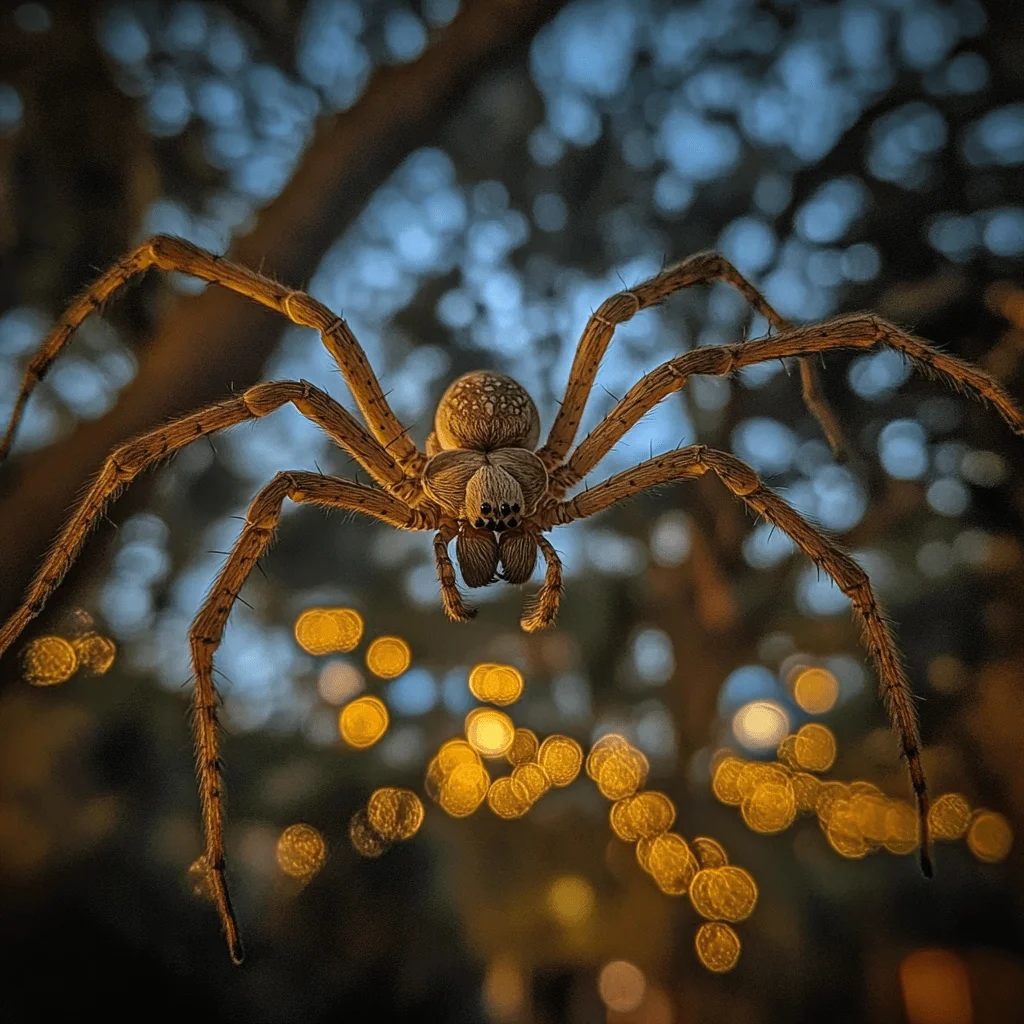
A customer emailed me a short list of insecticides another company had described to him, along with one honest sentence: the process can be very frustrating since the spiders can bounce back within 2 weeks to 2 months.
He’s right that they bounce back. He’s wrong about why — and so is almost everyone who blames the chemical.
Spiders rarely return because a product was too weak. They return because the things that produce spiders were never touched: protected egg sacs, sheltered harborages, entry points, the insects they eat, and the lights that deliver those insects to your wall every single night. You can spray a perfect band of the best residual on the market around a lakefront home in Sarasota, and if the pond keeps hatching midges and the coach lights burn until 2 a.m., you have built a feeding station with a treated floor.
This is the long version of what we tell customers on a spider call — the biology, the products, the honest limits, and what we actually do about it.
Key Takeaways
- Spiders come back for six reasons, and only one of them is the product: surviving females in protected retreats, egg sacs hatching on their own schedule, spiderlings ballooning in on silk, wandering spiders walking in from the landscape, prey insects arriving nightly, and residual that the spider never contacts.
- The egg sac is the bottleneck. Egg-sac silk is highly water-repellent, and in University of California research most water-based sprays failed to stop brown widow spiderlings from emerging. Physical removal is the dependable step, not spraying over the sac.
- All four products commonly named for spider work are pyrethroids — Permethrin SFR, Demand CS, Onslaught FastCap, and the beta-cyfluthrin half of Temprid FX. Switching brands is usually a formulation change, not a new strategy.
- A web-builder may never touch your treated wall. It hangs in silk. That is a placement problem, not a potency problem.
- Exterior lighting is the highest-leverage thing a homeowner controls. UF/IFAS puts warm or ultra-warm LEDs below 3600 K and yellow “bug lights” peaking at 550–600 nm in the least-attractive category; UV bug zappers make it worse.
- Living on water doesn’t breed spiders — it feeds them. A retention pond can export a fresh wave of midges every night.
- Structural insecticides never go toward the water. Different site, different label, different license.
Spiders don’t have a larval stage — and that changes the math
There’s no egg-larva-pupa-adult sequence to interrupt here. A male loads sperm into his pedipalps, transfers it during mating, and the female stores it internally. She fertilizes eggs later, on her own timetable, and wraps them in silk.
Two consequences matter for control:
One mating can fund several egg sacs. Removing the male — or never seeing one — does not mean the female is finished. Brown widows are the extreme case: about 120–150 eggs per sac, and University of California researchers describe females producing many sacs across a lifetime, often several in quick sequence (UC Riverside CISR).
The sacs hatch on a delay. A southern black widow sac holds roughly 220 eggs, and spiderlings emerge after about a month of incubation (UF/IFAS EENY-560). Treat the adults today and a sac tucked behind a shutter can still deliver a new generation three weeks from now. That looks exactly like a treatment that “stopped working.” It isn’t. It’s a timer nobody found.
Add that many of our common species have overlapping life stages year-round in Florida, and you get the honest version of the seasonality question: Southwest Florida has no clean spider season to schedule around. Individual species peak — orbweavers get conspicuous in fall — but there is no month where the whole cast goes quiet.
The spiders we actually find here
Before anyone reaches for a product, the species decides the plan. A web-builder, a crevice-dweller, and a roaming hunter are three different problems, and two of the seven below shouldn’t be treated at all.
Field identification
The spiders we actually find on Southwest Florida homes
-
Brown widow
Latrodectus geometricus
Medically significant
- Where it lives
- Undersides of patio furniture, grill covers, pool equipment, mailboxes, railings, buckets and sheltered eaves.
- How it hunts
- A messy tangle web tucked into a protected pocket — usually below knee height, out of the wind.
- Egg sac
- Unmistakable: a tan ball covered in silk spikes, like a pollen grain or a WWII harbor mine. About 120–150 eggs, and one female can build many in sequence.
Source: UC Riverside CISR
-
Southern black widow
Latrodectus mactans
Medically significant
- Where it lives
- Woodpiles, sheds, meter boxes, cluttered garages — low, protected spots nobody disturbs for months.
- How it hunts
- Irregular tangle web with a retreat she rarely leaves. Gloves on before you reach into a void.
- Egg sac
- Smooth beige sac around a half-inch across holding roughly 220 eggs. Spiderlings emerge about a month later.
Source: UF/IFAS EENY-560
-
Common house spider
Parasteatoda tepidariorum
Nuisance
- Where it lives
- Eaves, window frames, lanai corners, garages and light fixtures. The web you knock down every month.
- How it hunts
- Cobweb builder. Abandons a web that stops catching anything and rebuilds a few feet away.
- Egg sac
- Pear-shaped, light brown, hung loose in the web — and a single female produces many of them over a year.
Source: UF/IFAS EENY-238
-
Southern house spider
Kukulcania hibernalis
Nuisance
- Where it lives
- Stucco cracks, block joints, window sills, shutters and roof overhangs — the ragged silk fans on your exterior wall.
- How it hunts
- Lives inside a deep crevice retreat and lays radiating silk lines out from it. The wandering brown males are the ones mistaken for recluses.
- Egg sac
- About 200 eggs in a loose silk ball kept inside her retreat — behind the opening, where a surface spray never reaches. Females may live up to eight years.
Source: UF/IFAS EENY-144
-
Pantropical huntsman
Heteropoda venatoria
Nuisance
- Where it lives
- Garages, sheds, attics and the occasional living-room wall. Flat body, so it slips through gaps you would swear were sealed.
- How it hunts
- Builds no capture web at all — it runs prey down at night. Sweeping webs does nothing to it.
- Egg sac
- A flattened disc roughly an inch across holding over 200 eggs, carried underneath the female rather than fixed to a wall.
Source: UF/IFAS EENY-160
-
Wall & jumping spiders
Menemerus and Plexippus spp.
Beneficial
- Where it lives
- Sunny exterior walls, window frames, lanai screens and palm trunks. The ones that turn and look at you.
- How it hunts
- Daytime stalk-and-pounce hunters with excellent vision. No prey web — just a small silk sleeping retreat.
- Egg sac
- A lens-shaped case of roughly 25–60 eggs guarded inside that retreat, not out in a web.
Source: UF/IFAS EENY-158
-
Spinybacked orbweaver
Gasteracantha cancriformis
Beneficial
- Where it lives
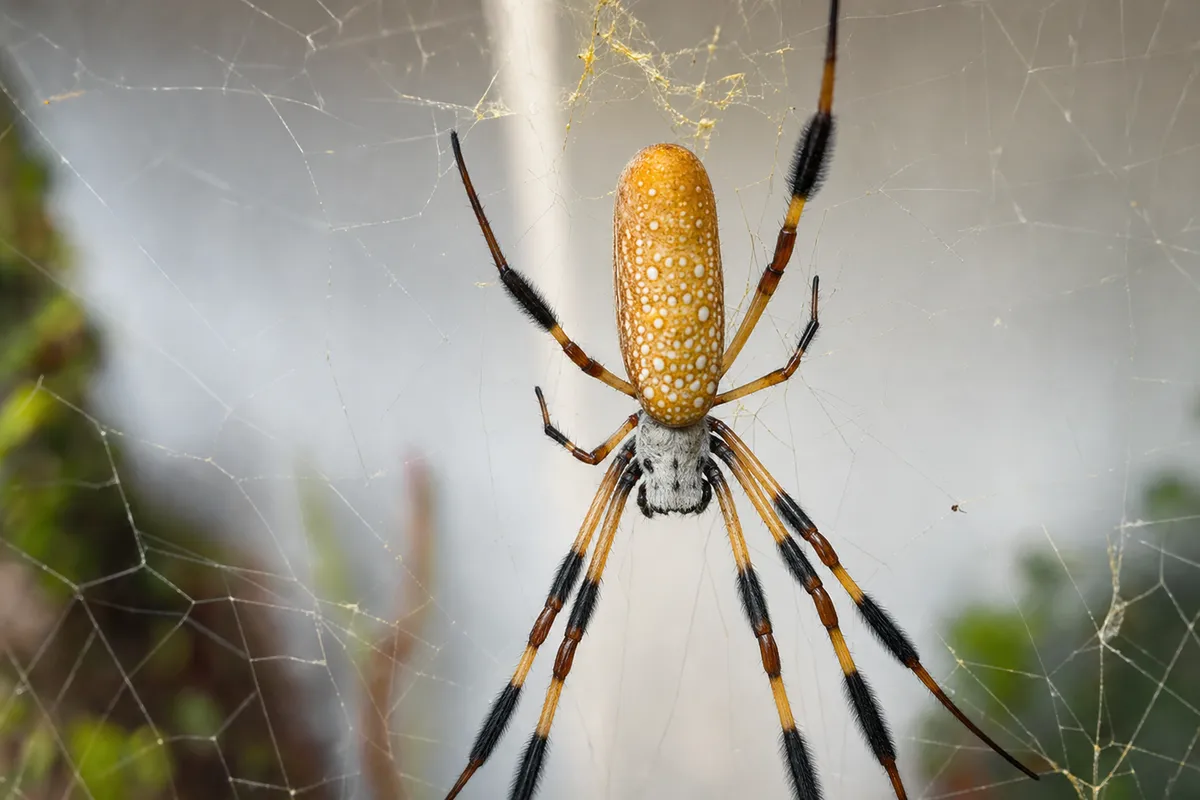
- Strung between shrubs, palms, screen-cage frames and anything else within reach. The white spiky "crab" spider everyone walks into.
- How it hunts
- Classic orb web, rebuilt constantly — which is why one reappears the morning after you cleared it.
- Egg sac
- Not in the web. She lays 101–256 eggs on the underside of a nearby leaf, October through January, so the web you removed and the eggs you missed are in two different places.
Source: UF/IFAS EENY-167
About the "brown recluse" in your garage: No recluse spider is native to Florida. Three species have been intercepted and have occasionally established inside a single building at scattered locations, and brown recluse records cluster in Alachua, Bay, Duval, Jefferson and Leon counties — not Southwest Florida. Around here, the "recluse" in the garage is almost always a male southern house spider.
Identification first, then removal, then product. Reverse that order and you spend money treating a wall the spider never walks on.
The lanai and pool cage deserve a specific note, because that’s where most of these calls start. If you’re chasing webs across a screen enclosure, we wrote up the seasonal side of that separately in why August brings a spider boom to Sarasota pool cages, and there’s a broader species walkthrough in Florida spider identification.
The egg sac is the real bottleneck
This is the part that reframes everything.
Spider egg sacs aren’t porous little bags. Depending on species, the eggs sit inside multiple layers of densely woven silk, and the outer layer can be strongly water-repellent. When University of California researchers tested treatments against brown widow egg sacs, the water-based sprays largely failed to penetrate — the co-author’s description was that the sac “is constructed with highly hydrophobic silks, so the water-based pesticide sprays were not very effective in penetrating the egg sac.” Certain oil-based aerosols did penetrate in that study (UC Riverside Entomology).
Most structural pest control is done with water-based products. So the honest statement is this:
A treatment can kill the female you can see and leave the egg sacs she already deposited fully viable.
What that means in practice:
- Spraying the outside of a sac may leave living embryos inside it.
- A residual around the sac may catch some spiderlings after they emerge and cross it — but emergence itself isn’t reliably prevented.
- Sacs behind shutters, inside soffits, under patio furniture or deep in masonry gaps may receive no product at all.
- Dust can cling to exterior silk and contact emerging spiderlings, but it should not be sold as reliably killing the contents.
Which is why the dependable step is mechanical. The technician has to find the sac, remove the whole thing — not just tear down the visible web — and contain or destroy it so the spiderlings can’t emerge somewhere else. UF/IFAS Extension in Collier County puts it plainly for lanais: routine cleaning is the most important strategy, and their guidance walks through vacuuming, web removal, sealing gaps and clutter reduction before reaching for a can (UF/IFAS Collier County).
The claim to avoid is “insecticides can’t kill spider eggs” — too absolute. The accurate claim is that ordinary water-based structural treatments don’t reliably penetrate egg sacs, so physical removal is the step you can count on.
So what about the products?
Here are the four commonly named for this work, scored on their practical value inside a complete spider program. These are not safety ratings, and I’m not publishing mixing rates — rates vary by pest, site, surface and application method, and the label is the law.
| Product | Chemistry | Program score | Best role | Real limitation |
|---|---|---|---|---|
| Onslaught FastCap | 6.4% esfenvalerate + 1.6% prallethrin + 8% piperonyl butoxide, microencapsulated | 8.5 / 10 | Hotspot and direct treatment where you want fast knockdown plus protected residual | Still pyrethroid chemistry; doesn’t solve protected eggs or a spider that never leaves its silk |
| Demand CS | 9.7% lambda-cyhalothrin, microencapsulated | 8.5 / 10 | Protected exterior residual at entry points, eaves, web anchors and harborages | One mode of action, and the spider has to actually contact a sufficient dose |
| Temprid FX | 10.5% beta-cyfluthrin + 21% imidacloprid | 8 / 10 | Targeted interior or protected crack-and-crevice work where spiders hide or enter | Not a license to blanket-spray occupied rooms; difficult spiders may need direct contact |
| Permethrin SFR | 36.8% permethrin emulsifiable concentrate | 6.5 / 10 | Economical broad-spectrum workhorse where the label and site fit | Least specialized formulation for high-pressure spider work; weather and porous stucco cut into it |
Now the part that rarely gets said out loud: permethrin, lambda-cyhalothrin, esfenvalerate, prallethrin and beta-cyfluthrin are all pyrethroids. So:
- Moving from Permethrin SFR to Demand CS changes the active ingredient and the formulation. It is not a different mode-of-action strategy.
- Onslaught contains two pyrethroids. That’s not two unrelated modes of action.
- The piperonyl butoxide in Onslaught is a synergist — it inhibits certain detoxification enzymes and can improve pyrethroid performance. It isn’t a killing active on its own.
- Temprid is the only one of the four carrying a genuinely different second class, imidacloprid.
- None of them work like an ant or termite bait. Spiders are solitary; there’s no colony to carry anything back to.
Demand CS is in our own exterior rotation, and I’ll still tell you the same thing: the product is not the differentiator. Directness of exposure, placement, surface, weather protection, egg-sac removal and prey reduction usually matter more than which jug came off the shelf. (The full named product set for our recurring service is in what quarterly pest control actually includes.)
Why a spider can cross a treated wall and live
This gets explained badly a lot, usually as “spiders walk on tiptoes.” Here’s the accurate version.
Contact with a dry residue is genuinely limited. On a flat treated surface a spider’s body sits elevated, so initial exposure concentrates on the ends of the legs. That’s a smaller exposed area than an insect dragging its body across the same band — and far less than a direct, label-compliant wet application that wets legs and body together.
Feet differ by lifestyle. Free-hunting spiders like huntsman and jumping spiders carry dense adhesive hairs; only a fraction touch the surface at any moment. Many web-builders lack that same adhesive gear because they’re built to move on silk — and that’s the important part. A cobweb or orb spider may spend nearly all its time suspended in its own web, using the silk as a bridge over the treated surface.
Dose depends on how long contact lasts. A spider brushing a residue briefly picks up a very different dose than one confined on it. Residue availability also shifts with surface porosity, formulation, residue age and weather — Florida stucco is absorbent, and Florida rain and sun are relentless.
Some spiders alter their behavior around fresh pyrethroid deposits, reducing contact rather than dying on it.
And spiders are not immune. Pyrethroids act on voltage-gated sodium channels, a target shared broadly across arthropods — arachnids included. Sensitivity just varies enormously between species. “Insecticides don’t work on spiders” is false; “a wall band may never reach this particular spider” is often true.
That distinction drives real decisions:
- Wandering hunters — huntsman, wolf spiders, males on the move — cross thresholds, sills and garage edges constantly, so they accumulate dry-residue exposure well.
- Web-builders — cobweb, cellar and orb spiders — may barely touch a wall treatment.
- For those, removal and direct label-compliant treatment at the occupied harborage beats a wider band of anything.
Where dust earns its place
Dust does one thing a liquid can’t: it stays available inside dry, protected voids that a spray can’t hold. Soffit voids, wall voids, gaps behind shutters, utility penetrations — fine particles travel into narrow spaces, cling to silk and hairs, and reach spiders sitting behind the opening instead of just coating the opening.
UC IPM specifically recognizes sorptive silica-gel dusts for cracks, crevices, attics and wall voids, while making the same point this whole article makes: insecticides alone don’t provide lasting spider control (UC IPM).
Two rules that matter more than the product choice:
- A dust deposit should be a light, nearly invisible film. Visible piles get avoided, kicked airborne, and route pests around the treatment instead of through it.
- Placement is restricted by the label, and dry protected voids are the point. Dust does not belong in air handlers, living surfaces, pool water, or anywhere wind can carry it to a pond or canal.
Diatomaceous earth is worth a specific caution here: its performance is slower and less consistent in humid conditions, which describes most of our year. And boric acid is a poor primary spider tool — spiders don’t eat conventional insect baits.
The 42-foot brush: real tool, incomplete program
A long-reach brush is genuinely valuable, and I’d rather see one on a truck than not. But reach is not the control step. What the brush is for is removing:
- the spider,
- the web,
- the attached egg sacs,
- the silk retreat where it’s practical,
- and the debris protecting the harborage.
A pole that knocks down visible webbing and leaves the sacs stuck under the eave has moved dust around. The removal is the treatment.
Your exterior lights are doing more than any product can undo
Spiders aren’t drawn to the bulb the way a moth is. The chain is indirect and completely mechanical:
- Night-flying insects concentrate and get disoriented around artificial light.
- They land on walls, screens, soffits and windows.
- Web-builders discover a reliable feeding station.
- Well-fed females put more energy into growth and egg production.
- Even after a treatment, new spiders recolonize the most profitable spot on the house.
UF/IFAS Extension in Sarasota County lays out the spectrum side of this clearly: humans see roughly 400–800 nm, insects see about 300–650 nm and strongly prefer 300–420 nm. The LED bulbs least attractive to insects are labeled warm white or ultra warm white — wavelengths above 550 nm, color temperature below 3600 K. Bulbs above 3600 K, labeled natural or cool white, attract more. Yellow “bug lights” peak at 550–600 nm and do reduce the crowd at the fixture (UF/IFAS Sarasota County).
The defensible hierarchy, best to worst:
- Off when nobody’s outside. Nothing beats it.
- Motion sensors or timers — darkness most of the night, light when you need it.
- True amber or yellow, shielded and aimed down, ideally on a post away from the door rather than beside it, so the insects pile up away from the structure.
- Ordinary warm white below 3600 K.
- Bright cool-white, blue-rich or UV lighting — the worst option for this problem.
Two more: close blinds and curtains after dark, because interior light spilling through glass concentrates insects on the outside of the frame. And skip the UV bug zapper on the lanai — it draws more insects toward the house and kills a great many non-target ones on the way.
If you live on a lake, canal, or pond
Waterfront is the single biggest driver of spider pressure in our master-planned communities, and it’s misunderstood. The pond does not breed your spiders. It manufactures and exports their food.
Aquatic midges — the “blind mosquitoes” — develop as larvae in the organic muck on the bottom of lakes, ponds and sluggish rivers. UF/IFAS notes they’re produced in huge numbers there, that the muck makes them very hard to control (insecticide struggles to penetrate it, and few predators live in it), and that the adults don’t bite or transmit disease and live only about two to three days (UF/IFAS). Those adults emerge, find your pond-facing lights, and die on your lanai screen — restocking the buffet nightly, no matter how good your perimeter treatment was.
If that’s your situation, the midges are the actual lane to work on. We covered that fully in how to get rid of aquatic midge flies.
A few honest notes on the water side:
- Aeration is a water-quality tool, not a midge cure. A fountain mostly interacts with the upper portion of the water column; bubblers mix deeper ponds more efficiently. UF/IFAS also warns that mixing a strongly stratified pond too rapidly can push low-oxygen bottom water through the whole pond, and that bottom systems can resuspend nutrient-rich sediment (UF/IFAS SS695). Design it off the pond’s actual condition, not off how the fountain looks.
- A maintained chlorinated pool is not normally your mosquito or midge source. Pool and landscape lighting around it still is a spider magnet.
- Don’t call every swarm mosquitoes. Container habitat — gutters, saucers, buckets, tires, boat covers, bromeliads — is a different problem with a different fix (UF/IFAS homeowner mosquito guidance).
And the rule we don’t bend, on any waterfront property: structural insecticides do not go toward the water. Onslaught’s own label warns it’s toxic to fish and aquatic invertebrates and must not enter storm drains, ditches or surface water, and similar aquatic precautions run across structural pyrethroids. We don’t spray toward the water, don’t treat when runoff is likely, don’t dust where wind can carry it to a canal or pond, and don’t rinse equipment into a drain. Treating an HOA pond is a different license and a different authorization entirely — Florida separates structural, outdoor pesticide and public-health mosquito licensing, and “natural” or “microbial” doesn’t exempt anything from that.
If you’re on the water in Sarasota and want the local version of this conversation, that’s the same crew and protocol we run for pest control in Sarasota.
What we actually do on a spider call
Our recurring service is exterior-focused by design; interior work happens on request or on active pressure. Here’s the sequence:
- Identify first. Web-builder, wandering hunter, widow, or beneficial orbweaver — that decision changes everything downstream. Two of the seven species on the board above are worth leaving alone.
- Map the pressure. Hot spots, web anchors, egg sacs, protected retreats. On an initial visit that inspection includes soffits, eaves and the slab line, and it’s why an initial runs 60–90 minutes rather than a lap with a wand.
- Remove mechanically. De-webbing entries, corners and eaves is a required step of every visit — not an add-on — and that’s where the egg sacs actually get dealt with.
- Treat to the label at cracks, voids, entry points, web anchors and harborages, with a full perimeter band roughly three feet out and three feet up.
- Use dust selectively in dry protected voids where it holds up better than a liquid.
- Attack the food supply — the lighting conversation above, plus the general insect pressure feeding the webs.
- Fix the structure. Torn lanai screen and loose spline, door sweeps, weather stripping, soffit gaps, garage seals, utility penetrations. Never caulk weep openings or drainage paths.
- Break the bridges. Branches, palms and vines touching the roof, cage or eaves; boards, leaf litter and debris stacked against the foundation.
- Re-inspect on activity, not on a calendar assumption. One new web is not a failed treatment. A broad return across the same locations, continued egg-sac production, or a wave of juveniles is a signal to go find the retreat, prey source or entry we missed.
| What happens | Spray-only service | Layered spider program |
|---|---|---|
| Active spiders on the wall | Knocked down where the residual is contacted | Same, plus direct removal at the harborage |
| Egg sacs behind shutters and under furniture | Often sprayed over and left viable | Located and physically removed |
| Web-builders suspended in silk | May never contact the treated surface | Web and spider removed, harborage treated directly |
| Spiders hiding in soffit and wall voids | Liquid runs out or is absorbed | Light dust deposit stays available in the dry void |
| Prey insects arriving nightly | Not addressed | Lighting and prey-source plan documented with you |
| Wandering hunters walking in | Caught only if they cross the band | Band plus exclusion at doors, screens and penetrations |
| What a rebound means | Assumed product failure, spray again | Triggers a re-inspection for the missed retreat or source |
Same chemistry in both columns. The difference is everything that happens around it.
What you can do before we ever show up
These are free, and several of them outperform anything in a tank:
- Turn off exterior lights you don’t need, and put the rest on motion or a timer.
- Close blinds and curtains after dark.
- Sweep webs and remove egg sacs on a schedule — cage rails, upper corners, door frames, furniture undersides, grill covers, soffits, shutters, pool-equipment shelters. Vacuum indoors, then bag and dispose of the vacuum contents.
- Repair the envelope: torn screen, loose spline, door sweeps, weather stripping, soffit screens, garage seals.
- Cut the bridges: trim branches, palms and vines off the roof, cage and siding; pull debris off the foundation.
- Dry it out: fix leaks, clean gutters, redirect irrigation off the walls, empty water-holding containers, ventilate a damp garage.
- Manage garage storage: lidded bins instead of open cardboard, off the floor, off the wall. Check gloves and shoes before putting them on.
- Skip total-release foggers. They don’t penetrate spider retreats and they add exposure for no control benefit.
- Time your pressure washing. Clean first, then treat — don’t wash a fresh residual off the house the next morning.
Frequently Asked Questions
Why did spiders come back two weeks after my treatment?
Usually one of six things, and only one is the product: a female survived in a protected retreat, an egg sac hatched on its own schedule, spiderlings ballooned in on silk, a wandering spider walked in from the landscape, prey insects kept arriving nightly, or the residual sat somewhere the spider never contacted. A single new web is normal. A broad return in the same locations means something was missed, and that’s an inspection, not a re-spray.
Do insecticides kill spider eggs?
Not reliably. Egg-sac silk can be strongly water-repellent, and in University of California testing most water-based sprays did not prevent brown widow spiderlings from emerging, while certain oil-based aerosols did penetrate. Since most structural treatments are water-based, physical removal of the sac remains the dependable step.
Is one spider product clearly better than the others?
Not in the way the question implies. Permethrin SFR, Demand CS, Onslaught FastCap and the beta-cyfluthrin in Temprid FX are all pyrethroids, so switching between them is a formulation change more than a strategic one. Temprid is the only one of the four with a second major class, imidacloprid. Placement, directness of exposure, surface, weather protection and egg-sac removal usually matter more than the brand.
Are there brown recluse spiders in Southwest Florida?
Essentially no. FDACS reports that no recluse species is native to Florida, and that brown recluse records cluster in a handful of North Florida counties rather than here. The spider people bring us as a “recluse” is almost always a male southern house spider, which is common on our exterior walls and completely harmless.
Does living on a lake or canal make spiders worse?
Yes — indirectly. The water doesn’t produce spiders, it produces their food. Aquatic midges develop in the muck at the bottom of ponds and lakes, emerge in large numbers, and get concentrated against your house by exterior lighting. That’s why lighting changes and midge management do more for a waterfront home than another round of perimeter spray.
Will a 42-foot brush fix my spider problem?
It’s a legitimate tool for reaching second-story eaves and cage frames, but reach isn’t the control step — removal is. The brush only works if it takes down the spider, the web, the attached egg sacs and the debris protecting the harborage. Knocking visible webbing off while the sacs stay stuck under the eave buys you about a week.
Should I kill every spider I find?
No, and we’ll tell you which ones to leave. Jumping spiders and spinybacked orbweavers are beneficial predators eating the insects you actually mind — UF/IFAS Extension notes an average spider eats about 2,000 other insects a year. On venom, the accurate framing is that most spiders are venomous, because that’s how they subdue prey; very few have venom of concern to people. UF/IFAS states that the only spiders native to or established in Florida with medically significant venom — the kind where a bite could require medical care — are the widow spiders (UF/IFAS ENY2080). That’s the group worth treating around patios, play areas and garages.
Getting a number for your own house
Our pest control cost calculator gives you a real estimate without a phone call, and you can see the full visit sequence in what to expect during a pest control visit.