If part of your lawn is yellowing, thinning or lifting like loose carpet, white grubs are one possible cause. They are also one of the most over-diagnosed lawn problems, so confirm them before you try to get rid of grubs. UF/IFAS says “white grub” is a general term for all scarab beetle larvae, and that chafer beetle grubs are the most common in Florida lawns (UF/IFAS Gardening Solutions).
This guide covers what UF/IFAS says about grubs in Florida turf, the one species that matters most on Gulf Coast St. Augustinegrass, how to check your own lawn, and what to do next.
Which grubs are in Southwest Florida lawns
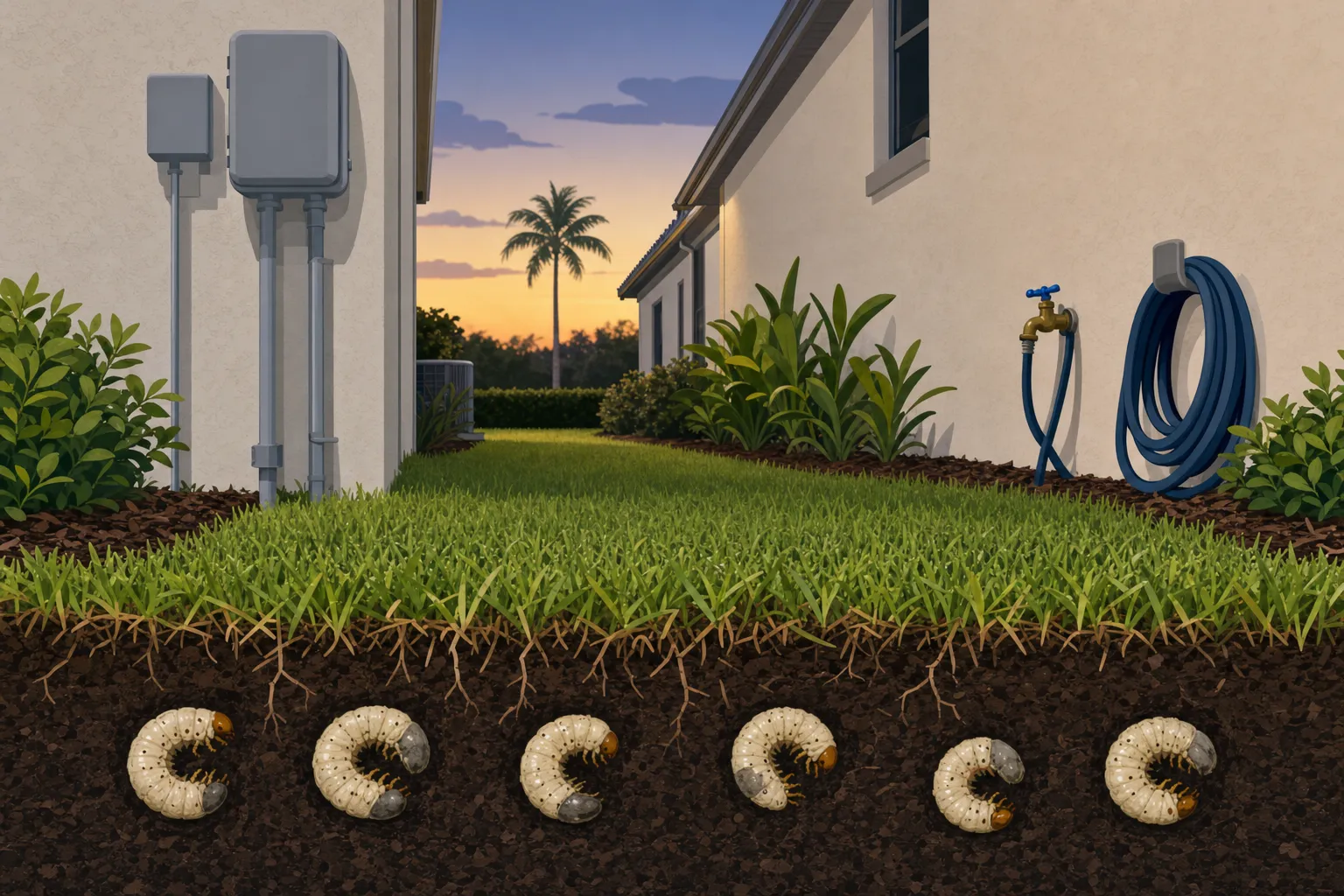
UF/IFAS says white grubs feed on the roots of all turfgrass species and live at or just below the soil-thatch interface. Three names come up most.
- Sugarcane grub (Tomarus subtropicus). This is the one to know. The UF/IFAS Featured Creatures profile says it has been collected in Manatee, Sarasota, Charlotte and Lee counties, among others. It also says these grubs “appear to be most damaging on St. Augustinegrass lawns along the Gulf Coast in Florida” (UF/IFAS Featured Creatures). Its hosts include St. Augustinegrass, bahiagrass and bermudagrass.
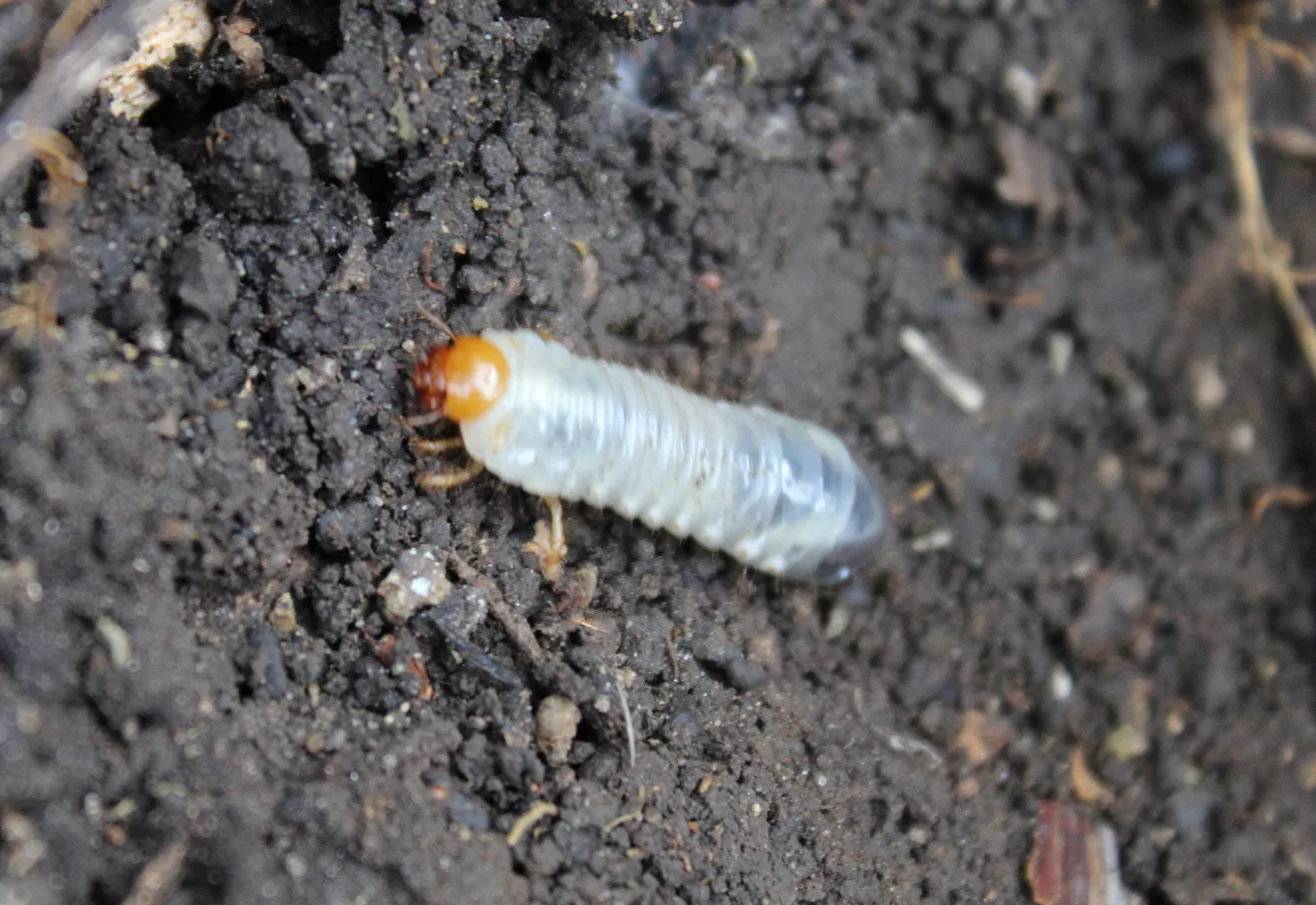
- May and June beetle grubs (Phyllophaga species). UF/IFAS describes these as white, C-shaped grubs with a brown head and three pairs of legs. A key clue is two parallel rows of spines on the underside of the last abdominal segment (UF/IFAS Featured Creatures).
- Japanese beetle grubs. You will see these in online lawn advice. UF/IFAS says the Japanese beetle “remains unable to establish in Florida” and is not yet reported as a pest problem here (UF/IFAS Featured Creatures). Advice written for Northern lawns does not map onto Southwest Florida.
The grub calendar, according to UF/IFAS
For sugarcane grub, the UF/IFAS profile gives this timing:
- April to June: adults are present, with peak emergence in May and June.
- June to July: eggs may be present.
- October to April: mature third-stage grubs are present, nearly 2 inches long.
Damage is a different matter. UF/IFAS Gardening Solutions says severe damage, with large areas of dead turf, usually becomes noticeable in late summer to early fall, particularly when the turf is stressed by something like drought. The adults are beetles that fly at night near lights, so a lot of beetles at the porch light in late spring is a hint, not a diagnosis.
What grub damage looks like
- Mild damage leaves turf yellow. That is easy to confuse with many other problems.
- Heavy damage leaves large areas of dead turf.
- Turf that pulls away from the soil easily has few or no roots left.
UF/IFAS Gardening Solutions says the way to check is to cut about 2 inches into the turf at the edge of an off-colored area. Cut three sides of a 1-foot square of sod and pull back the flap. If the turf lifts easily, has few roots, and you see grubs on the exposed soil, they are likely the cause (UF/IFAS Gardening Solutions).
Finding one grub is not proof. Look for the root loss and the grubs together. If animals are digging in the lawn at night, that can be another clue, which our Bradenton white grubs post explains.
What else looks like grub damage
Several other problems cause yellow to brown patches in a St. Augustinegrass lawn. Check these before you treat for grubs.
- Chinch bugs. UF/IFAS says damage appears as yellow to brown patches, sometimes with dead, bare centers, and injury often starts in water-stressed grass or full sun. Chinch bugs are found by vacuuming about 1 square foot of grass at the edge of the damage (UF/IFAS Gardening Solutions). Our chinch bug guide goes further.
- Lawn caterpillars. Tropical sod webworms and fall armyworms chew the blades and leave ragged, thinning turf, not lost roots. See our guide on how to get rid of webworms.
- Drought or water stress. UF/IFAS says grub damage is most noticeable when the turf is already stressed, so the two can overlap.
The root check is what separates these. Chewed blades with roots intact point away from grubs.
How to get rid of grubs once you confirm them
- Confirm first. Do the sod-flap check on two or three spots at the edge of damage. Do not apply an insecticide to a lawn that has not been checked.
- Watch irrigation. UF/IFAS says moist soil is critical for grub eggs to hatch and for grubs to survive, and that over-irrigation may attract egg-laying females, especially if the surrounding areas are dry. Water the lawn only as needed.
- Ask about treatment. The UF/IFAS grub page says that once you know the pest, your county Extension office can advise on treatments. For sugarcane grub, the profile says the best timing for a preventive treatment is May to June. Any insecticide must be an EPA-registered product used exactly as the label directs.
- Get help for damaged areas. Your Manatee County or Sarasota County Extension office can help you confirm the pest and plan repairs.
No treatment is a guarantee of results.
Where Waves fits in
At Waves Pest Control, an initial lawn visit includes a property walk with an active pest check, and photos go into the service report. If you would rather have the patch checked than dig it yourself, see our lawn pest control in Bradenton and lawn pest control in Lakewood Ranch pages. You can also browse our white grub ID page.
Header photo: a white grub, the larva of a May or June beetle (a Phyllophaga species), by filvad via iNaturalist, licensed CC BY 4.0, cropped.
Frequently Asked Questions
What are white grubs?
White grub is a general term for the larvae of scarab beetles. They are C-shaped, live at or just below the soil-thatch interface, and feed on grass roots. UF/IFAS says chafer beetle grubs are the most common in Florida lawns.
When do grubs damage lawns in Florida?
UF/IFAS says severe damage usually becomes noticeable in late summer to early fall, especially when the turf is stressed. For sugarcane grub, adults emerge in spring and early summer and mature grubs are present from October to April.
How do I check my lawn for grubs?
Cut about 2 inches into the turf at the edge of a damaged area, cut three sides of a 1-foot square, and pull back the flap. Grubs on the soil and turf that lifts easily with few roots point to grubs.
Are Japanese beetle grubs a problem in Southwest Florida?
UF/IFAS says Japanese beetle has been unable to establish in Florida. Grubs in Florida lawns are other scarab species, such as sugarcane grub and May or June beetle grubs.
Does overwatering cause grubs?
It can make a lawn more attractive to egg-laying beetles. UF/IFAS says over-irrigation may attract egg-laying females, especially if surrounding areas are dry, and that moist soil helps eggs hatch and grubs survive.