Jump to a section (10)
- 01How long do rats live in the wild?
- 02Can a rat live for 12 years?
- 03How long can a rat live in your house?
- 04Why a one-year lifespan does not end a rat problem
- 05What are rats afraid of?
- 06What kills rats naturally?
- 07What this means for a home in Southwest Florida
- 08Checks you can do at home
- 09When to call a professional
- 10How Waves Pest Control handles a rat job
The roof rats and Norway rats that get into Florida homes live about one year, according to the UF/IFAS Extension guide Rat and Mouse Control (ENY-224). They can start breeding a few months into that year, so a short life does little for you when one is running across your attic at night. For everything a rodent visit can cover, see our pest control services.
Hearing scratching overhead after dark, or finding droppings in the garage? Get a rodent control estimate and have the entry points checked.
How long do rats live in the wild?
About a year. UF/IFAS gives the roof rat and the Norway rat the same lifespan of about 1 year, and both species reach sexual maturity at 3 to 5 months old.
UF/IFAS describes the roof rat as a climber that prefers to nest off the ground, in attics, roof spaces, palm trees and ornamental shrubs. It is the dominant rat in Southwest Florida. Norway rats are heavy-set burrowers that dig under slabs and rubbish, and UF/IFAS says they are most common in Florida along the sea coasts and canals. Around here they are the less common of the two, living at ground level near foundations, water, dumpsters and woodpiles.
Can a rat live for 12 years?
Twelve years is far past any figure in these sources. A pet rat usually lives 2 to 3 years. The veterinary manual published by Merck lists 2 to 3 years as the typical pet rat lifespan and notes that research studies have recorded longer lifespans for rodents. In a 2020 article from Tufts, a veterinarian said pet rats live between two and three years on average. The same article names respiratory disease as by far the most common killer of pet rats.
How long can a rat live in your house?
About as long as it would live anywhere else, if your house and yard give it food, water and a place to nest. UF/IFAS says roof rats eat 1/2 to 1 ounce of food a day and must have water, about an ounce a day. Roof rats and Norway rats both range 100 to 150 feet from the nest for food or water, and rats habitually use the same paths between the two.
A roof rat nesting in your attic can feed on fallen citrus, bird seed or a pet bowl left on the lanai. UF/IFAS notes that roof rats live in citrus trees and gnaw on the fruit.
If a rat dies somewhere you cannot reach, like inside a wall, UF/IFAS says it is large enough to produce an unpleasant odor for up to two to four weeks.
Why a one-year lifespan does not end a rat problem
Rats breed fast. UF/IFAS gives these figures:
- Roof rat: 6 to 8 young per litter, up to 6 litters a year.
- Norway rat: 8 to 12 young per litter, up to 7 litters a year.
At those upper figures, one female can produce several dozen young in a year, and her first litters can be breeding before she dies.
Control has to come from the house itself: sealing the entry points, trapping the rats already inside and cutting off food and water. UF/IFAS says removing food, water and shelter can reduce rodent populations rapidly when it is kept up, and it calls yearly cleanup programs generally ineffective. It also suggests getting your neighbors to control their rats at the same time.
What are rats afraid of?
New things. UF/IFAS says rats are afraid of strange objects or strange food and may avoid both, and that it may be a week before a rat approaches a trap. House mice are curious and usually approach traps the first night, per the same guide, which is one reason a rat job takes more patience.
Pro tip: Set your snap traps out unset for several days first. UF/IFAS says this lets rats get over their trap shyness and results in better catches. Put the traps along walls and near holes, at right angles to the path the rats run, and only where children and pets cannot reach them.
What kills rats naturally?
Owls and snakes eat a lot of them. UF/IFAS calls barn owls exceptional rat killers and says a pair can be expected to kill several hundred rats over a year. It says nonvenomous snakes such as rat snakes, king snakes, pine snakes, black racers and coachwhips eat numerous rodents, and it asks people not to kill nonvenomous snakes.
Your cat or dog is a different story. UF/IFAS says cats and dogs in general are not good tools for rat control, and the food people put out for pets is excellent rat food. The guide adds that, according to studies, predators can keep an area free of rats but cannot remove an existing infestation.
What this means for a home in Southwest Florida
Expect a roof rat first. Roof rats travel oak canopy, fences and utility lines here, and they get into attics through gaps at the roofline and soffits. Mature oaks, fruit trees and dense landscaping support roof rats year-round, and in Sarasota they often reach tile roofs by way of the oak canopy. UF/IFAS says a rat can jump 8 feet from a tree to a house if the branch is 15 feet above the roof, so trim limbs back off the roofline.
Indoor pressure peaks in the cooler months, roughly October through February, as rats and mice move into attics and wall voids. Florida’s mild climate keeps them active year-round, through the summer storm season too. For a Norway rat, look low: UF/IFAS says freshly dug dirt in front of 3-inch openings, with runways leading in, is characteristic of Norway rat burrows. Check the sandy soil along the slab and the edges of shrub beds and St. Augustine.
Checks you can do at home
Identify the animal first. UF/IFAS says mice stay within 10 to 30 feet of the nest while rats range 100 to 150 feet, so a mouse problem needs more traps than a rat problem.
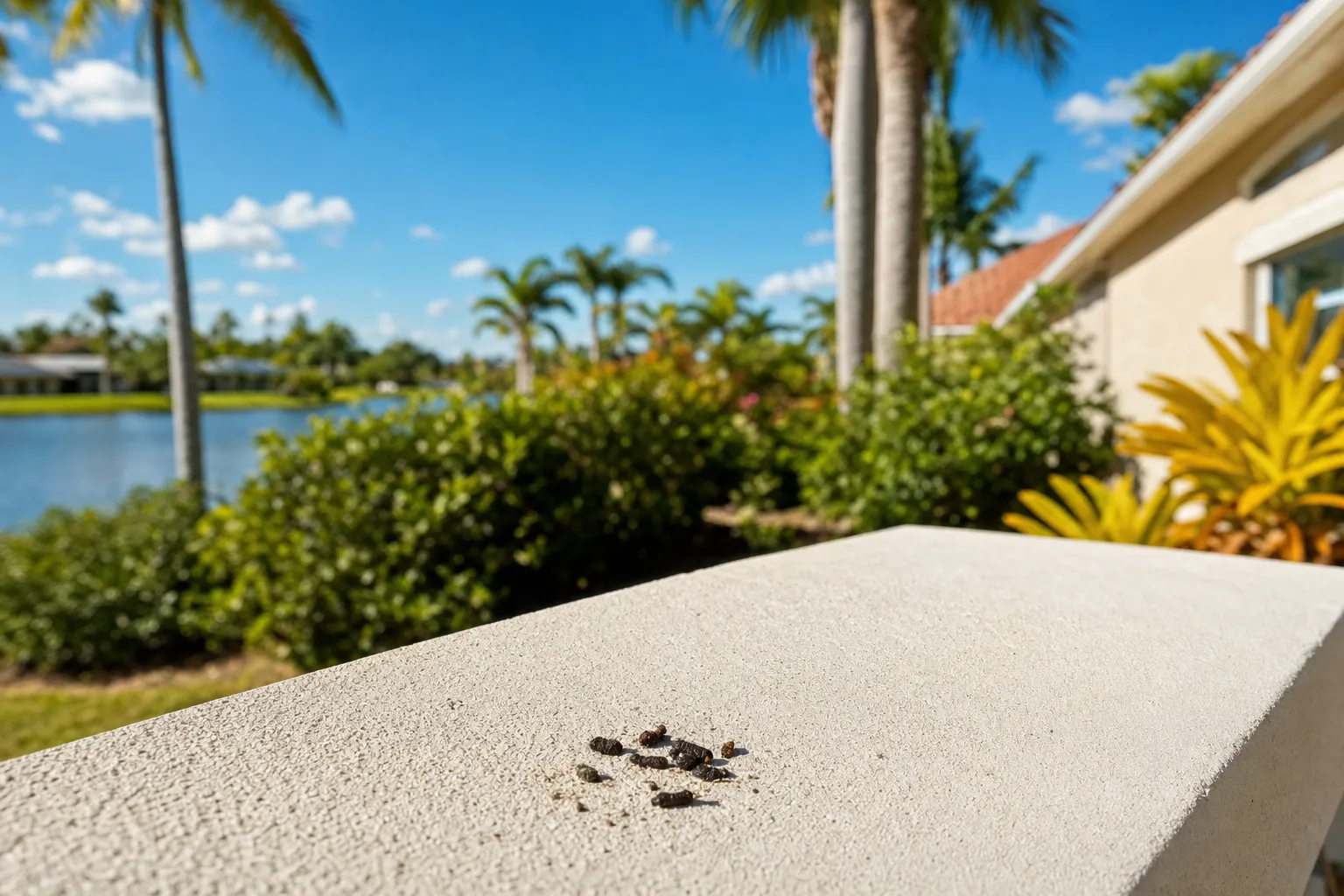
- Measure the droppings. UF/IFAS puts roof rat droppings at up to 1/2 inch and spindle-shaped, Norway rat droppings at 3/4 inch and capsule-shaped, and house mouse droppings at 1/8 inch. Fresh droppings are black and shiny; old ones are gray and crumble.
- Look for rub marks and gnawing. UF says rats leave dark, greasy rub marks along their runways, and rafters may show swing marks from roof rats. Fresh gnawing in wood is light-colored with sharp, splintery edges.
- Find and patch the gaps. UF/IFAS says rats can squeeze through cracks 1/2 inch wide. The CDC’s seal-up guidance lists the rafters, gables, eaves and soffits, doors and windows without weather stripping, and the gap between the foundation and the ground. It suggests steel wool held in place with caulk or spray foam for small holes, and hardware cloth, metal sheeting or cement for larger ones.
- Cut off food and water. UF/IFAS says to store pet food and bird seed in rat-proof containers, pick fruit when ripe and dry up water sources. The CDC adds: do not leave pet food or water bowls out overnight.
- Use snap traps. The CDC’s trapping guidance recommends traditional snap traps, checked daily, with dead rodents disposed of right away.
What not to do
- Skip glue traps and live traps. The CDC advises against both, since they can frighten rodents into urinating, which may raise your risk of illness.
- Do not sweep or vacuum droppings. The CDC’s cleanup steps say rodent diseases mainly spread to people through contaminated air. Wear rubber or plastic gloves, spray the mess with a bleach solution or an EPA-registered disinfectant until very wet, let it soak as the disinfectant label directs, and wipe it up with paper towels.
- Do not put out loose poison. The EPA’s rodent control options say to use only tamper-resistant bait stations and follow all label directions. If anyone in your house uses a rodent bait, read and follow the product label, keep it off food-preparation surfaces, and place it out of sight and reach of children and pets.
When to call a professional
Call when the scratching keeps going after trapping, droppings show up again after a cleanup, you find gnawed wiring, or you smell a dead animal you cannot reach. The CDC also says to contact a pest control specialist if rodents have gotten into areas you cannot reach to clean, and it notes that you cannot tell if a rodent is carrying a disease just by looking at it.
How Waves Pest Control handles a rat job
Our approach starts with an inspection. Waves Pest Control walks the roofline, soffits, gable, dryer and plumbing vents, A/C line penetrations, the garage and the door sweeps, then checks the attic for runways, droppings and nesting. Exclusion is the core of the work: we seal entry points with rodent-proof materials like hardware cloth, sealant, vent covers and door sweeps. Rats already inside are removed with interior traps, not loose bait near your living space, and tamper-resistant bait stations outside monitor pressure. Roof rat jobs include advice on trimming tree limbs back off the roof. Sealing the gaps lowers the odds that the next rat follows the last one in, though no one can promise it never happens again. Squirrels, raccoons, opossums and other wildlife are referred to a licensed wildlife trapper.
Tiny droppings? Our guide to how long mice live covers house mice. In Sarasota, see our rodent control in Sarasota page, and in Manatee County, start with rodent control in Bradenton. Want a number before anyone visits? Get a rodent control estimate online, or compare roof rats and Norway rats in the pest library.