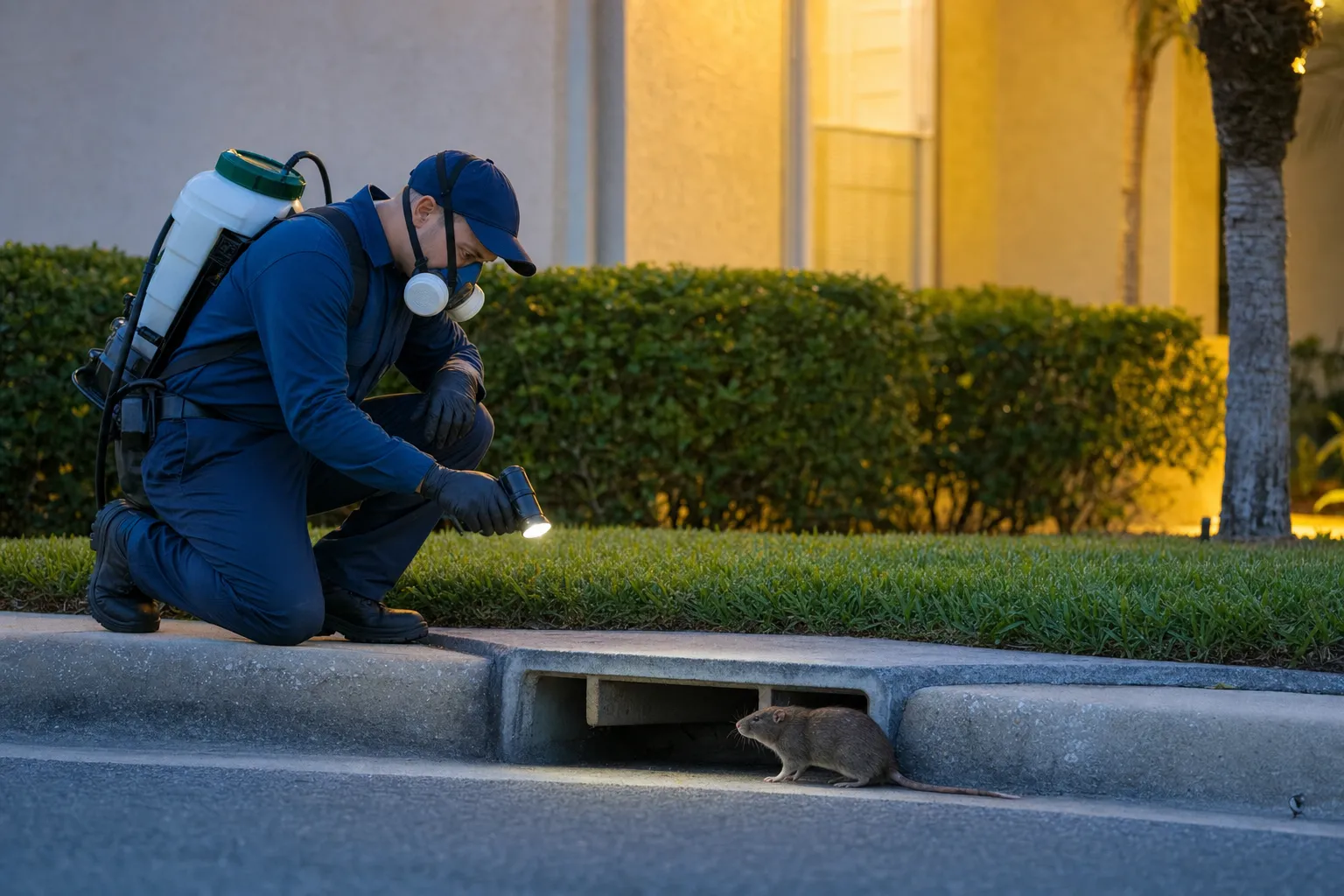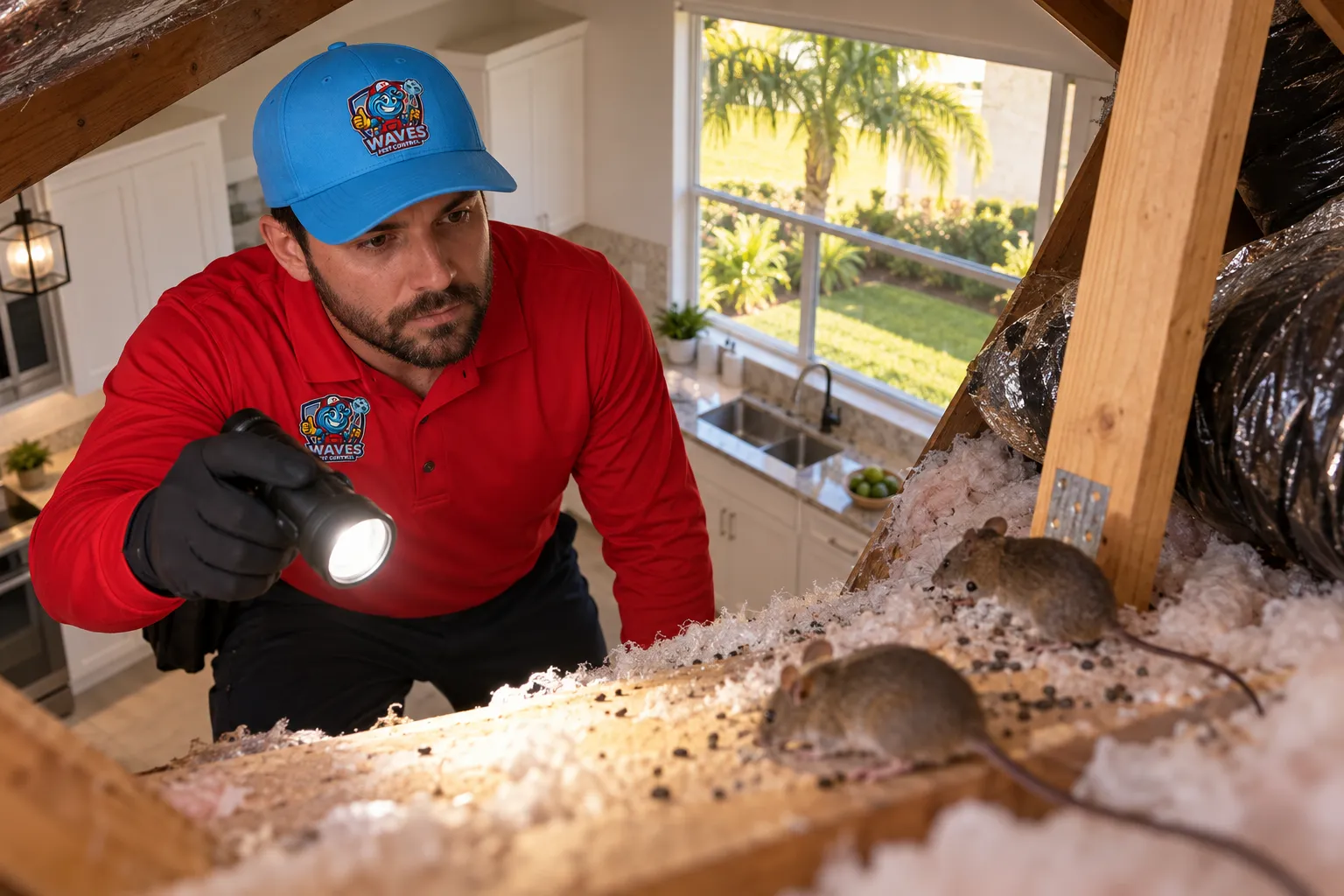
That sudden “something died in here” smell in a Southwest Florida house is usually a mouse or a rat that crawled into a wall, a cabinet base or the attic and never came out. This guide covers what the smell tells you, how to track it down, and how to clean up without stirring up germs. For everything a visit can cover, see our pest control services page.
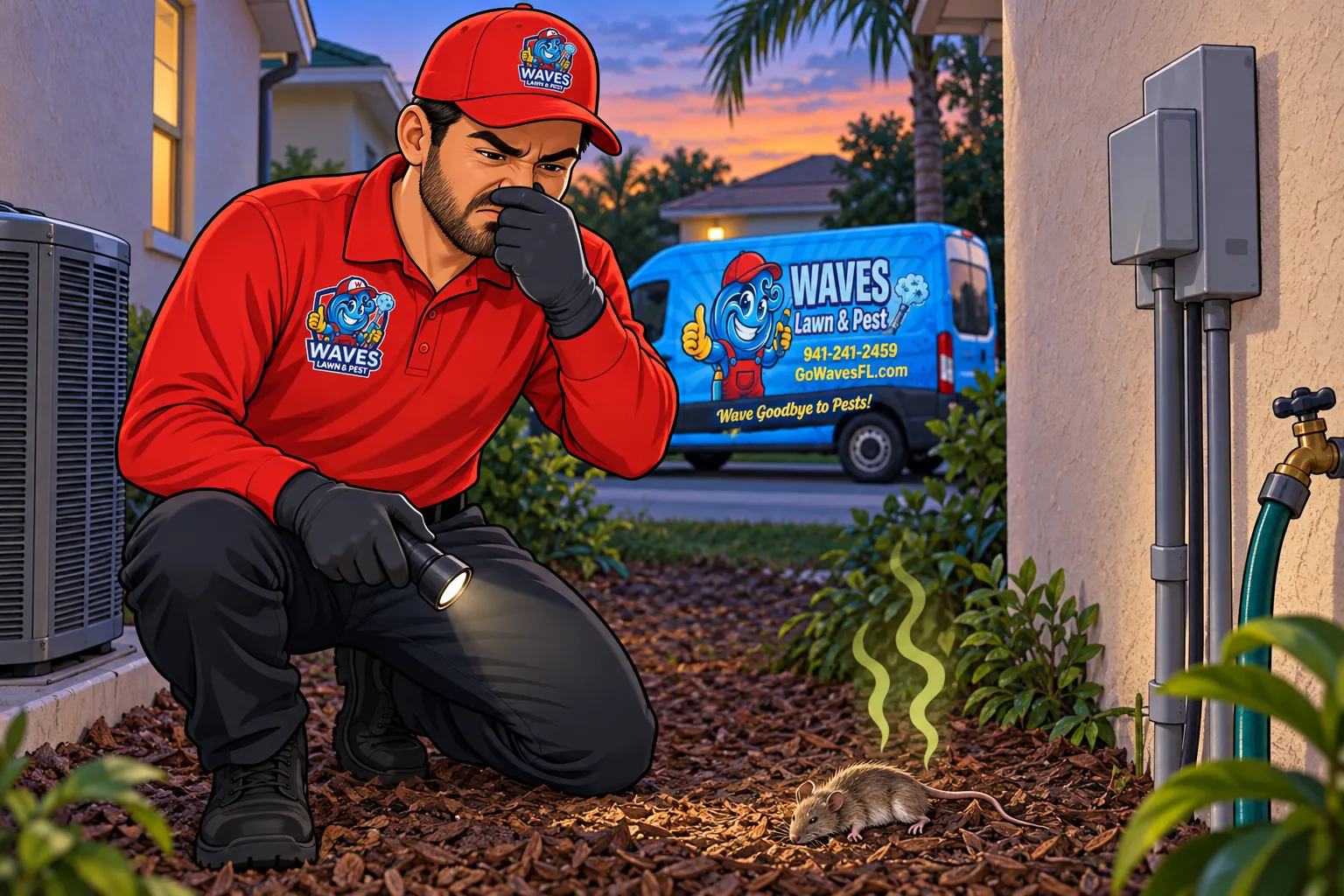
What does a dead mouse smell like?
A dead mouse smells like spoiled meat with a sour, sickly-sweet edge. It is strongest close to the body and fades as you move away, which is the clue you use to find it. In a closed wall cavity or a hot attic the smell can fill a room even though the mouse is tiny.
A live infestation smells different. The EPA lists “stale smells coming from hidden areas” as one of the signs of rodents in a home, and house mice leave a musky odor in the enclosed spaces where they live. So a stale, musky smell that hangs around for weeks points to live mice. A sudden rotten smell that gets worse over a few days points to a dead one.
Two more clues show up with a dead rodent. The EPA’s integrated pest management guide for child care settings lists dead animals and flies together as a rodent sign, and it notes that larder beetles feed on dead rodents. Flies gathering at one vent, outlet or baseboard are worth a close look.
Smelling it but not finding anything? A pro can check the attic and the entry points. Get a rodent control estimate to start.
Pro tip: Sniff at three heights: floor level, waist height and near the ceiling. A smell that is strongest high on a wall often means the body is in the attic or the top of the wall cavity, not under the floor.
Will a dead mouse stink?
Yes. Any dead rodent gives off an odor as it decays, and a hot space makes it worse. How long it lasts depends on where the body is, how warm and closed the space is, and how big the animal is. Removing the body is the only fast fix. Air fresheners cover the smell for a while but do nothing about the body or the flies it draws.
The EPA’s child care guide gives one reason the smell shows up after someone puts out poison: when mice and rats eat rodenticide, they may die in walls and cause odors. That is why the same guide tells you to check indoor traps daily, so a trapped mouse does not turn into an odor and fly problem.
What are the signs of a mouse infestation?
The signs of mice are droppings, chewing and nesting material near food, plus that stale smell from hidden spots. The EPA lists these signs:
- Droppings around food packages, in drawers or cupboards, and under the sink
- Nesting material such as shredded paper, fabric or dried plant matter
- Chewing on food packaging
- Holes chewed through walls and floors
- Stale smells coming from hidden areas
House mice need only about a 1/4-inch gap to get in, roughly the width of a pencil, and they nest in kitchens, pantries, garages and wall voids. Their droppings are small, about 1/4 inch long and shaped like a grain of rice.
Do mice urinate?
Yes, and wherever they travel. The CDC’s cleanup steps treat urine the same way as droppings: spray it with a bleach solution or an EPA-registered disinfectant until it is very wet, let it soak for 5 minutes, and wipe it up with paper towels.
Could it be a rat instead?
It could. Roof rats are the dominant rat in Southwest Florida. They climb trees, fences and utility lines and get into attics through gaps at the roofline and soffits. So a dead-animal smell from an attic in Sarasota or Bradenton could be either one. Indoor rodent pressure here peaks in the cooler months, roughly October through February, as rats and mice move into attics and wall voids.
How to find a dead mouse in your house
Find a dead mouse by following the smell to its strongest point, then checking the hidden warm spots near it. Work in this order:
- Air the room out first. Open doors and windows for a while. When you come back in, your nose picks up where the smell is strongest.
- Check the low, warm hiding spots. Look behind and under the refrigerator, the stove and the dishwasher, under the sink, and inside the cabinet bases where the toe-kick hides a gap.
- Check where pipes and lines come through. Plumbing, A/C lines and dryer vents leave gaps that mice use to move between the wall and the room.
- Look for flies or small beetles. Flies circling one outlet, vent or baseboard often sit right next to the body.
- Check the garage and the attic. Use a flashlight in the attic. Stay on the joists, and look along the edges where the roof meets the walls.
If the strongest point is a closed wall, don’t start cutting drywall at random. A pro can narrow down the spot first, and fixing the entry gap matters more than the hole you make.
How to clean up a dead mouse safely
Clean up a dead mouse with gloves and a disinfectant soak, and never sweep or vacuum. The CDC says diseases spread from rodents to people mainly when people breathe in contaminated air, and that sweeping or vacuuming urine, droppings or nesting material can put tiny droplets containing viruses into the air. The CDC’s rodent cleanup steps are:
- Open all doors and windows for 30 minutes before cleaning, and leave the area during that time.
- Wear rubber or plastic gloves.
- Spray the dead rodent, the nest and the area around it with a disinfectant. The CDC’s bleach mix is 1.5 cups of household bleach in 1 gallon of water (1 part bleach to 9 parts water). Let it soak for 5 minutes, or as long as the disinfectant label says.
- Put the dead rodent or nesting material in a plastic bag, along with any used traps.
- Tie the bag shut, put it in a second plastic bag, and tie that one shut too.
- Throw the bag in a covered garbage can that is emptied regularly.
- Wash your gloved hands with soap and water or a disinfectant, take the gloves off, then wash your hands with soap and warm water.
What not to do
- Don’t sweep or vacuum droppings, urine or nests. The CDC says that can put germs into the air.
- Don’t put out poison bait indoors to “finish the job.” The EPA’s guide notes that poisoned mice and rats may die in walls and cause the exact smell you are trying to get rid of.
- Don’t stop at the body. A dead mouse means a live one may follow it in through the same gap.
When to call a professional, and how Waves Pest Control approaches it
Call a professional when the smell is sealed inside a wall or ceiling, when you keep finding droppings after the cleanup, or when you hear scratching at night. Those signs mean live rodents are still getting in.
Here is our approach. Waves Pest Control starts a rodent job with an inspection: a full walk of the roofline, soffits, gable, dryer and plumbing vents, A/C line penetrations, the garage and the door sweeps, plus the attic for runways, droppings and nesting. We photograph what we find, and that drives the plan. Exclusion is the core of the work: we seal entry points with rodent-proof materials like hardware cloth, sealant, vent covers and door sweeps, because mice need only about 1/4 inch and rats about 1/2 inch. Rodents already inside are removed with interior traps, not loose bait near your living space, and the outside of the house gets tamper-resistant bait stations to monitor pressure. Sealing the gaps lowers the odds of the next mouse following the last one in. No one can promise it never happens again.
If the smell has you hunting through cabinets in Sarasota, see our rodent control in Sarasota page. In Manatee County, start with rodent control in Bradenton. Want a number before anyone visits? Get a rodent control estimate online, or browse the pest library to compare mice and rats.