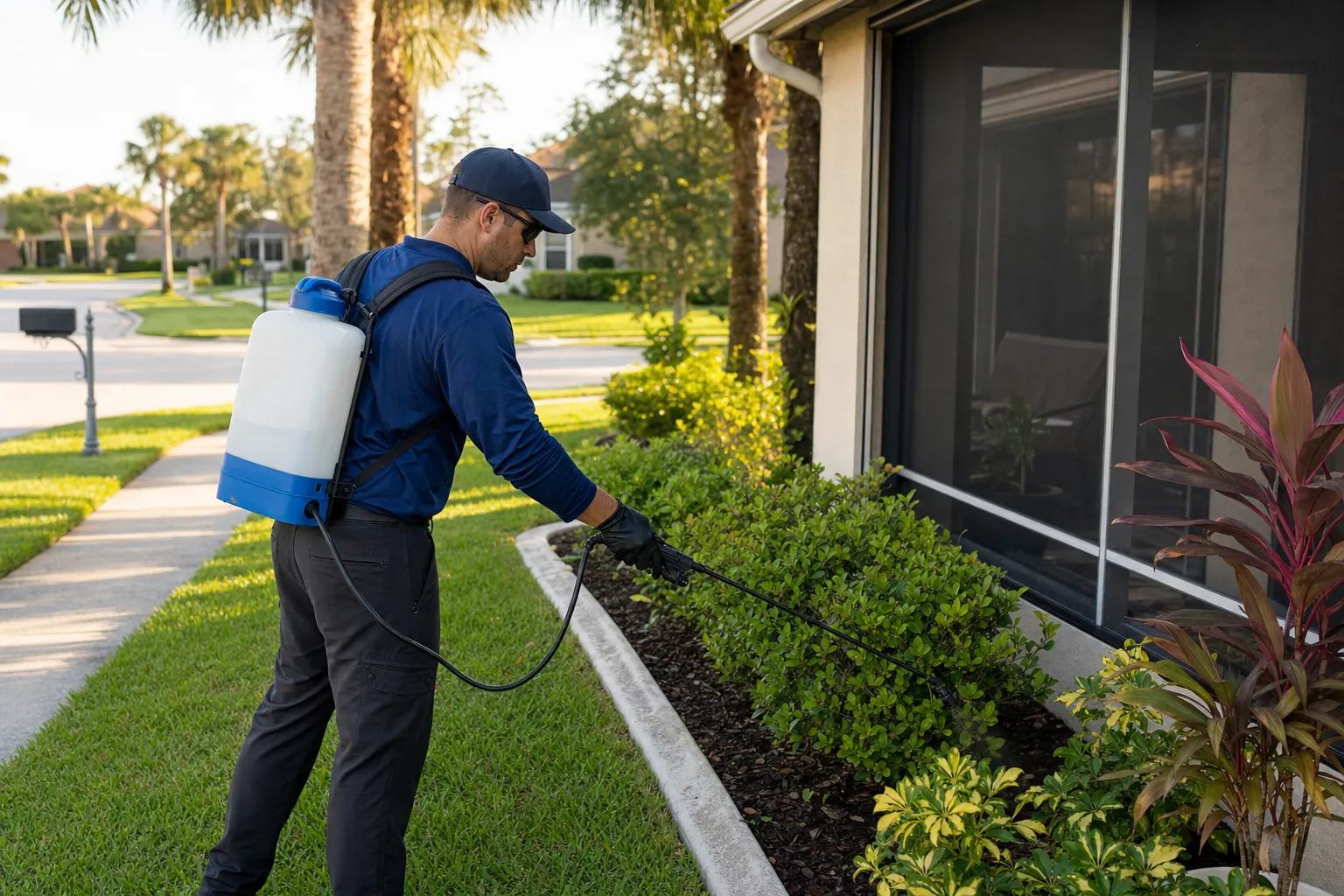
Screened lanais are one of the best parts of living on the Gulf side, right up until a little brown lizard is doing push-ups on your patio table at breakfast. If you have found anoles or geckos setting up shop inside your pool cage in Sarasota, Bradenton, or anywhere along the coast, the good news is that you can make the space less inviting. Lights can draw insects, and lizards may follow the prey. Reducing those insects and repairing entry gaps can help. Our perimeter pest control addresses insect pressure around homes across the region.
Want us to take the insect pressure off your hands while you tighten up the screens? You can Request a Pest Control Quote and we will have a look.
The quick version, in five steps
- Find and seal the gap they slipped through.
- Guide out the ones already inside without leaving a pool gate open.
- Swap the lights that feed them.
- Cut the bug supply on and around the cage.
- Keep the screens and the door sweep snug so it all holds.
The rest of this walks through each step, and helps you figure out which lizard you are actually looking at.
How to identify the lizard on your lanai
A handful of species turn up on screened porches around here, and none of the small species described below is venomous. They mostly hunt insects and may bite or scratch if handled, so give them space.
The one you will see most is the brown anole, sometimes called the Cuban brown anole. Per UF/IFAS, it is an introduced species that reached Florida more than a century ago, runs about 5 to 9 inches long, and comes in shades of brown and gray. It cannot turn green. Males flash a reddish-orange throat fan with a yellow border. It spends much of its time low to the ground.
The green anole is the only anole native to the United States, and it is the one people mislabel a chameleon because it shifts from bright green to dull brown. It runs about 5 to 8 inches. The male’s throat fan is often pink elsewhere in Florida, but UF/IFAS notes that males in Southwest Florida usually have a gray or dull-green one. Where brown anoles live alongside them, green anoles tend to climb higher into shrubs and trees.
After dark you are more likely to meet a gecko. UF/IFAS lists the Mediterranean house gecko and the tropical house gecko, both introduced, both small at roughly 3 to 6 inches, with big lidless eyes and sticky toe pads. These are your night-shift hunters, the ones you find frozen next to a porch light. The Mediterranean one even chirps like a bird.
Every so often something bigger and chunkier shows up that curls its tail up over its back when it gets spooked. That is the northern curly-tailed lizard, another introduced species per UF/IFAS and FWC, first released around Palm Beach back in the 1940s. It likes open, sunny, rocky ground, so a pool deck suits it fine. Consider it the occasional visitor rather than the regular tenant.
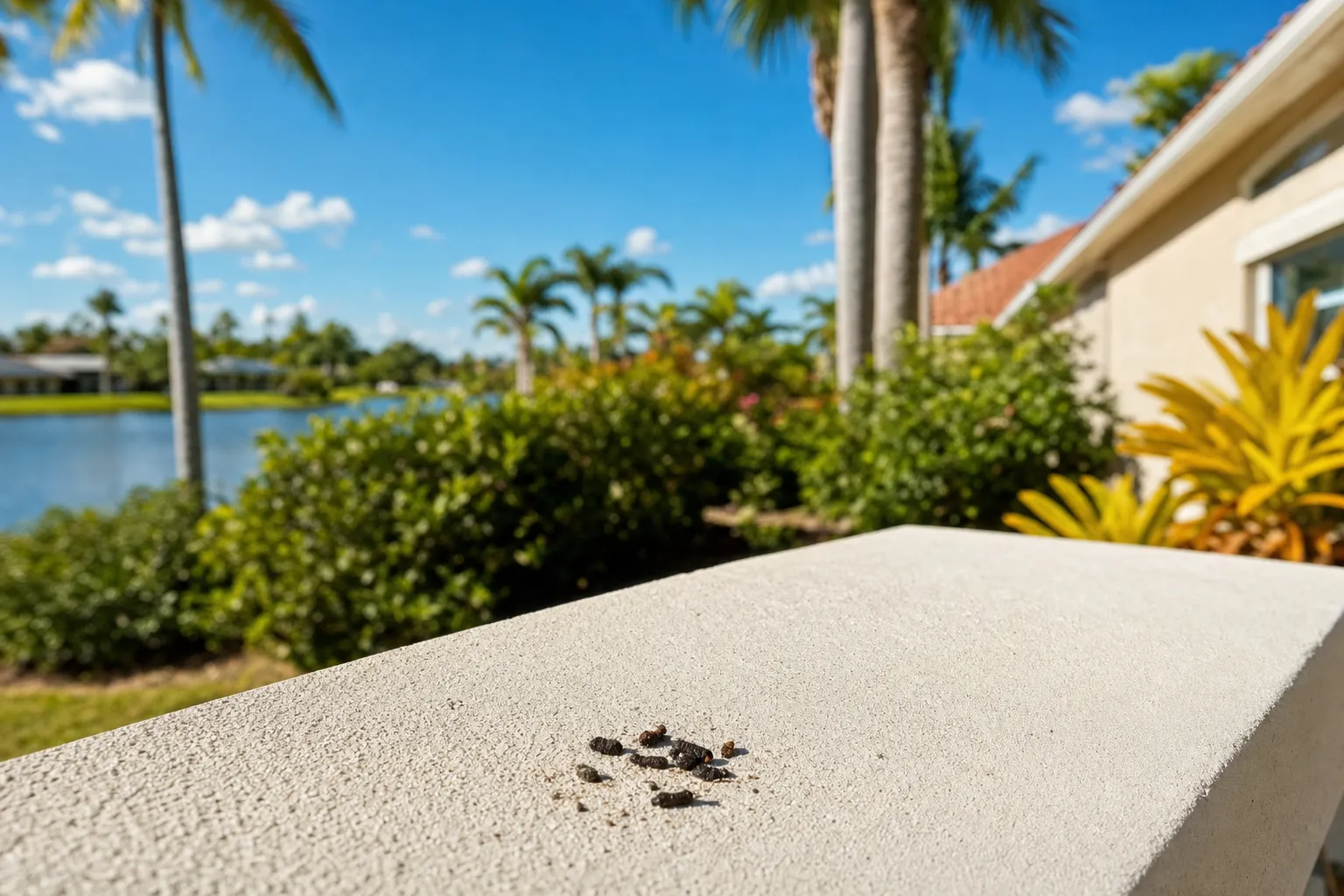
If what you are really finding is droppings and you are trying to work out who left them, we sorted that one out separately in our lizard droppings guide.
Why they picked your cage
Here is the part worth sitting with: the lizard is a symptom. UF/IFAS notes that understanding why an animal shows up is the first step to sorting it out, and with lanai lizards the answer is short. Your cage hands them warm slab edges to bask on, water sitting in plant saucers, a bit of cover, and a nightly buffet of insects swarming the lights. Anoles and geckos are good bug predators, so a lit, sheltered box full of moths and gnats is close to lizard paradise.
Down here that pressure rises and falls through the year. Our warm, wet summers and the afternoon storms that roll through most days crank up insect activity, and the lizards ride that wave. Sandy soil drains fast, so the reliable standing water on your lanai, the saucer under the potted hibiscus, can matter to them more than you would guess.
Which gap they used
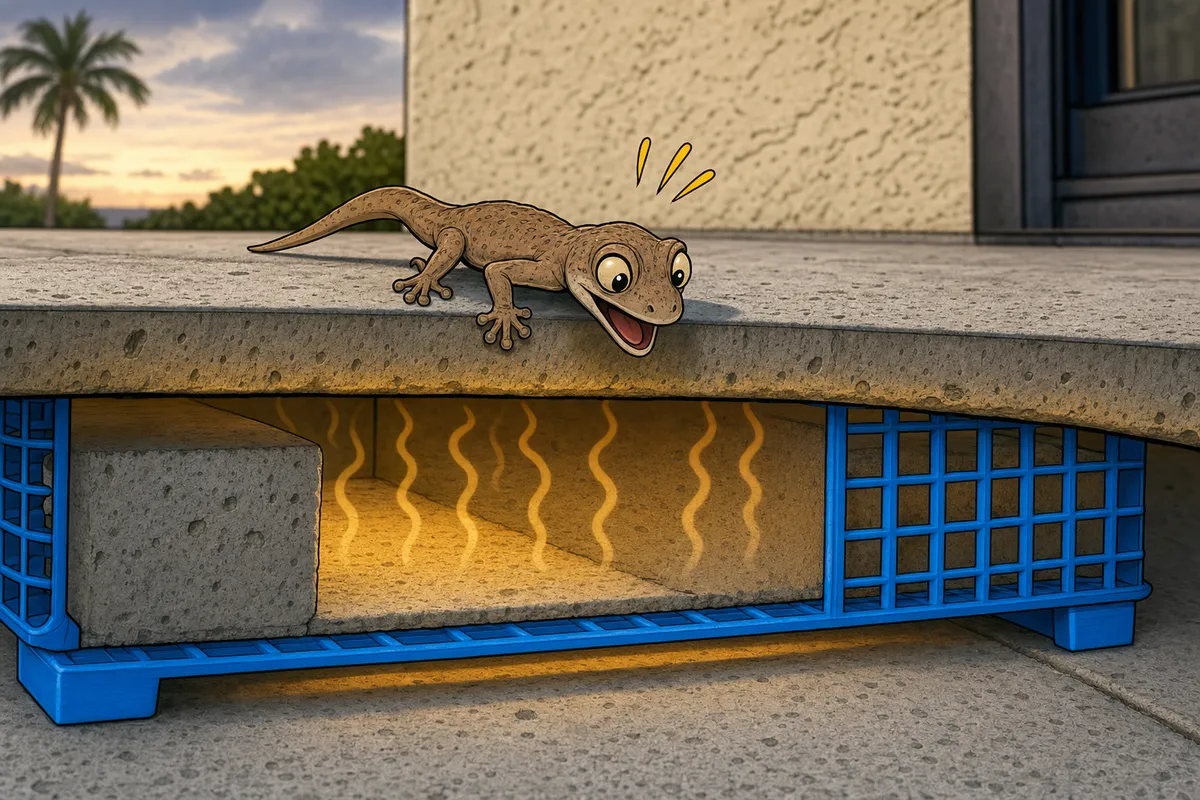
Screen enclosures leak in predictable spots. Grab a flashlight at dusk, when the geckos come out and the low light throws every gap into relief, and walk the perimeter. UF/IFAS points out that these lizards tuck into small confined gaps around a house, so you are hunting for anything a thumb-width or narrower.
On every inspection
Your five-minute lanai gap audit
- The screen door A gap under the sweep, or a door that no longer swings itself shut.
- Base panels Torn screen or popped spline where the mesh meets the kick plate.
- Cage-to-slab seam The channel where the frame meets your pool deck or slab.
- Kick plates and corners Loose fasteners and corners that have pulled away from the frame.
- Around the lights Small tears near fixtures, where the bugs and their hunters gather.
A dusk walk-around finds most of the ways a lizard gets in.
Pro tip: run the audit right at dusk with the porch lights already on. The bugs start stacking on the screen, the geckos come to the light, and the hole they are using tends to give itself away.
Getting the ones already inside out
For the small lizards already inside, you do not need a spray. With an adult controlling the screen door, briefly open it and gently guide one toward the opening, then close and latch it immediately. If a lizard is cornered, ease a cup over it, slide a stiff card underneath, and place it just outside the enclosure on the same property before closing the door. Do not take it to a park or another property: FWC restricts transport and off-site release of nonnative nuisance wildlife. If the enclosure is part of your pool barrier, never leave its gate propped open; Florida Department of Health recommends self-closing, self-latching pool gates.
Skip these
A couple of popular fixes cause more trouble than they solve.
Glue boards and sticky traps are the big one. UF/IFAS warns that geckos caught on sticky cards cannot be released and will die. Do not use them to remove lizards.
Mothballs are the other. People scatter them around foundations and lanais on the idea that the smell drives lizards or snakes off. Mothballs are registered pesticides, and UF/IFAS explains that using them anywhere the label does not specify is illegal. A separate wildlife repellent containing naphthalene does not make mothballs legal to scatter outdoors. Leave mothballs out of the lanai.
A spray does not change the math either. What pulls a lizard into a screen cage is the food and the light it hunts by, so the honest work is on those two things.
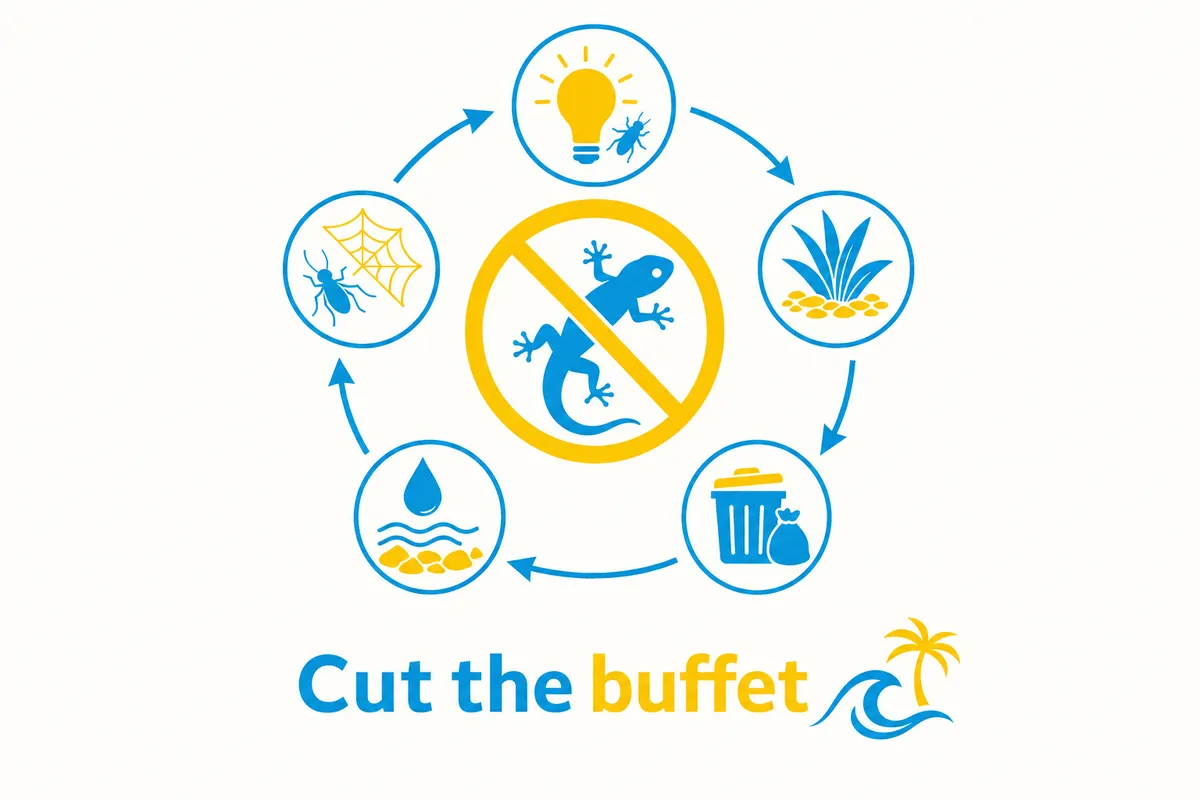
Cut the buffet
Take away the reasons a lizard bothers and the cage gets a lot less interesting. This is the part you control.
Start with the lights. Insects pile onto bright white bulbs, so switching your lanai fixtures to warm-spectrum or yellow bug bulbs tends to pull in fewer of them, and running the lights less late does the same. Fewer bugs at the light means less for a lizard to chase.
Then the odds and ends. Empty the water out of plant saucers to reduce mosquito breeding. Keep pet food and fruit off the lanai overnight. Trim shrubs so they do not touch the screen and provide a route in. Check the damp turf and planting beds beside the cage for insects and gaps at the frame.
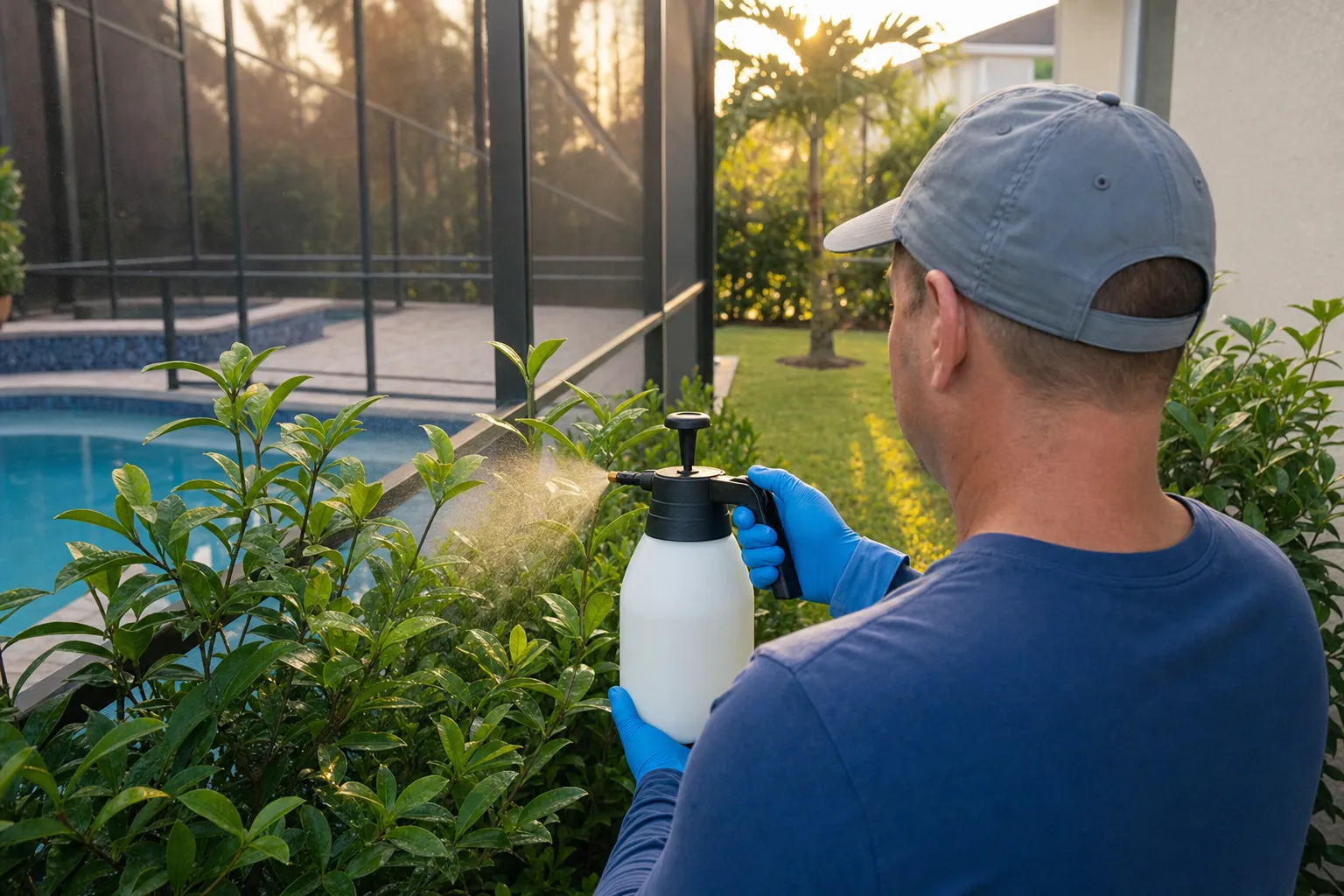
The bigger lever is reducing insect pressure around the house, not the cage alone. A perimeter pest program can help with covered insects, but it cannot guarantee that lizards will leave. Curious what one runs? You can Get a Pest Control Estimate, or read how the ongoing plans work under WaveGuard. If you would rather read up on the individual critters first, our pest library has the Southwest Florida regulars.
When to call a professional
If insects keep gathering at the lights after you repair the screens and adjust the lighting, ask a pest professional to identify the insects and the source. We treat covered insect pests around the home through perimeter pest work and WaveGuard plans. We do not trap, remove, relocate, or poison lizards. If a door will not self-close or a pool-cage screen has pulled loose, have an enclosure contractor repair it so the barrier works as intended. For an animal larger than the small anoles and house geckos in this guide, get a reliable identification before approaching it; FWC accepts reports of nonnative reptiles. Reducing insects can make the lanai less rewarding for lizards, but insect treatment alone will not clear the cage.
Frequently asked questions
Do lizards on a lanai bite?
The small anoles and house geckos described here are not venomous and usually avoid people. A cornered or handled lizard can bite or scratch, so give it room to move away.
My cat or dog caught one. Is that a problem?
If your pet ate a lizard or seems unwell after catching one, call your veterinarian. According to the Merck Veterinary Manual, cats in areas like Florida can acquire liver flukes by eating an infected lizard.
Do lizards lay eggs inside a lanai?
They can. UF/IFAS notes anoles favor moist spots to lay their eggs, so the damp soil of a potted plant on your lanai fits the bill, and geckos tuck small clutches into cracks and crevices through the warm months. Emptying saucers and checking your potted plants cuts down on the tucked-away nurseries.
Will a pest control treatment kill the lizards?
Insect treatments are intended to target labeled pests, not lizards, but it would be unsafe to promise they cannot harm one. EPA recognizes that reptiles can be exposed to pesticides through contaminated prey. Follow every product label, avoid spraying lizards, and ask the applicator about precautions if you see them in a proposed treatment area. Reducing insects may also reduce one reason lizards visit the cage.
Why do more lizards show up after it rains?
Warm, wet weather bumps up insect activity, and since these lizards live on those insects, a bright screen enclosure can draw more of them in the days after a storm. It usually settles down again as things dry out and the bugs thin.
If the bug pressure feeding your lanai lizards is getting old, that part we can take off your plate. Request a Pest Control Quote, or look over everything we cover on our pest control services page.