Jump to a section (10)
- 01The one-look ID: legs, speed and the curl test
- 02How to choose your next step
- 03Millipede ID and the rainy-season migration
- 04Centipede ID: house centipede and the bigger Florida species
- 05Why neither one wants to live indoors
- 06The moisture and mulch line at the foundation
- 07Interesting facts from UF/IFAS
- 08What the ID means in practice
- 09Frequently Asked Questions
- 10Get help in your area
A storm rolls through, and the next morning a few dark, curled-up “worms” are lying on the lanai tile. A week later something with a lot of legs shoots across the garage floor. Both get called the same thing in a lot of Southwest Florida houses, and they are two very different animals. This guide uses what UF/IFAS publishes about each one to show you how to tell them apart in a few seconds. If you would rather have someone else deal with the moisture problem that draws them in, our pest control services page explains what a visit covers.
Seeing a steady stream of them, and want a number before you decide? Request a pest control quote online.
The one-look ID: legs, speed and the curl test
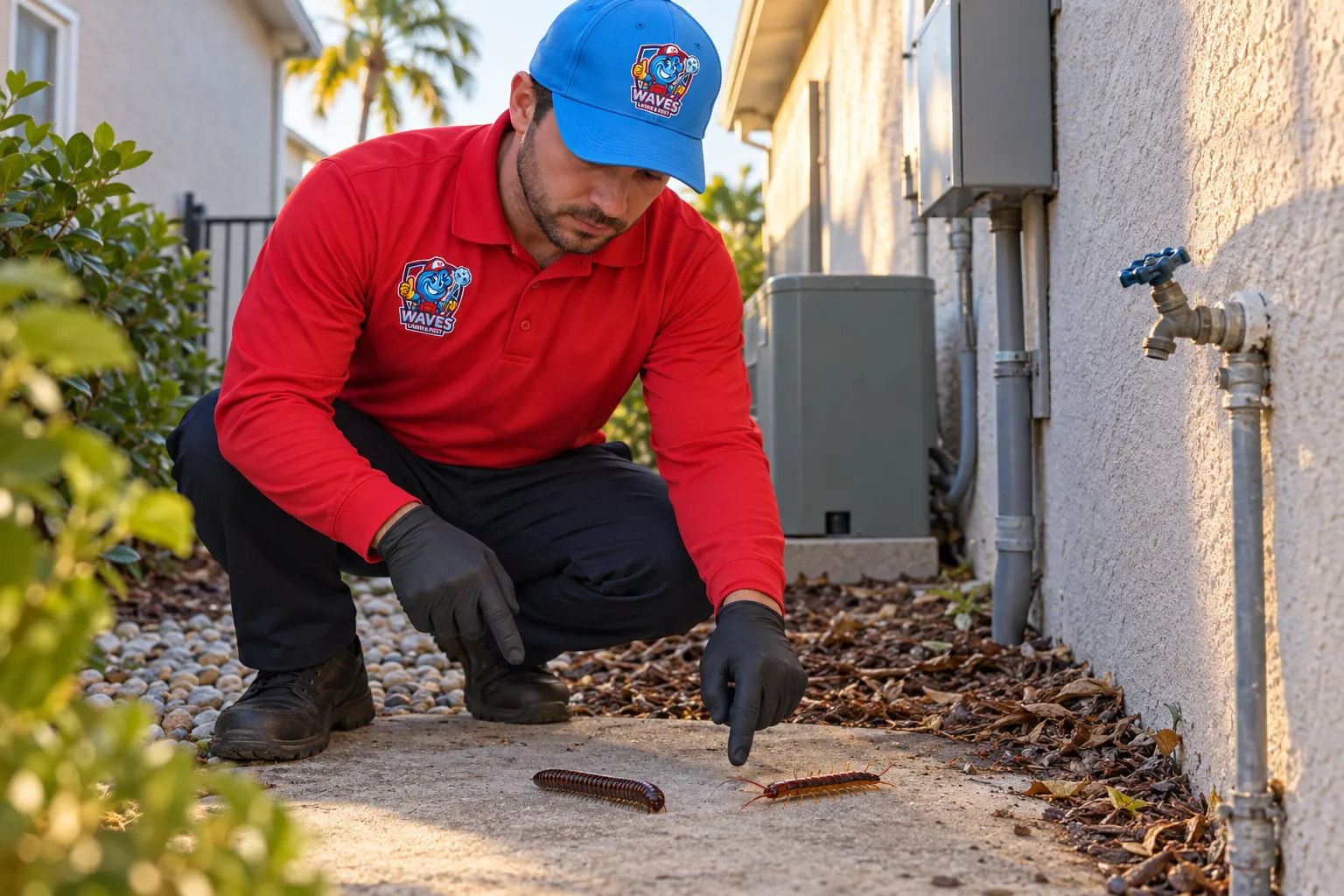
Count the legs on a single body segment. UF/IFAS Extension’s guide to pillbugs, sowbugs, centipedes, millipedes and earwigs says most millipede segments carry two pairs of legs, and most centipede segments carry one pair. Speed and posture back up the leg count.
| Clue | Millipede | Centipede |
|---|---|---|
| Legs per body segment | Two pairs on most segments | One pair on most segments |
| Body shape | Wormlike and round in cross-section | Flattened, usually brownish |
| Speed | Slow, steady crawl | Fast runner |
| When disturbed | Coils up tightly; some species give off a foul-smelling fluid | Runs for cover |
| Food | Decaying plant matter | Insects and spiders |
| Bite | Does not bite people | Smaller local species cannot break human skin; larger species may inflict painful bites |
Traits from UF/IFAS Extension publication ENY-221 (IG093). Two clues together give a better read than one.
The curl test is the easy one to remember. Touch a millipede with a stick and it coils into a tight spiral. A centipede does not coil. It runs.
How to choose your next step
- If the animal coils into a spiral and moves slowly, it is most likely a millipede: use a broom and dustpan to move it outside.
- If it runs fast on one pair of legs per segment, it is most likely a centipede: use a jar or dustpan to catch it, never your bare hand.
- When dozens of millipedes come in after heavy rain, start with the mulch line and the gaps under doors.
- When centipedes show up indoors week after week, start with the damp rooms and the small insects they hunt there.
- If you cannot tell from a photo, use our pest library to compare, or call a licensed professional to confirm.
Millipede ID and the rainy-season migration
Millipedes are wormlike, cylindrical animals that tend to coil up tightly when disturbed, according to UF/IFAS. The Indian River County Extension office describes the common ones as nearly 2 inches long and says they are harmless to pets, humans and furniture.
UF/IFAS Extension in Sarasota County names the three millipedes most common in Florida: the bumblebee millipede and the rusty millipede, both invasive, and the native Florida ivory millipede. That Sarasota County Extension post also explains the mass movements. Rain or irrigation fills the air gaps in the soil, and the millipedes leave to find a place where they can breathe. UF/IFAS adds that after rains, large numbers may climb foundation walls and enter homes through any small opening.
Centipede ID: house centipede and the bigger Florida species
UF/IFAS describes centipedes as brownish, flattened animals that range from 1 to 6 inches (2.5 to 15 cm) long, with one pair of antennae that is easy to see. They are fast runners, they have poorly developed eyes, and they are most active at night. They feed mainly on insects and spiders.
On bites, UF/IFAS says all centipedes have venom glands to immobilize their prey, but the toxicity of the venom is not enough to be lethal to humans. The jaws of the smaller local species cannot penetrate human skin. The larger species may inflict painful bites. Our post on centipedes in Southwest Florida homes without basements covers the house centipede, the long-legged one most people find indoors.
Pro tip: Size is a clue, not an answer. Use the leg count first. A long, thick body with one pair of legs per segment is the one to move with a jar and a piece of cardboard.
Why neither one wants to live indoors
Both need moisture, and a cooled, dry house does not give them much. UF/IFAS lists the outdoor places they live: centipedes under stones, leaf litter, logs, bark and soil crevices; millipedes under stones, flower pots, boards and other debris with abundant moisture. Indoors, UF/IFAS says centipedes turn up in closets and bathrooms where humidity is high. UF/IFAS also notes that neither centipedes nor millipedes damage furnishings, homes or food.
A millipede on the kitchen floor in Bradenton has most likely wandered in from wet soil outside. A centipede that keeps turning up indoors often points to a damp room with insects for it to eat.
The moisture and mulch line at the foundation
UF/IFAS calls removal of breeding sites and hiding places the key to long-term control of both. Their guide gives specific steps:
- Move compost piles and decaying vegetation away from the house.
- Keep mulch only 2 to 4 inches (5 to 10 cm) deep so it stays dry most of the time.
- Indoors, use a broom and dustpan or a vacuum, and remove hiding places, food and moisture sources.
The Sarasota County Extension post adds weatherstripping and sealing foundation cracks, and the Indian River County post suggests keeping a leaf-free strip at the foundation or using stone in place of wood mulch there. In a Venice yard with beds right against the slab, pulling the mulch back a few inches and fixing a gap under the garage door lowers the odds of the next wave reaching the kitchen.
Interesting facts from UF/IFAS
- Centipedes have from 10 to 100 legs, depending on the species.
- Most millipede species have from 40 to 400 legs, per the Sarasota County Extension post. One Australian species has been recorded with 1,306.
- Some millipedes defend themselves with compounds that contain trace amounts of hydrogen cyanide. The Sarasota post says this is not deadly but can irritate skin, so wash your hands after you handle one.
- A female centipede lays 15 to 55 eggs in the soil and usually guards the eggs and the young. UF/IFAS says the young need three years to mature and may live up to six years.
What the ID means in practice
Both are outdoor moisture followers that wander in. Avoid handling a large centipede with bare hands, and don’t pick up millipedes with bare hands, since some give off a fluid that can irritate skin. For a few millipedes after a storm, sweep them up, pull back the mulch and fit door sweeps where you can see daylight under a door. A mass migration that keeps coming back after every rain, or centipedes that show up indoors week after week, is the point to have a professional look at the moisture and entry points around the house. You can read about our WaveGuard memberships, and you can get my free pest control estimate before you call.
Frequently Asked Questions
What are the small worms curling up on my porch after rain?
They are most likely millipedes. UF/IFAS says millipedes coil up tightly when disturbed and may move into buildings in large numbers after rains.
Can a centipede bite me?
UF/IFAS says the jaws of the smaller local species cannot penetrate human skin, but the larger species may inflict painful bites. If a bite causes symptoms that worry you, contact a doctor; get emergency care right away for trouble breathing or swelling of the face or throat.
Are millipedes harmful to my house or my pets?
No. UF/IFAS says millipedes do not damage furnishings, homes or food, and Indian River County Extension calls them harmless to pets and people. Some species give off a fluid that can irritate skin, so use a broom instead of your hands.
Get help in your area
If millipedes or centipedes keep coming back to the same doors, see what pest control in Sarasota from Waves Pest Control includes, or get my free pest control quote online.